Getting A Vision of Heaven on Earth: Heaven, Earth, and the Bible Project

22But you have come to Mount Zion and to the city of the living God, the heavenly Jerusalem, and to innumerable angels in festal gathering,23and to the assembly of the firstborn who are enrolled in heaven, and to God, the judge of all, and to the spirits of the righteous made perfect,24and to Jesus, the mediator of a new covenant, and to the sprinkled blood that speaks a better word than the blood of Abel.25See that you do not refuse him who is speaking. For if they did not escape when they refused him who warned them on earth, much less will we escape if we reject him who warns from heaven.
— Hebrews 12:22–25 —

Yesterday, I argued in my sermon that the local church is an earthly display of a heavenly reality. From Hebrews 12, we learn that when we gather in the name of Jesus, we are (imperfectly) revealing the glories of heaven—a myriad of saints and angels gathered around the throne of God. Or better, we are foreshadowing the final assembly of the nations who will worship around the throne of God.

In making that argument, I assumed a certain amount of background information about how heaven and earth relate. I want to fill in some of the gaps here. (This brief temple story may help too). Continue reading

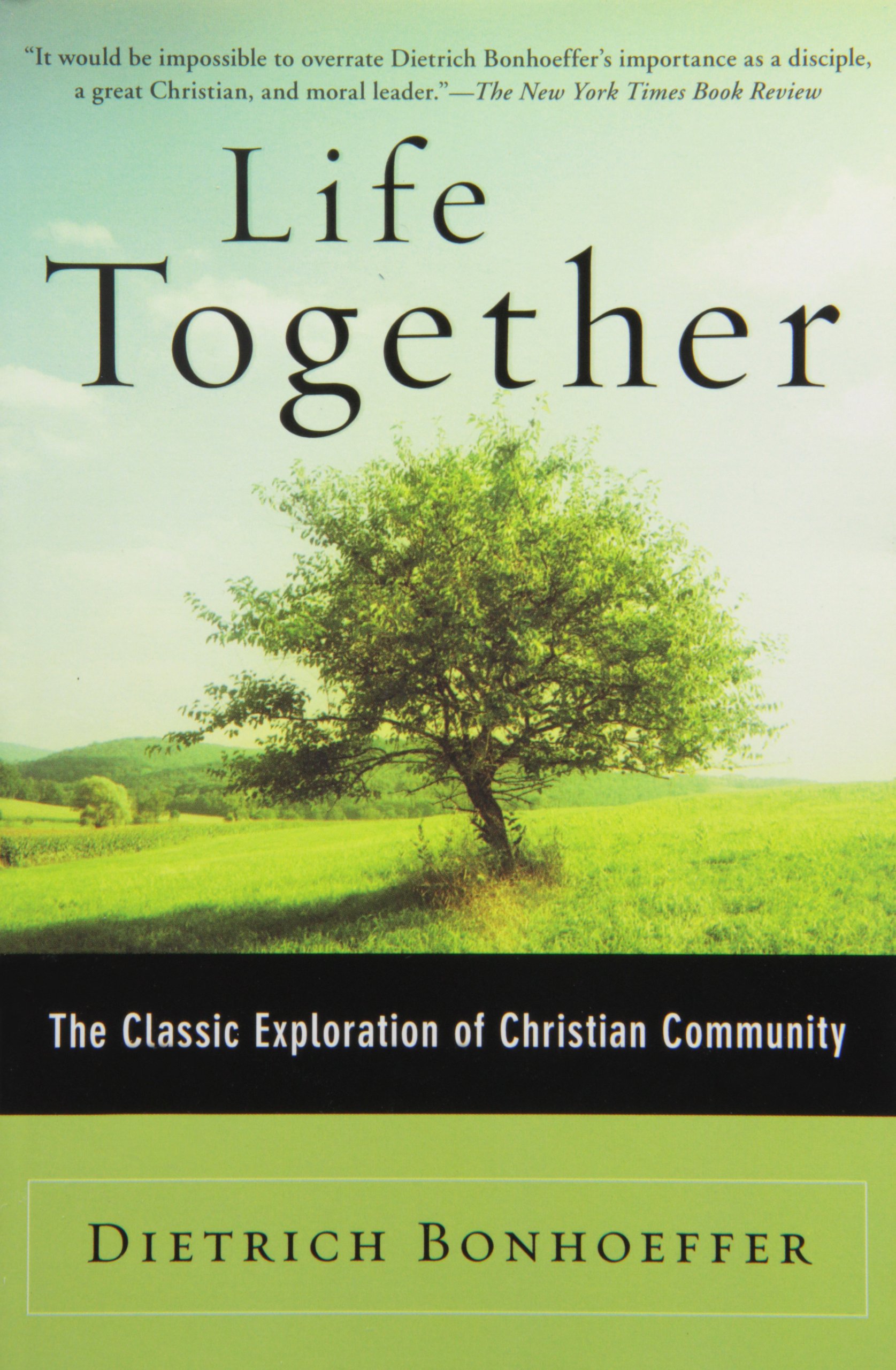
Life Together: A Short Review

lifeThe local church was always at the center of Dietrich Bonhoeffer’s heart and theology. In his studies he wrote his first dissertation on life in the church (“The Communion of Saints: A Dogmatic Inquiry into the Sociology of the Church”).  As a theological professor he labored to train pastors for the church. And in his later writings, he often returned to muse on life together in the local church.

It’s this subject that entitles one of his most famous works, Life Together, posthumously subtitled, “The Classic Exploration of Christian Community.” Coming in at 122 pages, Life Together is not a long book. But it is one that invites you to think deeply about God’s design for his people. Overflowing with wisdom, you will run your highlighter dry if you are given to marking up books.

As we consider the One Anothers in our weekly sermons, I would encourage you to pick up a copy. A small investment in reading Life Together will pay big dividends on doing life together. Continue reading

Life in Community: ‘The Roses and Lilies’ of the Christian Life

lifeWriting from Germany on the precipice of war, Dietrich Bonhoeffer wrote a classic on Christian community. In Life Together he called attention the grace of Christian community, calling it “the ‘roses and lilies’ of the Christian life” (21).

In our country, where freedom to worship remains unchecked, his words provide a needed corrective to any laissez-faire attitude we may have towards biblical community. While church membership and attendance are generally affirmed by Christians, I don’t think we see how much grace there is in our ability to gather. By contrast, Bonhoeffer watched the Third Reich run over the church and the Church in turn to compromise with the state.

In such a context, he came to see just how much grace there is when brothers dwell together in unity—true spiritual unity. Consider his words and give thanks for the community of believers he has given you. May his words spur us on to press deeper into the life of our church, or to start such a community of spiritually-minded believers, if one is not present. Continue reading

The Biblical Story of Priestly Glory

priesthoodOn Monday, I made the case that we should understand the imago dei in priestly terms. To develop that idea a bit, let me show how the biblical story line can be understood through the lens of the priesthood, as well.

Creation

In creation Adam was made to be a royal priest. Genesis 2:15 says, “The LORD God took the man and put him in the garden of Eden to work it and keep it.” Or it could be translated “to serve it and guard it.” In other words, the man in the Garden was more than a prehistoric gardener. He was a royal priest. And we know he was a priest because the language used in Genesis 2:15 is used repeatedly of priests in Numbers 3. Moses, the author of both books, is making the point that Adam was stationed in the Garden as a priest—to serve the Lord by cultivating the Garden (even expanding its borders) and to guard the Garden from unclean intruders (a key work of the priest and one he failed to do in Genesis 3). In short, redemptive history begins with a priest in the Garden, one whose righteous appearance and holy vocation was breathtaking, as Ezekiel 28:12–14 describes,

You were the signet of perfection, full of wisdom and perfect in beauty. You were in Eden, the garden of God; every precious stone was your covering, sardius, topaz, and diamond, beryl, onyx, and jasper, sapphire, emerald, and carbuncle; and crafted in gold were your settings and your engravings. On the day that you were created they were prepared. You were an anointed guardian cherub [A better translation is the NET: “I placed you there with an anointed guardian cherub]; I placed you; you were on the holy mountain of God; in the midst of the stones of fire you walked.

Sadly, this glorious beginning did not last long. Continue reading

The Priestly Aspect of the Imago Dei

priestIn The Christian FaithMichael Horton suggests four aspects of the Imago Dei, what it means to be made in God’s image. He enumerates them as

  1. Sonship/Royal Dominion
  2. Representation
  3. Glory
  4. Prophetic Witness

For each there is solid biblical evidence. Genesis 1:26–31; Psalm 8; and Hebrews 2:5–9 all testify to humanity’s royal sonship. Likewise, the whole creation narrative (Genesis 1–2) invites us to see man and woman as God’s creatures representing him on the earth. First Corinthians 11:7 speaks of mankind as the “glory of God.” Horton rightly distinguishes, “The Son and the Spirit are the uncreated Glory of God . . . human beings are the created reflectors of divine majesty” (401). They are, in other words, God’s “created glory,” which in time will be inhabited by the “uncreated glory” of God in the person of Jesus Christ. And last, as creatures made by the Word of God, in covenant relation with him, every human is a prophetic witness. In the fall, this prophetic witness is distorted. Humans are now ensnared to an innumerable cadre of idols (see Rom 1:18–32), but the formal purpose remains—to be made in the image of God is to be a prophetic witness.

Horton’s articulation is compelling, biblical, and beautiful. But it seems, in my estimation, to stress royal and prophetic tasks without giving equal attention to the priestly nature of humanity. To be fair, Horton refers to humanity’s priestly vocation under the headings of “representation” and “glory.” But because these are supporting the vocational idea of representation and the abstract idea of glory, we miss a key idea—the imago dei is by definition a priestly office. Or better, the imago dei is a royal priest who bears witness to the God of creation. Let’s consider. Continue reading

The Maleness of Christ: A Typological Necessity with Vast Ethical Implications

male

Why did Jesus have to be a man?

In our day of gender dysphoria and radical ideas about God (i.e., God is Transgender), we cannot take anything for granted—including the maleness of Jesus. Since everything about gender is being questioned, we need to see all Scripture says about gender, including why Jesus had to be a man. In the Incarnation, Jesus gender was not chosen at random. It was not accidental, nor was it incidental to his identity and mission.

Rather, as the centerpiece of God’s revelation, Jesus gender was divinely-intended. And as the canon of Scripture reveals, Jesus was the antitype to which all other types—saviors, leaders, kings, and priests—pointed. His maleness, therefore, was a vital component of his ability to save Israel and the world.

Though we don’t often question Jesus’ maleness, we should not take it for granted either. By considering why Jesus had to be a man helps understand who he is, what he came to do, and why gender is not a fluid concept we create for ourselves. Just like everyone else, Jesus received his gender for the purpose of glorifying God and fulfilling his calling.

May we consider Jesus’ maleness and why playing fast and loose with XY chromosomes—his or ours—has deadly, devastating effects. Continue reading

Martyn Lloyd-Jones on Preaching and Preachers, Revival and Religion

mljA few months ago I finished Iain Murray’s condensed version of his two-volume biography on Martyn Lloyd-Jones, The Life of Martyn Lloyd-Jones, 1899–1981. For those who do not know of “The Doctor,” Martyn Lloyd-Jones left the medical profession to be a preacher. From the late 1920s to the 1970s he was a powerful Calvinistic evangelist, whose pastoral labors took his to Wales and London, England.

Situated at Westminster Chapel, Lloyd-Jones impacted many prominent scholars (J. I. Packer and Iain Murray), interacted with dozens of evangelical leaders, and carried out a preaching ministry that shaped the likes of John MacArthur and John Piper. Though a generation removed from the Young, Restless, and Reformed crowd, his expositional commitment and doctrinal convictions have been carried on in his preaching, his writing, and his publishing house—the Banner of Truth Trust, which was begun under his ministry.

In short, Lloyd-Jones lived remarkable life as a man committed to prayer and evangelistic, expositional preaching. I benefitted greatly from reading his biography, especially in his treatment of subjects like preaching, revival, religion, and evangelism. In what follows, I have listed a number of his insightful comments on these and others subjects.

May they spur you on towards love and good deeds and (re)fuel in you a hunger for the Word of God rightly preached and warmly embraced. Continue reading

Spirit-Filled Worship is Christ-Centered Worship

spirit2How do you know if your church is Spirit-filled?

One answer, the charismatic one, is to equate passion with presence. The presence of the Spirit is displayed in a congregation’s passionate expression and rockin’ music—to use technical language. As an example, the other night I spoke to a local minister who raved about a church that was “simply on fire.” How so? According to him, God’s work was evident because of their large attendance, loud singing, and expressive worship. For his sake and theirs, I hope he is right. But if numbers and noise are all it takes to qualify as “Spirit-filled,” the prophets of Baal would be headlining Christian conferences (see 1 Kings 18).

Another answer moves in the opposite direction. Since the Holy Spirit is a Spirit of truth (not falsehood), order (not confusion), and holiness (not irreverence), a Spirit-filled church is properly organized, doctrinally-sound, and dedicated the service of the Lord. Certainly, holiness does mark the presence of the Spirit. Truth and testimony will be present in a Spirit-filled church, but we can all imagine (and many of us have experienced) churches where truth is present, but love and zeal are not.

Our charismatic friends rightly react against this kind of “spiritual lethargy.” Still, activity in the church is no more a proof of life than putting a corpse in an elevator. Neither vigorous activity, musical expression, or doctrinal precision guarantee a real sense of the Spirit.

So what does?

Three Marks of Christ’s Real, Spiritual Presence

In John’s Gospel, the beloved disciple three times indicates the kind of work the Holy Spirit will do when Jesus sends him from the Father. From John 14:26; 15:26; and 16:13 we get a real sense of what Spirit-filled looks like. Continue reading

If Dietrich Bonhoeffer Were Your ‘Doktorvater,’ or, Seven Qualifications for Ministerial Students

seminaryIn doctoral studies doktorvater is a term for the direct supervisor who oversees your research and writing. It is not surprising that aspiring seminarians seek out a program based on the possibility of working under such a supervisor. For historically, it has often been the case that rising disciples take on the theology and ecclesial habits of their doktorvater.

Sadly, in seminary life there are many students who go through their studies without such a ‘father in the faith.’ Paul House has written about this trend in contemporary theological education, and his book about Dietrich Bonhoeffer is aimed at correcting it. I am sympathetic to his argument, as my forthcoming book review at TGC will show. In what follows I want to consider once slice of what seminary training with Bonhoeffer might have looked like.

Seven Requisite Qualities for Studying Under Dietrich Bonhoeffer

For now, I am especially intrigued by the program of study instituted by Bonhoeffer. What would it have been like to have Dietrich Bonhoeffer as your doktorvater? Based on Paul House’s book, Bonhoeffer’s Seminary Vision (44–45), here are seven things it might have entailed and what Bonhoeffer would have expected.

  1. Submissive to the Word. “Candidates would be committed persons, individuals who knew that their calling ‘demands the entire person. It demands a life under the word of God. Everyday must stand under the discipline of the word.'”
  2. Self-disciplined. Candidates must “foster daily habits of Bible reading, meditation, and holy living.”
  3. Willingly submissive to church authority. Candidates must “pledge themselves to brotherhood with one another and obedience to the church authorities.”
  4. Loyal Allegiance to Christ over Country. “As a citizen [in Nazi Germany], a candidate would ‘serve the truth alone and understand himself to be accountable only to the word of God.'”
  5. A Diligent Student of the Word. “‘The candidate should make it his duty to read a section of the New Testament and the Old Testament daily in the original language. The expectation is that by so doing, he will come to know the entire New Testament and important parts of the Old Testament in the original text and will have worked through several texts with scholarly aids (concordance, dictionaries, commentaries).” [emphasis mine]
  6. An Apt Theologian. “A candidate was to have ‘thorough acquaintance with the confessional writings of his church and be completely accountable with regard to them.” Additionally, “since the church [i.e., the German United Church] had both Lutheran and Reformed congregations, the directors wanted pastoral candidates to be familiar with both confessional traditions.”
  7. Pastorally-Discipled. “Each candidate was to have spent some time as an apprentice with a fellow pastor who prayed with him and guided his work.”

All in all, the men whom Bonhoeffer sought to train were those who gave themselves to the Word and gladly submitted themselves to Christ, his church, and the pastors of those flocks. Moreover, in the face of Hitler’s reign in Germany, Bonhoeffer was looking for those men who would stand against the grain of national opinion. To be a servant in Christ’s church, Bonhoeffer believed one had to be an apt theologian, student of the word, and disciple of the church, while at the same time not seeking a position among the world.

For Contemporary Application

In historical context, the training Bonhoeffer offered only lasted a few years. Beginning in 1935, the Third Reich shut down his school in 1940. Because many of his pupils would be drafted into Germany’s army, most of them never reached the fields of pastoral service. Nevertheless, his labors were not in vain. His two most influential books, Life Together and The Cost of Discipleshipwere born in these seminary years and addressed to men in seminary contexts.

One can hope that in the days ahead, as theological education becomes more imperiled and the costs of pastoral ministry increase, more pastor-theologians will see the need for such educations models. Already, this trend is beginning in schools like Bethlehem Seminary and Beeson Divinity School. Without denigrating larger schools (of which I owe my whole theological training), it is my hope that schools—large and small—will take serious the call to develop godly servant leaders, not just enlist large numbers of graduates.

Scripture reminds us that the qualifications for pastoral ministry are high (1 Tim 3:1–7; Titus 1:5–9), which means that the standards and structures for theological education should be equally high. Though this kind of standard may shrink enrollment, it may in the end raise up a stronger band of brothers. This, House argues, was Bonhoeffer’s vision for training gospel ministers, and it is one that we should seriously consider as we plan and pray to train the next generation.

May God be pleased to raise up a generation of stalwart biblical stewards. And may he at the same time, raise up local, pastor-led, church-centered theological schools to do such training.

Soli Deo Gloria, ds
Continue reading

Entering the Land: Peter Leithart on the ‘Three Environments’ in Creation

leithartFew biblical commentators have a more fruitful mind than Peter Leithart. Sometimes his observations take off on a flight of fancy; other times they open fresh vistas of  biblical glory. In both cases, the judicious reader will find plenty to chew on. Personally, I have frequently initially disagreed with his reading only to be convinced later. Make no mistake, however, you should read his commentaries.

Right now I am reading his commentary on 1–2 Samuel, entitled A Son to Me. In it he makes a compelling argument for seeing Saul as a New Adam (81). He shows many ways how Saul, as a royal figure, falls from grace and repeats the fall of Adam—the first royal son. To set up his argument, he makes a compelling argument with regard to the land, and it is that argument I want to cite here.

What Leithart suggests is that the whole of biblical history (and geography) must be understood according to a tripartite division of the land. I have seen this kind of argument before (cf. G. K. Beale, T. D. Alexander, etc.) with regards to three parts of the tabernacle/temple, but I haven’t seen it so concisely described with regards to the “three environments” of the land.

Because the temple is made to mirror the rest of creation and vice versa, this argument should not surprise us. But, for most of us situated over three millennia from Moses and David, it is likely that we haven’t thought of the land in the way Leithart describes. Therefore, to better understand God’s geography, it is vital to have our minds renewed by the Bible when it comes to understand the world we inhabit.

Consider Leithart’s illuminating comments: Continue reading