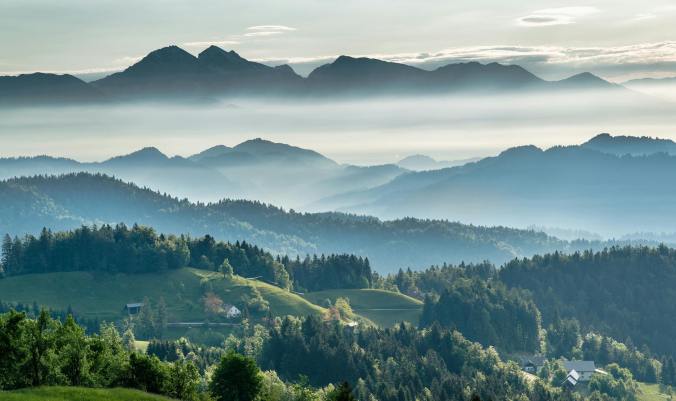
In recent weeks, my sermons on Genesis 3–4 have made much of the fact that the Garden of Eden is found on a mountain. In recounting the drama of Adam, Eve, the Serpent, and the Lord (Genesis 3), as well as Cain and Abel (Genesis 4), I have argued that the topography of Eden plays an important role. For example, when Cain’s face was downcast (Gen. 4:5), I have argued that he is looking down the mountain and away from God. Equally, when God told Cain to look for the sin offering, lying at the door of the Garden, he was calling him to look up the mountain from where his help would come (cf. Psalm 121).
Long story short, the theme of mountains in the Bible cannot be underestimated. Just this morning, I was pondering the way mountains play a role in Matthew (cp. Matt. 4:8; 17:1; 28:16). Maybe I’ll write something on that soon. For now, however I want to help studious Bible readers to see how Genesis 2–4 should be read with topography in mind.
So, in nine strokes, I will attempt to demonstrate why I believe Scripture presents Eden as a mountain sanctuary, and also why this matters for understanding the events of Genesis 2–4 and beyond.
First, the Bible explicitly calls Eden the Mountain of God.
In Ezekiel 28, the Lord addresses the King of Tyre, and in his oracle of judgment, the Lord identifies the wicked king with Adam in priestly garments. In vv. 13–14 he writes,
You were in Eden, the garden of God; every precious stone was your covering, sardius, topaz, and diamond, beryl, onyx, and jasper, sapphire, emerald, and carbuncle; and crafted in gold were your settings and your engravings. On the day that you were created they were prepared. 14 You were an anointed guardian cherub. I placed you; you were on the holy mountain of God; in the midst of the stones of fire you walked. . . .
He continues in verse 16, saying, “so I cast you as a profane thing from the mountain of God, and I destroyed you, O guardian cherub, from the midst of the stones of fire.”
Now, there is debate about who this figure is. Who did God cast down from the mountain? Is it a reference to Adam or to one of the guardian cherubs? That’s a good question, and I generally follow the line of thinking offered by the NET translation.[1] But for now, that question is not the point.
The point at issue is that Ezekiel makes it unmistakable: the Garden of Eden resides on a mountain. And the Prophet of Israel understood it this way because Genesis 2 makes it evident that the Garden stands below the spring of living water (at the top of the mountain) and above the fields, which enjoy the water of four rivers.
Second, the Garden is halfway up the Mountain.
In Genesis 2, we are given the topography of Eden, as verses 10–14 read,
A river flowed out of Eden to water the garden, and there it divided and became four rivers. 11 The name of the first is the Pishon. It is the one that flowed around the whole land of Havilah, where there is gold. 12 And the gold of that land is good; bdellium and onyx stone are there. 13 The name of the second river is the Gihon. It is the one that flowed around the whole land of Cush. 14 And the name of the third river is the Tigris, which flows east of Assyria. And the fourth river is the Euphrates.
Two of these rivers (Tigris and Euphrates) are known later in the Bible, and two are not (Pishon and Gihon). But it is important that we don’t superimpose the location of those known rivers onto the map of Genesis 2. As the Flood (Genesis 6–8) reforms the earth, it is best to understand the world before the Flood on the basis of Moses’ inspired words more than geographical speculation.
On the basis of the text, therefore, we have a mountain made up of many parts. From verse 10, we find that there are waters above the garden, waters that come into the garden, and waters that flow out of the garden and water the land below. In this way, the Garden is half way up the mountain.
That being the case, we still don’t know the height of this mountain, or its whereabouts. But that is less important than observing the topography itself. There is the mountaintop above the Garden, there is the Garden itself, and there is the land surrounding the mountain, which is watered by the waters of the Lord. And then actually, there are also the lands beyond the Garden, the place where Cain will wander.[2]
As we will see, this multi-tiered geography matches the three parts of the tabernacle. But also, it is worth noting two areas beyond the garden. These areas correspond to the coming encampment of Israel, and they help us understand the narrative of Genesis 4.
Third, Genesis 4 possesses five distinct areas that match Israel’s encampment.
In the Wilderness, the land outside of the camp was unclean and the place where the defiled and leprous would go. Accordingly, there are not just three parts of the tabernacle complex (Holy of Holies, Holy Place, and Courtyard), there are also concentric circles of cleanness from the camp to its outskirts. And importantly, this something identifiable in Genesis 4.
When Cain and Abel bring sacrifices to the door, they are ascending to the Garden of Eden, as I will explain below (4:2–5). Likewise, when Cain takes Abel into the field (4:8), he is moving into a place away from the Garden. That is to say, he has gone down the mountain. Still, Cain is in the fields near the Lord. After killing Abel, Cain will be driven from this land to become a wanderer on the earth. As Genesis 4:14 reads, “Behold, you have driven me today away from the ground, and from your face I shall be hidden. I shall be a fugitive and a wanderer on the earth, and whoever finds me will kill me.”
As I read Cain’s response to the Lord, he recognizes that he is being driven “out of the camp.” He is no longer permitted to dwell near the tent of the Lord. He is now, defiled by his sin, a leper on the earth. God is driving him out from the camp. Yet, understanding this depends upon a reading of Genesis 4 that is informed by the tabernacle of God and the camp of Israel. (See Footnote 2).
Fourth, the three parts of God’s Mountain mirror the three parts of the tabernacle.
In Exodus 25–40, Moses receives a vision of God’s house, complete with typological blueprints (see Exod. 25:9, 40). Accordingly, he builds the tabernacle, with the Spirit-guided help of Bezalel, as a type of God’s heavenly tabernacle. In this way, the three parts of the tabernacle—the holy of holies, the holy place, and the courtyard—are meant to teach Israel how to approach God.
Importantly, the tabernacle’s system of gates and sacrifices is necessary for understanding Genesis 2–4, too. For, after mankind sinned, it is not possible to simply climb the hill of God and to approach him as we want. Rather, we must have clean hands and a pure heart (See Psalm 24). Yet, sure purification requires a blood sacrifice. And thus, when Cain climbed the hill of the Lord, he was rejected because he came without blood. Likewise, Abel was accepted because he came with a sacrifice.
But all of this depends upon relating Eden to the express purposes and requirements of the Levitical system.
Fifth, the Garden of Eden was not the holy of holies, but the holy place.
Reading Eden through the lens of Leviticus means that God put Adam in the Garden to work it and keep it as a priest, but not as a high priest. For consider, when Moses built the tabernacle, only the high priest could enter the holy of holies and that but once a year (Leviticus 16). In this way, the high priest was permitted to enter into God’s presence at the height of the mountain.
Indeed, in Leviticus, the priest had to enter the holy of holies in the clouds. That is to say, he offered incense in such a way that he would go behind the veil, but still hidden by the clouds (see Lev. 16:2, 13). Later Daniel 7:13–14 would use this cloud imagery to speak of a Son of Adam entering into the presence of the Lord “on the clouds.” While many take “on the clouds” Christ descending to the earth, in Daniel the orientation is definitely one of ascent, not descent. It is the way of the high priest. And this priestly orientation is not only built on the background of Leviticus 16, but also Genesis 2.
If Adam had obeyed God’s command to not eat of the tree of knowledge of good and evil, and if he had kept God’s word and covenant, then he would have received access to ascend the hill of the Lord. Again, God gave Adam the duties of a priest in the garden. But he was not yet a royal priest, a priest exalted to enter into God’s presence. Instead, he was placed in the garden sanctuary (i.e., the holy place) to serve and guard. From that location, the height of Eden still remained at a distance, and such access to that height depended on obedience.
Filling out this point: we know Adam failed and missed the heights of glory. But the true Adam, the last Adam, Jesus Christ succeeded. Jesus refused the temptation of the devil, obeyed God perfectly, offered the true and final sacrifice, and after his death, he was raised to life and invited to enter God’s presence. In other words, by his perfect obedience he was given access to ascend the hill of the Lord. This is what Hebrews is all about, so that now, everyone who has trusted in him has the same access to God (see Heb. 4:14–16). His perfect obedience as a son made him the true and eternal high priest.
Yet, to understand the logic of this, we must have a clear understanding of the hill of the Lord in Genesis 2–4.
Sixth, Adam’s exile from the Garden dismissed him from being a priest who could ascend God’s hill, but it didn’t preclude him from bringing sacrifices to the door of the garden.
If Adam’s sin meant that the heights of God’s hill were off limits, it did not mean worship was. Rather, as Genesis 4 begins, the first thing (!) that happens outside of the Garden is worship. While decades have passed since the sin of Adam (we have two grown sons in Genesis 4:1–2), and the world is now populated by Adam and Eve’s offspring (see Gen. 5:4), the story of Cain and Abel tells us that Adam has taught his children how to worship God. Tragically, however, only one obeys.
As the New Testament informs us, Abel came to God in faith offering a true sacrifice. As the Bible teaches, true faith is always in response to God’s word (cf. Rom. 10:17). And thus, Abel came bringing his sacrifice as God instructed Adam. While many commentators make Abel’s faith a purely subjective encounter with God, William Symington is better.
In his outstanding work, On the Atonement and Intercession of Jesus Christ (81–86), the Scottish pastor argues that nature does not make a logical connection between sacrifice and blessing, nor does superstition. Rather, Abel’s faith and God’s acceptance must come from God’s divine command. As Symington puts it, “It is absurd to suppose, that the destruction of an innocent animal should be, in itself, acceptable to God. Nothing but duty, . . . could make it acceptable, and nothing but the command of God could make it a duty” (81).
Following this logic, Abel believed God and it was credited to him as righteousness. God accepted his sacrifice because he offered it in faith (Heb. 11:4). Conversely, Cain displease God because he refused to bring a sacrifice for sin, even when God provided such an animal (see Gen. 4:7). Still, for all of these details, the one point I am trying to make most clearly is that the place where the sacrifice was offered was at the door of the Lord.
As Genesis 3 ends, we see that God put Cherubim at the gate of the Garden. Then, when we turn to Genesis 4 and see sacrifices being offered, we should understand that the location of those sacrifices are at the door of the garden too. For as the original audience of Genesis would have brought sacrifices to the tabernacle entrance, where cherubim were woven into the fabric of the door (Exod. 26:31–35), so Cain and Abel, following their father’s instruction, would have done the same.
Bringing the sacrifice before God was rooted in the geography of God’s world, and that geography again centered on the mountain. As God would bring his people to Mount Moriah (Genesis 22), Mount Sinai (Exodus 19), and Mount Moriah again (2 Samuel 6–7), so he called Adam and his children to worship at the mountain in Eden. Thus, the sacrifices offered by Cain and Abel were not offered just anywhere; they were brought up the mountain of God to be sacrificed before the cherubim.
Seventh, the sacrifice was accepted by fire.
If Leviticus informs our reading of Genesis, as it should, then the acceptance of the offering in Genesis 4 is also specified. In other words, when Scripture says that God accepted Abel’s sacrifice, but not Cain’s there must be a visible difference. But what is it? And how might we know?
I would argue that Abel’s sacrifice was accepted by fire falling from heaven on the altar, while Cain’s was left untouched. Here’s the connection. In Leviticus 9, when all the preparation for Aaron’s priesthood is made, God sends fire from heaven to consume the meat on the altar. After making all the provisions, Leviticus 9:22–24 reads,
Then Aaron lifted up his hands toward the people and blessed them, and he came down from offering the sin offering and the burnt offering and the peace offerings. 23 And Moses and Aaron went into the tent of meeting, and when they came out they blessed the people, and the glory of the Lord appeared to all the people. 24 And fire came out from before the Lord and consumed the burnt offering and the pieces of fat on the altar, and when all the people saw it, they shouted and fell on their faces.
This fire is not the production of men, but God. And it would be this fire from heaven that would continue to burn in the tabernacle. In other words, the priests were responsible for tending this fire, so that it would not go out. And strikingly, this is not the only place where heavenly fire falls.
In 1 Kings 18, when Elijah confronted the prophets of Baal (at the Lord’s direction, we should note), God also sent fire from heaven. And equally, when the Lord established his new covenant priests at Pentecost he did the same. By way of sending heavenly fire (Acts 2), God also made the church a living sacrifice, acceptable and pleasing to him (Rom. 12:1–2).
And again all of this goes back to Eden, when God accepted Abel’s sacrifice and rejected Cain’s.
Eighth, when God refused to accept Cain’s offering with fire, that was not the end.
As Genesis 4:5 records, Cain’s face fell. And God addresses the fallenness of his face (Gen. 4:6). But what does this mean? The answer in my mind comes again from the mountainous terrain of Genesis 4.
Cain ascended the hill with his unacceptable offering and it was not accepted. In other words, it was not received with fire, which means, the offering did not ascend into heaven. As Peter Leithart and others have noted, the burnt offering was consumed on the altar and the smoke of the sacrifice entered into heaven where it pleased God. To put differently, the worshiper was transported to heaven when he offered a sacrifice on the altar, by means of the animal’s pleasing aroma.
In Cain’s case, there was no pleasing aroma before God. He was not lifted into heaven. And thus, his face fell, as he went back down the mountain.
Pause here for a moment: If Genesis 4 is flat and has no mountain, this reading of Cain’s face falling resorts to a psychological interpretation more than a physical one. Certainly, the heart of Cain is involved, but so is his body and his standing before God.
If we accept, however, that his face falls as he descends the mountain. And God speaks to the descending Cain by calling him back, the rest of the narrative makes more sense. That is to say, when the Lord identifies his descending face, he offers to Cain a true sacrifice that will lift him up. Notice what it says, “If you do well, will not be accepted?” But literally, the offering is one of lifting up. The word for “accepted” carries the idea of being exalted or lifted up. God was literally offering the descending Cain a way to ascend the hill.
In this way, God’s grace was specific to Cain’s problem. His sacrifice was not lifted up by fire, and thus he needed to offer a true sacrifice, which in fact God also provided for him, if we render Genesis 4:7 like this, “If you do not do well, at the door a sin offering is lying down.”
Following Symington and Michael Morales, I take the word hattat to be a “sin offering,” not some personification of sin. On this reading, God is telling Cain to repent and believe. In other words, Cain must turn around, look up the mountain, and receive the sacrifice that would be offered on the altar that stands before the Cherubim.
Again, this reading of Scripture comes from careful attention to the text, but also by comparison to Leviticus and the pattern of mountain-top worship that runs through the Bible. In fact, this reading is best explained by a comparison with another place in Genesis, Genesis 22. In that passage, the Lord provides a sacrifice for Isaac on the hill of the Lord, and it seems that God does the same for Cain. Only Cain, in his unbelief, refuses and departs from the mountain with a mission to shed the blood of Abel, not the blood of the animal given to him.
Ninth, the place of that killing was in the field, which would have been down the hill.
To finish our look at the mountain of God in Genesis 2–4, we can see how God intervened and offered grace to Cain, if he would look up the mountain. But refusing to do so and following the downward trajectory of his unbelief, he did the opposite. Cain went down the hill, sought his brother, and aimed to put him to death.
Accordingly, in Genesis 4:8 Cain kills Able at a place far away from God. Refusing to come up the mountain to offer a sacrifice; he provides for himself a sacrifice in the fields. Tragically, instead of receiving grace to pardon his false worship, he seeks to assuage his guilt by means of killing Abel, whose true worship serves as a painful reminder of his own condition.
In many ways, this contrast between Cain and Abel does not require an understanding of the hill of the Lord. But without it, and the way that ascending the hill of the Lord relates to true and false worship, it will be difficult to understand the nature of the conflict between those who trust God (Abel) and those who do not (Cain). But with the mountain theology in place, it becomes clear: every person made in God’s image will either worship God truly or falsely.
And that is not something that begins after Jesus. It begins in the beginning.
Conclusion
So, hopefully, this examination of Genesis 2–4 helps you see the terrain of these chapters. For, in fact, the topography of Eden and the hill of the Lord will play an important part of the biblical storyline. And wonderfully, the center of the whole story, the person and work of God’s Son, is the one who makes a way for sinners to ascend the hill of the Lord.
That is the core of the gospel. And one that is directly related to seeing the Mountain of God in Genesis.
Soli Deo Gloria, ds
Photo by Krivec Ales on Pexels.com
_______________
[1] The Textual Note in the NET reads: Heb “you (were) an anointed cherub that covers and I placed you.” In the Hebrew text the ruler of Tyre is equated with a cherub, and the verb “I placed you” is taken with what follows (“on the holy mountain of God”). However, this reading is problematic. The pronoun “you” at the beginning of verse 14 is feminine singular in the Hebrew text; elsewhere in this passage the ruler of Tyre is addressed with masculine singular forms. It is possible that the pronoun is a rare (see Deut 5:24; Num 11:15) or defectively written (see 1 Sam 24:19; Neh 9:6; Job 1:10; Ps 6:3; Eccl 7:22) masculine form, but it is more likely that the form should be repointed as the preposition “with” (see the LXX). In this case the ruler of Tyre is compared to the first man, not to a cherub. If this emendation is accepted, then the verb “I placed you” belongs with what precedes and concludes the first sentence in the verse. It is noteworthy that the verbs in the second and third lines of the verse also appear at the end of the sentence in the Hebrew text. The presence of a conjunction at the beginning of “I placed you” is problematic for the proposal, but it may reflect a later misunderstanding of the syntax of the verse. For a defense of the proposed emendation, see L. C. Allen, Ezekiel (WBC), 2:91.[1]
[2] James Jordan is even more explicit, when he writes of Cain’s exile from Eden,
The fact that Cain entered a homeless land indicates that he left a homeland. We see in this an important distinction in sacred geography that will become important later on. Genesis 2 presents us with the high Land of Eden, with its Garden on its east side. Immediately to the east of this is the homeland where Adam and Eve and Cain and Abel lived. We may see this as next to the slope leading up to the Edenic plateau. Farther away is the homeless area into which Cain moved.
This fivefold geography is replicated in various ways in later parts of the Bible. [1]The Holy of Holies corresponds to the highest Land of Eden. [2] The Holy Place is a replica of the firmament heavens and thus also of the Garden of Eden. [3] The Courtyard with its Altar corresponds to the slope leading up to the Garden. [4] Around it is the camp of Israel in the wilderness, and the Promised Land after Israel enters it. It links with the Homeland where Adam and Eve dwelt. [5] Farther away are the gentile lands, the river-watered lands of Genesis 2, the gentile sea. (Trees and Thorns, 330)
 Via Emmaus
Hello, in your opening paragraph, you substantially based your subsequent perspective on the passage of Psalm 121 being instructive that Cain would get help from the hills/mountains “He was calling him to look up the mountain from where his help would come (cf. Psalm 121).”
Psalm 121 is actually stating that our help doesn’t come from men in their government, wealth or any perceived strength, but instead as the inspired writer of Psalms says: it “comes from The Lord who made heaven and earth!”
Hills and mountains are often used metaphorically to portray man’s strength contrary to God’s strength. for example:
Jeramiah 3:23 “Surely deception comes from the hills, and commotion from the mountains. Surely the salvation of Israel is in the LORD our God.”
Jeremiah 3:6 Now in the days of King Josiah, the LORD said to me, “Have you seen what faithless Israel has done? She has gone up on every high hill and under every green tree to prostitute herself there.”
Jeremiah 50:6 My people are lost sheep; their shepherds have led them astray, causing them to roam the mountains. They have wandered from mountain to hill; they have forgotten their resting place.
Ezekiel 6:3 You are to say: ‘O mountains of Israel, hear the word of the Lord GOD! This is what the Lord GOD says to the mountains and hills, to the ravines and valleys: I am about to bring a sword against you, and I will destroy your high places.
Ezekiel 36:6 Therefore, prophesy concerning the land of Israel and tell the mountains and hills, the ravines and valleys, that this is what the Lord GOD says: Behold, I have spoken in My burning zeal because you have endured the reproach of the nations.
Jeremiah 3:23 Truly in vain is salvation hoped for from the hills, and from the multitude of mountains: truly in the LORD our God is the salvation of Israel.
Kind rgds
Andy