Via Emmaus on the Road: Luke 24

Further Resources

  • Questions for Luke 22–John 2 (Week 14)

Luke 24 (ESV)

The Resurrection

24 But on the first day of the week, at early dawn, they went to the tomb, taking the spices they had prepared. And they found the stone rolled away from the tomb, but when they went in they did not find the body of the Lord Jesus. While they were perplexed about this, behold, two men stood by them in dazzling apparel. And as they were frightened and bowed their faces to the ground, the men said to them, “Why do you seek the living among the dead? He is not here, but has risen. Remember how he told you, while he was still in Galilee, that the Son of Man must be delivered into the hands of sinful men and be crucified and on the third day rise.” And they remembered his words, and returning from the tomb they told all these things to the eleven and to all the rest. 10 Now it was Mary Magdalene and Joanna and Mary the mother of James and the other women with them who told these things to the apostles, 11 but these words seemed to them an idle tale, and they did not believe them. 12 But Peter rose and ran to the tomb; stooping and looking in, he saw the linen cloths by themselves; and he went home marveling at what had happened.

On the Road to Emmaus

13 That very day two of them were going to a village named Emmaus, about seven miles from Jerusalem, 14 and they were talking with each other about all these things that had happened. 15 While they were talking and discussing together, Jesus himself drew near and went with them. 16 But their eyes were kept from recognizing him. 17 And he said to them, “What is this conversation that you are holding with each other as you walk?” And they stood still, looking sad. 18 Then one of them, named Cleopas, answered him, “Are you the only visitor to Jerusalem who does not know the things that have happened there in these days?” 19 And he said to them, “What things?” And they said to him, “Concerning Jesus of Nazareth, a man who was a prophet mighty in deed and word before God and all the people, 20 and how our chief priests and rulers delivered him up to be condemned to death, and crucified him. 21 But we had hoped that he was the one to redeem Israel. Yes, and besides all this, it is now the third day since these things happened. 22 Moreover, some women of our company amazed us. They were at the tomb early in the morning, 23 and when they did not find his body, they came back saying that they had even seen a vision of angels, who said that he was alive. 24 Some of those who were with us went to the tomb and found it just as the women had said, but him they did not see.” 25 And he said to them, “O foolish ones, and slow of heart to believe all that the prophets have spoken! 26 Was it not necessary that the Christ should suffer these things and enter into his glory?” 27 And beginning with Moses and all the Prophets, he interpreted to them in all the Scriptures the things concerning himself.

28 So they drew near to the village to which they were going. He acted as if he were going farther, 29 but they urged him strongly, saying, “Stay with us, for it is toward evening and the day is now far spent.” So he went in to stay with them. 30 When he was at table with them, he took the bread and blessed and broke it and gave it to them. 31 And their eyes were opened, and they recognized him. And he vanished from their sight. 32 They said to each other, “Did not our hearts burn within us while he talked to us on the road, while he opened to us the Scriptures?” 33 And they rose that same hour and returned to Jerusalem. And they found the eleven and those who were with them gathered together, 34 saying, “The Lord has risen indeed, and has appeared to Simon!” 35 Then they told what had happened on the road, and how he was known to them in the breaking of the bread.

Jesus Appears to His Disciples

36 As they were talking about these things, Jesus himself stood among them, and said to them, “Peace to you!” 37 But they were startled and frightened and thought they saw a spirit. 38 And he said to them, “Why are you troubled, and why do doubts arise in your hearts? 39 See my hands and my feet, that it is I myself. Touch me, and see. For a spirit does not have flesh and bones as you see that I have.” 40 And when he had said this, he showed them his hands and his feet. 41 And while they still disbelieved for joy and were marveling, he said to them, “Have you anything here to eat?” 42 They gave him a piece of broiled fish, 43 and he took it and ate before them.

44 Then he said to them, “These are my words that I spoke to you while I was still with you, that everything written about me in the Law of Moses and the Prophets and the Psalms must be fulfilled.” 45 Then he opened their minds to understand the Scriptures, 46 and said to them, “Thus it is written, that the Christ should suffer and on the third day rise from the dead, 47 and that repentance for the forgiveness of sins should be proclaimed in his name to all nations, beginning from Jerusalem. 48 You are witnesses of these things. 49 And behold, I am sending the promise of my Father upon you. But stay in the city until you are clothed with power from on high.”

The Ascension

50 And he led them out as far as Bethany, and lifting up his hands he blessed them. 51 While he blessed them, he parted from them and was carried up into heaven. 52 And they worshiped him and returned to Jerusalem with great joy, 53 and were continually in the temple blessing God.

Soli Deo Gloria!
The Need for Expositional Preaching (pt. 3): Jesus was an Expositor

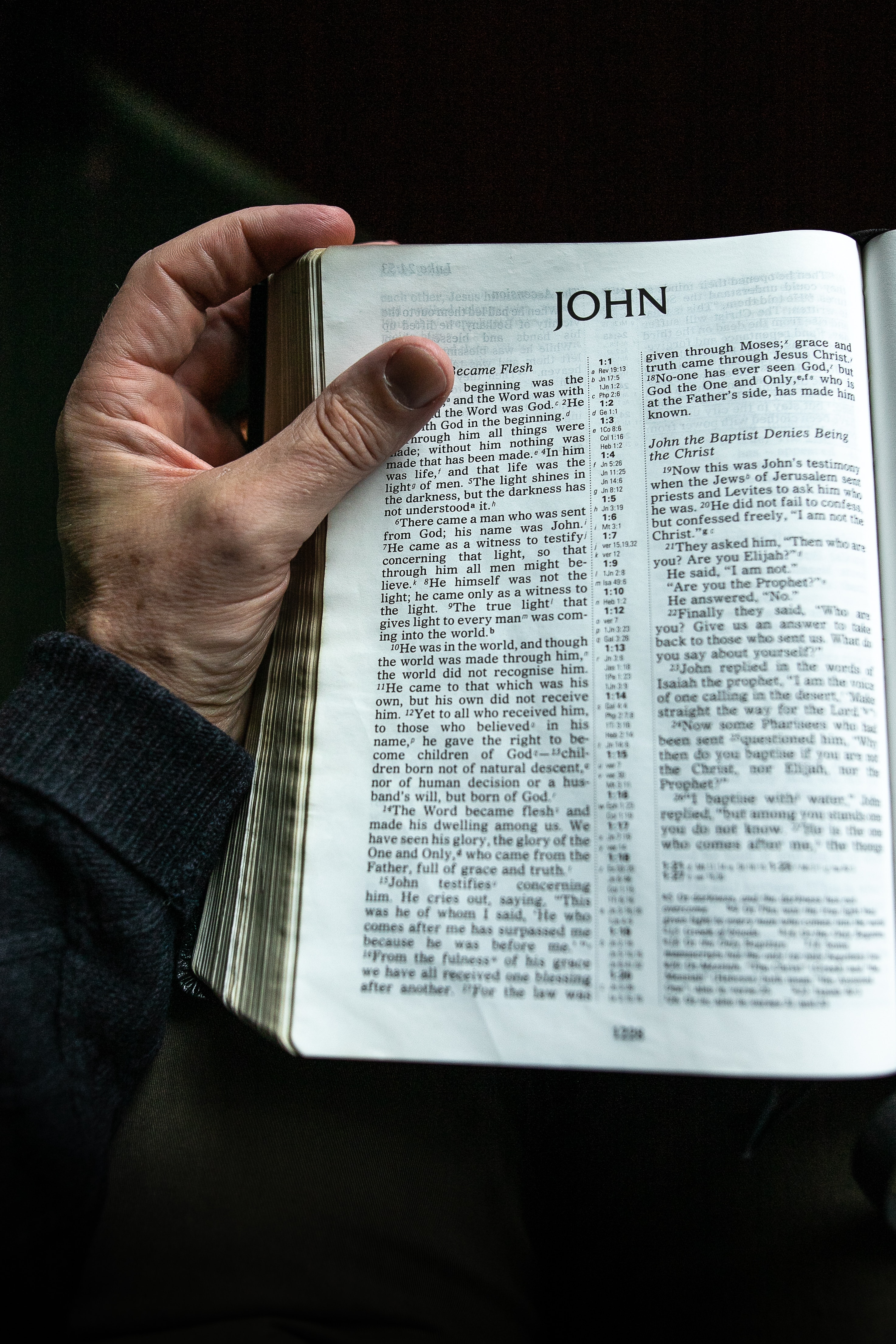
james-coleman-9S5FNcs_qPw-unsplash.jpgThe Old Testament is the not the only place where we find expositional preaching. Jesus himself preached expositionally. In fact, he was more than an expositional preacher, according to John John 1:18 he literally ‘exegeted’ the Father, meaning that he explained, exposed, and revealed the character of God in his very life and person.

As the Word Incarnate, Jesus perfectly revealed God. And as the Prophet like Moses (Acts 3:22–26), he handled the Word of God with skill and authority (cf. Matthew 7:29). For these reasons, we should be listen to what Jesus said (Matthew 17:5; cf. Deuteronomy 18:15) and follow him. And learning from him how to read and interpret Scripture, we should see what kind of expositional preacher he was.

Jesus Was an Expositional Preacher

Jesus carried on a ministry of exposition before and after his death and resurrection. For instance, in the Sermon on the Mount, Jesus repeatedly quoted the Old Testament and provided a more accurate interpretation and deeper application by showing how the Law was fulfilled in the new covenant he was bringing.

In full agreement with his opponents that God’s word was divinely inspired, Jesus taught as one with authority (Matthew 7:29). Interestingly, with absolute authority, he did not create his own sermons; he repeatedly put himself under the word of God (cf. Gal 4:4) and interpreted how he himself fulfilled the Old Testament. (We might even find a similar pattern in the way the Father used Genesis 22, Psalm 2, and Isaiah 42 to identity Jesus as his beloved Son at Jesus’s baptism). Continue reading

Through the Bible in 2010: Evidence of God’s Grace

How important is Bible reading and interpretation?

Consider this: On the day that Jesus Christ was raised from the dead–arguably the most significant day in world history–Jesus spent 1/8, maybe 1/6, of the day interpreting Scripture to two wayward disciples on the way to Emmaus.  Over the course of a few hours, Jesus showed these disciples how all the Scriptures should be interpreted in the light of himself.  As he walked with the two runaway followers (Luke 24), he walked them through the Old Testament.  Beginning with Moses, he explained how he fulfilled the types, promises, and prefigurations found throughout the Old Testament (Luke 24:27).  In a word: All Scripture points to Jesus (John 5:39). The effect was to replace the disciple’s doubt and disappointment with burning hearts ignited by the Word of Christ and for the Christ of the Word.

Luke 24, from which this blog gets its name, is a powerful testimony for the importance of Christ-centered Bible interpretation and Bible reading.

This year, following our Savior’s example, I led our Wednesday night Bible study through the Scriptures with eyes towards Christ.  Last week, by God’s grace, we finished our year-long journey.  It was amazing to see how faithful God was to help us walk through the Scriptures in one year.  With the exception of 1-2 Chronicles and Lamentations, we surveyed every book in the Bible and how each book helps us know and love Christ.

For me, this course of study was rewarding and I would recommend it to anyone who pastors, teaches a Sunday School class, or leads a small group.  Those who attended were grateful for the 30,000 foot exposition of the Scriptures, and I was greatly stretched to better understand how all the books of the Bible point to Christ (Eph 1:10). Make no mistake, it was challenging and I grew weary in the process.  In fact, as I look back I realize that I probably bit off more than I could chew, but God was faithful and gave me time and grace to prepare lessons each week.  By his grace, we made it through the whole Bible. Here are the notes from the New Testament.  You can find all the handouts here.

Gospels-Acts
Matthew: The King and His Kingdom (September 22, 2010)
Mark: Seeing the Christ of the Cross (September 29, 2010)
Luke: The Messiah Must Go To Mount Zion (October 6, 2010)
Acts: Taking the Gospel From Zion to Zimbabwe (October 13, 2010)
John: Jesus, The Son of God, The Messiah of Israel, and The Savior of the World (October 20 & 27, 2010)

The Letters and Revelation
Paul (1): The Apostle to the Gentiles (November 3 & 10, 2010)
Paul (2): The Prison Epistles and Philemon (November 17, 2010) — compiled by David Crater
Hebrews: Believe and Draw Near, For Jesus Christ is Greater Still (December 8, 2010)
General Epistles: James, 1-2 Peter, 1-3 John, and Jude (December 15, 2010)
Revelation: The Revelation of Jesus Christ (December 22, 2010)

Tomorrow, I will post a few thoughts on tips and tools for anyone who has thought or is thinking about teaching through the Bible in a year.

Soli Deo Gloria, dss

Beginning with Moses (Weekend Website)

In keeping with the turn towards biblical theology, this weekend’s website is Beginning with Moses.  Taking its name from Luke 24, this website is dedicated to offering “briefings on biblical theology.”  It is filled with insightful articles from some of the world’s premier biblical theologians, living and dead (i.e. Graeme Goldsworthy, D.A. Carson, Richard Gaffin, Edmund Clowney, even Carl Henry).  The website also has articles from younger biblical-theologians like Simon Gathercole, Carl Trueman, and SBTS’s most recent faculty addition, Jim Hamilton

Additionally, the website offers an extensive list of book recommendations, book reviews, and web links to other biblical-theological resources.  The four contributors are David and Jonathan Gibson, Andrew Grundy, and Dave Bish.  Since 2002 these four have committed themselves to promoting high-quality biblical theology–Goldsworthy, Gathercole, and David Jackman serve as the sites overseers.  They are from from the UK (one is now studying at Moore Theological College in Sydney), and from their brief bio’s it seems that most, if not all, are/have been divinity students and ministers of the gospel.  One just finished his PhD at Aberdeen.  In short, their website is a gem with a rich array of biblical content.

So check out Beginning with Moses this weekend.  If you are at all interested in the subject of biblical theology you will visit often. 

Sola Deo Gloria, dss

Via Emmaus

So again, on another website, with the same name.  I try my hand again at this thing called blogging.  With more humble intentions this time, I write– not trying to write bits-and-pieces of a theological treatise, but rather aiming to simply articulate thoughts on biblical theology, contemporary ecclesiology, and anything else on which the gospel light shines.  This is the concept; Jesus Christ is the content.  For in Him all things are united (Eph. 1:10) and by Him are all things explained (Luke 24).  He is the creator, sustainer, savior, and Lord, and to Him does this blog seek to point.  Following the trajectory of Scripture that leads all things to him (John 5:39), seeks to understand all life in the radiance of his glory.  And so it is called Via Emmaus.

This blog derives its name from the account in Luke 24, where two disciples are caught on the road (via ) fleeing Jerusalem for easier days in Emmaus.  Graciously, Jesus appears to them, interprets the enigmatic current events of His resurrection in light of Scripture, and explains how He–thought still hidden to them– is the fulfillment of all the law, prophets, and psalms, and prompts them to return to Jerusalem.  Such “biblical theology” explained reality and redemption to these wayward disciples.

So too, my prayer for this blog is that it might be a place where people are likewise turned back to the cross, to the resurrection, and to the coming kingdom of Jesus Christ.  Just as the two doubting disciples returned to the Lord’s assembly in the middle of the night after hearing Christ’s words, may those who are here pointed to his sufficient Word, the Bible, experience greater hope and faith in the inspired truths therein contained.  My hope is that this blog will not take on a life of its own, but rather that it would point to the true life, King Jesus.  That in the end, it would simply be a signpost or a watering hole for those walking the dusty road from–not to– Emmaus.

Soli Dei Gloria!

ds