A Heart for Excellence: Thinking Biblically about Skill in Singing

sven-read-4yZGWYCul-w-unsplashSing to him a new song; play skillfully on the strings, with loud shouts.
— Psalm 33:3 —

They were all under the direction of their father in the music in the house of the Lord with cymbals, harps, and lyres for the service of the house of God. Asaph, Jeduthun, and Heman were under the order of the king. 7 The number of them along with their brothers, who were trained in singing to the Lord, all who were skillful, was 288.
— 1 Chronicles 25:6–7 —

So, whether you eat or drink, or whatever you do, do all to the glory of God.
— 1 Corinthians 10:31 —

To each is given the manifestation of the Spirit for the common good.
— 1 Corinthians 12:7 —

Music is a gift from God. And in the church, those gifted in song are given by Christ to build up his body. To that end, those who lead the church in song should serve with true faith, pure hearts, and skilled hands. For various reasons, the combination of head, heart, and hands is not always easy. But it is something we should pray for and work towards

To that end, I offer the following eight points on the place of skill in song. These eight points summarize a larger article on the biblical necessity of excellence in music. (You can read that article here: True Worship Includes a Heart for Excellence.) Let me know what you think of these eight points, and/or what you would add or improve. Continue reading

Reading Mark 13 in Context: Seeing 16 Connections between Jesus’s Olivet Discourse and His Death and Ascension

robert-bye-6PLB5SKWiIY-unsplashI saw in the night visions, and behold, with the clouds of heaven there came one like a son of man, and he came to the Ancient of Days and was presented before him. 14 And to him was given dominion and glory and a kingdom, that all peoples, nations, and languages should serve him; his dominion is an everlasting dominion, which shall not pass away, and his kingdom one that shall not be destroyed.
— Daniel 7:13–14 —

On Sunday, I preached a message on Daniel 7:13–14, how it is understood by the New Testament authors and why Christ’s ascension is such good news for us today. You can listen to the sermon here. And if you do, you will find that the longest part of the message is located in Mark 13–14.

The reason for that long meditation is that Mark cites Jesus referencing Daniel 7:13–14 in two places. First, answering his disciples’ question about the destruction of the temple and when these things will be (Mark 13:1–2), Jesus says, “And then they will see the Son of Man coming in clouds with great power and glory” (Mark 13:26). Second, after his arrest, Jesus is  interrogated by the high priest. In response to a question of his identity, Jesus again references Daniel 7, “I am, and you will see the Son of Man seated at the right hand of Power, and coming with the clouds of heaven.” (Mark 14:62)

Following the lead of Daniel itself, I interpreted these two passages as a reference to Jesus’s ascension in relationship to his impending crucifixion. Instead of reading these references of the clouds to something still future or his second coming from heaven to earth, I recalled the original meaning of Daniel 7:13–14 and explained how Jesus is speaking about his ascension and entrance into heaven.

As you might expect, this led to some questions. In our community group that followed Sunday’s sermon, there were more than a few questions about this reading, as it stands in contrast to more popular readings of Mark 13 and its parallel accounts in Matthew 24–25 and Luke 21. In what follows, I will restrict my focus to Mark and try to explain how we might read his Gospel with greater attention to his own words and the meaning of Jesus’s words in Mark 13. By paying attention to the literary connections between Mark 13 and Mark 14–15 (#4 below), I believe we can see how Jesus is preparing his disciples and Mark is preparing his readers for understanding a heavenly perspective on Christ’s death, resurrection, and ascension, with (perhaps) ongoing implications for the destruction of the temple in AD 70.

Continue reading

A Neglected but Necessary Doctrine: How Christ’s Ascension Clarifies Our Theology and Comforts Our Souls

clouds and blue sky

And when he had said these things, as they were looking on, he was lifted up, and a cloud took him out of their sight. And while they were gazing into heaven as he went, behold, two men stood by them in white robes, and said, “Men of Galilee, why do you stand looking into heaven? This Jesus, who was taken up from you into heaven, will come in the same way as you saw him go into heaven.”
— Acts 1:9–11 —

   He ascended to heaven
      and is seated at the right hand of God the Father almighty.
— The Apostles Creed — 

In Acts 1:9–11 Luke reports the ascension of Jesus from earth to heaven. This event has been a staple in orthodox confessions, as listed in the Apostle’s Creed, but it has also been spiritualized by some (like Origen and Rudolph Bultmann) and overlooked by others (too many to count!). But what about you, how do you think about the ascension?

Do you think about it all? Does it form your theology (especially your eschatology), or do you skip from Christ’s resurrection to his return? What about your daily life, how does ascension bring the good news of heaven to your earthly struggles? If the ascension is absent in your thoughts, you are missing a chief way that we know and experience the presence of Christ. For that reason, we need to go back and see what Scripture says about this  vital doctrine. Continue reading

When The Son of Man Comes Around: A Sermon on Daniel 7

daniel05Who is in control?

This is a question germane to every area of life—personal, parental, political, etc. And as we know all to well, when wicked people are in control, the people under their ‘care’ suffer! Just consider a couple proverbs related to kings and their citizens:

When the righteous increase, the people rejoice, but when the wicked rule, the people groan. (Proverbs 29:2)

Like a roaring lion or a charging bear is a wicked ruler over a poor people. (Proverbs 28:15)

Because of the profound impact rulers can play on a nation, we can make politics the most important part of life. And while not denying its importance (see here), Daniel 7 teaches us that there is only one true ruler, and he alone will receive a kingdom that never ends. Indeed, until he reigns, the nations and their leaders are beasts by comparison.

With this in mind, Daniel 7, the pinnacle chapter in the book of Daniel, teaches us how to think about who is in control. The vision of Daniel brings us to the throne of God and to the Ancient of Days who decides who rules on the earth.  More than that it gives us a picture of God’s rule over the nations and the fact that the Son of Man has authority to judge all flesh (see John 17:2).

These are themes found in this week’s sermon, “When the Son of Man Comes Around.” You can watch the sermon here. Other sermons in this series can be found here.

Soli Deo Gloria, ds

How Did You See That? A Case for Scripture Saturation

david-travis-aVvZJC0ynBQ-unsplashSometimes in a class or after a sermon, someone will ask? How did you see that, which is shorthand for saying: How did you make the connection from Joshua’s baptism to that of Jesus? Or, Daniel in the Lion’s Den to Jesus’s death and resurrection? 

Many times the answer is: Well, I read it. I heard another teacher preach it. Or, a commentary made the connection. Other times, however, I must say: Well, I just remembered it—from reading the Bible last year, this week, or, even sometimes, ten years ago. This latter answer leads the point of this post. 

Good preachers don’t just know and use the good commentaries. They have good biblical instincts; instincts that come from reading, re-reading, studying, discussing, and sitting under God’s Word. Certainly, this means reading good books, but it also means reading the Good Book. A. LOT.

In seminary, this approach to Scripture was given the term: Scripture Saturation. This term comes from David Prince, who in answering this same question said plainly that such connections are found not by reading commentaries, but by saturating yourself with Scripture. No commentary. he argued and I am repeating, can replace the reading of the Bible, for often it is only through Scripture Saturation that various connections are made. Often, it pleases the Spirit to reveal things to us, only as we read the Bible.

Today, this question surfaced again in an online Simeon Trust workshop on Ecclesiastes. In this session, Ryan Bishop showed a connection between Ecclesiastes 8:14–17 and Isaiah 55:8–9. The question came up: How did you see that? And the answer was not that Alec Motyer or Barry Webb showed it to me, but “I remembered it from a sermon I heard a year or so ago?”

That’s how it works: By reading, re-reading, studying, discussing, meditating, stewing over, and sitting under the Word, we become saturated with God’s Truth. And then, with hearts full of the Bible, it comes to mind as we read other portions of Scripture, or prepare a message, or share the gospel with a friend. Many times, the Spirit begins to bring to life connections that we would not see in any other way.

Indeed, commentaries are helpful, even necessary for arriving at a faithful understanding of the Bible. They are typically written by men and women who are saturated with Scripture. But more than reading books about the Bible, reading Scripture again and again is the best way to understand the Bible and to see its contents.

I call this the “parable principle.” God often reveals his biblical truth only through repeated readings. At the same time, he conceals his truth from those who think a singular reading of the Bible will disclose all that Scripture has to say. Such a reality makes reading the Bible imperative and exhilarating, as we continue to see how the whole Bible fits together. Moreover, this principle explains why seasoned preachers will see things that younger teachers do not. Conversely, those who read the Bible as a unified whole (even if young) will be more prepared to see the connections in Scripture before those who read verses and books as isolated compartments in the Bible (even if older).

In practice, sometimes we only see things after we’ve read them a few dozen or a few hundred times. That’s not because they weren’t there in the text from the beginning. Rather, such progressive understanding comes from our minds being renewed by more and more of the Bible. Indeed, just as the apostles were identified because they had been with Jesus (Acts 4:13); the same is true for disciples today.  

For this reason, we should give ourselves to reading the Bible and reading the Bible a lot. While preachers can and should certainly focus their devotional reading to their current sermon series. It is also important to read from the whole Bible and to do so regularly. Earlier this year, I outlined a way of reading Scripture that focuses on such saturation.

If interested, you can find the outline here. And if you have kept up with this blog you may see some of the ways I have been reading Scripture this year. And others may notice how I’ve failed to live up to the promise of providing content each month. I do apologize. I’m reading, but haven’t kept up writing. Lord willing there will be more coming. 

Fortunately, the best part about a Bible reading plan is reading the Bible. So brothers and sisters, keep reading God’s Word. Keep delighting in what you find there. Don’t aim to check off a box or get through a plan. Feed yourself on God’s Word and watch how the world of the Bible opens up and reveals to you the glory of God in the face of Christ.

Soli Deo Gloria, ds
David Among the Priests: Seeing the Royal Priesthood of David in the Book of 1 Chronicles

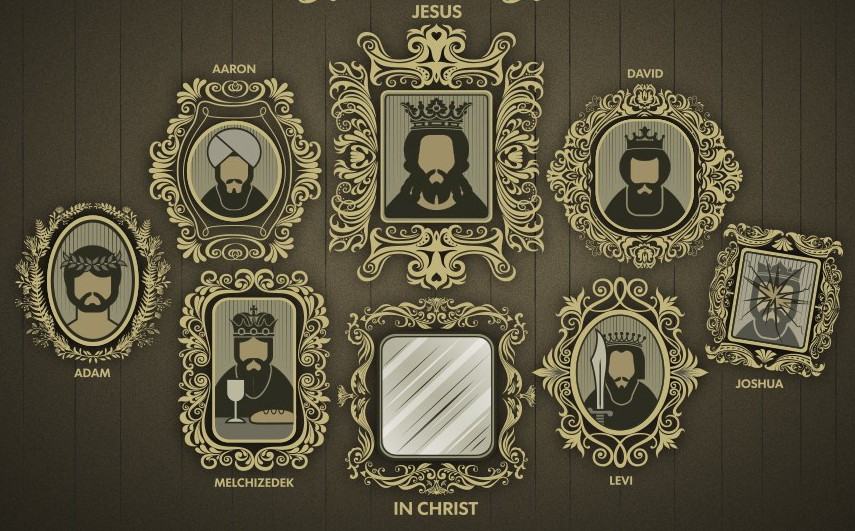
priestcolorIn 1 Chronicles 1–9, the central feature of the genealogy is the priestly service of sons of Aaron and Levi. (See this post). Yet, as the book unfolds, there is another “priest” who takes center stage. Who is this priest? It is none other than David himself, a royal priest after the order of Melchizedek, we might say.

His priesthood, however, may be veiled to many readers because of the fact that David is not called a priest and because passages like Exodus 28 and Deuteronomy 33:8–11 restrict priesthood to the sons of Aaron. Yet, taking those Levitical instructions seriously, we should not miss how 1 Chronicles presents David.

In what follows, I will present four evidences of David’s priesthood, the last includes five actions that identify David as a priest. If time permitted, we could find more evidences for David’s priesthood and give rationale for how this works in Scripture. Some of these things will become clear below; others we will have to explore later. For now, let us content ourselves with what Scripture gives us in 1 Chronicles and how David is presented in priestly ways.

Continue reading

Getting Into 1 Chronicles without Getting Stuck: Or, How to Read a Genealogy

woman in red t shirt looking at her laptop

“Just skip the first 9 chapters in 1 Chronicles and start in chapter 10.”

This is something I’ve both said and done. And yet in this post, I want to return to 1 Chronicles 1–9 to show you how important these chapters are for understanding Chronicles and the theme of royal priesthood in the Bible.

For those reading the Bible for the first time or the fiftieth time, the likelihood of reading 1 Chronicles 1–9 with profit is challenging, to say the least. Yes, these chapters do include the cottage industry known as Jabez’s Prayer (1 Chr. 4:9–10). But appeals to that blessed man, whose name means pain—probably a prophecy for the way his life would be misused by 20th C. Christians—only confirms how hard it is to read these chapters with anything but the most general profit—i.e., God is Lord of history. (For a proper interpretation of Jabez’s prayer, read this).

Our approach to 1 Chronicles 1–9 changes, however, when we discover (1) the structure of this passage and (2) its purpose in the book of 1–2 Chronicles. Assisting in both of these endeavors, James T. Sparks has written The Chronicler’s Genealogies: Towards an Understanding of 1 Chronicles 1–9.

In Sparks’ research, he argues for the intentional placement of this genealogy and how it works in this book. After correcting a few modern errors on reading genealogies (check back for a post on that point), Sparks identifies a chiastic structure in these nine chapters that focuses on the cultic personnel (i.e., the priests). Continue reading

Seeking the Kingdom of God with the Church of Jesus Christ

three kings figurines

Is the kingdom of God present or future? Is it now or not yet? Could it in any way be both? If so, how? These are important questions for anyone who has read the Bible, and for anyone who is studying the book of Daniel—a book that speaks of God’s kingdom throughout.

In evangelical circles the question of God’s Kingdom has been answered for the last half-century with a view called “inaugurated eschatology.” This view affirms Christ’s present royal position as seated at God’s right hand (Psalm 110), even as he rules the church by way of his Spirit (Matthew 28:20; John 16:7; Ephesians 1:21–23). At the same time, his kingdom has not been yet consummated, and the people who have believed the good news of the kingdom await the day when he will return to establish his rule on the earth.

Among the many names who have advocated this position, few are more important than George Eldon Ladd, the late New Testament professor from Fuller Seminary. During the middle decades of the twentieth century, his books on the kingdom of God engaged Dispensationalism and Covenant Theology alike. And in each, he provided a rich biblical exposition on the subject.

Ladd maintained that the kingdom of God is found in Christ’s reign more than the location of his rule (i.e., his realm).[1] He understood the kingdom as a future reality, but one that had broken into the present. Against a view of the kingdom of God as spiritualized in the individual—a view based on a poor translation of Luke 17:21 (“the kingdom of God is within you,” KJV; rather than “the kingdom of God is in the midst of you,” ESV)—Ladd centered the presence of Christ’s kingdom in the church, without confusing the church with the kingdom. In this way, Ladd opposed both the replacement theology of Covenant Theology and the radical division of God’s people (Israel vs. Church) in some forms of Dispensationalism.

Today, Ladd’s work remains invaluable for students of eschatology. Indeed, those who are unfamiliar with him or inaugurated eschatology, in general, are missing some of the best exegetical research on the kingdom of God for the last two generations. While certainly fallible—as Ladd’s biography shows—his studies have been a major catalyst in evangelical theology.

In what follows, I will offer a summary of five points from a chapter entitled “The Kingdom and the Church” in his A Theology of the New Testament.[2]. In these five points, he shows how the Kingdom of God does and does not relate to the Church of Jesus Christ. As we consider the kingdom of God throughout the book of Daniel, these basic points of theology can help us from going astray from Christ and God’s plan to unify all things in him (Eph. 1:10). Continue reading

An Invitation to the Book of Daniel: Neither Diet Plans, Nor Date-Setting, Nor Dares to Be Like Daniel, But Dreams, Dominion, and Resurrection from the Dead

daniel05What is Daniel about?

There are lots of answers to this question, but not all of them are equal. Like so many books of the Bible, Daniel is often “used” more than “read.” And when readers “use” Daniel they come up with diet plans, end-times dating schemes, and moralistic teachings devoid of gospel power. To be sure, Daniel does talk about food, future events, and bold faithfulness, but until we understand that Daniel is a book about God and the arrival of his eternal kingdom, we will miss much of the message.

So again, what is Daniel about? Let me answer that in six ways—three negative, three positive. Continue reading

Getting into Daniel: Five Notes on Daniel 1

daniel05This month our church begins a new sermon series on the book of Daniel and Daniel is also the book of the month for the Via Emmaus Bible Reading Plan. With both of those things in mind, I will begin today to post a few notes from each chapter in Daniel, starting with Daniel 1. As with the notes I wrote for Joshua, these notes will primarily be theological in orientation. Yet, because good theology depends on good grammatical and historical observations, they will also tap into various literary issues in the book of Daniel.

As we read /preach through Daniel, if there are observations or questions you have, please leave them in the comments. For now, here are five introductory notes on Daniel 1. There will be more to come.

Five Note on Daniel 1

1. Daniel highlights Israel’s captivity and release.

1In the third year of the reign of Jehoiakim king of Judah, Nebuchadnezzar king of Babylon came to Jerusalem and besieged it. . . . 21And Daniel was there until the first year of King Cyrus. (1:1, 21)

Daniel 1 begins in 605 BC, when Nebuchadnezzar first raids Jerusalem and plunders the temple and takes the leaders from the royal family (see vv. 1–3). Daniel 1 ends in 539 BC, with a mention of the first year of Cyrus (v. 21), king of Persia (6:28). Cyrus would eventually grant Israel the right to return to Jerusalem and rebuild the temple (see Isaiah 44:28; 45:1ff.). In Daniel 10:1, he is mentioned again in association with Daniel’s vision.

It is noteworthy that Daniel 1 includes Daniel’s entrance and exit from Babylon. The former sets the context for the whole book—God’s people in exile in Babylon. The latter flashes a light of hope, that the exiles will be released from bondage. Captivity is not the final word for Israel, and the inclusion of Cyrus in the first chapter speaks to that. The mention of Cyrus’s also indicates that the book is written after the exile and after Cyrus sends Israel back to Jerusalem. Continue reading