Liturgical Lathes: Idolatry, Imagination, and James K. A. Smith’s ‘Homo Liturgicus’

jkasFew books have been more illuminating for me in 2016 than Desiring the Kingdom: Worship, Worldview, and Cultural Formation by James K. A. Smith, professor of philosophy at Calvin College. In fact, his anthropological observations have provided much background to the dangers of idolatry that we find in 1 Corinthians 10 (our church’s current sermon series).

In what follows, I will trace a few of his main points, to show how Christians who don’t want to worship idols yet create them through the rhythms of their lives. This post is the first in a brief series to interact with Desiring the Kingdom and the modern challenge of identifying idols and the liturgical lathes that create them.

Homo Liturgicus

In biology, the human species is called homo sapiens. Sapiens, or sapient, is a term for wisdom and intelligence (e.g., God is omni-sapient, all-wise). Compared to all other species, humans possess a higher degree of rationality and intelligence, hence we are called homo sapiens. 

Smith takes this idea and shows how philosophers and theologians have defined humanity in terms of rationality (“I think, therefore I am”) and belief (“I believe, therefore I am”) (40–46). In contrast, he argues we should understand humans as basically affective–“the human person as lover” (46ff). He critiques purely-cerebral anthropologies, and argues we must consider the human body and the heart: “If humans are conceived almost as beings without bodies, then they also are portrayed as creatures without histories, without any sense of unfolding and development over time” (47).

While his argument may, at first, sound as if he is denying the place of the intellect, it must be remembered that this philosopher (whose vocation trades on the intellect) is offering a corrective to disembodied anthropologies which forget how much our bodies impact our thinking, feeling, and believing. In fact, Smith’s taxonomy of thinking, believing, and loving anthropologies helps us recover an Augustinian view of humanity, with its attention to affections and desires. In our hyper-visual, über-sensual world, we desperately need this corrective. So, let’s dig in. Continue reading

Get a Rhythm with Christ and his People: Communion, Culture, and Co-Mission (pt. 1) (1 Corinthians 10:14–22)

sermon photoYou are what you eat. If that’s at all true physically, it’s even more true spiritually, relationally, covenantally. In Scripture, we find that communion takes place around meal tables; covenants are culminated with fellowship meals; and those who eat together not share their meats but shape our souls.
These are some of the lessons underlying 1 Corinthians 10:14–22, as Paul warns us to flee idols and abide with Christ. As he continues to instruct the Corinthians about freedom, worship, and service, he challenges us to make it a habit — to get a rhythm — of feasting at the Lord’s Table with God’s people and not being deceived by powerless idols who provoke God’s anger.

You can listen to the sermon here and read the sermon notes here. Below are discussion questions and resources for further study.

1 Corinthians 10:14–22

14 Therefore, my beloved, flee from idolatry. 15 I speak as to sensible people; judge for yourselves what I say. 16 The cup of blessing that we bless, is it not a participation in the blood of Christ? The bread that we break, is it not a participation in the body of Christ? 17 Because there is one bread, we who are many are one body, for we all partake of the one bread. 18 Consider the people of Israel: are not those who eat the sacrifices participants in the altar? 19 What do I imply then? That food offered to idols is anything, or that an idol is anything? 20 No, I imply that what pagans sacrifice they offer to demons and not to God. I do not want you to be participants with demons. 21 You cannot drink the cup of the Lord and the cup of demons. You cannot partake of the table of the Lord and the table of demons. 22 Shall we provoke the Lord to jealousy? Are we stronger than he?

Discussion Questions

  1. What is an idol? Where do the Corinthians struggle in their idolatry? Where do we struggle with idols today? Read Psalm 115:1–8. What does this Psalm teach us about idolatry? How does worshiping something impact/change/shape us?
  2. What are the four ways we can see the concept of covenant in 1 Corinthians 10:14–22? How does that background aid in understanding Paul’s argument? Does it change the way you view the Lord’s Supper?
  3. What are the three ‘tables’ in 1 Corinthians 10:14–22? How does the Lord’s Table empower us to say ‘no’ to the ‘tables of demons’? Historically, what were the ‘tables of demons’? Contemporarily, can you think of any modern analogies? (Next week’s sermon, Lord willing, will tackle this head on).
  4. What is vertical communion? What is horizontal communion? And how does the Lord’s Supper facilitate them both? As you take the Lord’s Supper, which do you emphasize? Which can you grow in? What happens if either is missing in your meditation and practice?
  5. The final charge in the sermon called for you to ‘get a rhythm’ with Christ and his people? How can you do that? Why is prioritizing communion with Christ and his body necessary for getting your rhythms right? How does this ‘resonate’ with a lifestyle of ‘neighboring’?

For Further Study

Music

Articles

Books

Soli Deo Gloria, ds

On Typology: Ten Axioms from God’s Kingdom through God’s Covenants

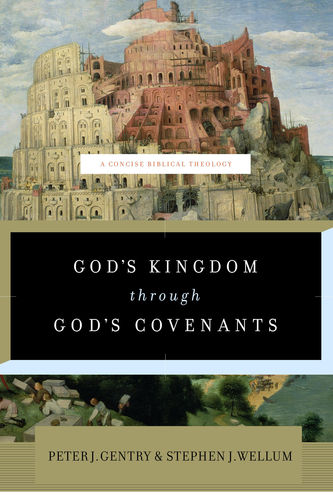
ktcIn the opening pages of their “concise biblical theology,” God’s Kingdom through God’s Covenants (GKTGC), Stephen Wellum and Peter Gentry lay out a description of typology that is worth considering. In what follows, I’ve synthesized their discussion into ten axioms. All of the quotations are from GKTGC; the references to other authors are found in their discussion (pp. 38–43). I’ve also taken the liberty comment and expand their thoughts in a few places.

1. Typology is not allegory.

This is an important distinction, one that is often confused. Wellum and Gentry write, “The major difference is that typology is grounded in history, the text, and intertextual development, where various ‘persons, events, and institutions’ are intended by God to correspond to each other, while allegory assumes none of these things.” Moreover, “‘allegorical interpretation’ depends on some kind of extratextual grid to warrant its explanation.” (38)

2. Typology is textual-historical.

Citing Richard Davidson,  Wellum and Gentry explain, “Typology is symbolism rooted in historical and textual realities.” But more than isolated (synchronic) symbols scattered in Scripture, biblical types (i.e., redemptive events explained by inspired Scripture) fit into a larger system of revelation. Richard Lints defines this when he says, “The typological relationship is a central means by which particular epochal and textual horizons are linked to later horizons in redemptive revelation.” (39) Continue reading

Let the Reader Understand: Interpretation That Sanctifies (1 Corinthians 10:1–13)

sermon photoTypology. Intertexuality. Biblical interpretation. Sanctification.

Those are esoteric subjects for a nerdy few, right? Well, I don’t think so. At least, according to 1 Corinthians 10, we see how the Apostle Paul cites ten different events in Israel’s history, which he says were written down for the church, as a means of instruction and sanctification.

In a section of 1 Corinthians where Paul continues to confront idolatry, Paul teaches us how to read the Bible and what ongoing purpose the Old Testament Scripture has for New Testament churches. You can listen to or read this week’s sermon. Below are discussion questions and resources for further study.  Continue reading

Israel and the Church: Continuity, Discontinuity, or Something of the Two?

haysIn his influential study on intertextuality, Echoes of Scripture in the Letters of PaulRichard Hays argues the apostle Paul’s hermeneutic is “functionally ecclesiocentric rather than christocentric” (xiii). In a series of essays, he shows how the apostle applies Old Testament texts to the New Testament church, and in so doing he questions the commonly held assumption that Paul wrote with a Christocentric approach to the Old Testament.

In comparison to the Gospels, especially Matthew and John, Hays shows that Paul is much more reticent to cite messianic prooftexts. Rather, writing to local churches who are comprised of the eschatological people of God (cf. 1 Corinthians 10:11), he applies the Old Testament scriptures semi-directly to the church. I say semi-directly, because the old covenant scriptures only apply through the mediation of Jesus Christ, a point Hays goes on to affirm: “christology is the foundation on which [Paul’s] ecclesiocentric counterreadings are constructed” (120).

For Hays, his aim is to observe the hermeneutical principles at work in Paul’s letters. My question is more systematic. What does Paul’s method of interpretation say to us about the relationship between Israel and the Church? Debates rage between Dispensationalists who make a clear division between Israel and the Church and Covenant Theologians who have ostensibly replaced Israel with the Church. Thankfully, these hard divisions have been revised in recent years—Progressive Dispensationalists see more continuity between Israel and the Church (even as they retain a unique place for Israel), and Covenant Theologians like Richard Gaffin and Anthony Hoekema have centered Old Testament promises in Jesus Christ and his new covenant people. Still, the debate continues: how should we relate the testaments? Continue reading

Beholding Christ at the Lord’s Table: Penal Substitution (Old Testament)

altarAnd can it be, that I should gain an interest in the Savior’s blood?
Died he for me, who caused his pain? For me, who him to death pursued?
Amazing love! How can it be that thou, my God, shouldst die for me!
— Charles Wesley, “And Can It Be That I Should Gain”

Substitution stands at the heart of cross—the innocent dying in place of the guilty, the righteous for the unrighteous, the sinless for the sinful. English hymnody is filled with this truth, because the Bible repeats the emphasis—Jesus Christ, sinless son of God, laid down his life in the place of his beloved. But hymnody is not the only place in Christian worship where Christ’s substitution is proclaimed; when we come to the Lord’s Table we also remember his death in our place.

In recent years, there has been no little debate about this truth. More than a few books have been penned arguing against penal substitution. Negatively, some have said penal substitution posits an angry, blood-thirsty God. Others, more constructively, argue that Christ came to defeat the powers and principalities (Christus Victor) and give a moral example of love in his death. To the latter, we can whole-heartedly affirm—Jesus did come to defeat the devil (1 John 3:8) and provide an example of holy love (1 Peter 2:21). But he did so by nailing his people’s sin to the cross, disarming the devil (Colossians 2:13–15) and providing an atonement for those who would imitate him (read the context of 1 Peter 2:21, esp. v. 24).

Therefore, to pit penal substitution against any other aspect of the cross obscures the necessity and beauty of Christ’s death in our place. In fact, it is by remembering Christ’s substitution that we rightly understand God’s love (1 John 4:8–10), and how a holy, triune God reconciles sinners to himself. Therefore, when we approach the Lord’s Table, we must remember see how the meal portrays his substitution.

Today, let us consider three Old Testament passages which teach penal substitution and which prepare our hearts to worship the Son of God who gladly took our sin on his shoulders and died in our place. Continue reading

Gospel-Centered Leadership: Using our Freedom in Christ to Serve Others and Discipline Ourselves (1 Corinthians 9:19–27)

obc-1 corinthiansThis week, we returned to the book of 1 Corinthians. After two messages on discipleship, one on the goodness of gender, and another on marriage, we picked up the theme of gospel-centered leadership. In 1 Corinthians 9 Paul uses himself as a model for self-effacing ministry, and in verses 19–27 he shows the great lengths he is willing to go in order to share the gospel.

First, he shows what true freedom is (v.19–22)—the willingness to lay down his life for others, just like Christ did for him. Next, he speaks of his own self-discipline that enables him to serve the Lord and share in the inheritance that the gospel offers (vv. 24–27). In the middle (v. 23), he says that he does everything for the gospel. This is both the culmination of his gospel-centered service and the reason why he disciplines himself.

You can find the audio here and Scripture references and discussion questions. Continue reading

Hearing the Voice of God: Ten Axioms About God’s Authorship of Scripture

bible“The fear of the Lord is the beginning of wisdom.”
– Proverbs 1:7 –

“The fear of the Author is the beginning of literary understanding”
– Kevin Vanhoozer[1]

This morning, I have the privilege of beginning a series of “studies” on hermeneutics and biblical interpretation among the men at my church. The title I’ve chosen is “Toward Doxology and Discipleship: Presuppositions and Principles for a Trinitarian Reading of Scripture.”

Influenced by the work of Kevin Vanhoozer, my aim is to lay out three presuppositions in the next three months concerning the three horizons of communications—author, text, and recipient(s). By taking a trinitarian approach—where we see the Father as speaker, the Son as the content of Scripture, and the Spirit as the One who enables people  to rightly receive understand God’s speech—can are ready to rightly read Scripture.

Only after this triad of communicative presuppositions, can we employ biblical principles that cohere with God’s inspired Word.  That’s the goal of the next three studies, where I hope to outline the three horizons of the biblical text to show how every interpreter of of the Bible must do justice to the textual, covenantal, and canonical horizons (so Edmund Clowney, Richard Lints, etc.). Only by reading texts with respect to grammar and history, covenantal or epochal placement in the Bible, and the final revelation of Christ in God’s canon can we fully appreciated all Scripture has to say to us, indeed what God is speaking to us even today (see Hebrews 3:7).

If you are interested, I’ve included my notes for this week and listed below my ten concluding “axioms” that show the cash value of starting with the doctrine of God, and more specifically why bringing his Authorship to the forefront is imperative for good hermeneutics. If hermeneutics is “your thing,” or if it is not, I’d love your feedback. Continue reading

Transgenderism: But One Fruit on Individualism’s Pernicious Vine

bookIn recent days, the subject of gender and transgenderism have been the talk of our county and our church. Coming, therefore, at the perfect time is Vaughn Roberts little book TransgenderIn preparation for my sermon on the subject I read his book with great profit.
In less than 80 pages, Roberts, a British pastor who has himself grappled with same sex attraction, introduces the subject (ch. 1), sets out a biblical response through the framework of creation (ch. 3), fall (ch. 4), and rescue/redemption (ch. 5). He concludes with a chapter on wisdom (ch. 6), where he speaks to individuals and churches on how to lovingly and truthfully respond to our trans neighbors and family members. Still, the chapter that is most important in his book is chapter 2, titled “The iWorld.”

In this section, Roberts frames transgenderism against the backdrop of the Enlightenment and the (post)modernism turn towards the subject. In just a few pages he explains how a recent flurry of advocacy for an age-old condition, i.e., transgenderism (see Deuteronomy 22:5), stems from a Western world head-over-heels in love with the self.

Continue reading

Established by Creation: Nine Reasons for Biblical Complementarity


malefemaleIn Evangelical Feminism and Biblical Truth (EFBT) Wayne Grudem is at his complementarian finest as he explains from Genesis why God created men and women equal yet distinct. While egalitarians argue the fall caused gender distinctions and that Christ’s redemption erased them (as explained in their reading of Galatians 3:28), Grudem shows how God created men and women with beautiful distinction from the beginning.

What follows are a synopsis of his points from Evangelical Feminism and Biblical Truth, pp. 30–42. For reasons explained here, I have left off his argument for gender distinction based upon trinitarian analogy. That theological argument is not necessary for making the claim that God created men and women equal, yet different. Therefore, I list Grudem’s nine biblical arguments for biblical complementarity. Continue reading