The Crack in the Cosmos: Letting the Light of John 8:12–59 Expose the Divide in Humanity

brown and green grass field during sunset

31 So Jesus said to the Jews who had believed him,
“If you abide in my word, you are truly my disciples,
32 and you will know the truth, and the truth will set you free.”
— John 8:31–32 —

 I don’t know about you, but when I read lengthy dialogues in Scripture, especially in the Gospels, I find them hard to follow until I have a sense of structure of the argument. In John 8, this has been especially true. After Jesus announces that he is the light of the world (v. 12), his opponents (Pharisees in v. 13 and Jews in vv. 22, 31, 48, 52, 57) object, question, and reject his statements. Yet, this massive disputation is a jumble of back and forth, until you begin to see the order of the court.

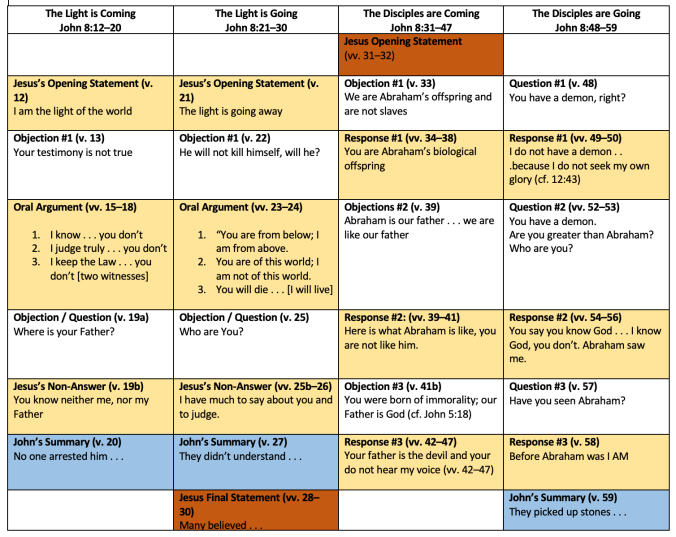
As many commentators have observed, John’s Gospel has many elements of a trial in it. And if the whole book is a court case written to show that Jesus is the Son of God (John 20:31), it should not surprise us to find witnesses, evidence, and other elements of a law court. Indeed, that is how I take John 8:12–59, and in the outline included here, I offer a court case in two parallel parts.
Screen Shot 2022-06-30 at 12.48.41 PM

From this outline, let’s consider a couple things.

The Legal Brief in John 8

First, there is, in John 8:12–30, two arguments that run in parallel. This parallel is found in the order of the speech and the shape of the argumentation. Compare verses 12–19 and 20–27. In these two sections, we find Jesus making an opening statement in each. Remarkably these statements should be read together, and give us a sense of what the first trial is addressing. In verse 12, Jesus announces that he is the light coming into the world, and in verse 20 he says that he (the Light of the World) will be departing. Commiserate with so much in John, this trial is about Jesus and the light he brings.

Importantly, Jesus’s statement are met with hostile unbelief, expressed in two objections—one long, one short. This is how the trial proceeds until, in verses 28–30, Jesus points to his coming cross, when he will be lifted up. As verse 30 indicates, many believed in him, even though moments earlier (v. 27), they didn’t understand. So clearly, this faith lacks understanding, which Jesus will proceed to show as false.

Stopping here in the middle of the chapter, notice how this response of faith is the turning point of the chapter. Quite possibly, the faith of his hearers is based upon the hope that Jesus “lifting up” would be an exaltation to glory, which they might enjoy too. What Jesus has in mind with respect to his lifting up, however, is his coming crucifixion. But these disciples do not understand that (v. 27), they simply believe in Jesus for other purposes. This is a warning to us today and to any who believe in Jesus for their own reasons, not his.

In the context of John, we will see that the people of Israel were seekers of glory, and it seems Jesus’s words of lifting up could have invited such a misplaced faith. Accordingly, this is where the next section begins, as it moves to reveal the darkness of Jesus questioners. Like before, the second section has another mirrored debate, a legal dispute in two parts.

Verses 31–32 begins with another opening statement, but this time Jesus’s statement covers the two parts of the trial. As to the content of his statement, Jesus tells his would-be followers how they prove themselves them true. If they remain in his word, they will have life eternal, but if they refuse him and his words, they are false, darkened, and spiritually dead. Tragically, this is what the chapter proves.

Let’s following the argument in order. First, in vv. 31–47, the Jews ask three questions, to which Jesus responds three times. And in that legal debate, Jesus splits the difference between biological seeds of Abraham (which these Jews are) from spiritual heirs of Abraham (which these Jews are not). The result of this distinction is Jesus’s famous and forceful declaration that these “believers” are actually children of the devil. “You are of your father the devil, and your will is to do your father’s desires” (v. 44a).

Next, these devilish sons of Abraham accuse Jesus of demonic activity and Samaritan origins (v. 48), even as they reject his self-identification with Abraham. Again, this legal debate turns on three questions, followed by three responses from Jesus. Ironically, once identified with the devil, these interlocuters do the work of the accuser, questioning Jesus, his identity, and his eternity (i.e., his ancient knowledge of Abraham). But in context, all they do by questioning Jesus is to show their own spiritual ignorance and lifeless religion.

Consequently, when they pick up stones to throw at Jesus, a symbol that the trial has moved from deliberation to execution, John reveals that these accusers of Jesus are the ones who stand condemned by God. They do not know God and this is evident in the fact that they cannot recognize God’s Son. Accordingly, the chapter closes not with a guilty verdict for Jesus, but a guilty verdict for his legal opponents.

All in all, John uses a tight literary structure to lead the reader to see what he is doing. And more, he reveals who Jesus is by contrasting him with those who accuse him. Jesus is the light of the world who will be extinguished on the cross, so that in the light of his resurrection, all who truly believe in him will be saved. Yet, such faith does not come from the selfish will of men who want to glorify themselves by Jesus. Saving faith comes to those who are truly heirs of Abraham, sheep who hear Jesus voice, and children born of God.

John 8 and the Crack in the Cosmos

The division between biological seeds and spiritual heirs is a division, a crack in the cosmos, that ranges across the whole of humanity. And in John, this spiritual division between two kinds of people is seen by paying attention to the trial. In questioning and condemning Jesus, the Jewish leaders show themselves to be men of darkness. By contrast, those who abide in the words of Christ will walk in the light, as he is in the light, because God gives light to those who are children of light.

Again, this spiritual division is what we face in every conflict—whether familial, ecclesial, societal, legal, or political. As Jesus teaches, there are two kinds of people in the world. And as John 8, the sides are determined by God and detected by how one responds to the Son. Ultimately, John 8 reveals much about who Jesus is, but it also reveals much about who we are.

With that realization in mind, let us seek God’s mercy and pray for his light to lead us to Christ. Jesus is the light of the world, and if you rejoice in his light, he will reveal to you his truth, and his truth alone will set you free. Just as he says in John 8:31–32.

Soli Deo Gloria, ds

Photo by Jonathan Petersson on Pexels.com

The Sharp Edges of God’s Sovereign Salvation: 9 Truths about the Doctrine of Election

black and white silhouette of christ the redeemer

A number of years ago, I preached a sermon Titus 1:1. In that passage, Paul says, he is “an apostle Jesus Christ, for the sake of the faith of God’s elect and their knowledge of the truth.” In that sermon it would be impossible and unfaithful to ignore the word “elect” (eklekton) and the way in which Paul labored for the faith of the elect.

And yet, despite the clear presence of the word in the text and its relationship to faith, truth, and Paul’s gospel ministry, my exposition initiated a cascade of events that resulted in my eventual resignation from my pastoral office. Such is the antagonism against the doctrine of election, which has often been flown under the banner of Calvinism.

In more recent days, I preached a series of messages from John 6, a passage that also touches the doctrine of election. And in these messages, preached in a church where the doctrines of grace are not eschewed but embraced, I was able to show from Scripture what Jesus says about God’s sovereignty in salvation.

In what follows, I want to bullet point some of the key truths uncovered in John 6 with respect to the doctrine of election. In many other articles, I have written how evangelism and election relate, what Scripture says about election, and what hyper-Calvinism really is. In this article, however, I want to stick to Jesus’s words in John 6—a passage where our Lord teaches about the ways God brings salvation to his elect, while passing over others.

Admittedly, this passage is a hard saying (v. 60) and election is a hard doctrine, but it is a true doctrine and one worth pondering. So, with the goal of understanding what Jesus says in John 6, let me offer nine truths about the doctrine of election.

Nine Truths about the Doctrine of Election

Before getting into the text, here is an outline of the nine points. Because what follows is rather long, you might consider picking which point is most interesting (or troubling) and starting there.

  1. Election depends on the God who selects, not mankind who seeks.
  2. Election is ordained in eternity and revealed in time.
  3. Election in time mirrors God’s election in eternity.
  4. God’s election results in faith, not the reverse.
  5. Election does not deny the universal offer of Christ; it secures a positive response.
  6. Election depends on the will of God, not the will of man.
  7. The election of God’s people ensures that he will bring the gospel to them.
  8. Election directs Jesus’s ministry, and ours.
  9. Election is for the glory of God, not the glory of man.

Continue reading

Blessed are the Un-Offended: For They are the Elect of God (John 6:60–71)

john03

Blessed are the Un-Offended: For They are the Elect of God (John 6:60–71)

Blessed is he who is not offended by me.
— Matthew 11:6 —

These are the words Jesus spoke to John the Baptist, when John sent his disciples to Jesus asking this question: Are you the one who is to come, or shall we look for another?

If you have never considered the pain of John’s words, it is worth time to ponder.

In John’s Gospel, John the Baptist is introduced as a faithful witness to Christ—a witness who so longed for the kingdom of God that he is willing to lose his kingdom. In John 3:30 he says, “He must increase, but I must decrease.” These are the words John declared, when his disciples came asking him about Jesus and the fact that more people were following him.

With humble faith, John accepted his role as a friend of the bridegroom and thus when the groom arrived, John rightly and righteously slipped out of the way. In fact, after John 3 the Baptist is not heard from again in John’s Gospel.

Nevertheless, this does not mean we do not know the rest of the story. Because we do! In Matthew 14, Mark 6, and Luke 9, we have the report that John was beheaded by Herod the tetrarch after his wife’s daughter requested decapitation as a party trick.

Yet, before his execution, Matthew 11 records the words that John sent to Jesus, as the forerunner to the Lord lay imprisoned, awaiting his deliverance or his death. And why does John ask his question about who he is? Is it because John doesn’t know Jesus, or believe him to be the Son of God? No, it is because things are not going as John anticipated! Continue reading

The Doctrine of Illumination in John’s Gospel

sunray through trees

It is the Spirit who gives life; the flesh is no help at all. The words that I have spoken to you are spirit and life. 64 But there are some of you who do not believe.” (For Jesus knew from the beginning who those were who did not believe, and who it was who would betray him.)
— John 6:63–64 —

The doctrine of illumination explains how spiritual insight is given to God’s children by the Holy Spirit. The locus classicus for this doctrine is 1 Corinthians 2:10–16, where the Apostle Paul explains the difference between those with the Spirit and those without. Describing this difference, he identifies two kinds of people—the natural man (i.e., the man without the Spirit) and the spiritual man (i.e., the man with the gift of the Spirit). In Paul’s thinking, there is no third category. The only way a man can rightly understand the mind of God is to have God himself reveal himself to the man. This occurs first in conversion, but then progressively in sanctification as the Spirit continues to instruct the saints through God’s Word (cf. John 17:17).

Going further, doctrine of illumination is the personal and subjective complement to the doctrine of inspiration. Whereas the Spirit inspired the words of the biblical authors (2 Pet. 1:19–21), the same Spirit must give light to the Scripture, in order for the child of God to understand God, his world, and his salvation. Without this illumination, the sinner remains in the dark—totally lost and wholly unable to find God (cf. Acts 17:27). Continue reading

Election and Evangelism: What God Has Joined Together Let Not Man Separate

brown rock formation on sea shore

On Sunday, our church considered one of many passages in John where the Beloved Disciple unites God’s sovereignty in salvation with the responsibility of man to repent and believe. With perfect, Spirit-inspired balance, John records the way God gave a particular people to the Son (i.e., the elect) and how these people will come to faith, as God calls all men and women to repent and believe. Indeed, what God has joined together—his sovereignty and man’s faith—cannot be torn apart without doing damage to the doctrine of election and the duty of evangelism.

For those familiar with the debates surrounding the doctrine of salvation, one of the longstanding charges against the doctrines of grace (Calvinism, if you prefer) is that the doctrine of election undermines evangelism and missions. Sadly, there have been some who have defended the doctrine of election without possessing an equal passion for the lost (i.e., Hyper-Calvinists, which means more than Calvinists with zeal). But biblically, election is one of the greatest motivations for evangelism.

This is evident in John’s Gospel and throughout the rest of the New Testament. And in what follows I want to highlight the connection between evangelism and election. In particular, I will show seven places, starting with John 6, where election is found in the same context as evangelism. Rather than hindering the gospel ministry, these passages teaches that the doctrine of election always spurs on missions and evangelism. Continue reading

Seeing New Creation Light in John 2–4: Three Ways Jesus Replaces the Darkness of the Old Covenant

brown and green grass field during sunset

A few weeks ago I offered a literary analysis of John 2–4. Today, I’ll add a few more thoughts on this remarkable passage.

In John 2–4, Marriage and Resurrection Go Together in Sign and Substance

First, there is an undeniable inclusio that connects Jesus’s first sign (turning water into wine) in John 2:1–12 to his second sign (healing the royal official’s son) in John 4:47–54. Observing the connections between these two bookends, Jim Hamilton finds 6 connections, to show how John mirrors these two events. Here is how he frames it (John, 101).

  • A need is communicated to Jesus (4:47; cf. 2:3),
  • but he initially rebuffs the petitioner (4:48; cf. 2:4).
  • When the petitioner responds in faith (4:49; cf. 2:5),
  • Jesus gives a command that is obeyed (4:50; cf. 2:7-8),
  • at which point the need is met (4:51-52; cf. 2:9-10).
  • These are then identified as the first and second signs, in response to which people believe in Jesus (4:53-54; cf. 2:11).

To this we could add the observation that the wedding takes place on the third day (John 2:1), as does the healing of the official’s son—i.e., it occurs on the day after the second day (4:40, 43).

From these seven links in the text, it would be a failure to “hear” John if we did not read them together. And what happens when we let the wine interpret the healing and vice versa? My short answer is that the themes of the wedding and its wine, combined with the resurrection of the son, are make a theological claim that the resurrection of the Son is what brings the wine of God’s new creation marriage. Continue reading

Was Jesus Among the Larpers? How Reading John 4 with Genesis 29 Helps Us Understand Biblical Typology and Jesus’s Identity

gabriel-rissi-MrdSyMik4ao-unsplash

Well, Well, Well, Look What We Have Hear: A Marriage, A Mountain, and a Messiah (pt. 1) — A Sermon on John 4:1–18

In John’s Gospel we learn that Jesus is the Word made flesh (1:14), the Only Begotten God (1:18), the Lamb of God who takes away the sin of the world (1:19), and the one to whom all the Law and Prophets wrote (1:45). But did you also know that Jesus was also a Larper? Not a leper, mind you, but Larper—a Live Action Role Player.

As best I could find online, Larping is a type of game where a group of people wear costumes representing a character they create to participate in an agreed [upon] fantasy world. Most recently, Larping gained attention in the Marvel Comic series Hawkeye, but it’s been around a lot longer than that. If you need an example of what Larping looks like up close, just go to a Medieval festival near you, and you will surely find a group of Live Action Role Players.

Now, if you don’t want to go to a Medieval Festival to see LARP-ing, you could also read John 4. In this famous chapter, where Jesus confronts the woman at the well, the Lord assumes the role of particular character from the world of the Patriarchs. Indeed, as John tells it, Jesus is a man (or “bridegroom,” see John 3:29) who meets a woman at a well, who will in time, become his bride. Let’s consider how this works. Continue reading

Doctrine and Life: Let Us Not Divorce What God Has Joined Together

jonathan-simcoe-pSjwUXBMnlc-unsplashKeep a close watch on yourself and on the teaching [doctrine].
Persist in this, for by so doing you will save both yourself and your hearers.
— 1 Timothy 4:16 —

Doctrine and life. Life and doctrine.

In Paul’s first letter to Timothy, he calls his pastoral protegé to embrace both and not let go of the other. And for anyone who cares about life or doctrine, we must also care about the other also. For doctrine without life is dead and life without sound doctrine is leading to death.

In truth, when doing theology, if it does not lead someone to the giver of life, it is dead theology. But simultaneously, life that downplays doctrine is equally deadly. This is why Paul repeatedly refers to sound doctrine in his Pastoral Epistles. He knows that sound (lit. healthy) doctrine does not give life; the Spirit of God does. But anyone born of the Spirit needs to know and grow in the life-giving doctrines of God. This is why he says that by paying attention to doctrine, “you will save both yourself and your hearers.”

Simultaneously, because he knows that knowledge by itself can puff up (1 Cor. 8:1), and that not all studies in the Law are lawful (1 Tim. 1:3–11), he calls for Timothy to guard his life and his doctrine. Too many are the knowledgable theologians who did not guard their lives. And too many are the false professors who have general sense of theology but no life. Thus, we must always pursue doctrine for the sake of knowing the life-giving God. To expound this idea further, let me turn to two theologians who knew both doctrine and life. Continue reading

Brother-Theologians: Preach the Word!

samuel-zeller-432101A few years ago I wrote this article on David Prince’s website. As I go to teach Systematic Theology 1 this week, I am reminded of it, and the need for theologians to be preachers.
In theology, we are not just called to study and store up knowledge of truth. We are called to study to show ourselves approved so that we may preach—or teach, or write, or counsel, or anything else that qualifies as heralding the good news—sound doctrine. To that point, I repost this article, in hopes that God may continue to raise up men sound in doctrine who will preach the Word.

*********

When I came to seminary, I wanted to study the Bible and theology. Having never “preached” a Sunday morning message, I was uncertain as to the role preaching would have in my life. Ten years later, through a combination of providential opportunities and willingness to preach whenever I was asked, I have finished my theological education  (Yes, it took a decade!) and have preached more Sundays than not.

For nearly five years I have filled the pulpit at my current church—first as a supply preacher, then an interim pastor, and last as the senior pastor. In the lustrum before serving at our church, I like so many of my seminary peers preached in nursing homes, urban missions, country parishes. It was a wonderfully painful time, one where precious little flocks like Corn Creek Baptist Church endured my preaching and helped me learn how to preach.

During that time, preaching was a priority, but so was theology. By training, I am a systematic theologian, or at least, that’s what my degree says. Therefore, as a pastor and a theologian, I feel a measure of familiarity with both vocations. And I feel a fraternal affection and responsibility to exhort aspiring theologians with what Paul commanded Timothy: Preach the Word! Continue reading

Reading for Scripture Saturation: Renewing the Via Emmaus Bible Reading Plan in 2022

Jesus washing the feet of Saint Peter on Maundy Thursday

How can a young man keep his way pure? By guarding it according to your word.
10  With my whole heart I seek you; let me not wander from your commandments!

11  I have stored up your word in my heart, that I might not sin against you.
12  Blessed are you, O Lord;
teach me your statutes!
— Psalm 119:9–12 —

With 2021 ending and 2022 approaching, you may be thinking about how to read the Bible in the new year. I hope so. The Word of God is not a trifle; it is our very life (Deut. 32:47). Man does not live on bread alone, but on every word that proceeds from the mouth of God (Deut. 8:3; Matt. 4:4). With that in mind, we should aim to read the Bible and to read it often!

Truly, the Bible is not a book to read once, or even once a year. It is meant to be imbibed and inhabited, adored and adorned, studied and savored. Mastery of the Bible does not mean comprehensive understanding of Scripture; it means ever-increasing submission to the Master who speaks in Scripture. This is why in the closing days of the year, it’s good to consider how we can saturate ourselves with Scripture in the next year.

Personally though, I wonder if our daily reading plans help us with this idea of Scripture saturation. Often, such plans call for reading single chapters from various parts of the Bible. And the daily routine can invite checking the box without understanding the book. So my question has been: Does such reading help us or hinder us in our Bible consumption and consumption? Continue reading