2 So put away all malice and all deceit and hypocrisy and envy and all slander. 2 Like newborn infants, long for the pure spiritual milk, that by it you may grow up into salvation— 3 if indeed you have tasted that the Lord is good.
4 As you come to him, a living stone rejected by men but in the sight of God chosen and precious, 5 you yourselves like living stones are being built up as a spiritual house, to be a holy priesthood, to offer spiritual sacrifices acceptable to God through Jesus Christ. 6 For it stands in Scripture:
“Behold, I am laying in Zion a stone,
a cornerstone chosen and precious,
and whoever believes in him will not be put to shame.”
7 So the honor is for you who believe, but for those who do not believe,
“The stone that the builders rejected
has become the cornerstone,”
8 and
“A stone of stumbling,
and a rock of offense.”
They stumble because they disobey the word, as they were destined to do.
9 But you are a chosen race, a royal priesthood, a holy nation, a people for his own possession, that you may proclaim the excellencies of him who called you out of darkness into his marvelous light. 10 Once you were not a people, but now you are God’s people; once you had not received mercy, but now you have received mercy.
11 Beloved, I urge you as sojourners and exiles to abstain from the passions of the flesh, which wage war against your soul. 12 Keep your conduct among the Gentiles honorable, so that when they speak against you as evildoers, they may see your good deeds and glorify God on the day of visitation.
Submission to Authority
13 Be subject for the Lord’s sake to every human institution, whether it be to the emperor as supreme, 14 or to governors as sent by him to punish those who do evil and to praise those who do good. 15 For this is the will of God, that by doing good you should put to silence the ignorance of foolish people. 16 Live as people who are free, not using your freedom as a cover-up for evil, but living as servants of God. 17 Honor everyone. Love the brotherhood. Fear God. Honor the emperor.
18 Servants, be subject to your masters with all respect, not only to the good and gentle but also to the unjust. 19 For this is a gracious thing, when, mindful of God, one endures sorrows while suffering unjustly. 20 For what credit is it if, when you sin and are beaten for it, you endure? But if when you do good and suffer for it you endure, this is a gracious thing in the sight of God. 21 For to this you have been called, because Christ also suffered for you, leaving you an example, so that you might follow in his steps. 22 He committed no sin, neither was deceit found in his mouth. 23 When he was reviled, he did not revile in return; when he suffered, he did not threaten, but continued entrusting himself to him who judges justly. 24 He himself bore our sins in his body on the tree, that we might die to sin and live to righteousness. By his wounds you have been healed. 25 For you were straying like sheep, but have now returned to the Shepherd and Overseer of your souls.
Working together with him, then, we appeal to you not to receive the grace of God in vain. 2 For he says,
“In a favorable time I listened to you,
and in a day of salvation I have helped you.”
Behold, now is the favorable time; behold, now is the day of salvation. 3 We put no obstacle in anyone’s way, so that no fault may be found with our ministry, 4 but as servants of God we commend ourselves in every way: by great endurance, in afflictions, hardships, calamities, 5 beatings, imprisonments, riots, labors, sleepless nights, hunger; 6 by purity, knowledge, patience, kindness, the Holy Spirit, genuine love; 7 by truthful speech, and the power of God; with the weapons of righteousness for the right hand and for the left; 8 through honor and dishonor, through slander and praise. We are treated as impostors, and yet are true; 9 as unknown, and yet well known; as dying, and behold, we live; as punished, and yet not killed; 10 as sorrowful, yet always rejoicing; as poor, yet making many rich; as having nothing, yet possessing everything.
11 We have spoken freely to you, Corinthians; our heart is wide open. 12 You are not restricted by us, but you are restricted in your own affections. 13 In return (I speak as to children) widen your hearts also.
The Temple of the Living God
14 Do not be unequally yoked with unbelievers. For what partnership has righteousness with lawlessness? Or what fellowship has light with darkness? 15 What accord has Christ with Belial? Or what portion does a believer share with an unbeliever? 16 What agreement has the temple of God with idols? For we are the temple of the living God; as God said,
“I will make my dwelling among them and walk among them,
6 When one of you has a grievance against another, does he dare go to law before the unrighteous instead of the saints? 2 Or do you not know that the saints will judge the world? And if the world is to be judged by you, are you incompetent to try trivial cases? 3 Do you not know that we are to judge angels? How much more, then, matters pertaining to this life! 4 So if you have such cases, why do you lay them before those who have no standing in the church? 5 I say this to your shame. Can it be that there is no one among you wise enough to settle a dispute between the brothers, 6 but brother goes to law against brother, and that before unbelievers? 7 To have lawsuits at all with one another is already a defeat for you. Why not rather suffer wrong? Why not rather be defrauded? 8 But you yourselves wrong and defraud—even your own brothers!
9 Or do you not know that the unrighteous will not inherit the kingdom of God? Do not be deceived: neither the sexually immoral, nor idolaters, nor adulterers, nor men who practice homosexuality, 10 nor thieves, nor the greedy, nor drunkards, nor revilers, nor swindlers will inherit the kingdom of God. 11 And such were some of you. But you were washed, you were sanctified, you were justified in the name of the Lord Jesus Christ and by the Spirit of our God.
Flee Sexual Immorality
12 “All things are lawful for me,” but not all things are helpful. “All things are lawful for me,” but I will not be dominated by anything. 13 “Food is meant for the stomach and the stomach for food”—and God will destroy both one and the other. The body is not meant for sexual immorality, but for the Lord, and the Lord for the body. 14 And God raised the Lord and will also raise us up by his power. 15 Do you not know that your bodies are members of Christ? Shall I then take the members of Christ and make them members of a prostitute? Never! 16 Or do you not know that he who is joined to a prostitute becomes one body with her? For, as it is written, “The two will become one flesh.” 17 But he who is joined to the Lord becomes one spirit with him. 18 Flee from sexual immorality. Every other sin a person commits is outside the body, but the sexually immoral person sins against his own body. 19 Or do you not know that your body is a temple of the Holy Spirit within you, whom you have from God? You are not your own, 20 for you were bought with a price. So glorify God in your body.
3 But I, brothers, could not address you as spiritual people, but as people of the flesh, as infants in Christ. 2 I fed you with milk, not solid food, for you were not ready for it. And even now you are not yet ready, 3 for you are still of the flesh. For while there is jealousy and strife among you, are you not of the flesh and behaving only in a human way? 4 For when one says, “I follow Paul,” and another, “I follow Apollos,” are you not being merely human?
5 What then is Apollos? What is Paul? Servants through whom you believed, as the Lord assigned to each. 6 I planted, Apollos watered, but God gave the growth. 7 So neither he who plants nor he who waters is anything, but only God who gives the growth. 8 He who plants and he who waters are one, and each will receive his wages according to his labor. 9 For we are God’s fellow workers. You are God’s field, God’s building.
10 According to the grace of God given to me, like a skilled master builder I laid a foundation, and someone else is building upon it. Let each one take care how he builds upon it. 11 For no one can lay a foundation other than that which is laid, which is Jesus Christ. 12 Now if anyone builds on the foundation with gold, silver, precious stones, wood, hay, straw— 13 each one’s work will become manifest, for the Day will disclose it, because it will be revealed by fire, and the fire will test what sort of work each one has done. 14 If the work that anyone has built on the foundation survives, he will receive a reward. 15 If anyone’s work is burned up, he will suffer loss, though he himself will be saved, but only as through fire.
16 Do you not know that you are God’s temple and that God’s Spirit dwells in you? 17 If anyone destroys God’s temple, God will destroy him. For God’s temple is holy, and you are that temple.
18 Let no one deceive himself. If anyone among you thinks that he is wise in this age, let him become a fool that he may become wise. 19 For the wisdom of this world is folly with God. For it is written, “He catches the wise in their craftiness,” 20 and again, “The Lord knows the thoughts of the wise, that they are futile.” 21 So let no one boast in men. For all things are yours, 22 whether Paul or Apollos or Cephas or the world or life or death or the present or the future—all are yours, 23 and you are Christ’s, and Christ is God’s.
7 And the high priest said, “Are these things so?” 2 And Stephen said:
“Brothers and fathers, hear me. The God of glory appeared to our father Abraham when he was in Mesopotamia, before he lived in Haran, 3 and said to him, ‘Go out from your land and from your kindred and go into the land that I will show you.’ 4 Then he went out from the land of the Chaldeans and lived in Haran. And after his father died, God removed him from there into this land in which you are now living. 5 Yet he gave him no inheritance in it, not even a foot’s length, but promised to give it to him as a possession and to his offspring after him, though he had no child. 6 And God spoke to this effect—that his offspring would be sojourners in a land belonging to others, who would enslave them and afflict them four hundred years. 7 ‘But I will judge the nation that they serve,’ said God, ‘and after that they shall come out and worship me in this place.’ 8 And he gave him the covenant of circumcision. And so Abraham became the father of Isaac, and circumcised him on the eighth day, and Isaac became the father of Jacob, and Jacob of the twelve patriarchs.
9 “And the patriarchs, jealous of Joseph, sold him into Egypt; but God was with him 10 and rescued him out of all his afflictions and gave him favor and wisdom before Pharaoh, king of Egypt, who made him ruler over Egypt and over all his household. 11 Now there came a famine throughout all Egypt and Canaan, and great affliction, and our fathers could find no food. 12 But when Jacob heard that there was grain in Egypt, he sent out our fathers on their first visit. 13 And on the second visit Joseph made himself known to his brothers, and Joseph’s family became known to Pharaoh. 14 And Joseph sent and summoned Jacob his father and all his kindred, seventy-five persons in all. 15 And Jacob went down into Egypt, and he died, he and our fathers, 16 and they were carried back to Shechem and laid in the tomb that Abraham had bought for a sum of silver from the sons of Hamor in Shechem.
17 “But as the time of the promise drew near, which God had granted to Abraham, the people increased and multiplied in Egypt 18 until there arose over Egypt another king who did not know Joseph. 19 He dealt shrewdly with our race and forced our fathers to expose their infants, so that they would not be kept alive. 20 At this time Moses was born; and he was beautiful in God’s sight. And he was brought up for three months in his father’s house, 21 and when he was exposed, Pharaoh’s daughter adopted him and brought him up as her own son. 22 And Moses was instructed in all the wisdom of the Egyptians, and he was mighty in his words and deeds.
23 “When he was forty years old, it came into his heart to visit his brothers, the children of Israel. 24 And seeing one of them being wronged, he defended the oppressed man and avenged him by striking down the Egyptian. 25 He supposed that his brothers would understand that God was giving them salvation by his hand, but they did not understand. 26 And on the following day he appeared to them as they were quarreling and tried to reconcile them, saying, ‘Men, you are brothers. Why do you wrong each other?’ 27 But the man who was wronging his neighbor thrust him aside, saying, ‘Who made you a ruler and a judge over us? 28 Do you want to kill me as you killed the Egyptian yesterday?’ 29 At this retort Moses fled and became an exile in the land of Midian, where he became the father of two sons.
30 “Now when forty years had passed, an angel appeared to him in the wilderness of Mount Sinai, in a flame of fire in a bush. 31 When Moses saw it, he was amazed at the sight, and as he drew near to look, there came the voice of the Lord: 32 ‘I am the God of your fathers, the God of Abraham and of Isaac and of Jacob.’ And Moses trembled and did not dare to look. 33 Then the Lord said to him, ‘Take off the sandals from your feet, for the place where you are standing is holy ground. 34 I have surely seen the affliction of my people who are in Egypt, and have heard their groaning, and I have come down to deliver them. And now come, I will send you to Egypt.’
35 “This Moses, whom they rejected, saying, ‘Who made you a ruler and a judge?’—this man God sent as both ruler and redeemer by the hand of the angel who appeared to him in the bush. 36 This man led them out, performing wonders and signs in Egypt and at the Red Sea and in the wilderness for forty years. 37 This is the Moses who said to the Israelites, ‘God will raise up for you a prophet like me from your brothers.’ 38 This is the one who was in the congregation in the wilderness with the angel who spoke to him at Mount Sinai, and with our fathers. He received living oracles to give to us. 39 Our fathers refused to obey him, but thrust him aside, and in their hearts they turned to Egypt, 40 saying to Aaron, ‘Make for us gods who will go before us. As for this Moses who led us out from the land of Egypt, we do not know what has become of him.’ 41 And they made a calf in those days, and offered a sacrifice to the idol and were rejoicing in the works of their hands. 42 But God turned away and gave them over to worship the host of heaven, as it is written in the book of the prophets:
“ ‘Did you bring to me slain beasts and sacrifices,
during the forty years in the wilderness, O house of Israel?
43 You took up the tent of Moloch
and the star of your god Rephan,
the images that you made to worship;
and I will send you into exile beyond Babylon.’ [Amos 5:25–27]
44 “Our fathers had the tent of witness in the wilderness, just as he who spoke to Moses directed him to make it, according to the pattern that he had seen. 45 Our fathers in turn brought it in with Joshua when they dispossessed the nations that God drove out before our fathers. So it was until the days of David, 46 who found favor in the sight of God and asked to find a dwelling place for the God of Jacob. 47 But it was Solomon who built a house for him. 48 Yet the Most High does not dwell in houses made by hands, as the prophet says,
49 “ ‘Heaven is my throne,
and the earth is my footstool.
What kind of house will you build for me, says the Lord,
or what is the place of my rest?
50 Did not my hand make all these things?’ [Isaiah 66:1–2]
51 “You stiff-necked people, uncircumcised in heart and ears, you always resist the Holy Spirit. As your fathers did, so do you. 52 Which of the prophets did your fathers not persecute? And they killed those who announced beforehand the coming of the Righteous One, whom you have now betrayed and murdered, 53 you who received the law as delivered by angels and did not keep it.”
The Stoning of Stephen
54 Now when they heard these things they were enraged, and they ground their teeth at him. 55 But he, full of the Holy Spirit, gazed into heaven and saw the glory of God, and Jesus standing at the right hand of God. 56 And he said, “Behold, I see the heavens opened, and the Son of Man standing at the right hand of God.” 57 But they cried out with a loud voice and stopped their ears and rushed together at him. 58 Then they cast him out of the city and stoned him. And the witnesses laid down their garments at the feet of a young man named Saul. 59 And as they were stoning Stephen, he called out, “Lord Jesus, receive my spirit.” 60 And falling to his knees he cried out with a loud voice, “Lord, do not hold this sin against them.” And when he had said this, he fell asleep.
[The earliest manuscripts do not include 7:53–8:11.]
The Woman Caught in Adultery
[[They went each to his own house,1 but Jesus went to the Mount of Olives. 2 Early in the morning he came again to the temple. All the people came to him, and he sat down and taught them. 3 The scribes and the Pharisees brought a woman who had been caught in adultery, and placing her in the midst 4 they said to him, “Teacher, this woman has been caught in the act of adultery. 5 Now in the Law, Moses commanded us to stone such women. So what do you say?” 6 This they said to test him, that they might have some charge to bring against him. Jesus bent down and wrote with his finger on the ground. 7 And as they continued to ask him, he stood up and said to them, “Let him who is without sin among you be the first to throw a stone at her.” 8 And once more he bent down and wrote on the ground. 9 But when they heard it, they went away one by one, beginning with the older ones, and Jesus was left alone with the woman standing before him. 10 Jesus stood up and said to her, “Woman, where are they? Has no one condemned you?” 11 She said, “No one, Lord.” And Jesus said, “Neither do I condemn you; go, and from now on sin no more.” ]]
I Am the Light of the World
12 Again Jesus spoke to them, saying, “I am the light of the world. Whoever follows me will not walk in darkness, but will have the light of life.” 13 So the Pharisees said to him, “You are bearing witness about yourself; your testimony is not true.” 14 Jesus answered, “Even if I do bear witness about myself, my testimony is true, for I know where I came from and where I am going, but you do not know where I come from or where I am going. 15 You judge according to the flesh; I judge no one. 16 Yet even if I do judge, my judgment is true, for it is not I alone who judge, but I and the Father who sent me. 17 In your Law it is written that the testimony of two people is true. 18 I am the one who bears witness about myself, and the Father who sent me bears witness about me.” 19 They said to him therefore, “Where is your Father?” Jesus answered, “You know neither me nor my Father. If you knew me, you would know my Father also.” 20 These words he spoke in the treasury, as he taught in the temple; but no one arrested him, because his hour had not yet come.
21 So he said to them again, “I am going away, and you will seek me, and you will die in your sin. Where I am going, you cannot come.” 22 So the Jews said, “Will he kill himself, since he says, ‘Where I am going, you cannot come’?” 23 He said to them, “You are from below; I am from above. You are of this world; I am not of this world. 24 I told you that you would die in your sins, for unless you believe that I am he you will die in your sins.” 25 So they said to him, “Who are you?” Jesus said to them, “Just what I have been telling you from the beginning. 26 I have much to say about you and much to judge, but he who sent me is true, and I declare to the world what I have heard from him.” 27 They did not understand that he had been speaking to them about the Father. 28 So Jesus said to them, “When you have lifted up the Son of Man, then you will know that I am he, and that I do nothing on my own authority, but speak just as the Father taught me. 29 And he who sent me is with me. He has not left me alone, for I always do the things that are pleasing to him.” 30 As he was saying these things, many believed in him.
The Truth Will Set You Free
31 So Jesus said to the Jews who had believed him, “If you abide in my word, you are truly my disciples, 32 and you will know the truth, and the truth will set you free.” 33 They answered him, “We are offspring of Abraham and have never been enslaved to anyone. How is it that you say, ‘You will become free’?”
34 Jesus answered them, “Truly, truly, I say to you, everyone who practices sin is a slave to sin. 35 The slave does not remain in the house forever; the son remains forever. 36 So if the Son sets you free, you will be free indeed. 37 I know that you are offspring of Abraham; yet you seek to kill me because my word finds no place in you. 38 I speak of what I have seen with my Father, and you do what you have heard from your father.”
You Are of Your Father the Devil
39 They answered him, “Abraham is our father.” Jesus said to them, “If you were Abraham’s children, you would be doing the works Abraham did, 40 but now you seek to kill me, a man who has told you the truth that I heard from God. This is not what Abraham did. 41 You are doing the works your father did.” They said to him, “We were not born of sexual immorality. We have one Father—even God.” 42 Jesus said to them, “If God were your Father, you would love me, for I came from God and I am here. I came not of my own accord, but he sent me. 43 Why do you not understand what I say? It is because you cannot bear to hear my word. 44 You are of your father the devil, and your will is to do your father’s desires. He was a murderer from the beginning, and does not stand in the truth, because there is no truth in him. When he lies, he speaks out of his own character, for he is a liar and the father of lies. 45 But because I tell the truth, you do not believe me. 46 Which one of you convicts me of sin? If I tell the truth, why do you not believe me? 47 Whoever is of God hears the words of God. The reason why you do not hear them is that you are not of God.”
Before Abraham Was, I Am
48 The Jews answered him, “Are we not right in saying that you are a Samaritan and have a demon?” 49 Jesus answered, “I do not have a demon, but I honor my Father, and you dishonor me. 50 Yet I do not seek my own glory; there is One who seeks it, and he is the judge. 51 Truly, truly, I say to you, if anyone keeps my word, he will never see death.” 52 The Jews said to him, “Now we know that you have a demon! Abraham died, as did the prophets, yet you say, ‘If anyone keeps my word, he will never taste death.’ 53 Are you greater than our father Abraham, who died? And the prophets died! Who do you make yourself out to be?” 54 Jesus answered, “If I glorify myself, my glory is nothing. It is my Father who glorifies me, of whom you say, ‘He is our God.’ 55 But you have not known him. I know him. If I were to say that I do not know him, I would be a liar like you, but I do know him and I keep his word. 56 Your father Abraham rejoiced that he would see my day. He saw it and was glad.” 57 So the Jews said to him, “You are not yet fifty years old, and have you seen Abraham?” 58 Jesus said to them, “Truly, truly, I say to you, before Abraham was, I am.” 59 So they picked up stones to throw at him, but Jesus hid himself and went out of the temple.
21 Jesus looked up and saw the rich putting their gifts into the offering box, 2 and he saw a poor widow put in two small copper coins. 3 And he said, “Truly, I tell you, this poor widow has put in more than all of them. 4 For they all contributed out of their abundance, but she out of her poverty put in all she had to live on.”
Jesus Foretells Destruction of the Temple
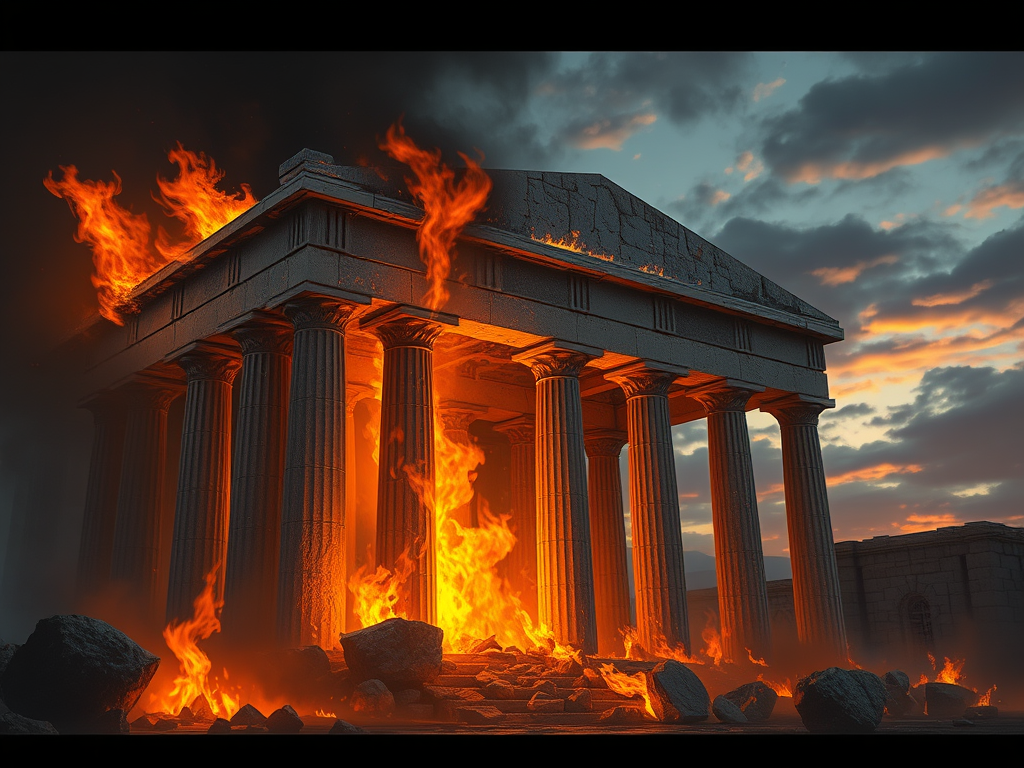
5 And while some were speaking of the temple, how it was adorned with noble stones and offerings, he said, 6 “As for these things that you see, the days will come when there will not be left here one stone upon another that will not be thrown down.” 7 And they asked him, “Teacher, when will these things be, and what will be the sign when these things are about to take place?” 8 And he said, “See that you are not led astray. For many will come in my name, saying, ‘I am he!’ and, ‘The time is at hand!’ Do not go after them. 9 And when you hear of wars and tumults, do not be terrified, for these things must first take place, but the end will not be at once.”
Jesus Foretells Wars and Persecution
10 Then he said to them, “Nation will rise against nation, and kingdom against kingdom. 11 There will be great earthquakes, and in various places famines and pestilences. And there will be terrors and great signs from heaven. 12 But before all this they will lay their hands on you and persecute you, delivering you up to the synagogues and prisons, and you will be brought before kings and governors for my name’s sake. 13 This will be your opportunity to bear witness. 14 Settle it therefore in your minds not to meditate beforehand how to answer, 15 for I will give you a mouth and wisdom, which none of your adversaries will be able to withstand or contradict. 16 You will be delivered up even by parents and brothers and relatives and friends, and some of you they will put to death. 17 You will be hated by all for my name’s sake. 18 But not a hair of your head will perish. 19 By your endurance you will gain your lives.
Jesus Foretells Destruction of Jerusalem
20 “But when you see Jerusalem surrounded by armies, then know that its desolation has come near. 21 Then let those who are in Judea flee to the mountains, and let those who are inside the city depart, and let not those who are out in the country enter it, 22 for these are days of vengeance, to fulfill all that is written. 23 Alas for women who are pregnant and for those who are nursing infants in those days! For there will be great distress upon the earth and wrath against this people. 24 They will fall by the edge of the sword and be led captive among all nations, and Jerusalem will be trampled underfoot by the Gentiles, until the times of the Gentiles are fulfilled.
The Coming of the Son of Man
25 “And there will be signs in sun and moon and stars, and on the earth distress of nations in perplexity because of the roaring of the sea and the waves, 26 people fainting with fear and with foreboding of what is coming on the world. For the powers of the heavens will be shaken. 27 And then they will see the Son of Man coming in a cloud with power and great glory. 28 Now when these things begin to take place, straighten up and raise your heads, because your redemption is drawing near.”
The Lesson of the Fig Tree
29 And he told them a parable: “Look at the fig tree, and all the trees. 30 As soon as they come out in leaf, you see for yourselves and know that the summer is already near. 31 So also, when you see these things taking place, you know that the kingdom of God is near. 32 Truly, I say to you, this generation will not pass away until all has taken place. 33 Heaven and earth will pass away, but my words will not pass away.
Watch Yourselves
34 “But watch yourselves lest your hearts be weighed down with dissipation and drunkenness and cares of this life, and that day come upon you suddenly like a trap. 35 For it will come upon all who dwell on the face of the whole earth. 36 But stay awake at all times, praying that you may have strength to escape all these things that are going to take place, and to stand before the Son of Man.”
37 And every day he was teaching in the temple, but at night he went out and lodged on the mount called Olivet. 38 And early in the morning all the people came to him in the temple to hear him.
Truly, truly, I say to you, he who does not enter the sheepfold by the door but climbs in by another way, that man is a thief and a robber. — John 10:1 —
In John 16:25, Jesus says to his disciples, “I have said these things to you in figures of speech [paroimia]. The hour is coming when I will no longer speak to you in figures of speech [paroimia] but will tell you plainly about the Father.” In that context, Jesus was speaking of his going away and the resulting sorrow his disciples would experience (John 16:16–24). In this exchange, Jesus’s disciples did not understand what he was saying (v. 18), and so verse 25 is a pivot in the conversation.
Starting here, Jesus begins to explain what his going away means—soon he is going to leave the world and return to the Father. It is unlikely, in that moment, that the disciples understood how this departure (his exodus) would take place (by means of a cross, resurrection, and ascension), but they say in v. 29, “Ah, now you are speaking plainly and not using figurative speech.”
Importantly, this word for “figure of speech” is used only one other time in John’s Gospel. In John 10:6, John narrates and says, “This figure of speech Jesus used with them, but they did not understand what he was saying to them.” Structurally, John 10:1–21 works very similarly to John 16:16–33. Jesus says something figuratively, i.e., in a figure of speech, which his audience does not understand (compare John 10:6 and John 16:18). Then, after acknowledging the confusion, Jesus speaks again more plainly. In John 16, the focus is on Jesus’s coming departure. In John 10, the focus is similar, as Jesus describes the way he will lead his sheep out of something.
But what is that something?
In John 10:3, Jesus speaks of an unidentified shepherd, “To him the gatekeeper opens. The sheep hear his voice, and he calls his own sheep by name and leads them out.” In these five verses, the place from which the sheep are led out is the “sheepfold.” As verse 1–2 indicate, the thief enters the sheepfold falsely (v. 1), but the true shepherd enters the sheepfold by means of the door (v. 2). This is the contrast that Jesus sets up in figure of speech, and it is repeated in verse 4–5, when he explains how sheep follow the true shepherd (v. 4) but not the stranger (v. 5). As John notes, this figure of speech is lost on Jesus audience. Continue reading →
When Jesus said “I have come not to abolish the Law, but to fulfill it” (Matthew 5:17), what did he mean? Specifically, what did he have in mind with respect to the Sabbath? Is the Fourth Commandment (Remember the Sabbath, to keep it holy”) an enduring command mutatis mutandis? That is, once we make the necessary changes to the day, the place of our worship, and the full revelation of God in Christ, do we keep this day? Or do we not?
This question has generated entire books and led to more than a few fissures in the Church? And one of many arguments for Sabbatarianism (i.e., the ongoing practice of the Fourth Commandment) is that the New Testament does not need to reissue a command for the Sabbath, if it is laid out plainly in the Old Testament. But what if the New Testament actually issues a command that stands against the Fourth Commandment? Is it possible that the New Testament doesn’t reissue a command for the Sabbath, because there are places where it abrogates the old covenant system of Sabbath?
In answer to that question, one may think of Colossians 2:16–17 or Romans 14:5, or even Matthew 5:17. If Jesus fulfills the Sabbath in himself (see Matthew 11:28), then does that bring the old covenant practice to an end? This is where my reading of Scripture, informed by the likes of Steve Wellum and Thomas Schreiner leads, but recently I have found another passage that confirms this reading—one that I have not seen elsewhere. And so, I offer this reflection on John 5:1–18 and its copious use of Jeremiah 17:1–29, a passage that bears directly on the Sabbath. Continue reading →
When John Calvin returned to Geneva, after being exiled from the city for three years, he picked up right where he left off. Rather than preaching some preacher-centered ‘I’m Back” message, he simply preached the next verse in the Bible. So great was Calvin’s commitment to verse-by-verse exposition, he made no fanfare for his return to the pulpit. Rather, he preached the next verse in the text and pointed people to Christ.
This week, our church did something similar. In March 2020, we were forced to stop gathering for two months. And though we continued to preach the Bible (online at first and soon after together), we moved from John to Psalms and Joel and other scriptures. In leaving John, we always planned to come back, and by God’s grace we were able to do that on Sunday.
Picking up where we left off, we overviewed John 1–2 to remember what those chapters said. In seven portraits from those two chapters, we saw a beautiful picture of Christ. And in return, we learned two important things about ourselves. You can find those nine truths in this sermon: Getting Back Into the Gospel of John. You can also find our earlier sermons here, plus other resources on John’s Gospel.
May the Lord bless this series and permit us to continue to study the Gospel of John.





 When Jesus said “I have come not to abolish the Law, but to fulfill it” (Matthew 5:17), what did he mean? Specifically, what did he have in mind with respect to the Sabbath? Is the Fourth Commandment (Remember the Sabbath, to keep it holy”) an enduring command mutatis mutandis? That is, once we make the necessary changes to the day, the place of our worship, and the full revelation of God in Christ, do we keep this day? Or do we not?
 When John Calvin returned to Geneva, after being exiled from the city for three years, he picked up right where he left off. Rather than preaching some preacher-centered ‘I’m Back” message, he simply preached the next verse in the Bible. So great was Calvin’s commitment to verse-by-verse exposition, he made no fanfare for his return to the pulpit. Rather, he preached the next verse in the text and pointed people to Christ.
 Via Emmaus