Guard the Flock and Contend for the Faith: An Introduction to 2 Peter and Jude

This summer, when the Southern Baptist Convention met in Indianapolis, Daily Wire reporter, Megan Basham, spoke to a packed room of 1000 people. In her speech, which you can now find online, she revealed various ways that pastors, churches, and other ministries have been targeted by well-funded political activists.

More recently, Megan’s book, Shepherds for Sale: How Evangelical Leaders Traded the Truth for a Leftist Agenda, became a New York Times Bestseller, as it uncovers multiple instances of evangelicals compromising their Christian commitment to the truth to have a place at the world’s table.

In eight chapters, she highlights how false teaching has been brought into the church. These issues include making climate change a Christian mission, opening borders to permit illegal immigration, diluting the pro-life movement, hijacking Christian media, employing the church to promote COVID protocols, preaching Critical Race Theory, refusing to call homosexuality a sin, and weaponizing the claims of sexual abuse.

Sadly, these eight subjects are not just matters that we find outside the church. All too often, they have been brought into the church, and they have been brought into the church by otherwise faithful pastors. Megan’s book highlights these compromises, documents their sources, and calls on faithful Christians to stand against these progressive trends.

Not surprisingly, her book has book has received a great deal of pushback. Yet, what is surprising is how evangelical leaders, including popular authors and one former SBC president, instead of admitting errors have doubled-down and repudiated Megan’s claims. It appears repentance is hard to come by these days, even among those who preach the gospel.

For my part, I have appreciated Megan’s book because it resonates with what I have seen up close and personal. I can count close to ten individuals named in this book who I know personally. And her reporting puts one place what I have seen over the last decade—once faithful friends compromising with the world in small or great ways. To give one example, my former Sunday School teacher, the Dean of the Theology School at Southern Seminary, and the man who signed both of my seminary diplomas is now partnering with an organization (Evangelicals for a Diverse Democracy) that is sponsored by an Interfaith organization led by an American Muslim. If that does not evidence Christianity astray, I don’t know what does.

Long story short, the weakness of the church in America today has not happened by accident alone. It is has also been planned by outside agitators who are looking for Christians willing to sell their birthright for a bowl of stew (Gen. 25:29–34). And sadly, many evangelical leaders have done just that. Megan’s book chronicles the last decade to show how this has happened, and Christ Over All recently sat down with her to discuss her book and why it matters for local churches.

I would encourage you to listen to our podcast and then, if time and interest allows, read (or listen) to her book and pray for the church in America. Every month, we gather on the third Wednesday to pray and one of repeated prayers is for revival to come to America. Yet, such revival will not come until repentance is led by church leaders. Judgment, Peter says, begins with the household of God (1 Peter 4:17). And to be sure, the Spirit, in order to build an unshakeable kingdom (Heb. 12:25–29), is shaking the church in America today.

So, let us pray that he grants us grace and pleas for mercy (Zech. 12:10), even as God exposes many faults in his churches. Today, as in every generation, churches need pruning. And so, let us not despise the discipline of the Lord, but let us trust him and see his lovingkindness in it. Continue reading
Situational Awareness: Restoring Fellowship with Truth and Love (A Sermon on 3 John)

Unknown

Situational Awareness: Restoring Fellowship with Truth and Love
(A Sermon on 3 John)

In 3 John, we move from the universal church of 1 John, to the local church of 2 John, to an individual Christian by the name of Gaius. Interestingly, if we titled 3 John the way we title 1–2 Timothy and Titus, this letter would actually be called Gaius, not 3 John. And though I don’t think we need to rename this letter, recognizing this name change helps us see how personal this letter is.

In fact, across its 15 verses, there are four individuals named (the Elder, Gaius, Diotrephes, and Demetrius), plus a group of traveling evangelists, who serve as faithful reporters to John, who in turn writes this letter to encourage Gaius and to communicate his intentions to come and address Diotrephes.

Long story short, this letter is filled with personal relationships. And as we think about fellowship, it is necessary to get into the specific details of such relationships. For in truth, not all relationships are equally good, healthy, or true.

Just the same, with fellowship focused on the Lord and his church, there are questions that Christians must ask about the relationships they form. How do we decide with whom to spend time? What is a healthy relationship? What is harmful? And how can we tell the difference?

On Sunday, I addressed those questions and more, as we finished our mini-series on “Restoring the Right Hand of Fellowship.” You can find the sermon here, and below are the twelve points of application I drew from 3 John. Continue reading

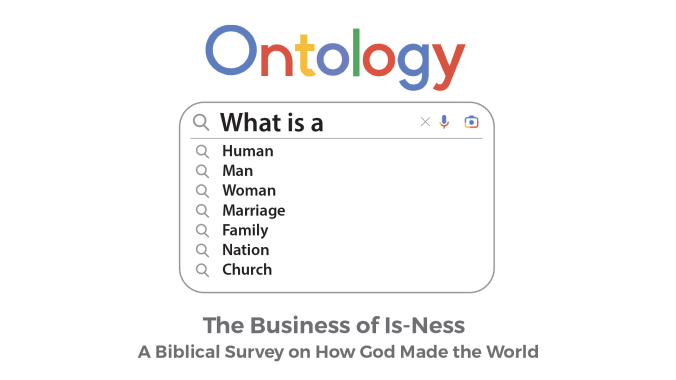
Ontology 101: What is Humanity?

ontology1920x1080-1Since 2013, I have taught the doctrine of humanity a half a dozen times. And in each class, I have put this question on the final exam: What is the most important doctrine for the twenty-first century?

I ask the question because in every era of the church there are unique theological challenges. For instance,

  • In the second and third centuries, the church had to grapple with the relationship between the Old and New Testaments, as well as the errors of Gnosticism.
  • In the fourth and fifth centuries, the church had to defend the deity and humanity of Christ, the proper understanding of the Trinity, and the divinity of Holy Spirit.
  • During the Reformation, the church recovered the doctrine of justification by grace alone through faith alone in the person and work of Christ alone.
  • And nineteenth and twentieth centuries, the doctrine of Scripture had to be clarified, because scientific claims and critical methods of interpretation sought to make the Bible a book like any other.

These are but a few doctrinal disputes that have arisen in church history. By identifying doctrines with decades (or centuries), I am not denying the perpetual need to declare and defend all doctrines, but there are certain pressures in culture that cause the church to reassert or reinforce biblical doctrines. And when it comes to the twenty-first century, there is no more important doctrine than the doctrine of humanity.

That’s why I ask that question on my theology exam, and here is the reason. Continue reading

Ontology 101: A New Sermon Series

ontology1920x1080-1“It depends on what the meaning of ‘is’ is.” Those infamous words, uttered by Bill Clinton under oath in 1998, should have told us that the world and everything in it was already succumbing to the deconstructive forces of postmodernism. Postmodernism claims that meaning is no longer found in what a human author intends or what the Author of life declares. Rather, meaning is decided by individuals or groups interpreting, or in most cases reinterpreting, the words others.

In college after college, postmodern ideas have sprung to life since the 1960s, and by 1998 such epistemic redefinitions and verbal deconstructions were emerging in the public square. Bill Clinton’s elusive response to a question about his relations with Monica Lewinsky was not abnormal for a culture celebrating transgression (think: the Hippies of the 1960s), raised on MTV (think: the teens of the 1980s), or enslaved to self-expression instead of submission to the truth (every generation since WWII).

Fast forward 25 years, add two decades of social media, a handful of contested elections, one global pandemic, and endless woke crusades in public schools and city streets, and it is not just language that has come under assault, it is everything that God upholds by the word of his power. To be certain, Christ the Lord reigns in heaven. But on earth, all is not well. And in our day, our cultural elites can’t even figure out what a man is, why women’s sports should only include women, or why children should not be exposed to drag queens at the public library.

In a word, the world has gone mad. And its insanity began when words could mean anything, or nothing, or something at one time and not another. Continue reading

Brother-Theologians: Preach the Word!

samuel-zeller-432101A few years ago I wrote this article on David Prince’s website. As I go to teach Systematic Theology 1 this week, I am reminded of it, and the need for theologians to be preachers.
In theology, we are not just called to study and store up knowledge of truth. We are called to study to show ourselves approved so that we may preach—or teach, or write, or counsel, or anything else that qualifies as heralding the good news—sound doctrine. To that point, I repost this article, in hopes that God may continue to raise up men sound in doctrine who will preach the Word.

*********

When I came to seminary, I wanted to study the Bible and theology. Having never “preached” a Sunday morning message, I was uncertain as to the role preaching would have in my life. Ten years later, through a combination of providential opportunities and willingness to preach whenever I was asked, I have finished my theological education  (Yes, it took a decade!) and have preached more Sundays than not.

For nearly five years I have filled the pulpit at my current church—first as a supply preacher, then an interim pastor, and last as the senior pastor. In the lustrum before serving at our church, I like so many of my seminary peers preached in nursing homes, urban missions, country parishes. It was a wonderfully painful time, one where precious little flocks like Corn Creek Baptist Church endured my preaching and helped me learn how to preach.

During that time, preaching was a priority, but so was theology. By training, I am a systematic theologian, or at least, that’s what my degree says. Therefore, as a pastor and a theologian, I feel a measure of familiarity with both vocations. And I feel a fraternal affection and responsibility to exhort aspiring theologians with what Paul commanded Timothy: Preach the Word! Continue reading

The Seed of the Woman Wins (Revelation 12): How Reading Revelation Rightly Gives Us Lasting Hope

1920x1080 CradleAny time you read Revelation, it is like stepping out of reality and into a carnival of mirrors. Only those mirrors do not, or should not, reflect our own faces, so much as they reflect the prophets of the Old Testament, whose faces were reflected the glory of God’s Son.

While Revelation is a book that is filled with signs, those signs have a registered trademark—a trademark found in the Old Testament. And anytime we read Revelation we should labor to understand the book in its canonical context. To that end, let me offer three words of how to interpret and apply this chapter.

These three exhortations come from my last sermon on Revelation 12. But they would apply to any passage in this glorious and mystifying book. Continue reading

True Religion Consists in Holy Affections: Jonathan Edwards’ Reflections on 1 Peter 1:8

peter-lewis-D1kher2Zx2U-unsplashTrue religion, in great part, consists in holy affections.
— Jonathan Edwards —

In his classic treatise on nature of the Christian experience, Jonathan Edwards begins Religious Affections with a brief and fruitful examination of 1 Peter 1:8. As this verse stands in the middle of this Sunday’s sermon, I share the opening pages from the abridged and updated version.  As many have experienced, Edwards writing is challenging, but his vision of God is glorious. Thus, it is always worth wrestling with words. Here, however, we find in language more accessible to modern readers an explanation of the way trials purify believers and enlarge our love for Christ and our joy in Christ. The section is not long and I share it as an introduction to Edwards, Religious Affections, and some of the themes we will see on Sunday.

8 Though you have not seen him, you love him. Though you do not now see him,
you believe in him and rejoice with joy that is inexpressible and filled with glory,
— 1 Peter 1:8 —

With these words the apostle demonstrates the state of mind of the Christians to whom he wrote. In the two preceding verses, he speaks of their trials: *the trial of their faith*, their *being in heaviness through manifold temptations*. These trials benefit true faith in three ways.

First, above all else, trials like this have a tendency to distinguish between true faith and false, causing the difference between them to be evident. That is why in the verse immediately preceding the text, and in innumerable other places, they are called trials because they try the faith of people who profess to be Christians, just as apparent gold is tried in the fire to see whether it is true gold or not. When faith is tried this way and proved to be true, it is “found unto praise and honour and glory” (1 Pet. 1:7). Continue reading

Rescue Those Who Are Being Taken Away to Death: Remembering What is At Stake in the Abortion Debate

sebastian-grochowicz-qri3tMKrc84-unsplashExchanging Darkness for Light and Speaking Light to the Darkness (Sermon Audio)

Woe to those who call evil good and good evil,
who put darkness for light and light for darkness,
who put bitter for sweet and sweet for bitter!
— Isaiah 5:20 —

This Sunday is Sanctity of Life Sunday and with it, we remember the lethal decision of the Supreme Court in 1973 to legalize abortion in our country. In the 47 years since Roe v Wade, and its accompanying case (Doe v Bolton), more than 61 million babies have been aborted in our country.

Put into perspective, this means that 61 million babies created by God, made in the image of God, and created for the glory of God, have been killed in the place where God brings life into the world. A mother’s womb should be the safest place on earth, yet in our day it has become one of the most dangerous.

At the same time, countless lies have been used to deceive women to pursue abortions. Uncertain or unaware of other options, institutions like Planned Parenthood have preyed on women, presenting abortion as their only hope. In other instances, men (fathers, boyfriends, and husbands) have pressured women to have abortions. And still other women vulnerable to lies, have aborted their babies because they believed it was the best way out of their situation. Continue reading

Fifty Sermons on Isaiah

readingplan04.jpegAs we approach the first Sunday in January and the first Sunday in Via Emmaus Bible reading plan, here are 50+ sermons on Isaiah, ordered in three ways.

  • The first section includes sermon overviews by Mark Dever (1 message) and Trent Hunter (5 messages). They will help you get the big picture of the book.
  • The second section is composed of selected sermons by various preachers. I will continue to add to this list. If you know of any exemplary sermons on particular passages in Isaiah, please add them in the comments.
  • The third section is dedicated to the series sermons preached by Ray Ortlund. I can’t wait to listen to many of these sermons and I encourage you to do the same.

Listening to good expositional sermons is an excellent way to learn the book of Isaiah and to love the God who gave us this book. Take time to listen to some of these sermons and be sure to respond in prayer to them, even if you hear them on the go. Again, if there are other good sermons to add to this list, please let me know (viaemmaus@obc.org).

Soli Deo Gloria, ds Continue reading