Via Emmaus on the Road: 2 Timothy 3

Further Resources


2 Timothy 3 (ESV)

Godlessness in the Last Days

But understand this, that in the last days there will come times of difficulty. For people will be lovers of self, lovers of money, proud, arrogant, abusive, disobedient to their parents, ungrateful, unholy, heartless, unappeasable, slanderous, without self-control, brutal, not loving good, treacherous, reckless, swollen with conceit, lovers of pleasure rather than lovers of God, having the appearance of godliness, but denying its power. Avoid such people. For among them are those who creep into households and capture weak women, burdened with sins and led astray by various passions, always learning and never able to arrive at a knowledge of the truth. Just as Jannes and Jambres opposed Moses, so these men also oppose the truth, men corrupted in mind and disqualified regarding the faith. But they will not get very far, for their folly will be plain to all, as was that of those two men.

All Scripture Is Breathed Out by God

10 You, however, have followed my teaching, my conduct, my aim in life, my faith, my patience, my love, my steadfastness, 11 my persecutions and sufferings that happened to me at Antioch, at Iconium, and at Lystra—which persecutions I endured; yet from them all the Lord rescued me. 12 Indeed, all who desire to live a godly life in Christ Jesus will be persecuted, 13 while evil people and impostors will go on from bad to worse, deceiving and being deceived. 14 But as for you, continue in what you have learned and have firmly believed, knowing from whom you learned it 15 and how from childhood you have been acquainted with the sacred writings, which are able to make you wise for salvation through faith in Christ Jesus. 16 All Scripture is breathed out by God and profitable for teaching, for reproof, for correction, and for training in righteousness, 17 that the man of God may be complete, equipped for every good work.

Soli Deo Gloria!

Via Emmaus on the Road: A Personal Introduction

Last week, I encouraged families, and especially, fathers to take the initiative to read the Bible together. And today, I’m pointing to a couple ways to do that, and for ways that friends can read the Bible together too.

For families with young children, reading colorful Bible story books is a great way to introduce children to the storyline of Scripture. In our family we wore out close to five Big Picture Story Bibles and we did the same with The Jesus Story Book Bible, as well as a few others. And this is great place to begin.

Yet, for older children, teenagers, and those who are new to reading the Bible, how do you teach them to read God’s Word? Yes, there are some who immediately take up the task of reading the Bible, but many find God’s Word long, complex, foreign, and challenging. Add in a translation that is difficult to read (the KJV) or psychological commitments that conflict with Scripture (think: Jordan Peterson) and the Bible will be a treasure entirely locked up.

For as many are the benefits come with having our own Bibles and reading God’s Word for ourselves, there are equal dangers. From the beginning, God sent his Spirit to equip prophets and apostles to write holy Scripture, and today, he does the same by raising up pastors and teachers who rightly handle the word of God (1 Tim. 2:15). Indeed, the way that churches grow and saints flourish is through pastors who equip the saints for every work of ministry.

Sadly, many are the YouTube Bible teachers who are not pastors, but whose qualification for service is a myriad of followers and good lighting. In these places, you might find truth, but you might also find indifference towards creation and evolution, ethical instructions about veganism, and contemplations of global warming.

When we read the Bible, we should be seeking to hear what the Spirit of Christ is revealing about the God the Son, who saves sinners from death and bring them to life in the light of his Father. Truly, the Bible is Christ-centered and a faithful reading of the Bible will help readers see how the inspired authors are leading people to Christ.

When I started my blog in 2008, as a fourth-year seminary student, this was my aim. I sought to proclaim Christ from all the Scriptures, in order to make disciples of all nations. In short order, the Lord called me to pastor in 2010. And in 2015, he moved my family to Northern Virginia, where I have been the pastor for preaching and theology at Occoquan Bible Church for over nine years.

In all of those years, my burden has remained the same: I want to help people to know Christ from all the Scripture and to expound the glories of Christ from all Scripture. And thus, I have filled my personal website with articles, essays, and resources on the Bible. Along the way, I have offered a few Bible reading plans. And this year, I am doing that again with a Bible reading plan aimed for new readers of the Bible—whether, they are children who have grown in church, reading the Big Picture Story Bible or if they are new Bible readers who are looking for a guide.

In short, I hope to provide a daily reflection on the Bible that provides a theological and devotional encouragement to those reading the Bible. And by theology, I simply mean that I will talk about God the Father, Son, and Holy Spirit. While there might be practical, and even political applications of the text, the main goal is to see and savor God in Christ.

And if you would like to join in, or lead your family to listen, or grab some friends to listen together, stay tuned to this website or subscribe on Apple. (Next week, I hope to add Spotify too). Until then, keep reading the Bible. And I’ll join you next week to start reading the Bible together.

Soli Deo Gloria!
What Should We Do With 1 Enoch? A Biblical Approach to Extra-Biblical Literature

konrad-hofmann-XFEqU_bf5nA-unsplashIn Genesis 6 we find the curious introduction to a group of people (?) called the Nephilim. In verse 4, the ESV reads, “The Nephilim were on the earth in those days, and also afterward, when the sons of God came in to the daughters of man and they bore children to them. These were the mighty men who were of old, the men of renown.”
Thus concludes one of the strangest passages in all the Bible. For centuries, the four verses that begin Genesis 6 have occasioned debate on whom the Nephilim are, who the sons of God are, who the daughters of man are, who the mighty men of old were, the men of renown, and how these characters all fit together. Are these all descriptions of human beings, sons and daughters of Adam? Or, is something more nefarious afoot? Are the sons of God fallen angels? And if so, who are their offspring?

To these questions and more, I will attempt to give an answer in this post and three more to come. Below, I will consider what it means for Christians to use extra-biblical sources, and how we can properly benefit from reading 1 Enoch. In the next post, I will lay out the options for reading Genesis 6, and explain the strengths and weaknesses of various positions. Then third, I will make a canonical argument for understanding the sons of God as fallen angels and the Nephilim/mighty men as giants. Fourth, I will draw some theological conclusions related to Genesis 6 but also to Christ and his rule over the cosmos. Continue reading

The Story of Isaiah’s Immanuel: An Advent Reading Plan

pink pencil on open bible page and pink

It’s beginning to look a lot like Christmas. Or at least, the stores are beginning to roll out their Christmas wares. Merchants and suppliers are setting their sights on the holidays, and starting next week, we will too.

On Sunday, November 13, our church will begin a six week series on the book of Isaiah. You know, the one that is 66 chapters long and contains some of the most memorable verses in the Bible.

Isaiah 6:1–3. In the year that King Uzziah died I saw the Lord sitting upon a throne, high and lifted up; and the train of his robe filled the temple. Above him stood the seraphim. Each had six wings: with two he covered his face, and with two he covered his feet, and with two he flew. And one called to another and said: “Holy, holy, holy is the Lord of hosts; the whole earth is full of his glory!”

Isaiah 7:14.  Therefore the Lord himself will give you a sign. Behold, the virgin shall conceive and bear a son, and shall call his name Immanuel.

Isaiah 9:6–7. For to us a child is born, to us a son is given; and the government shall be upon his shoulder, and his name shall be called Wonderful Counselor, Mighty God, Everlasting Father, Prince of Peace. Of the increase of his government and of peace there will be no end, on the throne of David and over his kingdom, to establish it and to uphold it with justice and with righteousness from this time forth and forevermore. The zeal of the Lord of hosts will do this.

If you are familiar with Isaiah, I suspect you are most familiar with parts and portions, famous passages and key persons—Uzziah dying (ch. 6), Hezekiah ailing (ch. 38), and the Suffering Servant saving (ch. 53). Until a few years ago, this is how I read Isaiah too. I knew the key theological passages and the Christmas verses. But I did not know the book of Isaiah or its overall message.

Accordingly, I didn’t understand why Isaiah has four birth narratives in Isaiah 7, 8, 9, 11 or  more than a dozen chapters dedicated to judging the nations (Isaiah 13–27). Moreover, I was aware of four servant songs in Isaiah 42, 49, 50, 53 which point to Christ (Acts 8), but I didn’t see how the four Spirit songs of Isaiah 60–62 also anticipated the Holy Spirit. Long story short, I had read Isaiah for years, but only in the last couple did the message begin to come together.

Seeing the message of Isaiah has been a glorious joy, as it tells the story of salvation and judgment, where God redeems a people immersed in sin, so that he can forever dwell with his redeemed on his holy mountain. That’s a simplified version of Isaiah’s message, and for the next six weeks, that’s what we are going to consider. Continue reading

Seeing John 9 with New Eyes: A Few Notes on Literary Structure

close up shot of bible text

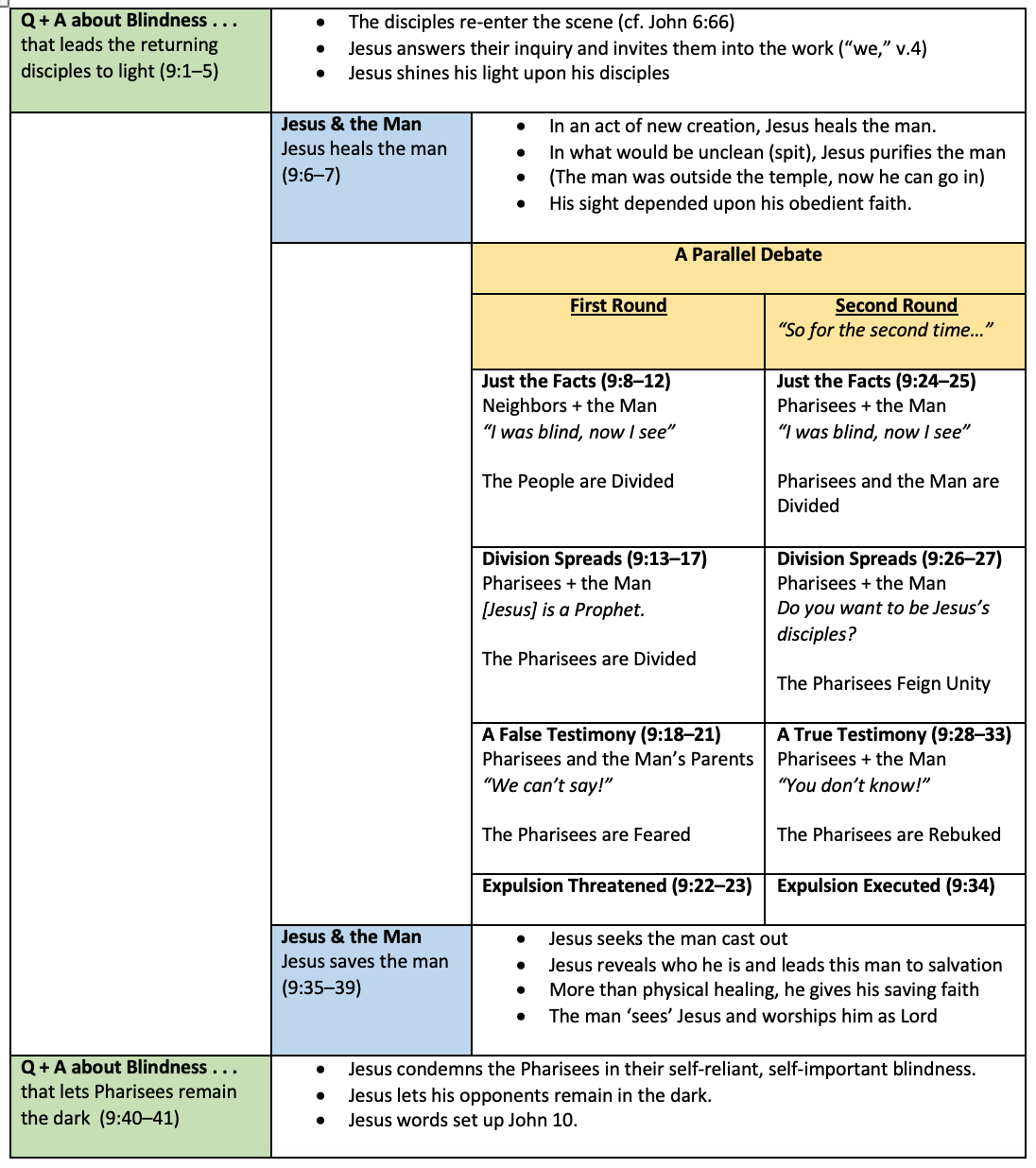
As I continue to study John’s Gospel, I grow increasingly amazed at the beloved disciple’s use of literary structure. Here’s a sampling of things to see in John 1–9.

For sake of time, I’m just going to leave this outline here. You can begin to make some biblical and theological connections as you read the chapter for yourself. Or check back in a week or so, and Lord willing, my sermon on John 9 will be up.

Screen Shot 2022-07-07 at 10.39.37 AM

Soli Deo Gloria, ds

Photo by Joshua Hurricks on Pexels.com

Finding Consolation from the Weeping Prophet: Or, Where to Find Springs of Living Water in Jeremiah’s Long, Dark Book

sandra-gabriel-s-7E4qC03oU-unsplash

This post is part of a series of resources for the Via Emmaus Bible Reading Plan. This month I am focusing on Jeremiah.

*************

In Jeremiah 30–33, we find four chapters that are often referred to as “The Book of Consolation.” The reason for this title is the way they promise hope for a battered and bruised people who are, or will soon be, held in bondage by Babylon. In context, these chapters come after the Prophet declares that God is sending Israel to Babylon for seventy years because of their sins. Following this judgment (see Jeremiah 25–29), Jeremiah 30–33 looks to a day in the future when God will restore his people (30:1–3), return a priestly king to the throne (30:21), and establish a new covenant (31:31–34).

These chapters are some of the brightest and best in all the Old Testament, but they are found in a book that is densely populated with oracles of destruction, jeremiads against Jerusalem (yes, jeremiads comes from Jeremiah), judgments against the nations, and other events that lead Jeremiah to be called the weeping prophet. All in all, the Book of Consolation stands in stark contrast to the rest of Jeremiah, and accordingly, I can imagine many who attempt to read Jeremiah will do so, skipping ahead to these chapters, or just cherry-picking a few verses along the way (e.g., Jer. 2:13; 9:23–24; 17:9–10; 23:1–6; 29:11–13; etc.).

Such approaches are understandable, given the length and complexity of the book, but if we really want to understand Jeremiah we need to find a better reading strategy. That’s what this blog post is for—to help give you a map which identifies key passages which as springs of living water for your soul.

In other words, because Jeremiah is meant to pluck up, tear down, destroy, and overthrow the city of Jerusalem and all its inhabitants (Jer. 1:10ab), his book will primarily consist of words of judgment. At the same time, because God calls Jeremiah to build up and plant (see also 1:10c), we should expect to find life-giving words of hope. The question is knowing where they are and how to find such refreshment in a book that is primarily deconstructive—in the prophetic, not the postmodern, sense of the word.

Reading through the book, it will help to know where the words of life are. And that’s what I offer below. In another blog post, I laid out a four-fold outline of the book that can be summarized like this.

  • Jeremiah 1–24: God’s War of Words . . . Against Israel
  • Jeremiah 25–34: God’s War of Words . . . Against the False Prophets
  • Jeremiah 35–44: God’s War of Words . . . Against the King and His Kingdom
  • Jeremiah 45–52: God’s War of Words . . . Against the Nations

This outline follows the illuminating work of Andrew Shead, and I would urge you to read that post and his book. In what follows, I will share the springs of living water that crop up in places like Jeremiah 3:15–18 and Jeremiah 51:48, and everywhere in between. As I have read through Jeremiah, these are the passages and the promises I am looking for as I read.  

As the apostles teach us, all the promises of God are “Yes” and “Amen” in Christ (2 Cor. 1:20). The gospel itself stands on the promises of God (Acts 13:32–33), and begins with Abraham (Gal. 3:8) not Matthew. For this reason, we should read the Bible as promise-seekers, so that we can become promise-believers. This is what the Bible is for, and in Jeremiah, there are plenty of hope-giving, Christ-centered promises for us to find. The trick is knowing where they are and how they fit into the book.

Without any further preliminaries, let me offer a roadmap to the springs of living water in Jeremiah. I will give a few notes as we go, but primarily what follows is the text of Scripture.[1] Continue reading

Seeing is Believing: Returning to John’s Gospel

john03In the Spring of 2020, our church began a new sermon series on the Gospel of John. Little did we know that things would get really weird in March of that year, when the onslaught of Covid-19 led us to stop gathering for eight weeks. During that time and after, we looked Psalm 90–106 and Joel. Thereafter, our church studied Daniel, 1 Peter, and Proverbs 1–9, to name a few. Yet, it has always been the hope to resume our sermon series in John.
Thankfully, and under the Lord’s providence, we plan to restart this series next Sunday. In that sermon, I will give an overview of the whole Gospel. The following week, I will (Lord willing) restart a verse-by-verse exposition of John’s Gospel. That first message will begin where we left off in John 3 with the incredible encounter between Jesus and Nicodemus. Today, for those in our church or others who might benefit from a sermon series on John’s Gospel, I share the five messages that we preached in 2020.

Continue reading

The Via Emmaus Bible Reading Plan: January Resources for Genesis, Isaiah, and Matthew

Jesus washing the feet of Saint Peter on Maundy Thursday

This month the Via Emmaus Reading Plan is looking at Genesis, Isaiah, and/or Matthew. (See below for the tracks). If you are following this plan, or looking for a new reading plan, you can find helpful resources on the following pages. 

Track 1: Genesis

Track 2: Isaiah

Track 3: Matthew

If you have other resources on these books, please feel free to share.

May the Lord bless you and keep you and make his face shine upon you as you draw near to him in his Word.

The Via Emmaus Bible Reading Plan

Tracks[1] Old Testament 1

Law + Prophets

Old Testament 2

Prophets + Writings

New Testament
January Genesis Isaiah Matthew
February Exodus Jeremiah Mark
March Leviticus

Psalms

Ezekiel Luke

Psalms

April Numbers The Twelve[2] John
May Deuteronomy Psalms Acts
June John Proverbs Romans
July Joshua

Judges

Job 1–2 Corinthians
August 1–2 Samuel The Five Scrolls[3] Galatians–

2 Thessalonians

September 1–2 Kings

Proverbs

Daniel Pastorals

Proverbs

October Ezra-Nehemiah 1–2 Chronicles Hebrews
November Psalms Mark General Epistles[4]
December[5] Matthew Luke Revelation

As I have explained before

The idea of this plan is simple. Read, re-read, listen, study, memorize, and meditate on one (or two or three) books per month. If you do multiple tracks, you could read them sequentially, together, or at different times of the week (e.g., morning and evening, or week and weekend, etc.). However you plan your reading—and you should have a plan for reading that includes a place and time(s) to read—these tracks can guide you as you swim in the Bible. Then, over the course of 1, 2, or 3 years (depending on how many tracks you do), you will have read the whole Bible once, the Gospels twice, and the Psalms and Proverbs three times.

Let me know how this approach is going and if you have any feedback.

Soli Deo Gloria, ds

The Word of God Made Possible: What the Reformation Teaches Us About Reading the Bible

kiwihug-L4gw27XZN1I-unsplashFrom the time of Moses until now, God’s people have always been a people of the Book. At times, such Word-centeredness has been lost, as in the Late Medieval period or the Modernist era, but in its healthiest moments the church has prioritized God’s Word and has been blessed as a result.

Today, as we celebrate the Word made flesh at Christmas, and as we make plans for reading the Word in the New Year, it is good to remember why and how we read should Scripture. And so, taking a few notes from our Protestant forebears, we can see how their commitment to God’s Word brought revival to the hearts of those who read Scripture and reformation to the churches who committed themselves to applying God’s Word to every aspect of life.

In what follows, I offer nine quotations from five Protestant Reformers: Martin Luther, Phillip Melanchton, John Calvin, Thomas Cranmer, and Heinrich Bullinger. These quotations come from Mark Thompson’s illuminating chapter on the Reformers view of Scripture in Reformation Theology (RT). May the wise counsel of Luther, Calvin, and others be an encouragement to you, as you pick up the Word of God and read. Continue reading

Picturing the Word without Caricaturing the Text: Fifteen Statements on Inerrancy and Interpretation

eduardo-pastor-pDAipmK6eRg-unsplashIn his six-volume opus, God, Revelation, and Authority, Carl F. H. Henry unpacks 15 Propositions about Revelation. These propositions include statements related to the source, nature, and purpose of God’s speech. And for anyone interested wrestling with the theological debates surrounding God’s Word and its inerrancy, this would be an excellent, if lengthy, place to begin. Henry was one of the chief architects of neo-evangelicalism and a defender of biblical inerrancy. He with 300 others authored the Chicago Statement on Biblical Inerrancy in 1978 and his enduring legacy includes not only his books on theology but his influence on other theologians. 

As noted by Kevin Vanhoozer, Henry was a part of evangelicalism’s “greatest generation,” a spin on the nickname given to the Post WWII generation (The Basics of the Faith). And in that generation, Henry and others argued against liberalism’s rejection of the Bible and for a view of the Bible that was infallibly true in “all matters upon which it touches.” This statement on inerrancy is part of the legacy that Henry and others passed on, but it also has been a legacy regularly contested.

As we should expect, the Word of God will always be questioned. “Did God really say?” is not a query left in the Garden of Eden. It is a question that persists at all times and in all fallen hearts. Thus, it is not surprising that today, those within evangelicalism and those without have raised questions about biblical inerrancy. In fact, to get a good lay of the land, just consider the book, Five Views on Biblical InerrancyIn that volume, you find two voices championing inerrancy, albeit with different terms (Albert Mohler and Kevin Vanhoozer), two voices denying inerrancy (John Franke and Peter Enns), and one voice basically affirming the contents of the Chicago Statement without giving it his international endorsement (Michael Bird).

From that volume, it is clear that the doctrine of inerrancy is not clearly understood today. That is, many who reject it fail to appreciate the nuance offered in the 1978 statement. And those who affirm it seek to provide clarity on what inerrancy is and is not. To that end, I think Kevin Vanhoozer is the most helpful. And in another of his books, Pictures at a Theological Exhibition, he lists—although by authorial intent, as far as I can tell—15 Propositions on Scripture that clarify what biblical inerrancy is and is not. Continue reading