6 Brothers, if anyone is caught in any transgression, you who are spiritual should restore him in a spirit of gentleness. Keep watch on yourself, lest you too be tempted. 2 Bear one another’s burdens, and so fulfill the law of Christ. 3 For if anyone thinks he is something, when he is nothing, he deceives himself. 4 But let each one test his own work, and then his reason to boast will be in himself alone and not in his neighbor. 5 For each will have to bear his own load.
6 Let the one who is taught the word share all good things with the one who teaches. 7 Do not be deceived: God is not mocked, for whatever one sows, that will he also reap. 8 For the one who sows to his own flesh will from the flesh reap corruption, but the one who sows to the Spirit will from the Spirit reap eternal life. 9 And let us not grow weary of doing good, for in due season we will reap, if we do not give up. 10 So then, as we have opportunity, let us do good to everyone, and especially to those who are of the household of faith.
Final Warning and Benediction
11 See with what large letters I am writing to you with my own hand. 12 It is those who want to make a good showing in the flesh who would force you to be circumcised, and only in order that they may not be persecuted for the cross of Christ. 13 For even those who are circumcised do not themselves keep the law, but they desire to have you circumcised that they may boast in your flesh. 14 But far be it from me to boast except in the cross of our Lord Jesus Christ, by which the world has been crucified to me, and I to the world. 15 For neither circumcision counts for anything, nor uncircumcision, but a new creation. 16 And as for all who walk by this rule, peace and mercy be upon them, and upon the Israel of God.
17 From now on let no one cause me trouble, for I bear on my body the marks of Jesus.
18 The grace of our Lord Jesus Christ be with your spirit, brothers. Amen.
12 At that time Jesus went through the grainfields on the Sabbath. His disciples were hungry, and they began to pluck heads of grain and to eat. 2 But when the Pharisees saw it, they said to him, “Look, your disciples are doing what is not lawful to do on the Sabbath.” 3 He said to them, “Have you not read what David did when he was hungry, and those who were with him: 4 how he entered the house of God and ate the bread of the Presence, which it was not lawful for him to eat nor for those who were with him, but only for the priests? 5 Or have you not read in the Law how on the Sabbath the priests in the temple profane the Sabbath and are guiltless? 6 I tell you, something greater than the temple is here. 7 And if you had known what this means, ‘I desire mercy, and not sacrifice,’ you would not have condemned the guiltless. 8 For the Son of Man is lord of the Sabbath.”
A Man with a Withered Hand
9 He went on from there and entered their synagogue. 10 And a man was there with a withered hand. And they asked him, “Is it lawful to heal on the Sabbath?”—so that they might accuse him. 11 He said to them, “Which one of you who has a sheep, if it falls into a pit on the Sabbath, will not take hold of it and lift it out? 12 Of how much more value is a man than a sheep! So it is lawful to do good on the Sabbath.” 13 Then he said to the man, “Stretch out your hand.” And the man stretched it out, and it was restored, healthy like the other. 14 But the Pharisees went out and conspired against him, how to destroy him.
God’s Chosen Servant
15 Jesus, aware of this, withdrew from there. And many followed him, and he healed them all 16 and ordered them not to make him known. 17 This was to fulfill what was spoken by the prophet Isaiah:
18 “Behold, my servant whom I have chosen,
my beloved with whom my soul is well pleased.
I will put my Spirit upon him,
and he will proclaim justice to the Gentiles.
19 He will not quarrel or cry aloud,
nor will anyone hear his voice in the streets;
20 a bruised reed he will not break,
and a smoldering wick he will not quench,
until he brings justice to victory;
21 and in his name the Gentiles will hope.”
Blasphemy Against the Holy Spirit
22 Then a demon-oppressed man who was blind and mute was brought to him, and he healed him, so that the man spoke and saw. 23 And all the people were amazed, and said, “Can this be the Son of David?” 24 But when the Pharisees heard it, they said, “It is only by Beelzebul, the prince of demons, that this man casts out demons.” 25 Knowing their thoughts, he said to them, “Every kingdom divided against itself is laid waste, and no city or house divided against itself will stand. 26 And if Satan casts out Satan, he is divided against himself. How then will his kingdom stand? 27 And if I cast out demons by Beelzebul, by whom do your sons cast them out? Therefore they will be your judges. 28 But if it is by the Spirit of God that I cast out demons, then the kingdom of God has come upon you. 29 Or how can someone enter a strong man’s house and plunder his goods, unless he first binds the strong man? Then indeed he may plunder his house. 30 Whoever is not with me is against me, and whoever does not gather with me scatters. 31 Therefore I tell you, every sin and blasphemy will be forgiven people, but the blasphemy against the Spirit will not be forgiven. 32 And whoever speaks a word against the Son of Man will be forgiven, but whoever speaks against the Holy Spirit will not be forgiven, either in this age or in the age to come.
A Tree Is Known by Its Fruit
33 “Either make the tree good and its fruit good, or make the tree bad and its fruit bad, for the tree is known by its fruit. 34 You brood of vipers! How can you speak good, when you are evil? For out of the abundance of the heart the mouth speaks. 35 The good person out of his good treasure brings forth good, and the evil person out of his evil treasure brings forth evil. 36 I tell you, on the day of judgment people will give account for every careless word they speak, 37 for by your words you will be justified, and by your words you will be condemned.”
The Sign of Jonah
38 Then some of the scribes and Pharisees answered him, saying, “Teacher, we wish to see a sign from you.” 39 But he answered them, “An evil and adulterous generation seeks for a sign, but no sign will be given to it except the sign of the prophet Jonah. 40 For just as Jonah was three days and three nights in the belly of the great fish, so will the Son of Man be three days and three nights in the heart of the earth. 41 The men of Nineveh will rise up at the judgment with this generation and condemn it, for they repented at the preaching of Jonah, and behold, something greater than Jonah is here. 42 The queen of the South will rise up at the judgment with this generation and condemn it, for she came from the ends of the earth to hear the wisdom of Solomon, and behold, something greater than Solomon is here.
Return of an Unclean Spirit
43 “When the unclean spirit has gone out of a person, it passes through waterless places seeking rest, but finds none. 44 Then it says, ‘I will return to my house from which I came.’ And when it comes, it finds the house empty, swept, and put in order. 45 Then it goes and brings with it seven other spirits more evil than itself, and they enter and dwell there, and the last state of that person is worse than the first. So also will it be with this evil generation.”
Jesus’ Mother and Brothers
46 While he was still speaking to the people, behold, his mother and his brothers stood outside, asking to speak to him. 48 But he replied to the man who told him, “Who is my mother, and who are my brothers?” 49 And stretching out his hand toward his disciples, he said, “Here are my mother and my brothers! 50 For whoever does the will of my Father in heaven is my brother and sister and mother.”
It’s beginning to look a lot like Christmas. Or at least, the stores are beginning to roll out their Christmas wares. Merchants and suppliers are setting their sights on the holidays, and starting next week, we will too.
On Sunday, November 13, our church will begin a six week series on the book of Isaiah. You know, the one that is 66 chapters long and contains some of the most memorable verses in the Bible.
Isaiah 6:1–3. In the year that King Uzziah died I saw the Lord sitting upon a throne, high and lifted up; and the train of his robe filled the temple. 2 Above him stood the seraphim. Each had six wings: with two he covered his face, and with two he covered his feet, and with two he flew. 3 And one called to another and said: “Holy, holy, holy is the Lord of hosts; the whole earth is full of his glory!”
Isaiah 7:14.Therefore the Lord himself will give you a sign. Behold, the virgin shall conceive and bear a son, and shall call his name Immanuel.
Isaiah 9:6–7. For to us a child is born, to us a son is given; and the government shall be upon his shoulder, and his name shall be called Wonderful Counselor, Mighty God, Everlasting Father, Prince of Peace. Of the increase of his government and of peace there will be no end, on the throne of David and over his kingdom, to establish it and to uphold it with justice and with righteousness from this time forth and forevermore. The zeal of the Lord of hosts will do this.
If you are familiar with Isaiah, I suspect you are most familiar with parts and portions, famous passages and key persons—Uzziah dying (ch. 6), Hezekiah ailing (ch. 38), and the Suffering Servant saving (ch. 53). Until a few years ago, this is how I read Isaiah too. I knew the key theological passages and the Christmas verses. But I did not know the book of Isaiah or its overall message.
Accordingly, I didn’t understand why Isaiah has four birth narratives in Isaiah 7, 8, 9, 11 or more than a dozen chapters dedicated to judging the nations (Isaiah 13–27). Moreover, I was aware of four servant songs in Isaiah 42, 49, 50, 53 which point to Christ (Acts 8), but I didn’t see how the four Spirit songs of Isaiah 60–62 also anticipated the Holy Spirit. Long story short, I had read Isaiah for years, but only in the last couple did the message begin to come together.
Seeing the message of Isaiah has been a glorious joy, as it tells the story of salvation and judgment, where God redeems a people immersed in sin, so that he can forever dwell with his redeemed on his holy mountain. That’s a simplified version of Isaiah’s message, and for the next six weeks, that’s what we are going to consider. Continue reading →
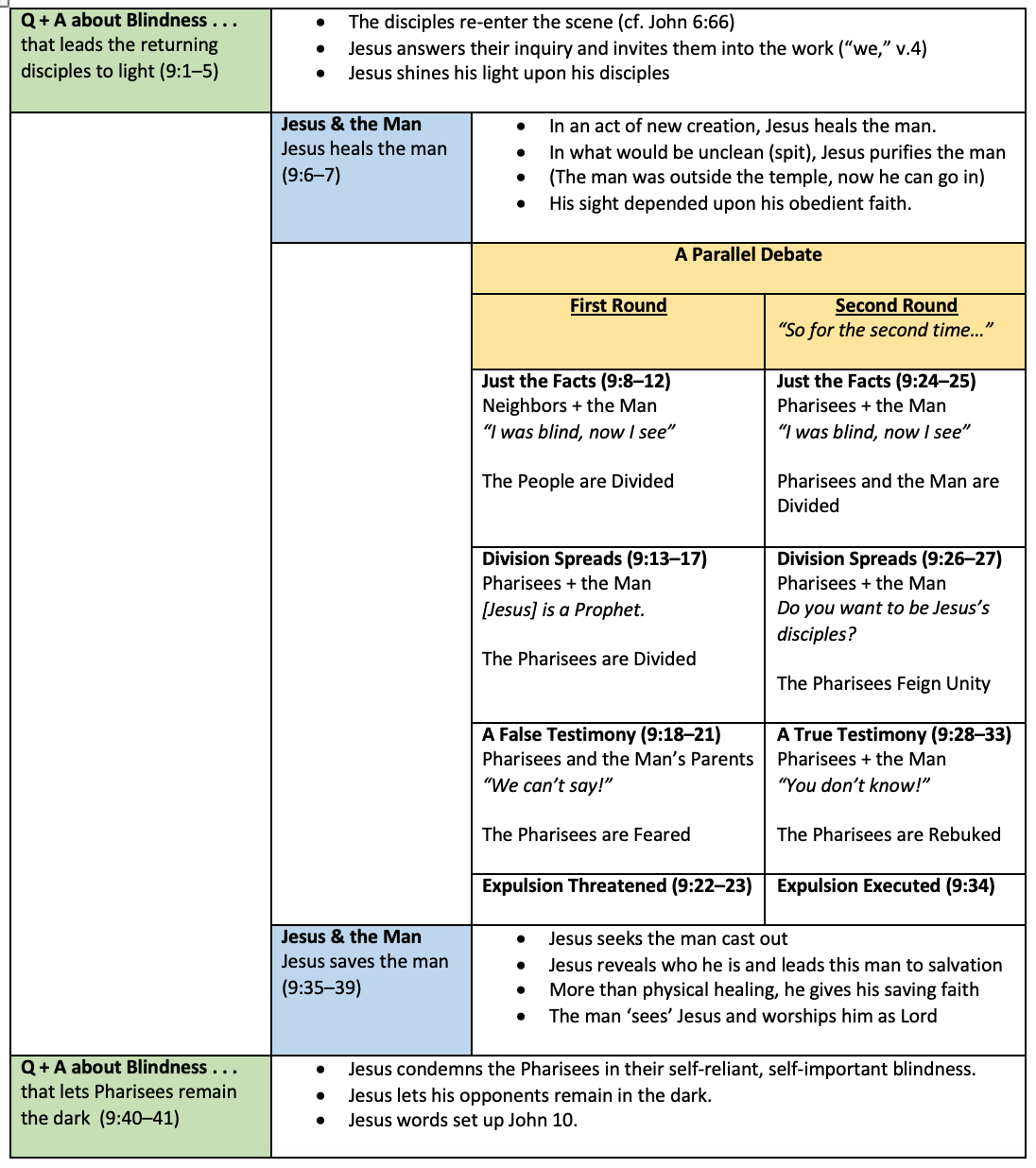
As I continue to study John’s Gospel, I grow increasingly amazed at the beloved disciple’s use of literary structure. Here’s a sampling of things to see in John 1–9.
The parallel testimony of the man born blind and all those amazed by his healing
For sake of time, I’m just going to leave this outline here. You can begin to make some biblical and theological connections as you read the chapter for yourself. Or check back in a week or so, and Lord willing, my sermon on John 9 will be up.
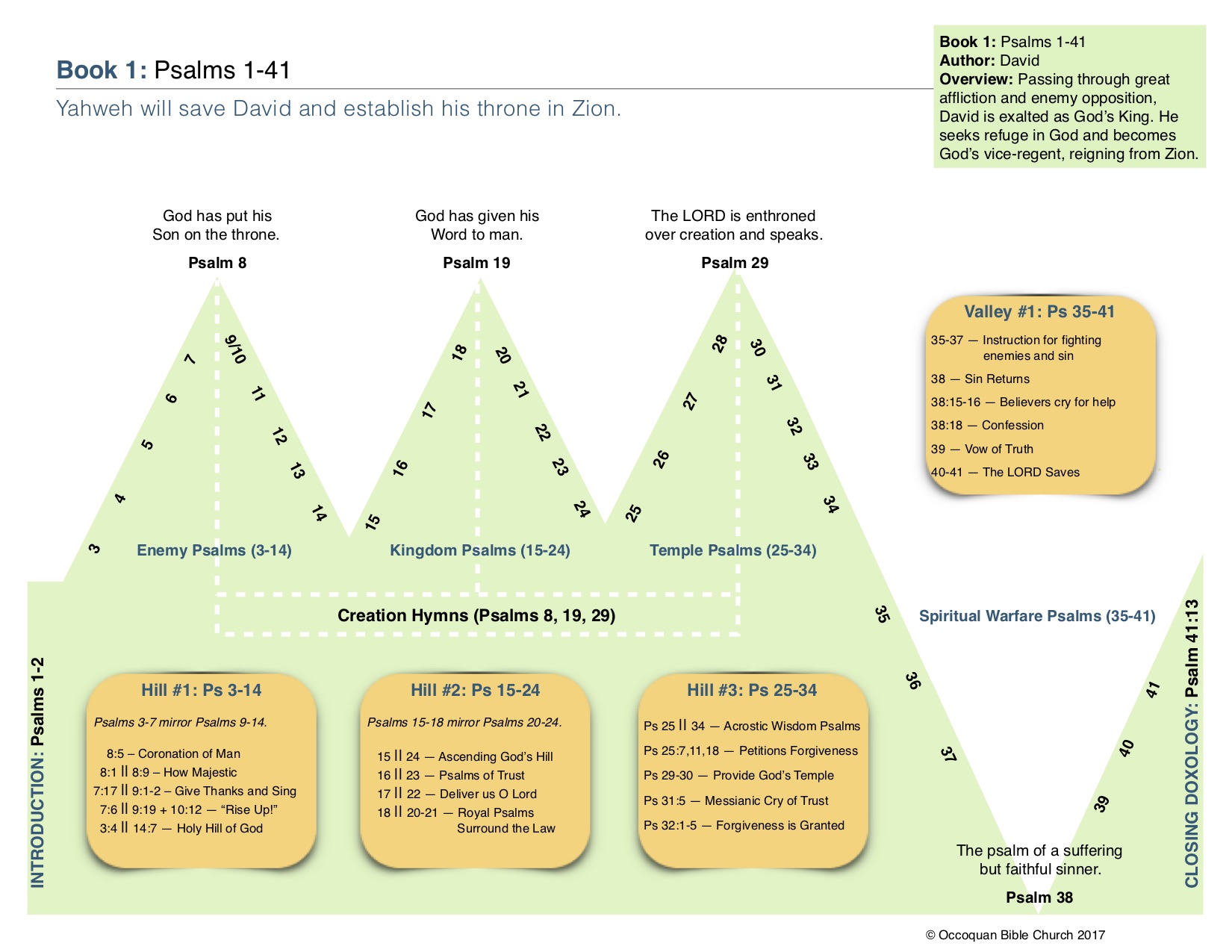
When I preached through the Five Books of the Psalms a few years ago, I began to see chiasms as “literary mountains” (see below). Which is to say, just as mountains in the Bible serve as meeting places with God, so chiastic structures (literary mountains) do the same. Because chiasms put stress on the high point of the passage, we should seek to understand how the author builds his argument and his artistry around that centerpiece. And what results is a staircase that moves up the literary mountain and back down again.
Without getting into all the interpretive details of all that follows, I offer the following literary structure. Each begin with the “feast of booths” as the gateway to each “mountain.” Then each put in the center of the chiasm, i.e., the high point of the mountain, the divide that stands in the crowd because of Jesus.
By looking at these these three chiasms together, it helps us get a sense for how to read the whole chapter, and to understand what the main point is—namely, that Jesus has come to fulfill the Feast of Booths, which will cause a divide between those who are enslaved to the shadow (i.e., the Law) and those who will believe in the substance (Christ, to which the Law points).
Tell me what you think? Does this reading match the text, as you see it? Or would you make adjustments? Continue reading →
This post is part of a series of resources for the Via Emmaus Bible Reading Plan. This month I am focusing on Ezekiel.

*************
24 “And for the house of Israel there shall be no more a brier to prick or a thorn to hurt them among all their neighbors who have treated them with contempt. Then they will know that I am the Lord God. 25 “Thus says the Lord God: When I gather the house of Israel from the peoples among whom they are scattered, and manifest my holiness in them in the sight of the nations, then they shall dwell in their own land that I gave to my servant Jacob. 26 And they shall dwell securely in it, and they shall build houses and plant vineyards. They shall dwell securely, when I execute judgments upon all their neighbors who have treated them with contempt.Then they will know that I am the Lord their God.” Ezekiel 28:24–26
Galatians 3:8 says that God preached the gospel beforehand to Abraham. As he promised that Abraham would be the father of many nations, God revealed his gospel purposes for the world. This truth has many implications, but one of them is that the gospel is something that goes back to the beginning—even to the Garden of Eden (see Gen. 3:15). Accordingly, whenever we read the Old Testament we should expect to find gospel promises of salvation and hope. Even in books that focus on the righteous judgments of God, there will be promises of grace and forgiveness.
This is the gospel message—that God will make a way of salvation for those who deserve eternal condemnation.
God gave this promise to Israel first (Rom. 1:16–17), but he always intended for his salvation to go from Israel to all the nations (Gen. 12:1–3; cf. Rom. 9:25–29; 10:18ff.). In the New Testament, we learn how this works. But we also find how this works by reading the Old Testament in light of the New. In the Prophets especially, we find new covenant promises that are given to Israel and the nations.
Over the last two months, I have focused on Isaiah and Jeremiah and the gospel hope found in each. This month, I turn to Ezekiel. And again the pattern of salvation and judgment remains. The message of the gospel is found scattered throughout Ezekiel, but it is also seenin the book as a whole.
In this blogpost, I want to offer some help on how to read Ezekiel, so that you can see the gospel in Ezekiel. Like Isaiah and Jeremiah, Ezekiel is challenging because it is so large. But it is also challenging because of how Ezekiel speaks and acts. Therefore, to get a better grasp on the book, I am turning to one of my seminary professors and his book on Ezekiel.
Daniel Block taught Old Testament when I went to Southern Seminary, and his collection of essays on Ezekiel (By the River Chebar: Historical, Literary, and Theological Studies in the Book of Ezekiel, 2013) nicely complements his massive, two-volume commentary on Ezekiel. In class, I remember him saying that his kids grew up with Ezekiel in the house, as he spent fourteen years (!!) working on his two commentaries. To such labor, we are indebted. And to those who read his work on Ezekiel, they will find excellent scholarship and great help for reading this prophet.
In what follows, I am summarizing Block’s introductory notes to Ezekiel. Continue reading →
If Jeremiah is structured around the word of the Lord, then it makes sense that the storyline of the book is also tailored to that end. God has called Jeremiah to speak his words to his people. Importantly, that word is not simply a message of comfort; it is a message that tears down and plucks up, a word that destroys and annihilates. Only then, can it build and plant (Jer. 1:10).
In Jeremiah’s call (ch. 1), we have an introduction to the man and his message, and as the visions signal, he will preach a message of judgment that will be rejected by his people. His message will include hope and blessing, but situated in the last decades of Judah’s reign in Jerusalem, his words of hope will all be future, not present. And thus, his words will go to war with his contemporaries. And over the course of his book, he will address the nation (ch. 1–24), the false prophets (ch. 25–34), the king (ch. 35–44), and the nations (ch. 45–52).
As seen yesterday, these four sections are ordered by various literary devices (disjunctive headings and narrative formulas), but they are also forming a storyline of God’s Word. And in his book, A Mouth Full of Fire, Andrew Shead shows how each section takes up the Word of God in order to tear down and pluck up the people of God. In order to understand the message of Jeremiah, therefore, we need to see how the book unfolds. And this is where Shead’s proposal is so helpful. Consider his outline. Continue reading →
In his must-read book Spiritual Disciplines for the Christian Life, Donald Whitney offers two chapters on Bible Intake. In the first of those two chapters he lists (1) hearing, (2) reading, and (3) studying as three key ways to imbibing, ingesting, and embracing God’s Word. With those disciplines in mind, let me offer a few verses to support them and then apply them to the Via Emmaus Bible Reading Plan (or any other plan).
Listen to the Word
Maybe it seems like reading the Bible should begin with the discipline of reading. But this read-first mentality only shows how literate our society is. To be sure, literacy is nothing but a blessing, and Christian missionaries have always brought schools with them to help converts read the Bible. But still, such literacy may actually obscure what Scripture says about hearing God’s Word. Additionally, it tends to forget that countless (most?) Christians have heard, not read, God’s Word. And actually, it is hearing that Scripture most frequently commends and commands. Consider a few verses.
First, Romans 10:17 says that faith comes by hearing and hearing from the word of Christ. Second, Jesus declares in Luke 11:28, “Blessed are those who hear the word of God and keep it!” Third, Revelation 1:3 describes the blessing of the book in terms of reading God’s Word “aloud,” not just reading it in the quiet of our dens. Certainly, there is blessing in reading the Bible in our prayer closets, but God’s Word is given to be read aloud with the people of God. And this means it is meant to be heard. Continue reading →
9 How can a young man keep his way pure? By guarding it according to your word. 10 With my whole heart I seek you; let me not wander from your commandments! 11 I have stored up your word in my heart, that I might not sin against you. 12 Blessed are you, O Lord; teach me your statutes!
— Psalm 119:9–12 —
With 2021 ending and 2022 approaching, you may be thinking about how to read the Bible in the new year. I hope so. The Word of God is not a trifle; it is our very life (Deut. 32:47). Man does not live on bread alone, but on every word that proceeds from the mouth of God (Deut. 8:3; Matt. 4:4). With that in mind, we should aim to read the Bible and to read it often!
Truly, the Bible is not a book to read once, or even once a year. It is meant to be imbibed and inhabited, adored and adorned, studied and savored. Mastery of the Bible does not mean comprehensive understanding of Scripture; it means ever-increasing submission to the Master who speaks in Scripture. This is why in the closing days of the year, it’s good to consider how we can saturate ourselves with Scripture in the next year.
Personally though, I wonder if our daily reading plans help us with this idea of Scripture saturation. Often, such plans call for reading single chapters from various parts of the Bible. And the daily routine can invite checking the box without understanding the book. So my question has been: Does such reading help us or hinder us in our Bible consumption and consumption? Continue reading →
“All Scripture is God-breathed and profitable . . .” 2 Timothy 3:16
This is what Paul says when speaking to Timothy about the origin of his faith, and this profitability is true for all parts of Scripture, including Leviticus. Yet, for Leviticus to be profitable, one must avoid pure historical interpretation, an approach to Leviticus that only discerns what priests did back then and what they should do today if the tabernacle was reconstructed and the old covenant were re-enacted. Similarly, for Leviticus to be profitable, one must avoid wild allegory, where every facet of the sacrifice becomes a token of some gospel truth.
Between these two poles, one must deal with the historical context of the book and yet see how the book draws us into a sacrificial system that leads us to Christ. Indeed, because Leviticus reveals to the “pattern” (typos) of worship that God commanded at Sinai (see Exodus 25:40), it is appropriate and necessary to see how Leviticus outlines a series of shadows (types) that find their substance in Christ (cf. Heb. 10:1). Continue reading →