Via Emmaus on the Road: 1 Peter 1

Further Resources


1 Peter 1 (ESV)

Greeting

Peter, an apostle of Jesus Christ,

To those who are elect exiles of the Dispersion in Pontus, Galatia, Cappadocia, Asia, and Bithynia, according to the foreknowledge of God the Father, in the sanctification of the Spirit, for obedience to Jesus Christ and for sprinkling with his blood:

May grace and peace be multiplied to you.

Born Again to a Living Hope

Blessed be the God and Father of our Lord Jesus Christ! According to his great mercy, he has caused us to be born again to a living hope through the resurrection of Jesus Christ from the dead, to an inheritance that is imperishable, undefiled, and unfading, kept in heaven for you, who by God’s power are being guarded through faith for a salvation ready to be revealed in the last time. In this you rejoice, though now for a little while, if necessary, you have been grieved by various trials, so that the tested genuineness of your faith—more precious than gold that perishes though it is tested by fire—may be found to result in praise and glory and honor at the revelation of Jesus Christ. Though you have not seen him, you love him. Though you do not now see him, you believe in him and rejoice with joy that is inexpressible and filled with glory, obtaining the outcome of your faith, the salvation of your souls.

10 Concerning this salvation, the prophets who prophesied about the grace that was to be yours searched and inquired carefully, 11 inquiring what person or time the Spirit of Christ in them was indicating when he predicted the sufferings of Christ and the subsequent glories. 12 It was revealed to them that they were serving not themselves but you, in the things that have now been announced to you through those who preached the good news to you by the Holy Spirit sent from heaven, things into which angels long to look.

Called to Be Holy

13 Therefore, preparing your minds for action, and being sober-minded, set your hope fully on the grace that will be brought to you at the revelation of Jesus Christ. 14 As obedient children, do not be conformed to the passions of your former ignorance, 15 but as he who called you is holy, you also be holy in all your conduct, 16 since it is written, “You shall be holy, for I am holy.” 17 And if you call on him as Father who judges impartially according to each one’s deeds, conduct yourselves with fear throughout the time of your exile, 18 knowing that you were ransomed from the futile ways inherited from your forefathers, not with perishable things such as silver or gold, 19 but with the precious blood of Christ, like that of a lamb without blemish or spot. 20 He was foreknown before the foundation of the world but was made manifest in the last times for the sake of you 21 who through him are believers in God, who raised him from the dead and gave him glory, so that your faith and hope are in God.

22 Having purified your souls by your obedience to the truth for a sincere brotherly love, love one another earnestly from a pure heart, 23 since you have been born again, not of perishable seed but of imperishable, through the living and abiding word of God; 24 for

“All flesh is like grass

and all its glory like the flower of grass.

The grass withers,

and the flower falls,

25  but the word of the Lord remains forever.”

And this word is the good news that was preached to you.

Soli Deo Gloria!

The Sons of God: Three Interpretations of Genesis 6:1–4

luigi-boccardo-OGSbrFW_dos-unsplashFigment. Absurd. Gross.

These are but three of the names John Calvin calls the position I hold on Genesis 6. And while, he doesn’t employ his most common insult (stupid!), I am sure he would have little trouble applying that label to the view that angels had sexual relations with women, such that the Nephilim (or giants) were the resultant offspring.

For indeed, when considering who the sons of God were in Genesis 6, he excoriates the ancient view that believed the sons of God (=angels) came from heaven to consort with the daughters of man. He writes in his commentary on Genesis 6, “That ancient figment, concerning the intercourse of angels with women, is abundantly refuted by its own absurdity; and it is surprising that learned men should formerly have been fascinated by ravings so gross and prodigious [strange or unusual].” [1]

Following this view, he adds another, namely, the idea that the sons of God were royal sons and the daughters of men were commoners. The problem in this case was the way that the nobility chased the commoners, resulting in offspring of mixed hereditary stock.[2] On this second view, whom he assigns to the “Chaldean paraphrast” (i.e., the Babylonian Talmud), we can agree that this interpretation fails to follow the terms of Scripture. (Yet, it is not far from another view that will be referenced below.)

In contrast to both views, Calvin then offers his—the idea that has become popular among so many evangelicals today. He sees the sons of God as the male heirs of Seth and the daughters of man as the female offspring of Cain. While Calvin frames this division in theological terms (i.e., the sons being chosen by grace and the daughters being left in their common condition), his reading is purely human, and wreaks nothing of gross absurdity.[3] Or, so he believes.

Historically, his view, which goes back to Augustine and before that to Julius Africanus (c. 160–240), can be summarized under the title of the Sethite position, while my position, which goes back to the Jewish interpreters of the Second Temple period might be titled the Fallen Angel position. Additionally, there is the view that understands the sons of God in royal terms, but not like that described by Calvin, what I’ll label the Kings of the Earth position.

In what follows, I want to lay out these three positions and begin to explain why I believe Calvin’s mockery of this position is wrong. As always, it is not a light thing to disagree with such an eminent theologian, but as a Baptist, Calvin’s insults don’t bother me. I’ve disagreed with him before, and here I will do so again. I will argue that his Sethite view is reasonable, but not ultimately persuasive. Better, we should read Genesis 6 in the context of the whole Bible, and when we do we will discover the fact that the angels of heaven left their proper abode, consorted with human women, and thus invited the judgment of God which led to the cosmic flood. Continue reading

A Dangerous Calling: Two Ways to Seek Ministry

boy wearing crown statue

Adonijah the son of Haggith exalted himself, saying, ‘I will be king.”
– 1 Kings 1:5 – 

But seek first the kingdom of God and his righteousness,
and all these things will be added to you.
– Matthew 6:33 –

There is nothing wrong with seeking the kingdom of God, or in seeking a place in that kingdom. In fact, it is absolutely right. Yet, with every good intention, there is the possibility to go astray, to take something good and to seek it badly. And for this reason, it is not sufficient to seek the kingdom. We must seek the kingdom and his righteousness.

In other words, seeking God’s kingdom is not the whole command. We must seek God’s kingdom righteously, which is to say, we must seek to be righteous in God’s kingdom. And this is the point that I want to pursue here and in the next two blogposts.

Unfortunately, too many followers of Christ have seen ministers who have sought the kingdom without righteousness. Likewise, too many who are now serving the Lord can reflect on the ways (multiple ways?) we have pursued ministry for vain reasons or with wrong motivations.

For instance, I learned of pastor last fall whose church had served as a money laundering front for his financial dealings. Clearly, he was seeking a kingdom, but not the Lord’s. Yet, as he stood in the pulpit each week, his vain pursuits were not seen. It took years for his self-interest to come to light. As Paul writes to Timothy, “The sins of some people are conspicuous, going before them to judgment, but the sins of others appear later” (1 Tim. 5:24).

So too, the fruit of ministry takes time to discover. Sometimes what looks like good fruit is not genuine. Similarly, for every ministry aspiration that is good, there are other aspirations that are corroded by pride, selfish ambition, and vain glory. As Paul David Tripp declared, ministry is A Dangerous Calling. How dangerous? So dangerous that three of the men who endorsed his book are no longer in ministry.

Accordingly, we should both be slow in seeking ministry (James 3:1). And we should be slow to affirm the ministries of others (1 Tim. 5:22). At the same time, we should be quick to learn from Scripture, what God says about seeking the ministry and a place of service in his kingdom. And to help us, I want to return to the book of 1 Kings and the story of Adonijah, the self-promoting son of David. For in him, and in comparison to Solomon, we can learn much about ministry. Continue reading

The Literary Structure of Isaiah 1–66: Eleven Infographics

concrete building

For the last two months, I have preached through the book of Isaiah, one section at a time. In all, that made for seven sermons and seven sermon handouts. In attempting to capture and communicate the message of Isaiah, I looked for the literary structures of Isaiah. First, I looked at the big picture of the book. Next, I considered each section. And last, I tried to see the branches on the trees, that are found in the glorious forest of Isaiah.

For each sermon, I put them together in infographics that look something like the stairs pictured above. What follows then are eleven screen shots of the book of Isaiah. They follow a basic chiastic structure for the whole book (see below), and each attempt to show the dramatic arc of judgment and salvation in each section, even down to the ten oracles of Isaiah 13–24.

Isaiah 1–12

Isaiah 13–27

Isaiah 28–35

Isaiah 36–39

Isaiah 40–48

Isaiah 49–54

Isaiah 55–66

As I went through Isaiah, I found help from David Dorsey, Alec Motyer, Barry Webb, Peter Leithart, the Chiasmus Xchange, and others. And for those who look at these outlines, I am sure that much more could be done to show the literary connections of the book, both at the micro- and macro-levels. But for now, I leave these outlines here, in hopes they may serve you as you read, study, or preach Isaiah. 

If you have further reflections and/or insights into this glorious book, please share them in the comments. At the bottom, I also linked to the seven sermons that arose from these outlines. May these graphical outlines be a source of encouragement and help as you hear the voice of God in Isaiah. Continue reading

Prosopological Exegesis: Four Reasons Not to Buy This Modern Approach to Scripture

books on the table

Yesterday, I explained in four points what Prosopological Exegesis (PE) was and is. Today, I offer a point-by-point examination.

This excerpt comes from the following from “Reading the Psalms with the Church: A Critical Evaluation of Prosopological Exegesis in Light of Church History” SBJT 25.3 (2021): 87–91. The larger article engages various approaches to the Psalms, and compares older modern versions of Psalm studies to the new approach found in PE. Suffice it to say, I am concerned with what PE offers. And here are four reasons why:

  1. PE’s use of Greco-Roman literary tools and dramatic practices are anachronistic, and should not be used for interpreting Scripture.
  2. PE’s rejection of Enlightenment typology misses the way Scripture employs typology; we need to go back and evaluate what true biblical typology is and is not.
  3. PE’s defense of orthodox doctrine comes at the expense of biblical unity, an interpretive practice that will ultimately undercut orthodoxy.
  4. PE’s interpretation of Hebrews is mistaken; we need to evaluate how Scripture interprets Scripture.

Here is the full text, explaining each point in detail.

Continue reading

Unmasking Prosopological Exegesis: Defining a New (and Improved?) Way to Read Scripture

rosary and face mask on top of a bible

Prosopological exegesis.

Have you heard of it? If not, that’s alright, I suspect this technique for reading Scripture will run its course in the next decade and be replaced by another interpretive fad in the 2030s. In the mean time, however, this way of (mis)reading Scripture will find its way into articles, book, commentaries, and pulpits. And for that reason, students of the Word and especially teachers who rely on the scholarship of others (read: all of us), should be( a)ware of this approach to reading the Bible Christologically. 

To those who have been stuck in hermeneutical circles that deny typology and the need to read Scripture canonically, prosopological exegesis (PE) may sound like a great gain, as the voices of God are “unmasked” in certain parts of the Old Testament. But as Peter GentryJim Hamilton, and Jim Dernell have each argued, this ostensibly Christ-centered approach to the Old Testament misreads God’s Word. Instead of following OT texts and types until they come to their full revelation in the New Testament, as God the Father, Son, and Spirit are revealed as the one God in three persons, PE takes a shortcut to the persons of the Trinity. For this reason, it is a “naughty” way to read Scripture, as Michael Carlino argues in his new piece at Christ Over All:Give Diamonds, Not Coal: Why Prosopological Exegesis is Not the Gift You Are Looking For.”

Tomorrow, I will share my own concerns with prosopological exegesis. But today, I will offer an explanation of what PE is. What follows, then, is part of my Southern Baptist Journal of Theological article, “Reading the Psalms with the Church: A Critical Evaluation of Prosopological Exegesis in Light of Church History.” You can find this SBJT article here, along with another article that gives a constructive proposal for reading the Psalms. In both articles, I show why PE is not a reliable method to reading Scripture, and what follows is the start of that argument—namely, defining what prosopological exegesis is.

Continue reading

Reading for Scripture Saturation: (Re)Introducing the Via Emmaus Bible Reading Plan

rod-long-DRgrzQQsJDA-unsplash

How can a young man keep his way pure?
By guarding it according to your word.
10  With my whole heart I seek you;
let me not wander from your commandments!
11  I have stored up your word in my heart,
that I might not sin against you.
12  Blessed are you, O Lord;
teach me your statutes!
— Psalm 119:9–12 —

A few years ago, I introduced a reading plan focused on Scripture saturation more than Scripture box-checking. As a new year begins, I return to that reading plan for myself and for others who might be interested in focusing on one (or two or three) books in a month, instead a daily selection of Bible readings.

As we all know, or should know, the Word of God is not a trifle; it is our very life (Deut. 32:47). Man does not live on bread alone, but on the very word that proceeds from the mouth of God (Deut. 8:3; Matt. 4:4). So we should aim to read the Bible and to read it often!

Truly, the Bible is not a book to read once, or even once a year. It is meant to be imbibed and inhabited, adored and adorned, studied and savored. Mastery of the Bible does not mean comprehensive understanding of Scripture; it means an ever-increasing submission to the Master who speaks in Scripture. This is why in the closing days of the year, it’s good to consider how we can saturate ourselves with Scripture in the new year.

And today I offer a reflection on why a reading plan dedicated to saturating in Scripture may be a help for those who need to slow down and meditate on God’s Word. Or, for others, why a plan that encourages reading larger sections of Scripture might help Bible readers see more clearly the full message of the Bible.

Continue reading

Worshiping Christ at Christmas: Two Christmas Sermons (Isaiah 60 and Matthew 2)

three kings figurines

This year, Christmas Day afforded the church a double blessing. Each Lord’s Day, the saints gather to celebrate the resurrection of Christ. And on that day, the first day of the week, the day of new creation, we (God’s new creations) bear testimony to the world that Jesus Christ is Lord.  This we do every Sunday, in order to worship God and bear witness to his gospel.

This year, however, with Christmas on the Lord’s Day, we also gathered to declare that Jesus Christ, the Lord, is born. Indeed, Christmas is the holiday that reminds us of the Lord come to earth, such that those of earth might come to heaven. Wonderfully, our church gathered twice in less than 24 hours to rejoice in all that Christ is and has done.

On Christmas Eve, we gathered to meditate on what it means that the Magi came to worship Christ, the king of the Jews (Matt. 2:1-12). Then, on Christmas morning, we gathered again to see how the Magi’s gifts of gold, frankincense, and myrrh fulfilled the prophecy of Isaiah 60. Indeed, Isaiah tells us that light has come into the world (vv. 1–3) and that light will one day engulf creation (vv. 19–22)—a prophecy that Revelation 21–22 picks up and applies to the new creation. In between the first coming of the light (in Christ’s birth) and its final establishment (in the new creation), we can continue to see how the light of God is coming into all the world, as the nations come to Zion and worship the Lord.

Those were the themes of our Christmas celebration. And I share the sermons below, so you might be able to dwell on these glorious truths. You can also find a pair of theological reflections on Isaiah 60 here and here. And if you need more Christological gold, take a look at what Christ Over All has published this month—Christology at Christmas. These essays are some of the best things I’ve read on the meaning of Christ and Christmas.

Come and Worship the True King (Matthew 2:1–12)

Let Us Come to Zion and Worship Christ (Isaiah 60)

Indeed, Christmas is one day behind us, or 364 days ahead us, if you are already counting. But the realities of Christ’s Incarnation, as well as his Lordship, abide year round. Therefore, may we continue to worship the Lord who was born in Bethlehem and the Lord who now reigns in Zion.

Soli Deo Gloria, ds

Photo by Jonathan Meyer on Pexels.com

The Servant-King Who Brings Peace to Earth: An Advent Message on Isaiah 49–54

three kings figurines

But he was pierced for our transgressions; he was crushed for our iniquities;
upon him was the chastisement that brought us peace, and with his wounds we are healed.
­­– Isaiah 53:4–5 –

I heard the bells on Christmas Day / Their old, familiar carols play,
and wild and sweet / The words repeat / Of peace on earth, good-will to men!

And thought how, as the day had come, / The belfries of all Christendom
Had rolled along / The unbroken song / Of peace on earth, good-will to men!

Till ringing, singing on its way, The world revolved from night to day,
A voice, a chime, A chant sublime / Of peace on earth, good-will to men!

These are the opening words to Henry Wadsworth Longfellow famous Christmas song, “I Heard the Bells on Xmas Day.” You’ve probably heard it, but if not I’d recommend the version by Caroline Cobb + Sean Carter. At the same time, you may not know the story behind the song, but it’s worth the telling.

Continue reading

Faith, Hope, Love, and a True Savior: Four Questions of Life and Death (Isaiah 36–39)

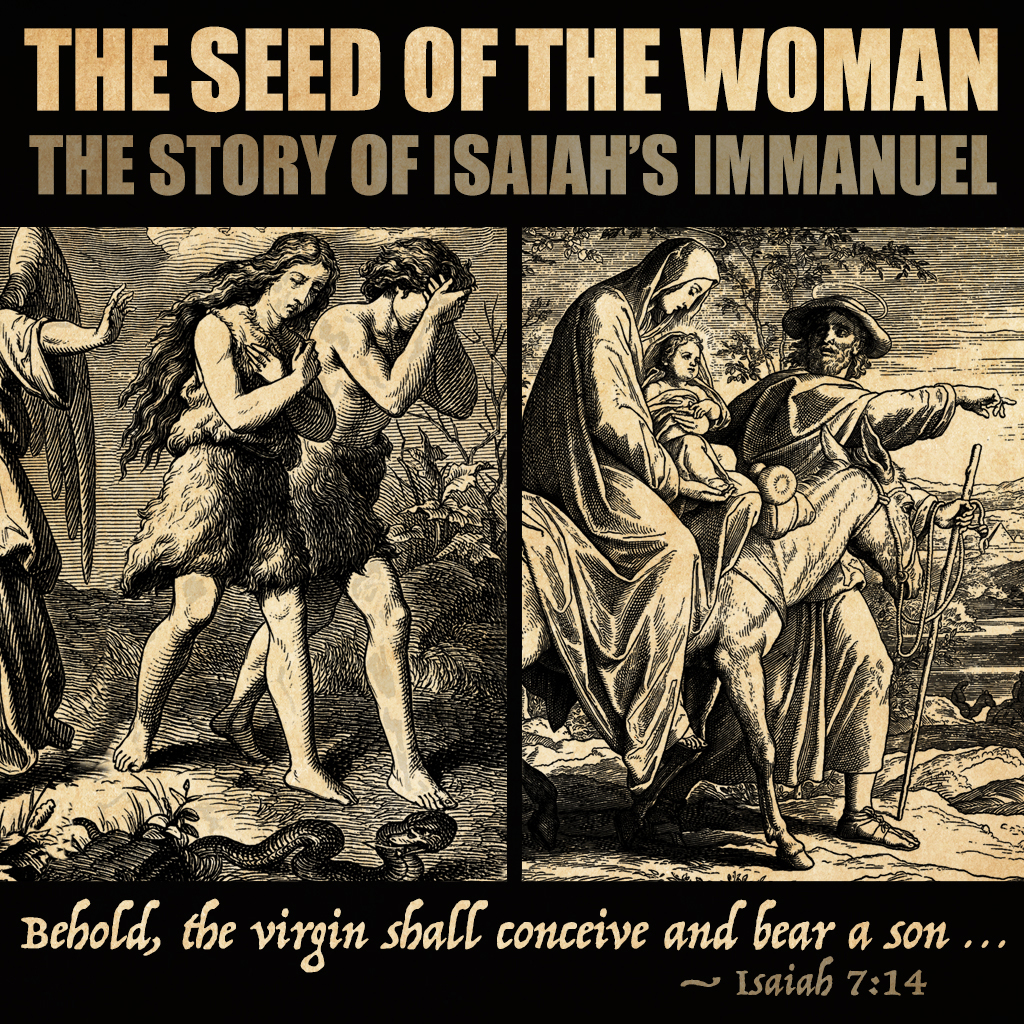
Seed of the Woman 1024x1024

Faith, Hope, Love, and a True Savior: Four Questions of Life and Death (Isaiah 36–39)

In Isaiah, the middle of the book presents us with a series of questions: Will you trust God when you are under threat? Will you turn to God when your life is in peril? Will you see God’s discipline as an act of love? And who is the king that can save you?

Truly, the book of Isaiah is not only one that foretells the coming of the messiah. It is also one that calls us to trust in the God who promised to send his Son as our messiah. In the events of Hezekiah’s life, which take center stage in Isaiah 36–39, we find an example of how one man trusted God and then failed to trust God. Indeed, Isaiah 36–39 is both a living parable for believers and a series of historical events that moves the story along in Isaiah’s long book.

On Sunday I preached a sermon these four chapters, complete with a spiritual parable about squirrels. If you are looking to learn how to have faith, hope, and love in the midst of hard times, this sermon may serve you well. In looking at Hezekiah’s faith and folly, we learn how to trust God and how to look for the greater king to come, the son of David who is greater than Hezekiah, the greatest of Israel’s kings (2 Kgs. 18:5).

Indeed, during this advent season, we continue to walk through Isaiah’s Gospel in order to see God’s plan of salvation. And in God’s plan of salvation, we not only find the promise of a king who will save his people (Matt. 1:21). We also find instructions for how the people of God shall respond to this Savior-King. To that end, you can listen to this sermon on Isaiah 36–39 to see how God calls us to trust him even when it costs us. This handout on Isaiah 36–39 may also help you to see what is in the text.

Until next time, let us continue to proclaim Christ from all Scriptures in order to make disciples of all the nations.

Soli Deo Gloria, ds