
One of the most challenging aspects of reading the Bible is applying the old covenant law to the new covenant follower of Christ. As the book Five Views on Law and Gospel illustrates, there are multiple ways in which Christians have sought to apply the Old Testament and its legal demands to the church today. And one of the most familiar ways is to differentiate three parts of the law.
Typically divided as moral, civil, and ceremonial, the tripartite approach to the Old Testament argues that some laws are eternal and unchanging (the moral); others are related to the theocracy given to Israel (the civil); still others are related to the system of priests, sacrifices, and the temple (the ceremonial). In Christ, the civil and ceremonial came to their completion, while the moral law continues unabated.
The trouble with this approach is that the Old Testament never specifies the tripartite division and in many places the moral, civil, and ceremonial overlap. Still, we must make some sense of the way parts of the law continue and others do not. And historically, the tripartite division has a long tradition of helping Christians think carefully about the Bible, the Law, and the Gospel. Still, it is not the only way and there may be better approaches.

Addressing this subject, I have found help in the way Jonathan Lunde uses three images to describe the way in which Christ fulfills the law. In his book Following Jesus, the Servant King, he spends three chapters outlining the way Christ fulfills the law of Moses. Focusing much of his attention on the Sermon on the Mount, he specifies the way Christ functions as filter, lens, and prism. In some ways, Christ brings the laws of Moses to an end (filter); in others, he clarifies what the law already meant (lens); and still in other ways, he heightens the demands of the law (prism).
While these three approaches (filter, lens, prism) are extra-textual and only illustrative, I find them more helpful in getting at what the text says. They make us consider what Jesus does and does not say about the law. And instead of foisting an extra-textual grid on the Bible, like the tripartite division of the law, they make us listen closely to the text itself to see how Jesus mediates between old and new covenants.
Because this approach is explicitly Christ-centered, in a way that the tripartite division of the law is not, I find it to be a surer guide. Likewise, because it does not create a whole system of categorization (which the Bible does not have), it lets the text of Scripture speak. It also permits more freedom to disagree about certain points—as I do below in two ways—and helps us go back to the feet of Jesus to learn how he approaches the old and new covenants. Continue reading →
 Discipling: How to Help Others Follow Jesus by Mark Dever is one of the most practical books on discipling I’ve read on the subject. And the reason why it is so practical is its unrelenting focus on the local church.
 In Matthew 5:17 Jesus says that he has not come to abolish the Law or the Prophets, but to fulfill them. And as D. A. Carson has observed about these verses, “The theological and canonical ramifications of one’s exegetical conclusions . . . are so numerous that discussion becomes freighted with the intricacies of biblical theology” (“
 Hunger. It’s one of the most basic of human desires. And in the Bible it is one of the most important concepts related to salvation, faith, and one’s experience with God.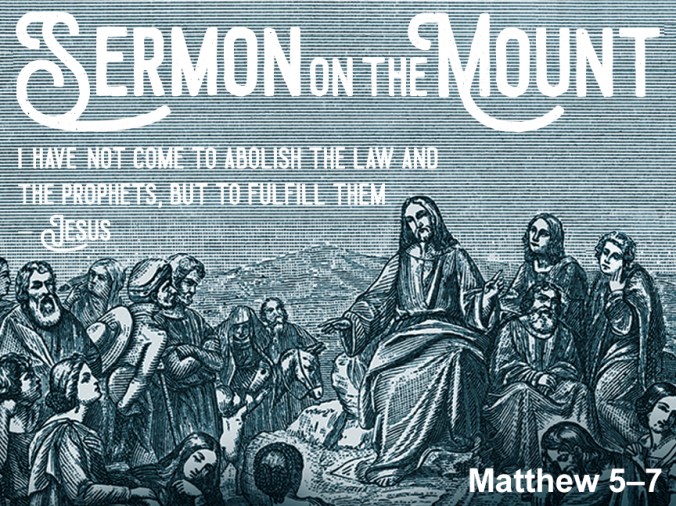
 “Disciples make disciples”
 In Matthew 5:21–26 Jesus outlines his interpretation and application of the sixth command, “Thou shall not murder” (Exod 20:13; Deut 5:17). And though Jesus words are only six verses in length, we can learn at least eleven truths about anger from Christ’s wise words.
 What is the Sermon on the Mount about? And more basically, what is the Sermon on the Mount? Is it a newer, more stringent law for Christ’s disciples? Is it an ideal which drives disciples to seek mercy? How should we understand it?
 When reading Matthew 5:21–26, the first of six illustrations from Jesus on how to read and apply the Law of Moses, there are a number of interpretive factors to consider. In fact, we need to consider the meaning of the “anger,” the relationship of the Law-covenant to the Jesus’s fulfillment, and the way Jesus employs imagery from the first recorded murder.
 Via Emmaus