Via Emmaus on the Road: Hebrews 11

Further Resources


Hebrews 11 (ESV)

By Faith

11 Now faith is the assurance of things hoped for, the conviction of things not seen. For by it the people of old received their commendation. By faith we understand that the universe was created by the word of God, so that what is seen was not made out of things that are visible.

By faith Abel offered to God a more acceptable sacrifice than Cain, through which he was commended as righteous, God commending him by accepting his gifts. And through his faith, though he died, he still speaks. By faith Enoch was taken up so that he should not see death, and he was not found, because God had taken him. Now before he was taken he was commended as having pleased God. And without faith it is impossible to please him, for whoever would draw near to God must believe that he exists and that he rewards those who seek him. By faith Noah, being warned by God concerning events as yet unseen, in reverent fear constructed an ark for the saving of his household. By this he condemned the world and became an heir of the righteousness that comes by faith.

By faith Abraham obeyed when he was called to go out to a place that he was to receive as an inheritance. And he went out, not knowing where he was going. By faith he went to live in the land of promise, as in a foreign land, living in tents with Isaac and Jacob, heirs with him of the same promise. 10 For he was looking forward to the city that has foundations, whose designer and builder is God. 11 By faith Sarah herself received power to conceive, even when she was past the age, since she considered him faithful who had promised. 12 Therefore from one man, and him as good as dead, were born descendants as many as the stars of heaven and as many as the innumerable grains of sand by the seashore.

13 These all died in faith, not having received the things promised, but having seen them and greeted them from afar, and having acknowledged that they were strangers and exiles on the earth. 14 For people who speak thus make it clear that they are seeking a homeland. 15 If they had been thinking of that land from which they had gone out, they would have had opportunity to return. 16 But as it is, they desire a better country, that is, a heavenly one. Therefore God is not ashamed to be called their God, for he has prepared for them a city.

17 By faith Abraham, when he was tested, offered up Isaac, and he who had received the promises was in the act of offering up his only son, 18 of whom it was said, “Through Isaac shall your offspring be named.” 19 He considered that God was able even to raise him from the dead, from which, figuratively speaking, he did receive him back. 20 By faith Isaac invoked future blessings on Jacob and Esau. 21 By faith Jacob, when dying, blessed each of the sons of Joseph, bowing in worship over the head of his staff. 22 By faith Joseph, at the end of his life, made mention of the exodus of the Israelites and gave directions concerning his bones.

23 By faith Moses, when he was born, was hidden for three months by his parents, because they saw that the child was beautiful, and they were not afraid of the king’s edict. 24 By faith Moses, when he was grown up, refused to be called the son of Pharaoh’s daughter, 25 choosing rather to be mistreated with the people of God than to enjoy the fleeting pleasures of sin. 26 He considered the reproach of Christ greater wealth than the treasures of Egypt, for he was looking to the reward. 27 By faith he left Egypt, not being afraid of the anger of the king, for he endured as seeing him who is invisible. 28 By faith he kept the Passover and sprinkled the blood, so that the Destroyer of the firstborn might not touch them.

29 By faith the people crossed the Red Sea as on dry land, but the Egyptians, when they attempted to do the same, were drowned. 30 By faith the walls of Jericho fell down after they had been encircled for seven days. 31 By faith Rahab the prostitute did not perish with those who were disobedient, because she had given a friendly welcome to the spies.

32 And what more shall I say? For time would fail me to tell of Gideon, Barak, Samson, Jephthah, of David and Samuel and the prophets— 33 who through faith conquered kingdoms, enforced justice, obtained promises, stopped the mouths of lions, 34 quenched the power of fire, escaped the edge of the sword, were made strong out of weakness, became mighty in war, put foreign armies to flight. 35 Women received back their dead by resurrection. Some were tortured, refusing to accept release, so that they might rise again to a better life. 36 Others suffered mocking and flogging, and even chains and imprisonment. 37 They were stoned, they were sawn in two, they were killed with the sword. They went about in skins of sheep and goats, destitute, afflicted, mistreated— 38 of whom the world was not worthy—wandering about in deserts and mountains, and in dens and caves of the earth.

39 And all these, though commended through their faith, did not receive what was promised, 40 since God had provided something better for us, that apart from us they should not be made perfect.

Soli Deo Gloria!
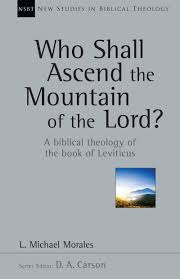
‘Sin Crouching at the Door’ or ‘A Sin Offering at the Gate’: Michael Morales on Genesis 4:7

morales

If you do well, will you not be accepted?
And if you do not do well, sin is crouching at the door.
Its desire is contrary to you, but you must rule over it.”
— Genesis 4:7 —

In one of the best books I read last year—a biblical theology of Leviticus—Michael Morales (Who Shall Ascend the Mountain of the Lord?offers an alternative reading to Genesis 4:7. Actually, he recalls a traditional reading found in commentators like Adam Clarke (1762–1832), Adoniram Judson (1788–1850), Young’s Literal Translation (1862), Jamieson, Fausset, and Brown (1877), and Matthew Henry (1662–1714) (p. 57n51).

Commenting on the way sin crouches at the door, he argues that the language could also be render “sin offering,” and that there is good reason for seeing the door, or gate, is the place where the sons of Adam brought their sin offerings—or, should have brought their sin offerings.

I appreciate this interpretation as it pays careful attention to the cultic themes of Genesis (i.e., temple, sacrifice, priesthood) and the way it explains in more objective terms why Cain’s offering is rejected and Abel’s is accepted. The reason? The former rejected God’s Word and Gods’ way; he brought a sacrifice of his own choosing, rather than the sin offering which God prescribed. Meanwhile, Abel brought a offering which responded to God’s Word in faith and sought atonement for his sin.

Read in the context of Moses’s five books, this seems like a superior interpretation, as Morales explains further. Continue reading

Faith Works: The Obedience of Faith in Hebrews 11

In 1993, John MacArthur released the book Faith Works: The Gospel According to the ApostlesIn his book, he showed how the apostles consistently speak of faith as resulting in  good works. This is a doctrine—sometimes called Lordship Salvation; or, historically a defense against antinomianism—that I have embraced for a long time. This week, however, another passage supporting this doctrine came to the forefront of my mind. The passage is the much beloved Hebrews 11.

The use of this passage in the debate is certainly not new, but it was a passage that I had not really considered in the debates surrounding faith and works.  Typically, I would look to Galatians 5:6; Ephesians 2:10; or James 2.  However, after spending some time on Hebrews 11, I am convinced, it is just as persuasive. Consider with me. Continue reading

A Bag of Treats or a River of Delights: A Halloween Parable

In a few weeks children, teenagers, and some adults will adorn super-hero suits, clown wigs, and other silly costumes all for the purpose of having some seasonal fun and gathering a bag full of candy.  Good Christians differ on what to do with this holiday, and without stepping into that firing line, I simply want to take note of the way that Halloween is a dramatic parable of the fleeting pleasures of sin handed out by the houses of this world.

In Hebrews 11, Moses is described as a man of faith because “he considered the reproach of Christ greater wealth than the treasures of Egypt” (v. 26).  Because he was looking to the reward, he chose to be “mistreated with the people of God rather than to enjoy the fleeting pleasures of sin” (v. 25).  With heaven in view, he sought God’s reward, instead of the treats of this age.

The same was true of Abraham.  Earlier in Hebrews 11, the father of faith is depicted as a man whose hope is set on the city whose architect and builder is God (v. 10).  Scripture says of him and his offspring, “If they had been thinking of that land from which they had gone out, they would have had opportunity to return.  But as it is, they desire a better country, that is, a heavenly one” (v. 15-16).

In these statements, we see that hope in God’s rewards defines the life of the Christian (Heb 11:6). While we do not yet see our treasure, we believe in the promises of God that Christ has gone away to prepare a place for us (John 14:2; Heb 11:16).  We live in this reality. We say no to the world’s offerings because our hearts are in love with the world to come.

Here is where Halloween provides such a fitting parable.  As trick-or-treaters dress up in search of candy, they hope to collect a sack full of Hershey miniatures and Starburst packets.  On that night, the collection is sweet.  Serious trick-or-treaters know where the best candy is, and they get there early to pull in the full-sized Snickers or Silver Dollar.  Yet, all that is gained on that single night is soon eaten and the costume outdated or outgrown.

The joy of Halloween is as light as cotton candy and as long-lasting as cheap gum.  Contrast this with the joy that comes from the Lord.  Psalm 16:11 says, “In God’s presence is fullness of joy and at your right hand are pleasures evermore.” So too, Psalm 46 describes his dwelling place as possessing “a river whose streams make glad the city of God, the holy habitation of the Most High.  God is in the midst of her; she shall not be moved; God will help her when morning dawns” (v. 4-5).

In terms of our parable, God’s house is the one who doesn’t stop you at the door.  He doesn’t demand a trick.  He doesn’t leave you hungry by giving you an itty-bitty bag of candy-coated chocolate.  Rather, his guests are invited to come and dine with him.  His food is satisfying and cost of admission is free.

But here is the rub.  In order to arrive at his home, the Christian must pass by all the other doors.  He must say “no” to constant offers of SweetTarts, Smarties, and Milk Duds.  Even when hunger sets in, he must keep plodding towards the mansion on the hill, whose invitation to dine with the king is sweeter than the houses in the valley of death.

So how will the Christian make it?  Like Moses and Abraham, he must keep before him the promises of God and the reward at the end.  Christian faith is not meant to be a stoic battle of the will, that says “I will do right, even when I don’t feel like it.”  No.  The Christian faith is much more like a long journey that says I will say “no” to the hospitality of this world, because I have the promise of an outstanding feast with the king ahead (See Isaiah 25:5-9).

To the world, this kind of reasoning sounds unappetizing.  They will say, “Just Trick or Treat!”  But to the Christian who takes God at his word, he becomes like the child who forsakes the city block to travel into the country to find the home he has never seen, but who has promised a Christmas dinner that is more than he could ask or imagine.

This fall, as you see children dressed in costume and pursuing an abundance of sugary treats, whether you partake or not, remember that such is the feasting of the world.  It comes through personal effort; it lasts for only a night; and its fruits fade away within days.  Contrast this with the city of God and the house of our Lord, whose gifts are never so small, never so fleeting, and never so empty… they only take time for them to come to us!

May we like Moses reject the fleeting treats of this world, because we remember that filling our bags with them is the devil’s trick.

Soli Deo Gloria, dss