Via Emmaus on the Road: Acts 2

Further Resources

Acts 2 (ESV)

The Coming of the Holy Spirit

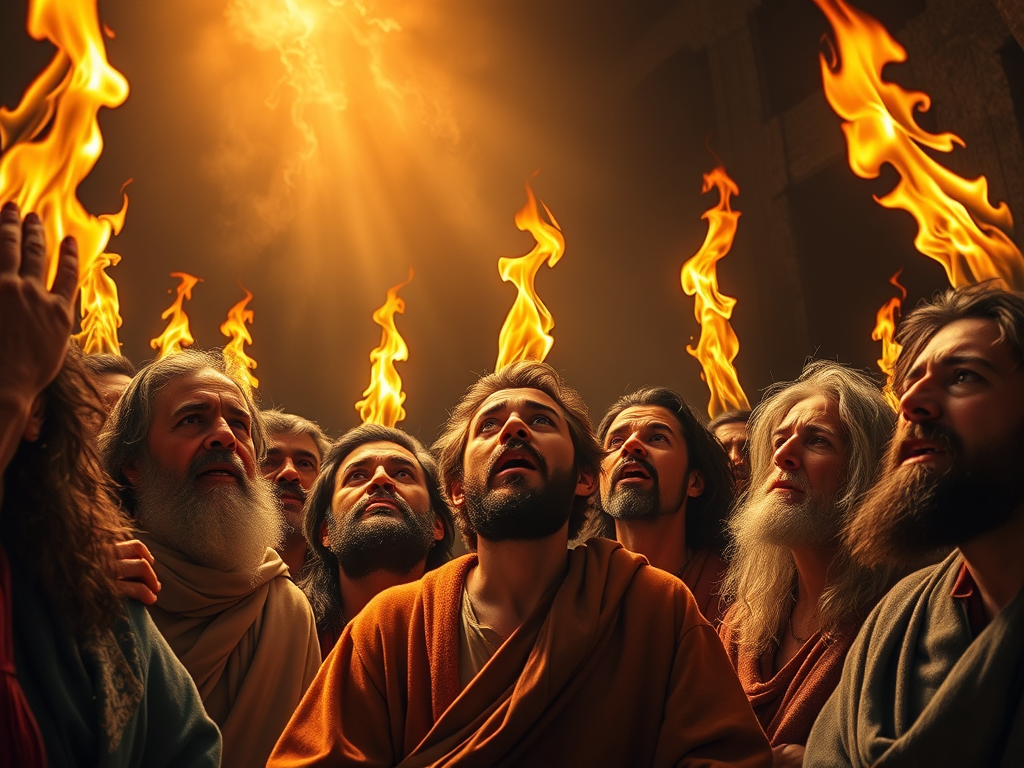
When the day of Pentecost arrived, they were all together in one place. And suddenly there came from heaven a sound like a mighty rushing wind, and it filled the entire house where they were sitting. And divided tongues as of fire appeared to them and rested on each one of them. And they were all filled with the Holy Spirit and began to speak in other tongues as the Spirit gave them utterance.

Now there were dwelling in Jerusalem Jews, devout men from every nation under heaven. And at this sound the multitude came together, and they were bewildered, because each one was hearing them speak in his own language. And they were amazed and astonished, saying, “Are not all these who are speaking Galileans? And how is it that we hear, each of us in his own native language? Parthians and Medes and Elamites and residents of Mesopotamia, Judea and Cappadocia, Pontus and Asia, 10 Phrygia and Pamphylia, Egypt and the parts of Libya belonging to Cyrene, and visitors from Rome, 11 both Jews and proselytes, Cretans and Arabians—we hear them telling in our own tongues the mighty works of God.” 12 And all were amazed and perplexed, saying to one another, “What does this mean?” 13 But others mocking said, “They are filled with new wine.”

Peter’s Sermon at Pentecost

14 But Peter, standing with the eleven, lifted up his voice and addressed them: “Men of Judea and all who dwell in Jerusalem, let this be known to you, and give ear to my words. 15 For these people are not drunk, as you suppose, since it is only the third hour of the day. 16 But this is what was uttered through the prophet Joel:

17  “ ‘And in the last days it shall be, God declares,

that I will pour out my Spirit on all flesh,

and your sons and your daughters shall prophesy,

and your young men shall see visions,

and your old men shall dream dreams;

18  even on my male servants and female servants

in those days I will pour out my Spirit, and they shall prophesy.

19  And I will show wonders in the heavens above

and signs on the earth below,

blood, and fire, and vapor of smoke;

20  the sun shall be turned to darkness

and the moon to blood,

before the day of the Lord comes, the great and magnificent day.

21  And it shall come to pass that everyone who calls upon the name of the Lord shall be saved.’

22 “Men of Israel, hear these words: Jesus of Nazareth, a man attested to you by God with mighty works and wonders and signs that God did through him in your midst, as you yourselves know— 23 this Jesus, delivered up according to the definite plan and foreknowledge of God, you crucified and killed by the hands of lawless men. 24 God raised him up, loosing the pangs of death, because it was not possible for him to be held by it. 25 For David says concerning him,

“ ‘I saw the Lord always before me,

for he is at my right hand that I may not be shaken;

26  therefore my heart was glad, and my tongue rejoiced;

my flesh also will dwell in hope.

27  For you will not abandon my soul to Hades,

or let your Holy One see corruption.

28  You have made known to me the paths of life;

you will make me full of gladness with your presence.’

29 “Brothers, I may say to you with confidence about the patriarch David that he both died and was buried, and his tomb is with us to this day. 30 Being therefore a prophet, and knowing that God had sworn with an oath to him that he would set one of his descendants on his throne, 31 he foresaw and spoke about the resurrection of the Christ, that he was not abandoned to Hades, nor did his flesh see corruption. 32 This Jesus God raised up, and of that we all are witnesses. 33 Being therefore exalted at the right hand of God, and having received from the Father the promise of the Holy Spirit, he has poured out this that you yourselves are seeing and hearing. 34 For David did not ascend into the heavens, but he himself says,

“ ‘The Lord said to my Lord,

“Sit at my right hand,

35  until I make your enemies your footstool.” ’

36 Let all the house of Israel therefore know for certain that God has made him both Lord and Christ, this Jesus whom you crucified.”

37 Now when they heard this they were cut to the heart, and said to Peter and the rest of the apostles, “Brothers, what shall we do?” 38 And Peter said to them, “Repent and be baptized every one of you in the name of Jesus Christ for the forgiveness of your sins, and you will receive the gift of the Holy Spirit. 39 For the promise is for you and for your children and for all who are far off, everyone whom the Lord our God calls to himself.” 40 And with many other words he bore witness and continued to exhort them, saying, “Save yourselves from this crooked generation.” 41 So those who received his word were baptized, and there were added that day about three thousand souls.

The Fellowship of the Believers

42 And they devoted themselves to the apostles’ teaching and the fellowship, to the breaking of bread and the prayers. 43 And awe came upon every soul, and many wonders and signs were being done through the apostles. 44 And all who believed were together and had all things in common. 45 And they were selling their possessions and belongings and distributing the proceeds to all, as any had need. 46 And day by day, attending the temple together and breaking bread in their homes, they received their food with glad and generous hearts, 47 praising God and having favor with all the people. And the Lord added to their number day by day those who were being saved.

Soli Deo Gloria!

Via Emmaus on the Road: John 7

Further Resources

John 7 (ESV)

Jesus at the Feast of Booths

After this Jesus went about in Galilee. He would not go about in Judea, because the Jews were seeking to kill him. Now the Jews’ Feast of Booths was at hand. So his brothers said to him, “Leave here and go to Judea, that your disciples also may see the works you are doing. For no one works in secret if he seeks to be known openly. If you do these things, show yourself to the world.” For not even his brothers believed in him. Jesus said to them, “My time has not yet come, but your time is always here. The world cannot hate you, but it hates me because I testify about it that its works are evil. You go up to the feast. I am not going up to this feast, for my time has not yet fully come.” After saying this, he remained in Galilee.

10 But after his brothers had gone up to the feast, then he also went up, not publicly but in private. 11 The Jews were looking for him at the feast, and saying, “Where is he?” 12 And there was much muttering about him among the people. While some said, “He is a good man,” others said, “No, he is leading the people astray.” 13 Yet for fear of the Jews no one spoke openly of him.

14 About the middle of the feast Jesus went up into the temple and began teaching. 15 The Jews therefore marveled, saying, “How is it that this man has learning, when he has never studied?” 16 So Jesus answered them, “My teaching is not mine, but his who sent me. 17 If anyone’s will is to do God’s will, he will know whether the teaching is from God or whether I am speaking on my own authority. 18 The one who speaks on his own authority seeks his own glory; but the one who seeks the glory of him who sent him is true, and in him there is no falsehood. 19 Has not Moses given you the law? Yet none of you keeps the law. Why do you seek to kill me?” 20 The crowd answered, “You have a demon! Who is seeking to kill you?” 21 Jesus answered them, “I did one work, and you all marvel at it. 22 Moses gave you circumcision (not that it is from Moses, but from the fathers), and you circumcise a man on the Sabbath. 23 If on the Sabbath a man receives circumcision, so that the law of Moses may not be broken, are you angry with me because on the Sabbath I made a man’s whole body well? 24 Do not judge by appearances, but judge with right judgment.”

Can This Be the Christ?

25 Some of the people of Jerusalem therefore said, “Is not this the man whom they seek to kill? 26 And here he is, speaking openly, and they say nothing to him! Can it be that the authorities really know that this is the Christ? 27 But we know where this man comes from, and when the Christ appears, no one will know where he comes from.” 28 So Jesus proclaimed, as he taught in the temple, “You know me, and you know where I come from. But I have not come of my own accord. He who sent me is true, and him you do not know. 29 I know him, for I come from him, and he sent me.” 30 So they were seeking to arrest him, but no one laid a hand on him, because his hour had not yet come. 31 Yet many of the people believed in him. They said, “When the Christ appears, will he do more signs than this man has done?”

Officers Sent to Arrest Jesus

32 The Pharisees heard the crowd muttering these things about him, and the chief priests and Pharisees sent officers to arrest him. 33 Jesus then said, “I will be with you a little longer, and then I am going to him who sent me. 34 You will seek me and you will not find me. Where I am you cannot come.” 35 The Jews said to one another, “Where does this man intend to go that we will not find him? Does he intend to go to the Dispersion among the Greeks and teach the Greeks? 36 What does he mean by saying, ‘You will seek me and you will not find me,’ and, ‘Where I am you cannot come’?”

Rivers of Living Water

37 On the last day of the feast, the great day, Jesus stood up and cried out, “If anyone thirsts, let him come to me and drink. 38 Whoever believes in me, as the Scripture has said, ‘Out of his heart will flow rivers of living water.’ ” 39 Now this he said about the Spirit, whom those who believed in him were to receive, for as yet the Spirit had not been given, because Jesus was not yet glorified.

Division Among the People

40 When they heard these words, some of the people said, “This really is the Prophet.” 41 Others said, “This is the Christ.” But some said, “Is the Christ to come from Galilee? 42 Has not the Scripture said that the Christ comes from the offspring of David, and comes from Bethlehem, the village where David was?” 43 So there was a division among the people over him. 44 Some of them wanted to arrest him, but no one laid hands on him.

45 The officers then came to the chief priests and Pharisees, who said to them, “Why did you not bring him?” 46 The officers answered, “No one ever spoke like this man!” 47 The Pharisees answered them, “Have you also been deceived? 48 Have any of the authorities or the Pharisees believed in him? 49 But this crowd that does not know the law is accursed.” 50 Nicodemus, who had gone to him before, and who was one of them, said to them, 51 “Does our law judge a man without first giving him a hearing and learning what he does?” 52 They replied, “Are you from Galilee too? Search and see that no prophet arises from Galilee.”

Soli Deo Gloria!

Via Emmaus on the Road: John 4

Further Resources


2:1–11

2:12

2:13–3:21

3:22–36

4:1–42

4:43–45

4:46–54

Cana in

Galilee

Capernaum

(in Galilee)

Jerusalem Courts

Judea

Samaria

The Well

Galilee

Cana in

Galilee

Jerusalem House

Samaritan Homes

Wedding with family + disciples

Levitical city (?) – purification jars

Mother

Brothers

Disciples

Pharisees and the Ds (2:13–25)

Nicodemus (3:1–21)

John the Baptist

Samaritan Woman
(4:1–24)

Samaritans & Disciples (4:25–42)

Hometown

Raised son Gentile (?) Official


Night (3:2)

Day

Midday (4:6)


Passover (2:23)


Passover (4:45)


John 4 (ESV)

Jesus and the Woman of Samaria

Now when Jesus learned that the Pharisees had heard that Jesus was making and baptizing more disciples than John 2(although Jesus himself did not baptize, but only his disciples), he left Judea and departed again for Galilee. And he had to pass through Samaria. So he came to a town of Samaria called Sychar, near the field that Jacob had given to his son Joseph. Jacob’s well was there; so Jesus, wearied as he was from his journey, was sitting beside the well. It was about the sixth hour.

A woman from Samaria came to draw water. Jesus said to her, “Give me a drink.” (For his disciples had gone away into the city to buy food.) The Samaritan woman said to him, “How is it that you, a Jew, ask for a drink from me, a woman of Samaria?” (For Jews have no dealings with Samaritans.) 10 Jesus answered her, “If you knew the gift of God, and who it is that is saying to you, ‘Give me a drink,’ you would have asked him, and he would have given you living water.” 11 The woman said to him, “Sir, you have nothing to draw water with, and the well is deep. Where do you get that living water? 12 Are you greater than our father Jacob? He gave us the well and drank from it himself, as did his sons and his livestock.” 13 Jesus said to her, “Everyone who drinks of this water will be thirsty again, 14 but whoever drinks of the water that I will give him will never be thirsty again. The water that I will give him will become in him a spring of water welling up to eternal life.” 15 The woman said to him, “Sir, give me this water, so that I will not be thirsty or have to come here to draw water.”

16 Jesus said to her, “Go, call your husband, and come here.” 17 The woman answered him, “I have no husband.” Jesus said to her, “You are right in saying, ‘I have no husband’; 18 for you have had five husbands, and the one you now have is not your husband. What you have said is true.” 19 The woman said to him, “Sir, I perceive that you are a prophet. 20 Our fathers worshiped on this mountain, but you say that in Jerusalem is the place where people ought to worship.” 21 Jesus said to her, “Woman, believe me, the hour is coming when neither on this mountain nor in Jerusalem will you worship the Father. 22 You worship what you do not know; we worship what we know, for salvation is from the Jews. 23 But the hour is coming, and is now here, when the true worshipers will worship the Father in spirit and truth, for the Father is seeking such people to worship him. 24 God is spirit, and those who worship him must worship in spirit and truth.” 25 The woman said to him, “I know that Messiah is coming (he who is called Christ). When he comes, he will tell us all things.” 26 Jesus said to her, “I who speak to you am he.”

27 Just then his disciples came back. They marveled that he was talking with a woman, but no one said, “What do you seek?” or, “Why are you talking with her?” 28 So the woman left her water jar and went away into town and said to the people, 29 “Come, see a man who told me all that I ever did. Can this be the Christ?” 30 They went out of the town and were coming to him.

31 Meanwhile the disciples were urging him, saying, “Rabbi, eat.” 32 But he said to them, “I have food to eat that you do not know about.” 33 So the disciples said to one another, “Has anyone brought him something to eat?” 34 Jesus said to them, “My food is to do the will of him who sent me and to accomplish his work. 35 Do you not say, ‘There are yet four months, then comes the harvest’? Look, I tell you, lift up your eyes, and see that the fields are white for harvest. 36 Already the one who reaps is receiving wages and gathering fruit for eternal life, so that sower and reaper may rejoice together. 37 For here the saying holds true, ‘One sows and another reaps.’ 38 I sent you to reap that for which you did not labor. Others have labored, and you have entered into their labor.”

39 Many Samaritans from that town believed in him because of the woman’s testimony, “He told me all that I ever did.” 40 So when the Samaritans came to him, they asked him to stay with them, and he stayed there two days. 41 And many more believed because of his word. 42 They said to the woman, “It is no longer because of what you said that we believe, for we have heard for ourselves, and we know that this is indeed the Savior of the world.”

43 After the two days he departed for Galilee. 44 (For Jesus himself had testified that a prophet has no honor in his own hometown.) 45 So when he came to Galilee, the Galileans welcomed him, having seen all that he had done in Jerusalem at the feast. For they too had gone to the feast.

Jesus Heals an Official’s Son

46 So he came again to Cana in Galilee, where he had made the water wine. And at Capernaum there was an official whose son was ill. 47 When this man heard that Jesus had come from Judea to Galilee, he went to him and asked him to come down and heal his son, for he was at the point of death. 48 So Jesus said to him, “Unless you see signs and wonders you will not believe.” 49 The official said to him, “Sir, come down before my child dies.” 50 Jesus said to him, “Go; your son will live.” The man believed the word that Jesus spoke to him and went on his way. 51 As he was going down, his servants met him and told him that his son was recovering. 52 So he asked them the hour when he began to get better, and they said to him, “Yesterday at the seventh hour the fever left him.” 53 The father knew that was the hour when Jesus had said to him, “Your son will live.” And he himself believed, and all his household. 54 This was now the second sign that Jesus did when he had come from Judea to Galilee.

Soli Deo Gloria!

Twelve Ways to Order Your Week by the Son (Part 2)

Last week, in application of a recent sermon, I outlined six ways to set your watch by the Son. In order, these included.

  1. Start your day with God.
  2. Consume God’s Word on the way and make plans to feed on his faithfulness.
  3. Pray without ceasing.
  4. Make a midweek gathering a priority.
  5. Preserve and protect the altar.
  6. Make space in your calendar to meet with other Christians.

By and large, these six orientations were given as guides for making the most of the time between the time you gather for worship on the Lord’s Day. Today, I am adding six more ‘Helio’-centric orientations. Here they are.

  1. Enter the darkness of the city with the light of Christ.
  2. Lead others (family, friends, peers, strangers) to the altar of God on the Lord’s Day.
  3. When home (on Sundays), look for ways to bless the people who gather at your altar.
  4. When traveling (on Sundays), look for other faithful altars to visit and encourage.
  5. When sick (on Sundays), lament your absence.
  6. In each season, solidify your schedule and guard your time with God.

As you can tell, four of these orientations are directly related to the Lord’s Day (8–11). And three of them are directed to ways to make the best use of the Lord’s Day (9–11). In all, I hope these 12 orientations help you reflect on the best ways to order your week in a way that is centered on Christ. For a further reflection on these twelve points, you can listen to my Sunday School lesson.

Continue reading

Twelve Ways to Order Your Week by the Son (Part 1)

Last Sunday I preached a sermon entitled, “Keeping Time at the Altar By Setting Your Watch by the Son.” That sermon was part two of series of sermons explicating Genesis 8:20–9:7. You can find the introduction here. In all, my aim is to help members of my church, who are new creations in Christ (2 Cor. 5:17), order their lives by the pattern that comes in the New Creation. And, because Genesis 8:20–9:7, offers a glimpse of the new creation and that pattern, we are looking at each part. (For an overview of the whole pattern see this sermon on Genesis 8–9).

In the first sermon in this series, I argued that Christians should arrange their lives around the altar, which today occurs when the saints gather on the Lord’s Day to worship Christ. Yet, what do those saints do for the other six days of the week? That is what I attempted to answer in the second sermon. And in that sermon, I took three steps to move from (1) Israel’s calendar in Leviticus 23, to (2) Christ’s fulfillment of that calendar, to (3) our lives that should center themselves on Christ. If you want to see how this biblical theology moves to Christ, listen to the sermon. Yet, in that sermon I left out what I am writing here (in two parts)—12 ways to order your week by the Son.

Truly, if Christ has purchased us (1 Cor. 6:20), we are not free to do with our time whatever we want. Instead, as Paul puts it in Galatians 5:13, “you were called to freedom, brothers. Only do not use your freedom as an opportunity for the flesh, but through love serve one another.” Paul’s focus in this verse relates to the law, but part of that law relates to time—i.e., the Sabbatical Calendar (see Exod. 23:10–19; Lev. 23:1–44; Deut. 15:1–16:17).

Israel, as God’s son, was too immature to rightly define their own time. Rather, as Galatians 4:1–2 tells us, God’s children were treated as slaves and put under a guardian (the law) until the proper time. Jesus himself was born under the Law (Gal. 4:4) and had to keep the entire law, including all the commands related to the Sabbath. Yet, in keeping the Sabbath, he not only became the Sabbath-giver (cf. Matt. 11:28–30) but also reordered the calendar, such that annual feasts (like Passover) and mid-year rituals (like Yom Kippur) were all fulfilled in him.

In the New Testament, the consequence of this eschatological change was that the people of God now worshiped on the Lord’s Day, as found in 1 Corinthians 16:1–2; Acts 20:7; and Revelation 1:10. Indeed, as Jesus fulfilled and transmogrified the Passover into the Lord’s Supper, this became a weekly feast to be enjoyed everywhere God’s people gathered (1 Cor. 1:3; cf. Mal. 1:11), not just an annual feast celebrated in Jerusalem. To that end, the New Testament, as I understand it, defines Sunday (the Lord’s Day) as one day in seven to gather and worship. And this should be both the high point of the week and the central point of the Christian calendar.

Historically, liturgically, and confessionally this “Christian Sabbath” has been defined, specified, and applied in all sorts of ways. And at some point in the near future, I hope to say more about that. For now, I want to talk about the other days of the week and what Christians should do to orient themselves from and toward worship on the Lord’s Day.

Admittedly, these twelve orientations have to be general principles, not specific commands. And, if I am honest, these principles will need qualification that this article won’t have time to specify. Also, there are other principles that could be added to. So, don’t take this list as exhaustive or overly prescriptive. I am not trying to over-regulate what a Christian life looks like. Clearly, seasons in life, differing vocations, divergent interests, and various family dynamics will force these principles to form in asymmetrical ways. Over time, they will change in our lives, as well. That said, I am trying to offer wise counsel for those who are moving from the altar of God’s of worship to the city of their work.

In that way, take what is helpful. Retrofit what is partially helpful. And reject anything that stands in the way of walking faithfully with the Lord. Hopefully, however, there will be little rejection and much reflection. And so, to that end, here are twelve ways to order your week by the Son. Continue reading

On Earth, As It Is in Heaven: Making Plans That Please the Lord

Welcome to Quitter’s Day.

Until this week, I didn’t even know that such a day existed. Sure, I was familiar with the fact that the gym seems a lot less crowded by the end of January. But I didn’t know that we coronated the breaking of New Year’s resolution with an unofficial holiday. But some do, and today USA Today even ran a brief article on it.

Apparently, the Second Friday of the new year is dubbed Quitter’s Day because of the way that so many plans have been broken in the new year. To speak personally, my own Bible reading plans were thrown off yesterday because an early morning meeting took the place of my typical morning devotion. Yet, today I picked up the plan again, read yesterday’s Psalm (and todays), and continued in my reading in Matthew. Such is life.

If we are going to make progress in the world, we must make plans and keep them. And I suspect that everyone who makes and breaks a new year’s resolution to eat better, work out more, or spend less money—these are the Big 3, apparently—still maintains other plans. It’s not possible to finish a degree, order a home, build a career, or lead a team without making and keeping plans. Yes, some of us are better than others at making plans and keeping them, but part of being human is to order our steps for the purpose of accomplishing a goal.

In Proverbs, there are many such passages that describe this way of planning. Consider a few. In Proverbs 15:22, we learn that “without counsel plans fail, but with many advisers they succeed.” More positively, Proverbs 20:18 says, “Plans are established by counsel; by wise guidance wage war.” Later in Luke 14:31–33, Jesus will say something similar. When discussing what it takes to follow him, our Lord compared discipleship to kingship and the need to count the cost before engaging in war. Truly, planning is what kings do. And because humanity is given the task of ruling over the world, planning is part of what it means to be human.

Think about it. Before God made the world, he made a plan. And that plan included the “foundation of the world” (John 17), the storyline of history (Eph. 1:11; Rev. 13:8; 17:8), the cross of Christ (1 Pet. 1:20; cf. Acts 2:23; 4:27–28), and the election of every of sinner who would come to faith in Christ (Acts 13:48; Rom. 9:22–23). Indeed, the kingdom of God was not an after-thought in God’s mind; it was the reason why God created the world in the first place (Matt. 25:34). Though in time redemption came after creation, in the mind of God redemption in Christ came first. And thus, the world God made is filled with order, and if we are going to be like our Creator, we must order our days too. But how? Continue reading

Via Emmaus On the Road: A Brief Introduction

Via Emmaus 01

** Yes, this first episode only comes out one speaker. The next one will be better. And the one after that even more so. Or at least, that’s the plan. 

Introduction

In 2025, I am putting together a Bible reading plan for my family and a few others in my church. I am hosting that reading plan here and will start posting next Monday (January 6). Along the way, I hope to offer a short reflection (less than ten minutes) on each chapter of the New Testament (Monday-Friday). So, follow along, as we journey through the New Testament this year. And don’t stray too far from this website as I will point to other resources that might help reading the New Testament this year.

For now, here’s a quick list of navigation tools to acquire.

Navigation Tools to Acquire

Think Oregon Trail, the video game. Before starting reading through the New Testament, you will need to pick up a few resources. And below is a list of essential and premium supplies and/or strategies for reading the New Testament.

Essential

  • A Bible — You can’t read the Bible without a Bible, so find a Bible that you can read in 2025. And better than a Bible App, find a Bible you can hold in your hands.
  • A Notebook — In addition to prayer, Bible Study goes best with deliberate reflection. And reflection goes best with a place to write your thoughts down. So grab a notebook or a journaling Bible (see below).
  • A Weekly Questionnaire (see Week 1 ) — Each week, I will put up a set of questions to help you engage with the Bible. Print these out and use them as a guide, not a homework assignment. They are intended to help you see what is in the Bible, not to just get the right answer to the test.
  • Community — While we can read the Bible on our own, it is better to read the Bible and discuss it with others. That’s a point I made in this sermon, and it is something this Bible reading plan is intended to foster. Just as walking down the road goes better with others, so does reading Scripture.
  • A Place and Time — Finally, you will succeed in your Bible reading most if you commit to a place and time to read Scripture. For me, this is first thing in the morning. But for you, it could be at lunch, in your car, on a break, or before bed. Most importantly, find a fixed time and place and make it happen. And don’t be ashamed to ask God to help you or for friends / family to hold you accountable.

Premium

  • The ESV Bible Journal — This was a Christmas present to each of our kids, and it is a great way to read and reflect all in the same place. Right now, Amazon still has the whole New Testament half off.
  • A Study Bible — There are countless study Bibles to choose from, but you might find help by having one or two to answer questions as you go. The ESV Study Bible is still my favorite.
  • A Commentary — Going one step further, a commentary can help answer questions of history, culture, or language as you read. The New Bible Commentary is a good one-volume commentary.

The Basic Description of Via Emmaus On the Road

  • A 10 Minute Reflection on 1 Chapter of the Bible
  • 5 Days out of the Week, 52 Weeks out of the Year
  • Equals the Whole New Testament in a Year

May the Lord help us read his Word with understanding this year, and may his Word produce in us faith, hope, and love.

Soli Deo Gloria, ds

5 x 52: A New Testament Bible Reading Plan for 2025

How sweet are your words to my taste, sweeter than honey to my mouth!
— Psalm 119:103 —

But he answered, “It is written, ‘Man shall not live by bread alone,
but by every word that comes from the mouth of God.”
— Matthew 4:4 —

Did you know that there are 260 chapters in the New Testament? I am sure I had learned this number before, but I forgot about until the other day. Yet, with this numerological epiphany in view, my mind began to race and to consider what a fifty-two week Bible reading plan would look like for those just getting started.

Indeed, if you read five chapters of the New Testament, every week for 52 weeks, you would finish the whole New Testament in a year. Certainly, this feat can be accomplished in a much shorter period of time, and for those who have already adopted a pattern of reading the Bible, there is no reason to skip the Old Testament, or to take a whole year to read twenty-five percent of Scripture. For those with larger appetites for Scripture, this Bible reading plan may be too scant. Or, for reasons I’ll explain below, it might be a portion of your Bible reading to be joined with others.

Indeed, for those who have never read the Bible in a systematic way, I have rarely encourage reading through the whole thing to start. Just as newborn babes have small stomachs and need assistance in their eating, so do newborn babes in Christ. Certainly, there might be counter examples to this counsel, but as Scripture so regularly compares itself to bread (Matt. 4:4) and honey (Ps. 19:10), milk (1 Pet. 2:2) and meat (Heb. 6:12), I do believe it is wise to start out slow and build an appetite over time.

To that end, I’ve encouraged new Christians and newborn Bible readers to make use of the E-100 Scripture Reading Plan. In twenty weeks, this plan leads readers through the whole Bible. From Genesis to Revelation, it picks up some of the most important parts and helps show how the whole Bible fits together. Equally, Christianity Explored is a tremendous resource that introduces Christ through the Gospel of Mark.

To have a full-formed faith, one does need to read the whole Bible. But reading the whole Bible (by oneself) is—if we are honest—a mark of maturity, not a necessary prerequisite to faith or salvation. Even more, giving someone a Bible and the imperative, “Read!” might do more harm than good. Just consider how many people have burned out trying to read the whole Bible. And others, while reading the whole Bible might take up very idiosyncratic views of God and his Word, when they read Scripture without conversation or communion with others. Truly, God has given his church pastors and teachers for a reason (Eph. 4:11–16)—and that reason includes rightly interpreting God’s Word and protecting young Christians from error (Titus 1:9).

So, back to reading the New Testament.

In 2025, I am leading my family (with two teens and two pre-teens) to read five chapters a week for the whole year, with the goal of reading the whole New Testament. And to help them have a greater comprehension of what we are reading, I am putting together a few reading tools—tools that I will catalog here, if anyone else wants to jump in. Additionally, if all goes as planned (=if the Lord allows), I will record a short reflection on each chapter as we read, so that interested readers (my family and others) might have a growing interest and skill in reading God’s Word.

Continue reading

Jesus is Prophet, Priest, and King: A Good Friday Meditation

Into Thy HandsOn this Good Friday, I want to share a meditation from Alexander Watson (1815?–1865) related to the cross of Christ and the way Jesus’s death brought to fulfillment his triple office of prophet, priest, and king. But first, a little background.

Seven Sayings and Seven Sermons

For the last six years (beginning in 2018), I have preached a Good Friday sermon that has focused on one of Jesus’s words from the cross. In all, there are seven statements found across the four gospels. Here they are in order.

  1. Father, forgive them, for they know not what they do. (Luke 23:34)
  2. Truly, I say to you, today you will be with me in paradise. (Luke 23:43)
  3. Woman, behold your son . . . Son, behold your mother. (John 19:26–27)
  4. My God, My God, why have you forsaken me? (Matthew 27:46; Mark 15:43)
  5. I thirst. (John 19:28)
  6. It is finished. (John 19:30)
  7. Father, into your hands I commit my spirit (Luke 23:46)

You can also listen to these songs in Andrew Peterson’s Tenebrae.

For the last six years, I have preached six sermons. And you can find them here.

  1. Father, Forgive Them (2018)
  2. Today, You Will Be With Me In Paradise (2019, no audio)
  3. Woman, Behold Your Son (2020, Covid year)
  4. My God, My God, Why Have You Forsaken Me? (2021)
  5. I Thirst (2022)
  6. It is Finished (2023)
  7. Father, Into Your Hands I Commit My Spirit (2024)

Along the way, I have found great help in preparing these messages and thinking about the cross of Christ by reading Alexander Watson, The Seven Sayings on the Cross; Or, The Dying Christ Our Prophet, Priest, and King. Continue reading

Of Weddings and Witnessing: The Evangelistic Pressure to Stay Positive in a Negative World

wedding reception

For even if I made you grieve with my letter, I do not regret it—though I did regret it, for I see that that letter grieved you, though only for a while. As it is, I rejoice, not because you were grieved, but because you were grieved into repenting. For you felt a godly grief, so that you suffered no loss through us.

– 2 Corinthians 7:8–9 –

In a world without sin, sermons on marriage would not be needed.

In fact, without sin, pastors might not be needed either. Or at least, they would not be needed to condemn sin, preach repentance, or offer grace. They might be needed to organize the worship of God in Christ—for God, the almighty, good, and glorious Creator would still be praised. Or, they might be needed to study the history of God’s world and to report their findings.

But, in a world without sin, heralds of the gospel would not be called to preach Christ crucified for wicked sinners, for there would be no sin. Nor would such pastors have the task of identifying idols and destroying every false idea that stands against Christ. Instead, they could just be unswervingly cheerful.

Tragically, in a world overrun with sin, many preachers have taken this path. Famously, when Larry King asked Joel Osteen about the eternal condition of Jews, Muslims, and other unbelievers, Osteen said he didn’t like to talk about sin, only about love and what the Bible says about Jesus.

Yet, what does the Bible say about Jesus? And what does Jesus say about sin? Quite a bit, actually.

The whole reason the Son of God became man was to climb the hill of Calvary and put an end to sin and death. Jesus’s whole ministry consisted of preaching about the kingdom of God and calling sinners to repent (Mark 1:14–15). Thus, it is a misnomer to speak of Christ’s love without addressing man’s sin (cf. 1 John 4:10). Unless we address the wrath of God, we cannot understand his grace or preach his gospel. Continue reading