
Finding Life in Leviticus 19: Ten Gospel Notes for Social Justice Warriors

commandments-311202__480The Ten Commandments are listed twice in the Old Testament—once in Exodus 20; once in Deuteronomy 5. They are also explicated at least twice. After each list (Exodus 21–23 and Deuteronomy 12–25), Moses specifies and applies the Lord’s “ten words.” This means that we do not need to wait for Jesus’ Sermon on the Mount (Matthew 5–7) to get an inspired interpretation and application of these commands. There is, within the Torah itself, explanation and application.

In fact, there is one other passage on the Ten Commandments which stands between Exodus and Deuteronomy. In Leviticus 19 Moses records the holy standards of God and makes personal application to the people of Israel. In reading this chapter recently, I took note of ten observations related to the content and context of these laws. I share them here to help us to better understand the good purposes of God’s Law, and specifically to show how many modern desires are best fulfilled by God’s all-sufficient Word.

In short, Leviticus 19 is not an archaic list of do’s and don’ts; it is actually a personal application of the Law which deals with so many of the issues Social Justice Warriors seek out. Only because these “laws” are grounded in the personal, holy love of Israel’s God, they retain their life-giving shape—something that no human set of ordinances can ever do.

Take time to read Leviticus 19 and consider how these laws give life by leading members of God’s covenant to trust in him. Continue reading

Rightly Dividing the Cultural Background to 1 Corinthians 11

corinth

The Corinth Channel

There are a lot of cultural challenges to 1 Corinthians 11:2–16, a passage that invites discussion about the trinity, gender roles, the use of head coverings, and the role of angels in public worship. Tomorrow I will preach on this passage, but today I share a number of quotations from various commentaries related to various cultural and theological challenges in this passage. These quotes provide some background to this enigmatic passage.

Dress

In the context of prayer and prophesy, it makes sense that dress would be considered. For prophets often had a particular dress. Moreover, they often symbolized in their appearance various biblical truths. So for instance, John the Baptist appearance is given as wearing “a garment of camel’s hair and a leather belt around his waist” (Matthew 3:4). Importantly, this outward dress identified him as a prophet in the manner of Elijah (2 Kings 1:8: “They answered him, ‘He wore a garment of hair, with a belt of leather about his waist.’ And he said, ‘It is Elijah the Tishbite.’)

Likewise Isaiah 20 records how God commanded Isaiah to walk through Israel naked for three years to indicate God’s coming judgment on Egypt and on those who trusted in that foreign power. This outward expression of God’s will fits other examples too. For instance, the high priest wore garments of beauty and glory to reflect the presence of God’s holiness with Israel (Exodus 28:2); Nazirites did not cut their hair in order to express devotion to the Lord (Numbers 6); and many grieving saints tore their clothing or wore sackclothe and ash in order to express their contrition. So, throughout Scripture, clothing and hair did play a part in expressing worship to God.

Moving from Old Testament to Greco-Roman culture, the same attention to dress is found.

The Greeks’ self-identity arose most from their speech and education, while our Roman often distinguished himself by what he wore. It was not the Greeks eschewed head apparel. Rather it was clear to them and Romans that the habitual propensity of Romans to wear head apparel in liturgical settings stood in sharp contrast to the practice of others. (R.E. Oster, “When Men Wore Veils to Worship: The Historical Context of 1 Corinthians 11.4,” NTS 34 (1988): 494; cited by Ben Witherington, Conflict and Communion in Corinth24) Continue reading

The Air That We Breathe: Expressive Individualism, I, and Me

mirrorFew modern theologians have helped me think more clearly about culture than David Wells. His collection of works on modernity and postmodernity (listed below) address the many ways evangelicalism has been bent and broken by chasing the winds of culture. Considering the ways the modern world (with its penchant for technology, urbanization, consumerism, and mass communication) has refocused Christianity, and the way modern philosophies have turned religion towards the subject, he shows why so much modern Christianity mirrors the world, rather than prophetically modeling a different way of life.

For me, his observations have been a helpful corrective against the acids of culture that eat away at our soul. He has given me eyes to be a better cultural exegete, and his Reformed convictions, have pressed me back to the Bible to see what it says about any number of topics. Most recently, I picked up his Losing Our Virtue: Why the Church Must Recover Its Moral Vision to consider in more detail the effects of individualism on the church.

What follows are a few quotes, observations, and insights on the topic of expressive individualism—a poisonous air wafting through so many American churches.  Continue reading

Exposing the Allies of Abortion: Personal Autonomy, Hyper-Individualism, Sexual Immorality, Technological Utopia

light-bulbAn abortifacient is any man-made device which leads to an intentional miscarriage. Typically, this word is used to describe drugs or devices which terminate a pregnancy. But I want to suggest that it is not only chemicals and syringes that abort babies. Ideas do too!
For instance, when a Christian learns their method of birth control kills embryos, they change. Why? Because knowledge of the world makes their biblical convictions sharper. Psalm 139 says that God forms the child in the mother’s womb, and anything that might result in destroying God’s handiwork is impermissible for biblical Christians.

This is the way that ideas save life or destroy it. Margaret Sanger, the founder of Planned Parenthood, believed among other things in the Satanic lie that the white race was superior to all others. Accordingly, her ideas led her to found an organization which targeted the elimination of babies—but especially black babies.

Ideas have consequences, and conversely, consequences spring forth from ideas. And so in the battle to protect life, and especially unborn life, we must not only confront the legal system and the abortion providers; we must confront the ideas that strengthen and make plausible abortion. We must confront the lies that lead young women to turn against their child. And we must confront ourselves for believing some of the same lies that fuel abortion.

In truth, abortion only exists in a world with a number of pre-requisite factors. Just as a fire requires a certain source of fuel to keep it burning, so abortion requires a certain number of ideas to keep it burning. And like with the fire, we must bravely confront flames. But just as important, cut off the fuel supply. Hence, with the fires of abortion, we must expose the beliefs that make abortion plausible, even desirable. Only then will we will be able to see abortion stamped out in our day. Continue reading

How ‘Be Still and Know’ Is a Call to Arms: Five Ways to Labor from Rest

dc
[This post depends largely on yesterday’s exegetical consideration of Psalm 46.]

If the first step in troubled times is to take refuge in the Lord, it is not the last step. Only by reading Psalm 46:10 (“Be still and know that I am God”) in isolation from the historical context of the Psalter or the whole counsel of God found in the rest of Scripture could we walk away from Psalm 46 and believe passivity is proper.

Rather, the best reading of that classic devotional verse is to see that it is a word spoken by God to the nations that he will subdue them (cf. vv. 8–9). For us, in other passages then he tells us to take up arms—the sword of the Spirit and the prayers of faith (Ephesians 6)—to engage in the battle we find all around us.

Indeed, to believe in God is not “nothing.” Rather it is the foundation of all good works (see Galatians 5:6; Ephesians 2:8–10; James 2:14–26). Likewise, Word-inspired intercession is not “nothing.” To the world, prayer seems like pious but powerless chore. Yet, James 5:16 rightly corrects us: “The prayer of a righteous person has great power as it is working.” Therefore, as we abide in the shadow of his wings, we find that abiding in his Word and prayer are two powerful actions. Still ,such Godward devotion is not a cul-de-sac but a rest area that leads God’s people from the church gathered to the church scattered, from worship to work in the community, the state, the nation and beyond.

Indeed, with that centrifugal framework in mind, we are ready to move from the safety of God’s refuge into a sin-cursed world desperately in need of redemption. And to help us think about how to move into the culture from the firm foundation of refuge in the Lord, let me suggest five ways to labor from rest. Continue reading

Two Truths For Troubled Times: A Meditation on Psalm 46

battle

Come, behold the works of the Lord,
how he has brought desolations on the earth.
He makes wars cease to the end of the earth;
he breaks the bow and shatters the spear;
he burns the chariots with fire.
10  “Be still, and know that I am God.
I will be exalted among the nations,
I will be exalted in the earth!”
11  The Lord of hosts is with us;
the God of Jacob is our fortress. Selah
— 
Psalm 46:8–11 —

Has the election season of 2016 brought unusual stress? If so, consider the words of Psalm 46, a psalm which gives us to truths for troubled times.

In that passage, the Sons of Korah — a people whose own existence depended on the sheer grace of God in the face of cataclysmic judgment (see Numbers 16) — speak of fearlessness in the face of a crumbling world. They write,

God is our refuge and strength,
a very present help in trouble.
Therefore we will not fear though the earth gives way,
though the mountains be moved into the heart of the sea,
though its waters roar and foam,
though the mountains tremble at its swelling. Selah

My question: Where do they find the grace to say “we will not fear though the earth and that is in it gives way”? To most of us when the foundations shake and the rafters rock, we tremble. And in that trembling we look for cover, yet hasty searches for safety in tremulous times often leads to devastating results.

The answer comes to us in verse 1, “God is our refuge and strength.” Because he is a refuge, we don’t need to look for another. And because he is present with us in the chaos of this fallen world (“a very present help in trouble”), therefore we will not fear. Still, such fearlessness takes more than the right answers to theology exam; it takes personal knowledge of a God who is with us and for us. Continue reading

Transgenderism: But One Fruit on Individualism’s Pernicious Vine

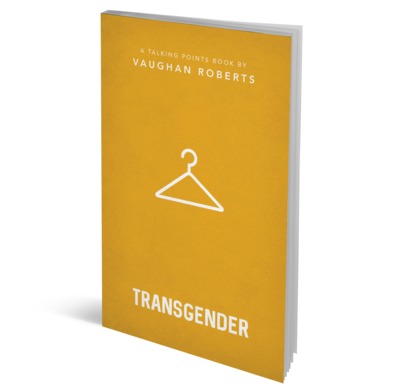
bookIn recent days, the subject of gender and transgenderism have been the talk of our county and our church. Coming, therefore, at the perfect time is Vaughn Roberts little book TransgenderIn preparation for my sermon on the subject I read his book with great profit.

In less than 80 pages, Roberts, a British pastor who has himself grappled with same sex attraction, introduces the subject (ch. 1), sets out a biblical response through the framework of creation (ch. 3), fall (ch. 4), and rescue/redemption (ch. 5). He concludes with a chapter on wisdom (ch. 6), where he speaks to individuals and churches on how to lovingly and truthfully respond to our trans neighbors and family members. Still, the chapter that is most important in his book is chapter 2, titled “The iWorld.”

In this section, Roberts frames transgenderism against the backdrop of the Enlightenment and the (post)modernism turn towards the subject. In just a few pages he explains how a recent flurry of advocacy for an age-old condition, i.e., transgenderism (see Deuteronomy 22:5), stems from a Western world head-over-heels in love with the self.

Continue reading

When Evil Solicits Your Vote: Six Lessons from Judas’ Betrayal


judsa

Do you not know that friendship with the world is enmity with God?
— James 4:3 —

Going back to Cain (Genesis 4), evil has always positioned itself right outside our doors looking to destroy. But recently, Christians in America have faced new challenges. In a country that continues to trample first amendment rights and eviscerate religious liberty, there is great temptation to do anything to maintain our place in the public square. I value that endeavor and lament the way Christians are being threatened in public, but I wonder if we are not being tempted to overcome evil with evil—or at least, the lesser of two evils.

What follows began as a study in Matthew, not an attempt to speak into the political fray. But as I considered the actions of Judas, I couldn’t help but think about Christians who are using (or being tempted to use) their proximity to Jesus as a means of securing our worldly standing. In truth, as Psalm 118:8–9 says, “It is better to take refuge in the Lord than to trust in man. It is better to take refuge in the Lord than to trust in princes.”

With that truth in mind, I share a few observations about Judas that I pray will protect us from putting confidence in earthly princes, and instead will steel our resolve to take refuge in Christ. Continue reading

Opening Our Eyes to Obergefell and Its Effects: A Pastoral, Cultural, and Legal Round-Up

SCOTUSOn June 26, 2015, in a 5–4 decision, the Supreme Court of the United States (SCOTUS) ruled that same-sex marriage was legal in all 50 states. In the hours that have passed, Christians have been praying and wondering aloud what comes next and how we should respond. To aid our collective understanding of the Supreme Court’s decision, I’ve listed dozens of resources under the following headings:

  • The Decision: What Did the Court Decide?
  • On the Pastoral Front: What do we say to our church?
  • On the Cultural Front: What do we say to our neighbor?
  • On the Legal Front: What about religious liberty?

I am so thankful for the men and women who have been reporting and commenting on these issues. May their wise words aid you—as they have me—to think and pray and act with grace and courage for truth in these days. Still before reading any of these posts, let me encourage you to watch this two minute exhortation from Russell Moore, president of the ERLC.

Continue reading

Eleven Questions to Facilitate Hospitality Evangelism

foodIn our post-Christian age, evangelistic Christians (a redundant statement, if ever there was one) must learn to love their neighbors through means of proactive hospitality. A few years ago I wrote about the subject of evangelism and hospitality (here and here). Today, let me list 11 questions that might help facilitate conversation that goes beyond the weather and sports. Moving from the generic to the more evangelistic, these personal questions may help us to engage others with meaningful questions that move towards the most important subjects of life. Continue reading