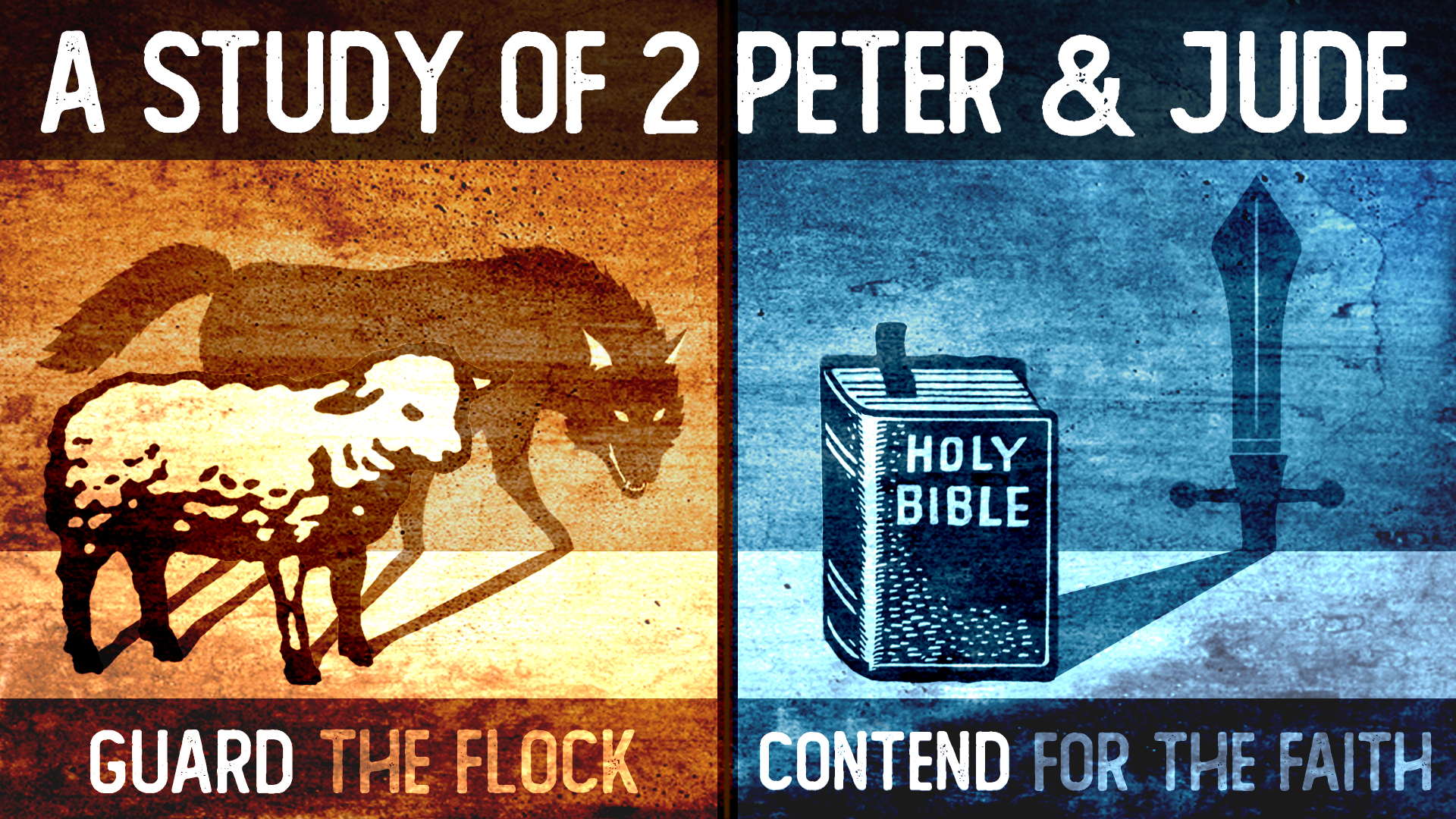
Guard the Flock and Contend for the Faith: An Introduction to 2 Peter and Jude

This summer, when the Southern Baptist Convention met in Indianapolis, Daily Wire reporter, Megan Basham, spoke to a packed room of 1000 people. In her speech, which you can now find online, she revealed various ways that pastors, churches, and other ministries have been targeted by well-funded political activists.

More recently, Megan’s book, Shepherds for Sale: How Evangelical Leaders Traded the Truth for a Leftist Agenda, became a New York Times Bestseller, as it uncovers multiple instances of evangelicals compromising their Christian commitment to the truth to have a place at the world’s table.

In eight chapters, she highlights how false teaching has been brought into the church. These issues include making climate change a Christian mission, opening borders to permit illegal immigration, diluting the pro-life movement, hijacking Christian media, employing the church to promote COVID protocols, preaching Critical Race Theory, refusing to call homosexuality a sin, and weaponizing the claims of sexual abuse.

Sadly, these eight subjects are not just matters that we find outside the church. All too often, they have been brought into the church, and they have been brought into the church by otherwise faithful pastors. Megan’s book highlights these compromises, documents their sources, and calls on faithful Christians to stand against these progressive trends.

Not surprisingly, her book has book has received a great deal of pushback. Yet, what is surprising is how evangelical leaders, including popular authors and one former SBC president, instead of admitting errors have doubled-down and repudiated Megan’s claims. It appears repentance is hard to come by these days, even among those who preach the gospel.

For my part, I have appreciated Megan’s book because it resonates with what I have seen up close and personal. I can count close to ten individuals named in this book who I know personally. And her reporting puts one place what I have seen over the last decade—once faithful friends compromising with the world in small or great ways. To give one example, my former Sunday School teacher, the Dean of the Theology School at Southern Seminary, and the man who signed both of my seminary diplomas is now partnering with an organization (Evangelicals for a Diverse Democracy) that is sponsored by an Interfaith organization led by an American Muslim. If that does not evidence Christianity astray, I don’t know what does.

Long story short, the weakness of the church in America today has not happened by accident alone. It is has also been planned by outside agitators who are looking for Christians willing to sell their birthright for a bowl of stew (Gen. 25:29–34). And sadly, many evangelical leaders have done just that. Megan’s book chronicles the last decade to show how this has happened, and Christ Over All recently sat down with her to discuss her book and why it matters for local churches.

I would encourage you to listen to our podcast and then, if time and interest allows, read (or listen) to her book and pray for the church in America. Every month, we gather on the third Wednesday to pray and one of repeated prayers is for revival to come to America. Yet, such revival will not come until repentance is led by church leaders. Judgment, Peter says, begins with the household of God (1 Peter 4:17). And to be sure, the Spirit, in order to build an unshakeable kingdom (Heb. 12:25–29), is shaking the church in America today.

So, let us pray that he grants us grace and pleas for mercy (Zech. 12:10), even as God exposes many faults in his churches. Today, as in every generation, churches need pruning. And so, let us not despise the discipline of the Lord, but let us trust him and see his lovingkindness in it. Continue reading
Discipleship and the Church: 12 Quotes from Mark Dever’s Book on Discipling

discDiscipling: How to Help Others Follow Jesus by Mark Dever is one of the most practical books on discipling I’ve read on the subject. And the reason why it is so practical is its unrelenting focus on the local church.

While many books on discipleship talk about how Jesus discipled others, or how we can make disciples, Discipling sets discipleship in the context of the local church. More than how-to book for individuals, it persuasively argues that the church is theplace for discipleship. In fact, only as churches disciple will they grow in vitality. And only as discipling takes place in the church will disciples grow in the place designed by the Lord.

Indeed, because this focus on the church is often missed in discussions about discipleship, I would highly commend anyone who cares about the church or the growth of Christians to read this book. This week, our church men’s group will be discussing its contents, and in preparation for that, let me share a dozen or so quotations from Discipling. These quotes highlight the ecclesial nature of discipleship found in Mark Dever’s book, and hopefully they both capture the shape of his argument and whet your appetite to read the book. Continue reading

Six Biblical Evidences for a Covenant in Creation

covenantA few years ago, Crossway Books began a series called Short Studies in Biblical Theology. These books are wonderful introductions to various topics on biblical theology. So far they have included,

Most recently, I read Tom Schreiner’s book on covenant, where in 120 pages he unpacks in plain language the biblical covenants from the covenant in creation to the new covenant in Christ. While the whole book is worth reading, I found his discussion on the first covenant a helpful introduction to God’s with mankind mediated through Adam, what some have called a creation covenant.

Six Evidences for a Covenant in Creation

On this disputed understanding of Genesis 1–2, Tom Schreiner summarizes six reasons for seeing a covenant in creation. While his work does not delve into the technical aspects of the debate, his clear presentation should give the reader a strong biblical case for seeing God’s creation in covenantal terms.

Here is a summarized version of his list with a few reflections on his points. Continue reading

Considering the Conscience: A Book Review

conscienceAlready in this election cycle we’ve heard a great deal about the conscience. Religious liberty stands or falls with ones ability to speak and act according to conscience. Likewise, many political commentaries have spoken about the conscience with regards to voting. Some, like Wayne Grudem, have made a matter of moral obligation to vote for Donald Trump. Others, like Andy Naselli, have explained why his conscience cannot vote for the not-so-conservative “conservative” choice.

In truth, we are going to hear a great deal more about the conscience. But what is it? And how does a biblical understanding of the conscience help us in these difficult times—in our voting and more to be at peace with brothers or sisters in Christ who hold different views of the political landscape. Again, Naselli is helpful, as he and J.D. Crowley have written a book on the subject: Conscience: What It Is, How to Train It, And Loving Those Who Differ.

In what follows I provide an overview of their book that both encapsulates some of their key points and hopefully whets your appetite to consider further this important topic. Continue reading

Life Together: A Short Review

lifeThe local church was always at the center of Dietrich Bonhoeffer’s heart and theology. In his studies he wrote his first dissertation on life in the church (“The Communion of Saints: A Dogmatic Inquiry into the Sociology of the Church”).  As a theological professor he labored to train pastors for the church. And in his later writings, he often returned to muse on life together in the local church.

It’s this subject that entitles one of his most famous works, Life Together, posthumously subtitled, “The Classic Exploration of Christian Community.” Coming in at 122 pages, Life Together is not a long book. But it is one that invites you to think deeply about God’s design for his people. Overflowing with wisdom, you will run your highlighter dry if you are given to marking up books.

As we consider the One Anothers in our weekly sermons, I would encourage you to pick up a copy. A small investment in reading Life Together will pay big dividends on doing life together. Continue reading

Catching Christ in Scripture: Christ-Centered Coaching from David Prince

princeIt’s been rightly said that preaching is more caught than taught. But what happens when a baseball player turned preacher and preaching professor writes a book on preaching and the life of the church? Well, it’s possible that what is taught also has the chance of being caught. And more importantly, teachable readers/preachers who read this book will be helped in catching the Christ who inhabits all the Bible.

In Church with Jesus as the HeroDavid Prince (Pastor of Preaching and Vision at Ashland Avenue Baptist Church in Lexington, Kentucky) along with his church staff have provided a helpful tool for “catching” the centrality of Christ in preaching and ministry. In only 130 pages, Prince et al. have made a compelling case for putting Christ at the center of biblical interpretation, gospel proclamation, singing, counseling, missions, and even church announcements.

While others have reviewed his book in full, I want to highlight the interpretive core of this book which sets it apart from others. While a host of practical applications can be found in Part 3 of the book, it is the method of biblical interpretation that forms the foundation for all that Prince and his pastoral staff undertake to communicate. Continue reading

Exploring Kenotic Christology: A Book Review

kenoticc
 
This review goes back a couple years, but it gets at an issue that continues to be espoused—namely the idea that Christ “emptied” (kenosis) himself of some of his divine attributes.

Evans, C. Stephen (ed.).  Exploring Kenotic Christology: The Self-Emptying of God.  New York: Oxford University Press, 2006. 360 pp. $34.95.

Exploring Kenotic Christology is a compilation of 12 essays edited by Stephen Evans.  From start to finish the goal of the book is to make a place for the “kenotic view” of Christ’s incarnation alongside, or in replace of, the “classical view.”  Introducing the writers, Evans writes, “Most of the authors can fairly be described as advocates of kenotic Christology, at least in the sense that they are convinced that this approach is a promising one to explore, even if not all of them are convinced of its final adequacy” (5).

In the assigned essays, this statement holds up.  While making a case for kenosis as a viable doctrinal interpretation, the authors do so with modesty and regard for the history of the church.  They recognize their position as the minority view and are very conscious of the Councils of Nicea and Chalcedon.  They frame their works within the boundaries prescribed by these historic councils, and they seek to demonstrate how their views better develop the confessions of 325 and 451.

The topics in this book range from biblical interpretation to doctrinal formulation, historical and systematic, to philosophical implications and complications.  The dialogue centers around classic Christology, that which has been espoused since the early church, and the more recent development of kenotic Christology.  Thomas Thompson chronicles the rise of this theory in 19th century Germany with Gottfried Thomasius “first articulating this new approach” (78).  His name, along with Wolfgang Gess and Hugh Mackintosh, are mentioned frequently in the book as the forebears of this approach.

The differences between the classical view and the kenotic view are as follows: Classical Christology posits that when the Son of God became man, he added humanity to his divine nature, but he never lost any of his divine attributes.  His deity was veiled in humanity, but he was all the while God incarnate.  This view follows the Chalcedonian formula of “one person, two natures” and has been explicated through the centuries by theories such as Thomas Morris’ two minds view.  Often this approach appeals to mystery and ineffability when considering how humanity and deity coinhere, and when more specific details are pressed theologians often appeal to the communication idiomatum.  While giving an answer for how deity and humanity are conjoined in Christ, kenotic Christology wants to go further.

Appealing to the term ekenosin in Philippians 2:7, kenotic Christology emphasizes Christ’s “emptying.”  It is not that the Son took on flesh (cf. John 1:14), but in order to do so he had to leave behind certain properties or aspects of deity.  Looking to explain the manner in which deity took on humanity, kenoticists are dissatisfied with appeals to mystery.  They appeal to the Bible to find ways of describing God the Son’s humiliation.  They charge classical views with grounding their claims in views of God that are found outside the Bible—in natural theology and philosophical presuppositions of what God must be like.

Assessing their arguments, it seems that a kenotic view of Scripture does agree with orthodoxy.  Mackintosh’s four axioms, for instance, suppose “(1) the deity of Christ; (2) his personal pre-existence; (3) his true humanity; and (4) the unity of his person” (91).  Likewise, Gordon Fee’s chapter, “The New Testament and Kenosis Christology” appeals to Philippians, Hebrews, and the Synoptic Gospels to support his doctrinal claims.  Likewise, the overall argument of the book, while recruiting philosophy and theology, does aim at explicating Scripture.  In fact, some of the arguments against classical Christology’s reliance on natural theology and philosophy, while narrow, have a certain Sola Scriptura appeal.  So there are positive elements to the book.

With that said, there are some troubling features as well.  First, many of the authors appeal to God’s self-limitation to explain how the Son could “empty” himself.  They admit to the (temporary) loss of divine attributes of omniscience or omnipotence and explain it by God’s divine power to limit himself.  However, this radically reshapes who God is and opens the door to all kinds of unwanted entailments.  Open Theism being just one.

Second, with self-limitation comes a whole new formulation for God.  Kenotic Christology is willing to redefine immutability, simplicity, and even our understanding of the Trinity to a more social model.  In fact, the whole subject of divine attributes is brought into question, so that God’s “omni’s” may be accidental attributes, not essential.  This radically deforms Christianity’s understanding of who God is.  While they appeal to the Bible for a more “biblically informed” doctrine of God, they disregard these doctrines too easily.  They construe them as extra-biblical accretions from the natural theology of Anselm and others.

Third, while rejecting classical views of God and the incarnation on the basis of faulty philosophical positions, Evans et al are just as guilty.  Frequently, Evans sequesters free will theism and incompatiblistic freedom to advance his argument, yet in doing so he relies on a faulty belief system.  These Arminian notions do not best articulate Scripture’s teaching about God, his creation, and the people made in his image. Therefore, any doctrine built on their foundation will be skewed.

Overall, the kenotic model, while picking up many important and biblical elements of Christ’s incarnation, does not make sense of all the biblical data.  It keys in on the change in the incarnation, but it does not retain Christ’s unchanging deity (cf. Heb. 13:8; Col. 1:19; 2:9)  Even in the primary prooftext, Philippians 2:7, kenotic proponents fail to recognize that “emptying” is coupled with addition, “taking on the form of a bond-servant.”  Therefore, to single out Christ’s loss is to consider only one side of the equation.

Likewise, the systemic effect of reshaping other doctrines to fit this model demands too much.  Better to synthesize the self-sacrificing, humbling work of the incarnation with the unchanging, all-glorious, omnipotent Son of God, than to throw out his deity because it makes more sense.  There is a mystery to the incarnation and one that should be explored, but one that should not minimize Christ’s deity or devalue his humanity.  In the end, the kenotic theory of the incarnation does the former, it brings into question the sustained deity of Christ and it misshapes the whole Godhead.

Soli Deo Gloria, dss

Evangelical Theology’s Prolegomena: Strong on the Gospel, but Suspect on Its Sources

ET

Michael F. Bird. Evangelical Theology: A Biblical and Systematic IntroductionGrand Rapids: Zondervan, 2013. 912 pp. $49.99.

This month marks the release of Michael Bird’s new book, Evangelical Theology: A Biblical and Systematic Introduction (henceforth, ET). Professor Bird is lecturer in theology at Ridley Melbourne College of Mission and Ministry in Melbourne, Australia. He is the author of numerous books on topics ranging from the person of Christ to a commentary on Colossians—of which I gave high praise a few years ago. He also blogs at Euangellion.

Technically, Bird is a New Testament scholar. And yet, like another biblical scholar-turned-systematic theologian (Wayne Grudem), Bird is presenting the church with gospel-driven theology that stands on his careful exegesis. Yet, his book is not so much a desire to give an exegetical theology as much as he has written his book to provide an evangelical theology. You can see him speak to the need for a truly “evangelical” theology in the following video.

As a part of Zondervan’s blog tour, I’ve been commissioned to review the introductory section of ET, what is known as the prolegomena (“first words”). Fulfilling that commission, let me outline my review under three headings: (1) a summary of the section, (2) the strength of Bird’s gospel-centrality, (3) the stumbling block of his sources. Continue reading

Keep Christ at the Center: A Review Essay on Darrell Bock’s Book, ‘Recovering the Real Lost Gospel’

Darrell L. Bock. Recovering the Real Lost Gospel: Reclaiming The Gospel as Good News. Nashville: B & H Academic, 2010, pp. 146.

Darrell Bock’s book Recovering the Real Lost Gospel advertises itself as a “biblical theology of the gospel” (2).  Beginning with God’s promise to Abraham, he traces the good news of God from its seed form in “gospel preached beforehand to Abraham” (Gal 3:8) to the fullness of the gospel, the gift of the Holy Spirit in the Gospels, Acts, and the rest of the New Testament.

In his engaging book, it is clear that Bock is seeking to correct the notion that Jesus’ death and resurrection is coterminous with the gospel. Accordingly, he describes Paul’s use of the term “cross” in 1 Corinthians 1-2 as a synecdoche “for all that Jesus’ work brings” (3).  And what does Jesus’ work bring? The Spirit and the gift of a personal, loving relationship with the triune God.  So far, so good: The gospel is a message of the cross and it is also a message of life in the Spirit.

Yet, not everything about Bock’s book is quite so good. In my estimation, he shifts the focus from Christ to the Christian, from the objective work of the cross to the subjective work of the Spirit. You can read the rest of my review here: Keep Christ at the Center (CredoMag Blog).

Soli Deo Gloria, dss

Book Review: Deep Church by Jim Belcher

Jim Belcher, Deep Church: A Third Way Beyond Emerging and Traditional (Downers Grove, IL: InterVarsity Press, 2009).

Jim Belcher has written an irenic and constructive proposal for charting a course somewhere between traditional churches and emerging churches.  He calls it “deep church,” and it is his proposal for a “third way” to do church. 

Belcher’s personal bio is interesting.  He is personal friends with nearly all the emergent/emerging leaders, yet his denominational affiliation with the PCA is far more confessional than many of his peers.  As he puts it, he is both an insider and an outsider (23-31).  This makes him an ideal candidate for drafting a conciliatory “third way.”  His writing shows his intimate acquaintance and appreciation for the emerging church, something that stands out against sea of criticism; yet, his theological convictions frame his acceptance of the emerging church. 

After introducing his story in Chapter 1, Belcher ‘defines’ the emerging church in Chapter 2.  He lists seven protests commonly made by “emergents.”  These seven responses to the traditional church outline the rest of the book (see chapters 4-10).   

In Deep Church, Belcher appeals to the likes of C.S. Lewis and calls for a return to “mere Christianity,” or more particularly, “mere ecclesiology.”  Leaning on the early church creeds, he sets out to define ‘two tiers’ of theology—one that “divides the essentials of orthodoxy from the particularities of differing traditions within the boundaries of orthodoxy” (60).  In making this critical distinction, Belcher supposes that churches can improve unity while still recognizing differences.  His point is well made, however his two-tier system lacks a necessary third distinction.  He equates unity within churches to the unity between churches.  However, there must be more unity within a congregation for the church to live in harmony than between two gospel-believing congregations. 

For instance, a Baptist church could clearly partner in an evangelistic campaign with a Presbyterian church, but try to unite these two churches constitutionally and differences concerning (paedo)baptism and church government will erupt.  Many other illustrations could be supplied.  All that to say, Albert Mohler’s theological triage (three-levels of doctrinal distinction) would improve Belcher’s argument, without taking away from the aim of his entire book.

Chapters 4-10 are the core of Deep ChurchThe format of each chapter is approximate: he takes up a specific EC protest, considers its validity and it problems from both sides, and then appeals to a particular “expert” on the matter (e.g. Francis Schaeffer on evangelism, Nicholas Wolterstorff on truth, Richard Mouw on the gospel, to name a few).  Then, Belcher concludes with practical steps towards the Deep Church and often illustrates his point with an example from his own experience. 

Overall, Deep Church offers a number of salient points with much food for thought.  Yet, its lack of biblical exposition added to an unwise neglect of 1500 years of church history weakens his argument immensely.  Favoring the church fathers, Belcher disregards the theological advances that have come from the likes of Protestant Reformers, Puritan divines, and congregational theologians.

In sum, Deep Church is orthodox and advances the conversation on twenty-first century ecclesiology.  It will stretch and challenge both traditional and emerging pastors to contextualize the gospel and to think deeply about the church.  But, at the end of the day, because Deep Church grounds its arguments in human authorities and promotes an outdated, Fifth Century ecumenism, I am hesitant to recommend it to church members looking for Biblically-saturated help.  For thoughtful pastors, it is a stimulating book, but for the inquisitive layman books by Clowney, (The Church), Carson (The Church in the Bible and the World; Becoming Conversant with Emerging Church; , Dever (What is a Healthy Church?; Deliberate Church), Stott (The Living Church) and especially J.L. Dagg would be better.

(Other Reviews: Deep Church has gotten a lot of attention in book reviews.  If Belcher’s book interests you, check out the balanced review by Kevin DeYoung  and an excoriating one by Greg Gilbert.  I appreciate Greg’s concern for Belcher’s light treatment of penal substitution–I share his concern with any model of the atonement that truncates the legal and vicarious nature of the cross–but I think DeYoung’s review is more helpful in evaluating Belcher’s third way, which DeYoung describes as the traditional way mediated through Tim Keller.)

 Soli Deo Gloria, dss