Biblical Theology in the Life of the Church: An Interview with Michael Lawrence

John Starke interviews Michael Lawrence at TGC Reviews, senior pastor (to-be) of Hinson Church (Portland, OR) about his newly published book, Biblical Theology in the Life of the Church: A Guide to Ministry.

In the interview, Michael helpfully defines biblical theology as a mediating discipline, which helps properly interpret and apply the Bible.  Thus, he sees biblical theology as a necessary step between understanding what the Bible meant and what it means today, and as the subtitle suggests, this is an essential part of the minister’s task.

I encourage you to check out the interview, and pick up the book.  I just got my copy and look forward to reading it and helping our church see the value of biblical theology.

John’s interview with Michael is one of many resources on TGC Reviews.

Soli Deo Gloria, dss

Jim Hamilton’s Forthcoming Biblical Theology

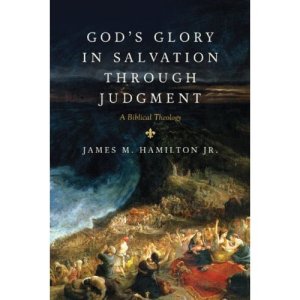
I am not sure where Matthew Montonini found the following description of Jim Hamilton’s new book, God’s Glory in Salvation Through Judgment.  Was it bootlegged?  Its not on Crossway‘s site, but regardless, I am excited to know that it is coming out this year.  I have heard much about its release, and believe the thesis is right on. 

Now that an announcement of the book is out, the cover alone draws me in, but even more the content: After sitting in Dr Hamilton’s “Messiah in the Old Testament” class at SBTS and reading some of his work on the subject, it promises to be a must-have biblical theology.  The best since Geerhardus Vos?  Time will tell.

Here is how Crossway sets it up.  (HT: New Testament Perspectives)

God’s Glory in Salvation through Judgment: A Biblical Theology (480 pages) [m]oves through the Bible book by book to demonstrate that there is a theological center: God’s glory in salvation through judgment.

In Exodus 34 Moses asks to see God’s glory, and God reveals himself as a God who is merciful and just. James Hamilton Jr. contends that from this passage comes a biblical theology that unites the meta-narrative of Scripture under one central theme: God’s glory in salvation through judgment.

Hamilton begins in the Old Testament by showing that Israel was saved through God’s judgment on the Egyptians and the Caananites. God was glorified through both his judgment and mercy, accorded in salvation to Israel. The New Testament unfolds the ultimate display of God’s glory in justice and mercy, as it was God’s righteous judgment shown on the cross that brought us salvation. God’s glory in salvation through judgment will be shown at the end of time, when Christ returns to judge his enemies and save all who have called on his name.

Hamilton moves through the Bible book by book, showing that there is one theological center to the whole Bible. The volume’s systematic method and scope make it a unique resource for pastors, professors, and students.

Until November, if you are looking to get a feel for what Hamilton’s book will include, check out some of his prepatory work:

The Glory of God in Salvation Through Judgment: The Centre of Biblical Theology?Tyndale Bulletin 57.1 (2006), 57-84.

The Center of Biblical Theology in Acts: Deliverance and Damnation Display the Divine,” Themelios 33.3 (2008), 34-47.

Soli Deo Gloria, dss

Biblical Theology in the Life of the Church

The ‘Second Mark’  of a “Healthy Church” is Biblical Theology (see Nine Marks of Healthy Church), but because of its sweeping synthesis of the Bible, Biblical Theology is also one of the most confusing disciplines to church members.  At least, this has been my experience introducing the ‘Big Picture’ of the Bible to the churches I have served.

Enter Biblical Theology in the Life of the Church.  In April, Michael Lawrence’s new book will come out, and hopefully serve as a tool introduce and clarify this critically-important discipline.  Here is Crossway‘s description:

Capitol Hill Baptist Church associate pastor Michael Lawrence contributes to the IXMarks series as he centers on the practical importance of biblical theology to ministry. He begins with an examination of a pastor’s tools of the trade: exegesis and biblical and systematic theology. The book distinguishes between the power of narrative in biblical theology and the power of application in systematic theology, but also emphasizes the importance of their collaboration in ministry.

Having laid the foundation for pastoral ministry, Lawrence uses the three tools to build a biblical theology, telling the entire story of the Bible from five different angles. He puts biblical theology to work in four areas: counseling, missions, caring for the poor, and church/state relations. Rich in application and practical insight, this book will equip pastors and church leaders to think, preach, and do ministry through the framework of biblical theology.

This forthcoming book looks like an excellent tool for introducing biblical theology to church members who have questions on why Biblical Theology is important and how to put the Bible together.  It goes beyond just the basics too, relating the big picture of the Bible to everyday life– ‘counseling, missions, caring for the poor, and church/state relations.’  Since biblical illiteracy is one of the church’s greatest obstacles for making mature disciples, encouraging biblical theology (read: a comprehensive understanding of the Bible) should be a priority of every pastor, church leader, and church member.

April 30, 2010 is its anticipated release date.  Mark it down!  

Soli Deo Gloria, dss

Biblical Theology: The Second Mark of a Healthy Church Member

Whether you know it or not, you are a theologian!  

Being made in the image of God (Gen. 1:26-28), you are irreversibly created to think thoughts about God.    But whether or not you are a good ‘theologian’ is another story.   While everyone thinks about God — even the atheist who denies his existence — the unanswered question is “Do you think true and right thoughts about the triune God who made you?” 

Moses, in Deuteronomy 32:47 reminds us that the Word of God “is not merely a trifle, it is your life!”  Accordingly, we who want to grow in our relationship with God, who want to be healthy church members are those who must grow in our knowledge and love for the “macro-story” of the Bible.  In truth, our salvation and knowledge of God depend on it. 

Studying the second mark of Thabiti Anyabwile’s book, What is a Healthy Church Member?, this weekend at Calvary Baptist Church (Seymour, IN), I suggested 5 ways to grow as  “biblical theologians,”  and I share them with you now:

(1) Find a Bible reading plan and set a course to read the Bible cover-to-cover. This exercise will familiarize yourself with God’s wise and gracious plan of salvation and insure that you see over the course of a year or two all that God has done in this age and in the age to come.  There are many helpful reading plans that can set your pace, as well as, resources to shed light on the Bible as you read. D.A. Carson’s two books,  For the Love of God: Volume 1 and For the Love of God: Volume 2 are excellent companions to your journey through the Bible.  Likewise The ESV Study Bible is another excellent reference for reading the Bible.

(2) Read an introductory book on Biblical Theology.  If you are new to the idea of biblical theology, Vaughan Robert’s book, God’s Big Picture is the best introductory work on the subject.  An intermediate work that also has an informative section on how to interpret the Bible is Graeme Goldsworthy’s According to Plan.  For advanced “biblical theologians,” Geerhardus Vos’ Biblical Theology is the standard.   

Finally, whether you are a novice or an expert in biblical theology, let me encourage you to invest $35 in The New Dictionary of Biblical Theology — no single resource is better written to help you see the broad strokes of the biblical story.  Its short treatments of every book of the Bible and hundreds of articles–again short–will illumine many key themes and ideas present in the Bible, but often missed on account of unfamiliarity.  In the word of Nike, Just Do It!   

If you have kids, God’s Big Picture Story Bible is just as critical.  Rejecting the moralism that fills so many children’s story Bibles, God’s Big Picture Story Bible synthesizes the Bible into 40 managable chapters–short sentences and captivating pictures.  It takes the biblical themes of God’s King, God’s People, and God’s Place and shows how they all relate to Jesus.  It is excellent! 

(3) Read the Bible with eyes open to the intra-textual connections between the OT – NT connections.  Looking for ways that the OT promises, prepares, and pictures the coming of Christ is one of the most rewarding aspects of the Old Testament Scriptures.  How else can we read the Old Testament, but as New Covenant Christians.  See John 5:39; Luke 24:27, 44-49; 1 Cor. 10:1-11; 2 Tim. 3:14-17; Heb. 1:1-3; 1 Pet. 1:10-12; 2 Pet. 1:19-21 for examples of how the New Testament authors read the OT. 

(4) In your Bible, write down personal cross-references when you make any inter-textual connection.  For instance, when you see Isaiah 7:14 quoted in Matthew 1:23, or when you read the story of the serpent being lifted up in the desert in Numbers 21, scribble in the margin the John 3:14-16 connection.  There is no better way to get around the Bible then to install a personal set of markers and street signs that will help you remember that you have been here before.  Yes, this does presuppose that you are reading the Bible :-) 

(5) Learn from the experts.  Matthew, John, Paul, the author of Hebrews, Jude, indeed all the NT authors were Biblical Theologians par excellence.  Fortunately for us, they have left us with plenty of samples of how to relate the Christ of the NT to the promises of the OT.  For instance, notice the way Matthew begins his gospel applying the OT to Christ; read Stephen’s sermon in Acts 7 where he traces biblical history from Abraham to Solomon; study Paul’s sermons in Acts 13 and 17 to see his reading of the OT (cf. Rom. 4; 9-11; Gal. 3-4); or examine the book of Hebrews and the way it presents Christ as superceding all of the OT offices, sacrifices, and promises. 

Finally, if Biblical Theology is still a mystery, let me encourage you to simply keep reading.  The Spirit of Christ will open your eyes to the truth of God’s word as you come to the Bible with humility and faith.  As Paul told Timothy, “Think over what I say, for the Lord will give you understanding in everything” (2 Tim 2:7). 

God has not freed us from thinking, but he has promised to help.  He has promised that his word will never return void (Isa 55:10-11), that the one who studies it will be refreshed and rewarded (Ps. 19:7-11), and that he given us his Holy Spirit who will lead us into all truth (1 John 2:27).   Remember: the men who confounded the world with the wisdom of God and the gospel of Jesus Christ were ordinary, uneducated fishermen who had simply been with Jesus (Acts 4:13). 

May that be said of us too!

Soli Deo Gloria, dss

Four Volumes of Biblical Theology…for free!!!

Simon Gerrit De Graaf  was a minister of the Reformed Church in the Netherlands during the early twentieth-century (1889-1955).  During the course of his ministry he wrote a four-volume work called Promise and DeliveranceIt is a comprehensive set of lessons tracing the redemptive story of salvation from Genesis to Revelation.  While long in content, its original intention was aimed at teaching children how to read the Bible with eyes to see the grand story of “promise and deliverance.”  Here is what the Publisher’s Note says in Volume I:

Each chapter of Promise and Deliverance begins with a short discussion of points to bear in mind when studying the story or telling it to children. After this introductory section, the author formulates the story’s main thought in a single sentence. For the sake of emphasis, this sentence is set off from the rest of the text and printed in italic type. Then comes the narrative itself, which makes up the bulk of the chapter. Since some readers will also want to use the narrative sections as a story Bible aimed at older children, the narrative is presented in slightly larger type than the background material at the beginning of each chapter, which is not intended for reading aloud.

So, much like Jonathan Gibson’s The Story of a Kingdom , De Graaf’s work looks to be an excellent resource in studying the Bible diachronically, that is along the lines of redemptive histor.  In a brief review, Drew Goodmanson remarks, “De Graaf does a great job moving beyond the ‘moral lesson’ or ‘typical point’ used in the stories of the Bible to seeing OT stories as foreshadows of Jesus and all part of the redemptive plan of God.”   That is the kind of reading that we need more of, especially for children. But here is what makes it even better– the whole set is now available online for free. 

Paiedea Books, which publishes the four-volume work, has put each volume up online and has made available at no cost a great resource for understanding Biblical Theology and for reading the Bible better.  I would encourage you to check them out yourself.

Volume I : From Creation To The Conquest of Canaan

Volume II : The Failure of Israel’s Theocracy

Volume III: Christ’s Ministry and Death

Volume IV: Christ and the Church

Soli Deo Gloria, dss

John Murray on Systematic and Biblical Theology

Writing on the relationship between systematic and biblical theology, John Murray writes with great balance, saying

Systematic theology is tied to exegesis.  It coordinates and synthesizes the whole witness of Scripture on the various topics with which it deals.  However, systematic theolgoy will fail of its task to the extent to which it discards its rootage in biblical theology as properly conceived and developed.  It might seem that an undue limitation is placed upon systematic theology by requiring that the exegesis with which it is so intimately concerned should be regulated by the principle of biblical theology.  And it might seem contrary to the canon so important to both exegesis and systematics, namely the analogy of Scripture.  These appearances do not correspond to reality.  The fact is that only when systematic theology is rooted in biblical theology does it exemplify its true function and achieve its purpose (John Murray, “Systematic Theology: Second Article,” WTJ 26, no. 1 (1963), 44-45).

Well said.

(HT: Brian Payne, from his doctoral dissertation, The Summing Up of All Things in Christ and the Restoration of Human Viceregency: Implications for Ecclesiology, SBTS 2008, p. 15)

Covenant and Eschatology: The Divine Drama

Michael Horton’s Covenant and Eschatology: The Divine Drama is a book about theological method.  Unashamed of his Reformed heritage, the Westminster professor, draws on the redemptive-historical insights of John Calvin, Hermann Bavinck, Geerhardus Vos, and others, to speak to issues of post-modern literary theory and the narrative theology of George Lindbeck, Hans Frei, and Nicholas Wolterstorff.  As Kevin Vanhoozer puts it, “Messieurs Lindbeck and Wolterstorff, meet Geerhardus Vos and Herman Ridderbos!”  The result is an erudite and creative proposal that instructs Christians to conceive of the Bible as a Divine Drama.

In brief, Horton employs biblical theology and speech-act theory to show how this biblical drama–God’s acts of redemption and his interpretive revelation– should be the starting point for doing theology.  In this regard, Horton’s proposes an inductive method of doing theology.  Still, he relies on other theologians and philosophers to shape his thesis.  He depends heavily on Post-Reformational theologians and appropriates many of their redemptive-historical insights to combat and correct the modern philosophy and postmodern literary theory.  Yet, like Kevin Vanhoozer, Horton is adroit in gleaning from postmodern theories and philosophical instrumentation to better articulate what the Bible is doing.

The book is broken into two sections: “God Acts in History” (ch. 2-4) and “God Speech” (ch. 5-9); however, the contents of each chapter seem to move from one problem area to another.  In other words, instead of delineating a clear line of explanation, Horton responds to the problems and counter-proposals as he sets forth his case.  In this, he makes countless contributions to the subject of theological method; however, it is challenging to finish this book with a step-by-step program for ‘doing theology.’  Nevertheless, in the narrative of his book, there are four ideas that find repeated attention and that Horton sets out from the beginning.  They are a redemptive-historical method, an analogical mode (of discourse), a dramatic model, and a covenantal context.  We will consider these in turn.

First, Horton argues that we should read the Bible along redemptive-historical or biblical-theological lines.  Following the Dutch-American Reformed tradition, Horton conceives of biblical theology as an organically-connected development in biblical history–one that is laced with eschatological anticipation.  In this way, eschatology is not simply a systematic loci, but an interpretive lens.  Promise-fulfillment is the basic structure of the biblical narrative.  And the entire Bible itself takes on an escalating covenantal shape.

Horton contrasts the Platonic dualism that has lurked within the church from Augustine to Bultmann with the biblical, “two-age model”  which integrates history and eschatology.  Whereas the former sets up an unbiblical noumenal-phenomenal antithesis, the latter places eschatology within history and sees one age following another.  Jesus inaugurated the age to come with the ratification of the new covenant–the shedding of his blood on the cross– and his triumphant resurrection/ascension.  Today, we await the culmination when the King of Kings comes again.  Thus, according to Horton, we should read the Bible redemptive-historically.  I agree.

Second, Horton addresses the subject of biblical language.  Is it univocal, equivocal, or analogical?  He argues for the last of these three, and shows how and why proposals that turn away from analogical discourse result in aberrant doctrines.  For instance, in chapter two he shows the difficulty of fusing liberal, God-denying action in history with biblical & orthodox language (e.g. when Bultmann uses the language of resurrection, he is not speaking of physical, historical event).  Horton supplies four possible ways that the Bible and the world relate: (1) “mythological-symbolical-metaphorical” language where the God has spoken in his word but not in a way that comports with history, (2)  “communal interpretation of natural occurencce” where God acts providentially in history but does not provide sufficient interpretation of explanation, thus communities of faith are left to devise their own meaning, (3) “narrative interpretation” in which the Bible gives a plausible explanation of reality, but which may not in fact correspond to reality, and (4) “immanent interpretation” where belief is held that God lives, moves, and has his being in the world–this is a panentheist approach that blurs Creator and creation.

Horton lists all these to show the competing (and false) models in the church and academy today and to argue for a view of the Bible that recounts both God’s acts in history, as well as his covenantal speech found in Scripture.  God acts in his works and in his words, and Horton emphasizes that while the Bible only gives us analogical expressions of the God who acts and speaks, these analogical accomodations are true interpretations of God’s work of redemption.  He goes further though, asserting that Jesus Christ, the incarnate God, is in fact the univocal center of revelation, and that in him their is a univocal and irreducible core to the revelation of God in redemptive history.

Third, building on the redemptive-historical storyline and the way that God reveals himself through redemptive acts and inspiring nterpretive speech, Horton shows that this results in a divine drama where the world is a stage, the Bible a script, the people of God actors, and the covenantal structures (e.g. circumcision and the sacrificial system under the Mosaic administration; baptism and the Lord’s supper under the New Covenant) serve as visible props to reenact the drama.  This dramatic ideal is not held exclusively by Horton.  Hans von Balthasar developed it at length in his 5-volume Theo-Drama, and before that John Calvin even appealed to theatrical language.  More recently, Kevin Vanhoozer has appealed to this understanding in his The Drama of Doctrine

As with his emphasis on “two-world” model mentioned earlier, this historical progression of people and plot, which is sovereignly written and directed by God himself, overturns the static, platonic view of reality.  Instead of a purely vertical understanding of the platonic cosmology, with the earthly, material world somehow reflecting the timeless, immaterial noumenal worls, the Bible as Divine Drama puts the story on a horizontal axis that is moving from Creation to Consummation.  Simultaneously, the biblical drama casts God as the intervening hero who descends from heaven to earth to wisely, powerfully, and gloriously deliver his people–this is seen typologically in the OT and definitely in the NT with the birth, life, death, and resurrection of Jesus Christ.

Fourth, Horton develops this drama along the unifying theme of the biblical covenants.  He maintains that biblical canon itself is a covenantal document (a la Meredith Kline, The Structure of Biblical Authority), and that the revelation of redemption contained therein reflects the gracious initiative of God to save a people for himself, a people who journey in this age as pilgrims but in the age to come as partakers of the Kingdom of God.  As Horton works out this proposal, he on more than one occasion emphasizes the necessity of a theology of the cross, over against a theology of glory.  The Christocentric reality is that the covenantal pattern of the Bible is that those who will enter into glory must travel the road of redemption as sojourners and sufferers (cf. Phil. 2:5-11).  He critiques any reading of Scripture that purports an overrealized eschatology, and he cautions those of us in covenant with Jesus Christ to realize that the cross comes before glory.

So overall, Horton’s proposal is compelling, even if it is hard to follow at points.  His argumentation is strong and his knowledge of biblical theology and postmodern philosophy is vast.  Furthermore, it is obvious that his intention is not to advocate a system of theology.  This is seen in the way that he answers objections from liberal theologians on his left and the way he challenges hyper-conservative theologians on his right.  He aims to traverse a narrow path between “experiential-expressivists”  who subvert the Bible to contemporary prejudices and “cognitive-propositionalists” who in the name of orthodoxy reduce the Bible to a series of eternal truths and miss the narrative, historical, and eschatological framework of the Bible. 

Similarly, Horton’s use of speech-act theory and double author discourse does not distort the text or run into the rocks of Tillich’s method of correlation.  Instead, Horton deftly employs philosophical language to articulate what the Bible is in fact doing.  This selective use of literary theory and philosophy, along with his repeated appeals to biblical theology, serves as a needed corrective against extreme liberalism and reductionistic biblicism.  Against both of these polarities, Horton is emphatic on the covenantal structure of the Bible, the way in which God has time and again redeemed a people for himself, something that the Divine Drama is continuing to do today.  Which leads to a final point.

Horton concludes his work with a chapter on the “Community Theater” where he suggests ways in which the twenty-first century church is called to perform the drama found in Scripture.  Appealing to the likes of Calvin, he shows how preaching the Word, performing the sacraments–his word, not mine, and effecting church discipline display for a watching world the Divine Drama.  Thus the church is to appropriate the speech and acts found in the biblical narrative, the language of the covenant, and to continue walking by faith in the redemption once for all accomplished in Christ and once for all delivered (read: spoken) to the saints.  While the objective work of redemption and revelation is completed, its local reenactment by the redeemed people of God will continue until the end of age.

On the whole, Horton’s book is an enriching proposal on how to do biblical and systematic theology.  It is not for the faint of heart, though.  It is a technical work that requires background knowledge of contemporary theology and Post-Reformation Reformed theology.   Simultaneously, it is a book that while written clearly could be structured better.  The book is generally organized by the four emphases consider here, but the execution of explaining these ideas is lacking.  Nevertheless, his main point of reading the Bible redemptive-historically, analogically, and covenantly comes through, and his model of a Divine Drama is one that helps unify the gap between theory and practice.  I commend Horton’s book to you and hope that it helps you delight in the God who acts and speaks!

Sola Deo Gloria, dss
The Insufficiency of Biblical Theology ?

Over the last thirty years, evangelicalism has seen a strong resurgence and appeal for biblical theology.  Evidences of this are the expanding series of books edited by D.A. Carson, New Studies in Biblical Theology; the New Dictionary for Biblical Theology; and the rising appeal of the subject among younger evangelicals.  Just come to Southern Seminary, and you will find students who, next to John Piper, have been most influenced by Graeme Goldsworthy.

Yet, is biblical theology enough?  Is it sufficient for the task of theology?  Some believe it is.  Fred Sanders, for instance, in his doctoral dissertation–now published as The Image of the Immanent Trinity–argues that the doctrine of the Trinity went awry as it entered the realms of philosophical discussion and systematic exploration.  The early church fathers (i.e. Irenaueus, Tertullian) spoke of God in biblical-theological terms, whereas later theologians (i.e. Athanasius, Gregory Nazianzen, and Augustine, to name a few) employed philosophical nomenclature and concepts to define the Trinity.  Sanders argument is that this systematizing and (mis)use of philosophical categories distorted the biblical doctrine of the Trinity, and that in order to recover a biblical concept of the doctrine we should appeal to biblical theology and a theological interpretation of Scripture.

I am not as sure.  Before beginning doctoral work in systematic theology, I would have believed it to be true that biblical theology was sufficient for doctrinal formulation, but after considering it further, I see the need for all the disciplines of theology (biblical, systematic, philosophical, and practical).  So, in this way, “biblical theology” alone is insufficient.

Now please hear me, I am not saying that the Bible is insufficient.  On the contrary, it is all-sufficient and gives us everything we need for life and godliness (2 Pet. 1:3-4; cf. Deut. 29:29).  What I am saying is that the discipline of biblical theology, reading the Bible along the lines of its progressive revelation and its redemptive-historical makeup, is a part of a greater whole.  I think that today, biblical theology can be so emphasized that the other disciplines can be overshadowed and (un)intentionally de-emphasized.  The simple point I am trying to make is that biblical theology needs dogmatics, just like dogmatics need biblical, and of course, theology is always benefitted by considering the way in which doctrines have developed and deviated throughout the course of church history.

Herman Bavinck cautions against the same thing and articulates a fuller sense of doing theology.  Consider his argument,

Scripture is not a legal document, the articles of which only need be looked up for a person to find out what its view is in a given case.  It is composed on many books written by various authors, dating back to different times and divergent in content.  It is a living whole, not abstract but organic–[this is a favorite expression of HB].  It nowhere contains a sketch of the doctrine of faith; this is something that has to be drawn from the entire organism of Scripture.  Scripture is not designed so that we should parrot it but that as free children of God we should think his thoughts after him.  But them all so-called presuppositionaless and objectivity are impossible.  So much study and reflection on the subject is bound up with it that no person can possibly do it alone.  That takes centuries.  To that end the church has been appointed and given the promise of the Spirit’s guidance into all truth.   Whoever isolates himself from the church, i.e., from Christianity as a whole, from the history of dogma in its entirety, loses the truth of Christian faith.  That person becomes a branch that is torn from the tree and shrivels, an organ that is separated from the body and therefore doomed to die.  Only within the communion of saints can the length and the breadth, the depth and the height, of the love of Christ be comprehended (Eph. 3:18)…. Accordingly, the contrast [or independence] often made between biblical theology and dogmatics, as though one reproduced the content of Scripture while the other restates dogmas of the church, is false (Herman Bavinck, Reformed Dogmatics: Prolegomena [Grand Rapids: Baker Academics, 2003], 83).

In this brief paragraph Bavinck shows why his Reformed Dogmatics are so illuminating as he consistently expounds Scripture, scours the annals of church history, and uses rigorous logic to formulate doctrine.  Accordingly, what emerges in his dogmatics is a biblical, systematic, and historical theology where each discipline enriches the other.  I think this model is optimal, and of course should also include the appropriate use of philosophy and analytical theology.

As people of extremes, Bavinck’s counsel reminds us to engage all forms of theology to perceive and proclaim the glorious truths of God’s word, and only as we do that can we explore the depths of God’s all sufficient word.

Sola Deo Gloria, dss

Reformed Forums’ Interview with Richard Gamble

The guys from Reformed Forum posted their recent interview with Richard Gamble, Professor of Systematic Theology at  Reformed Presbyterian Theological Seminary and author of the recently released The Whole Counsel Of God, vol. 1.  Their conversation ranged from the relationship of biblical theology to systematics to the massive task of compiling a biblical, systematic, and historical theology to the way in which Gamble’s new volume– 1 of 3– depends upon and compares with other biblical and systematic theologies.  In addition to considering Gamble’s opus, here is the bibliography of books they discussed:

I highly encourage you to check out the interview

One more thing, they gave an introductory plug for Greg Wills new book on the history of Southern Seminary (Gregory Wills, Southern Baptist Theological Seminary, 1859-2009. New York: Oxford University Press, 2009).

Soli Deo Gloria, dss

The Ways of Our God: God’s Servant (2)

In the second section of The Ways of Our God: An Approach to Biblical Theology, Charles Scobie turns from the theology proper, creation, and the history of spiritual warfare in section one to the person and work of Jesus Christ in section two.  Instead of providing a thorough summary, let me point out some of the highs and lows.

6. The Messiah:  Scobie outlines five charateristic offices of the servant of God–namely Moses, prophet, priest, king, and sage.  These offices were first established in history before they were fulfilled in Christ.  Yet, before the advent of Jesus Christ and his ultimate fulfillment there seems to be a pattern of failure that escalated the hopes of the coming Messiah.  This idea of escalation is not unique to Scobie, but his recognition of this pattern is appreciable.   The high point for me in chapter 6 was Scobie’s edifying examination of the ways in which Jesus Christ fulfilled the OT figures in similar but superior ways.  One of the best chapters in the book.

7. The Son of Man: Whereas chapter 6 discussed some of the functional offices of the Christ, chapter 7 focuses on the usage of ‘Son of Man.’  Scobie picks up the Adamic referrences here showing how Jesus is the second Adam, and he shows how he is the fulfillment of the vision in Daniel 7.   Moreover, Scobie shows how Jesus comes to represent the true humanity of God.  Moving from Israel to Remnant to The Twelve Disciples to Jesus, he shows how history narrows to Jesus Christ as the single faithful Jew who is qualified to receive the promises of God.  It is worthy to note however, that Scobie misplaces the twelve, for they should probably go on the other side of Jesus.  In other words, the Twelve are as the reconstituted twelve tribes, function as the foundation of the New Testament, not the last vestige of Old Testament Israel.  So while they may serve a place in the narrowing process of history to point up Jesus as the one son of God, they should be more carefully placed after Jesus, as the firstfruits of the new creation.

8. Glory, Word, Wisdom, and Son:  This is a very illuminating chapter concerning OT adumbrations fulfilled in Christ.  Each of these four major themes (Glory, Word, Wisdom, and Sonship) prepares the way for the incarnation of the second member of the Godhead, Jesus Christ.  In truth, Jesus fulfills and exceeds each of these attributes/personifications of God in the OT.  It is worthwhile to meditate on how the presentations of glory, the word, wisdom, and sonship in the OT do and do not foreshadow Jesus Christ–and by ‘do not’ I mean that the Son’s incarnation outstrips all previous possibilities of hypostasis, or distinctions with God, in the Old Testament (cf. Dan. 7:13-14; Isa. 63:8-10).  Finally, I must say that this chapter did begin to evidence the prevailing weakness of this book, namely the unwillingness to examine theological issues at levels that go beyond the surface of the text. For instance, in response to the question, “Is Jesus God?” Scobie balks (395, 398ff).  His inability to affirm this metaphysical reality shows one of the weaknesses of his BT which sidesteps matters of critical theological debate.  He makes the evasive move to only say what Scripture says without defending the implications of what the Scriptures say.  There is a constant appeal to BT in Scobie’s work that he uses when he comes across a textual problem or divisive doctrine.  While I appreciate his ‘textuality,’ in this case the texts demand an answer.  Jesus is God. 

9. The Servant’s Suffering: Chapter 9 moves from the person of Christ to his work.  On page 403 Scobie writes, “In the OT there emerges what we may call a ‘profile’ of the ideal servant of God.  While embodied to varying degrees in specific historical individuals, the “Suffering Servant” is portrayed especially in certain psalms and in the “Servant Songs” of Isaiah.”  Scobie’s chapter helpfully outlines the common experience of God’s servants, showing that Jesus Christ is the ultimate servant, one who suffers and dies to ransom a people for God.  He bases his chapter not just on a limited word study but on a ‘servant pattern’ that emerges in the Bible where God’s servants, Jesus in particular, are “called and chosen by God and obedient, fulfilling his God-given mission.  He is misunderstood and mocked, suffers and dies; yet he is vindicated by God, and his death and resurrection have profound significance for Israel and for the naitons” (417).  This aspect of the chapter is very, very good.  So is Scobie’s multi-thematic understanding of Jesus’ atonement, where he defends propitiation and the substitutionary nature of the atonement.  However, the glaring abberation in this chapter is Scobie’s advocacy of ‘post-mortem evangelism.’   Scobie argues here (434) and later (540) that all people will get another chance to respond to the gospel after they die.  He bases this on 1 Pet. 4:6 and Rev. 14:6-7 (536), but fails to see the finality of death in verses like Hebrews 9:27 which reads, “And just as it is appointed for man to die once, and after that comes judgment.”

10. The Servant’s Vindication:  Finally, Scobie develops the pattern of vindication experienced by the servants of God in OT, in the life of Jesus, and in the life of believers who are united to Christ’s death and resurrection.  Unfortunately, Scobie spends little time developing the idea of vindication from the OT–only six paltry pages (441-46).  In the more substantial work on Christ’s resurrection he helpfully unpacks the fourfold meaning of Christ’s resurrection, ascension, session (being seated with Christ), and Lordship.  In this last section, he provides a helpful discussion of Christ’s Lordship in the lives of individuals, in the church, and in creation.  Unfortunately, like the discussion concerning Christ’s deity, Scobie again waffles on the evidential nature of the resurrection.  While he does not deny it, he is unwilling to affirm an evidential argument–based on eyewitness testimony–for the reality of the resurrection.  The resurrection, in Scobie’s view, is a matter of faith to be believed and less an event to be proved.  Sadly this splinters faith from history. Apparently, we are justified to believe in such an account, but we are not required to argue for its veracity. 

Overall, Scobie has some very helpful discussions on matters like the OT types that lead to biblical understanding of the Messiah and recognizing a servant pattern in the Scripture that helps develop a biblical understanding of what Christ accomplished in death.  Yet, in reading this section it becomes more apparent that Scobie and I do not share many biblical-theological convictions.  His work is to be commended for its breadth and synthesis of the biblical material.  However, in terms of analyzing and articulating many doctrines, The Ways of Our God shows itself to be theologically amiss.   Scobie does well in collecting and setting the biblical material; he just does not do equally well in explaining its theological difficulties.

We will pick up this point in the next post.

Sola Deo Gloria, dss