Was Jesus Among the Larpers? How Reading John 4 with Genesis 29 Helps Us Understand Biblical Typology and Jesus’s Identity

gabriel-rissi-MrdSyMik4ao-unsplash

Well, Well, Well, Look What We Have Hear: A Marriage, A Mountain, and a Messiah (pt. 1) — A Sermon on John 4:1–18

In John’s Gospel we learn that Jesus is the Word made flesh (1:14), the Only Begotten God (1:18), the Lamb of God who takes away the sin of the world (1:19), and the one to whom all the Law and Prophets wrote (1:45). But did you also know that Jesus was also a Larper? Not a leper, mind you, but Larper—a Live Action Role Player.

As best I could find online, Larping is a type of game where a group of people wear costumes representing a character they create to participate in an agreed [upon] fantasy world. Most recently, Larping gained attention in the Marvel Comic series Hawkeye, but it’s been around a lot longer than that. If you need an example of what Larping looks like up close, just go to a Medieval festival near you, and you will surely find a group of Live Action Role Players.

Now, if you don’t want to go to a Medieval Festival to see LARP-ing, you could also read John 4. In this famous chapter, where Jesus confronts the woman at the well, the Lord assumes the role of particular character from the world of the Patriarchs. Indeed, as John tells it, Jesus is a man (or “bridegroom,” see John 3:29) who meets a woman at a well, who will in time, become his bride. Let’s consider how this works. Continue reading

Can You See What Jeremiah is Saying? Finding the Literary Structure in a Book Where Structure is Often Missed

abstract close up cobweb connection

This post is part of a series of resources for the Via Emmaus Bible Reading Plan. This month I am focusing on Jeremiah.

*************

Whenever I teach hermeneutics or lead Bible studies, I want to help students of the Bible find the “breaks” in the text. Where does the human author insert literary devices to help the reader follow his message? In John’s Gospel, for instance, he organizes his introduction to Jesus around four days (John 1:19–51), and then he puts the wedding at Cana on the third day (2:1), which in context is the seventh day. In this way, John helps his audience know how he is ordering his material.

Such arrangement does not automatically produced meaning, but ignorance of an author’s literary structure will delimit our understanding. If we cannot see how the biblical author is writing, we won’t get what the author is saying. In any study of Scripture then, we must labor to understand the literary structure of a text. Sometimes this is easy, as in passages like Psalm 136, which repeats the refrain “for his steadfast love endures forever” (ESV) and follows the order of Israel’s history. But in other books, it is more difficult. And it is arguable that the book of Jeremiah is one of the most difficult books in the Bible for ascertaining a literary structure.

The reasons for this difficulty are manifold. First, Jeremiah is, by word count, the longest book of the Old Testament. And as we saw with Isaiah, it is a challenge to see the message of books so large. Second, the chronology of Jeremiah is difficult. The book does not proceed in historical order, and as a result some commentators (e.g., John Bright) have attempted to interpret the book by changing its order to match Israel’s history. This destroys the literary structure, however. As higher-criticism reigned over the last two hundred years, commitment to reading the Bible on its own terms was ignored and the mind of the interpreter trumped the words of the author. This will miss the message of the Bible and so we cannot follow those who rearrange the text.

Size and chronology are challenging in Jeremiah, but the greatest difficulty in finding the meaning of Jeremiah comes from divergent manuscripts. That is, when we compare the Hebrew text to the Septuagint (the Greek translation), we find that significant portions of the book are put in different order. This reminds us that the final form of the Bible came as a result of an editing process (cp. the arrangement of the Psalter), but leaving aside the formation of the final form, different final arrangements make it difficult to affirm a structure with certainty. And then, if meaning is tied to literary structure, then how should we can have confidence in finding a singular message about Jeremiah? Continue reading

What Does Baptism Look Like? Seven Observations from John 3:22–36

baptism_of_st_paul_-_capela_palatina_-_palermo_-_italy_2015-2“Look, he is baptizing, and all are going to him!”
— John 3:26b —

In John 3 a dispute about baptism arose between the disciples of John the Baptist and a Jew. While unnamed, this Jew caused an existential crisis for the followers of John. So great is their concern about purification, baptism, and the rise of Jesus, they run to their teacher and point to his baptism. Verse 26 captures their concern: “Rabbi, he who was with you across the Jordan, to whom you bore witness—look, he is baptizing, and all are going to him.”

In this question about baptism, prompted by a dispute about purification, we find an analogue to modern debates about this biblical ordinance. Today, there are questions related to the mode, the subject, and the place. That is: Does sprinkling or pouring count as baptism? What about sprinkling a believer? Or immersing an infant? (See video below). Does a private baptism between friends qualify? And how should we understand the difference (or similarities) between the initiating rite of the old covenant (circumcision) and the initiating rite of the new covenant (water baptism)? All these questions and more need biblical answers.

[The Greek Orthodox remind us that baptizō means immersion, plunging, dipping].

Over the last few years, I have written multiple articles on baptism in the Bible and its pre-requisite for membership in the church. As an unashamed Baptist, who affirms the historical confessions of London, Philadelphia, New Hampshire, and Nashville, I will continue to write on the subject. Why? Because baptism continues to come up in conversation with visitors and others who are thinking about membership at our church.

With that in mind, I offer another exegetical take on baptism—one that comes from John’s Gospel and the dispute about baptism found therein. Following the imperative to “Look!” we will look at what John says about John’s baptism, Jesus’s baptism, and the conversation in John 3 about the new birth, baptism in the Spirit, and the practice of baptizing repentant believers. So, with this visual approach to John 3, I offer seven things we see about baptism. Here’s the list; explanations will follow.

  1. Baptism is performed in public with a group of witnesses.
  2. Baptism requires biblical discernment.
  3. Baptism is handled by Jesus’s disciples, not Jesus.
  4. Baptism is always by immersion.
  5. Baptism requires people to seek water.
  6. Baptism leads to disputations.
  7. Baptism requires humility.

Continue reading

Seeing the Literary Structure of John 2–4

close up shot of bible text

The first step in understanding any book of the Bible is to see what is there and especially how the biblical author has arranged his material. In the case of the Gospels, for instance, it is important to remember Matthew, Mark, Luke, and John did not turn on their iPhones and hit record. While we have plenty of quotations from Jesus, nearly all of them have been translated from Aramaic and brought to mind by the Holy Spirit (John 14:26). This means we do not have Jesus’s spoken words in red letters. What we have are the Spirit-breathed words of God penned by the apostles.

In each book, the Spirit leads the authors to present Jesus in a coherent fashion. In Matthew’s Gospel, for example, Jesus is the Son of Abraham, the Son of David, the true Israel, and the prophet like Moses, to name a few ways he is presented. In John’s Gospel, Jesus is introduced as the true tabernacle (John 1:14), in whom the fullness of God dwells bodily. Throughout John’s Gospel, this theme of Jesus as the true and better temple will repeat (see e.g., John 2:19–22; 14:1–3).

Reading the Gospels on their own terms, therefore, becomes imperative for understanding their message. Harmonizing the Gospels (i.e., comparing Matthew to Mark to Luke to John) has its place, but it is far better to let the Evangelist speak each in his own way. When we do that, and stop strip-mining the text to find sources behind the Bible, we see how the Evangelists made their case for Jesus as God’s the Son, the long-awaited Messiah. To that end, this blogpost will consider one section of one Gospel—John 2–4. Continue reading

10 Things You Should Know About the Priesthood

priestcolorCrossway has a helpful series of blog articles called “10 Things You Should Know . . .” These articles summarize key ideas from some of Crossway’s recent books. And this week, they posted my contribution about the priesthood.

Here are the first three things you should know. The rest you can find here. The book you can find here. And a sermon series on the priesthood can also be found here.

1. The Edenic origin of the priesthood.

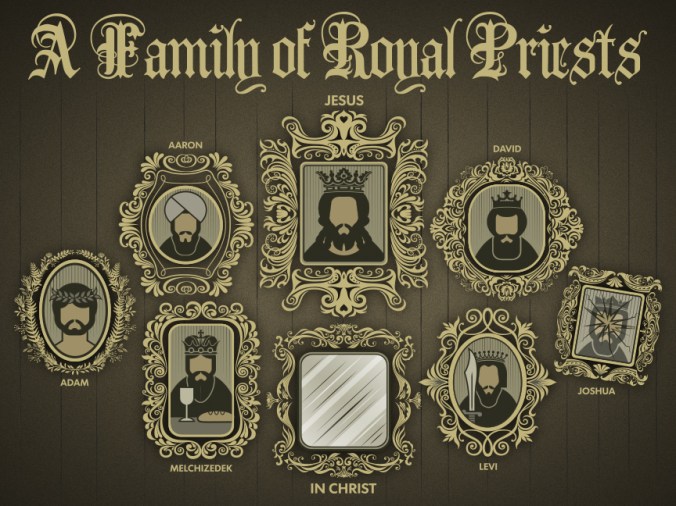
In Eden, God created mankind in his image to reflect his glory. In this setting, God crowned man with glory and honor (Ps. 8:5), authorized him to subdue and rule (Gen. 1:28), and gave him priestly instructions for serving in his garden-temple (Gen. 2:15; cf. Num. 3:8). This is the prototype of royal priesthood from which all other priests will be molded. In other words, when the priesthood is legislated in Israel, it will pick up language and imagery from Eden. At the same time, the Law of Moses divided the royal and priestly roles originally united in Adam. Thus, only a second Adam can unite priesthood and kingdom in a manner similar to Eden.

2. The cosmic fall of the priesthood.

When Adam sinned and fell short of God’s glory (cf. Rom. 1:21–23; 3:23; 5:12, 18–19), God expelled him from God’s garden-sanctuary (see Ezek. 28:11–19), destroying any chance of Adam serving God as priest-king. In the fall, Adam’s sin made sacrifice necessary, as indicated by the events of Genesis 4. Because death was the punishment for sin, blood must be shed. To be certain, the full consequence of sin and the need for a priest would require later revelation to explain (see Leviticus), but it is worth noting the original intent and downfall of the priesthood. For the rest of the Bible, we find a search for someone who could stand before God and serve as a mediator (cf. Job 9:33–35).

The Royal Priesthood and the Glory of God

The Royal Priesthood and the Glory of God

David S. Schrock

David Schrock traces the theme of priesthood throughout the Bible and displays how Jesus, the great high priest, informs the worship, discipleship, and evangelism of the church.

3. The fraternal development of the priesthood.

From Eden to Sinai, priestly ministration continued, but in a very ‘itinerant’ fashion. In the days of the Patriarchs, firstborn sons grew up to be mediators for their families. Job is a good example of this (Job 1:5), as is Abraham. In the Abraham narrative (Gen. 11:27–25:18), we find Abraham building altars (Gen. 12:7, 8; 13:4, 18), interceding for others (Gen. 18:22–33), and obeying God by offering a sacrifice (Gen. 22:1–18). While Abraham and his sons lacked the title of priest, these “priests” play an important role in understanding the earthly “priesthood” of Jesus—a priest in function, but without legal title. At the same time, the priestly service of firstborn sons helps explain Israel’s role as a royal priesthood (Ex. 19:6).

For the last seven points, see Crossway’s 10 Things You Should Know About the Priesthood in the Bible.

Soli Deo Gloria, ds

Preach Hebrews the Next Time You Don’t Have a Preacher, Plus a Post-Script on Answered Prayer

dawn-mcdonald-2RADIf5oR28-unsplashWhat will you do the next time you do not have a preacher? Oh, I am not talking about planning for an upcoming Sunday when you, or your pastor, will be absent, or when multiple teaching elders are unavailable. I am talking about when it becomes apparent 10 hours or 10 minutes before Sunday morning that the man called to preach simply cannot do it.
In such a situation, you have a few options. You could call on someone to preach something already prepared. Such preparation includes having a sermon ready, but it could also mean calling on a “prepared” person who could open a text and give a faithful exposition. Elder-qualified pastors and Bible teachers would fall into this category. And one of the best Resurrection Sunday expositions I ever heard came from a seminary professor who was called to preach 10 minutes before service as the teaching pastor lay ill in his office—literally, he was writhing in pain on the floor. (He’s okay now).

Extreme moments call for extreme measures. And churches shouldn’t be surprised that in a fallen world where clay pots preach the glories of God that sometimes those vessels of dust cannot stand and speak. Yet, knowing that, we can still be caught off guard, or in need of immediate relief. And this last weekend was such a case in our church.

What We Did When the Preacher Couldn’t Preach

As many readers of this blog know, I am not a full time blogger—hence, the regular but not absolutely consistent blog schedule. Day to day, I have the joy of serving at Occoquan Bible Church, located in Northern Virginia. Since 2015, I have been pastor for preaching and theology. So, most Sundays I am the one standing up and preaching.

At the same time, we have a deep bench of gifted preachers. And if you check our website, you will find messages from Ben, Rod, Jared, Dave, Ron, and Jeff. All of our elders have preached multiple times to our church. And by conviction, we do this because we believe the pulpit is the Lord’s, not man’s. It is God’s Word that is preached, not our own. And it is the faithful preaching of God’s Word that builds his church, not the gifting of any one pastor. For that reason, we intentionally share the pulpit. And by design I preach about 40 times a year, not 52.

Continue reading

The Via Emmaus Bible Reading Plan: February Resources for Exodus, Jeremiah, and Mark

Jesus washing the feet of Saint Peter on Maundy Thursday

This month the Via Emmaus Reading Plan is looking at Exodus, Jeremiah, and/or Mark. (See below for the tracks). If you are following this plan, or looking for a new reading plan, you can find helpful resources on the following pages. 

Track 1: Exodus

Track 2: Jeremiah

Track 3: Mark

If you have other resources on these books, please feel free to share.

May the Lord bless you and keep you and make his face shine upon you as you draw near to him in his Word. Continue reading

How John’s Prologue Placards the Glory of God’s Son: 10 Things About John 1:1–18

john03Sunday we begin a new sermon series on John’s Gospel. Whereas other sermon series may need an introductory sermon, John gives us his own in his opening “prologue.” In what follows, we will note ten things about those opening 18 verses.

1. John 1:1–18 introduces us to themes that will run throughout John’s Gospel.

In his commentary on John, Colin Kruse paints two word pictures to describe John’s opening verses. He says that the prologue functions like (1) an overture that introduces an opera or (2) a foyer to a theater “where various scenes from the drama to be enacted inside are placarded” (John, 52). With these visual aids in place, he helps us “see” how John 1:1-18 previews many themes in John’s Gospel.

These themes include,

  • Jesus’s pre-existence (1:1a / 17:5, 24)
  • Jesus’s union with God (1:1c/8:58; 10:30; 20:28),
  • the coming of life in Jesus (1:4a/ 5:26; 6:33; 10:10; 11:25-26; 14:6),
  • the coming of light in Jesus (1:4b, 9/ 3:19; 8:12; 12:46),
  • the conflict between light and darkness (1:5 / 3:19; 8:12; 12:35, 46),
  • believing in Jesus (1:7, 12 / 2:11; 3:16, 18, 365 5:24 6:69; 11:25; 14:1; 16:27; 17:21; 20:25),
  • the rejection of Jesus (1:10, 11/ 4:44; 7:21; 8:59; 10:31; 12:37-40; 15:18),
  • divine regeneration (1:13/3:1-7),
  • the glory of Jesus (1:14/ 12:41; 17:5, 22, 24),
  • the grace and truth of God in Jesus (1:14, 17/ 4:24; 8:32; 14:6; 17:17; 18:38)
  • Jesus and Moses/the law (1:17/ 1:45; 3:14; 5:46; 6:32; 919; 9:29),
  • only Jesus has seen God (1:18/ 6:46), and
  • Jesus’ revelation of the Father (1:18/ 3:34; 38; 12:49-50; 14:6-11; 17:8). (52)

2. John 1:1–18 demonstrates a very clear chiastic structure.

In his article, “The Pivot of John’s Prologue,” Alan Culpepper makes a compelling argument for a chiastic structure in the prologue. Continue reading

Returning to Romans: An Epistle of Faith, Hope, and Love

kelly-sikkema-GPoh17DxqdM-unsplashIn the Fall of 2019 our church began a Bible study in the book of Romans. It ran through the first seven chapters of Paul’s magnum opus, but in March 2020, when the world shut down, we pushed pause on this book. When we returned to church, our Bible study shifted to Leviticus. But with that study completed, we are now returning to Paul’s largest letter. And for those interested in following along, they can find previous lessons here. New lessons will also be posted on the same page each week through the Spring.

For this blogpost, I want to offer a brief sketch of the book and how Paul’s triad of Faith, Hope, and Love organize his magnificent exposition of the gospel. For those studying Romans (again), this will help acquaint you with the book as a whole. And it also will provide a way of seeing the gospel, and what the gospel achieves, in this whole letter. Additionally, this approach to Romans may also remind us of how Paul brought unity to the church of Rome, when it was facing divisions. Today, we face the same. And thus, we need to learn as much from Paul as we can about what the gospel is and what the gospel does.

Continue reading

Brother-Theologians: Preach the Word!

samuel-zeller-432101A few years ago I wrote this article on David Prince’s website. As I go to teach Systematic Theology 1 this week, I am reminded of it, and the need for theologians to be preachers.

In theology, we are not just called to study and store up knowledge of truth. We are called to study to show ourselves approved so that we may preach—or teach, or write, or counsel, or anything else that qualifies as heralding the good news—sound doctrine. To that point, I repost this article, in hopes that God may continue to raise up men sound in doctrine who will preach the Word.

*********

When I came to seminary, I wanted to study the Bible and theology. Having never “preached” a Sunday morning message, I was uncertain as to the role preaching would have in my life. Ten years later, through a combination of providential opportunities and willingness to preach whenever I was asked, I have finished my theological education  (Yes, it took a decade!) and have preached more Sundays than not.

For nearly five years I have filled the pulpit at my current church—first as a supply preacher, then an interim pastor, and last as the senior pastor. In the lustrum before serving at our church, I like so many of my seminary peers preached in nursing homes, urban missions, country parishes. It was a wonderfully painful time, one where precious little flocks like Corn Creek Baptist Church endured my preaching and helped me learn how to preach.

During that time, preaching was a priority, but so was theology. By training, I am a systematic theologian, or at least, that’s what my degree says. Therefore, as a pastor and a theologian, I feel a measure of familiarity with both vocations. And I feel a fraternal affection and responsibility to exhort aspiring theologians with what Paul commanded Timothy: Preach the Word! Continue reading