Via Emmaus on the Road: Luke 24

Further Resources

  • Questions for Luke 22–John 2 (Week 14)

Luke 24 (ESV)

The Resurrection

24 But on the first day of the week, at early dawn, they went to the tomb, taking the spices they had prepared. And they found the stone rolled away from the tomb, but when they went in they did not find the body of the Lord Jesus. While they were perplexed about this, behold, two men stood by them in dazzling apparel. And as they were frightened and bowed their faces to the ground, the men said to them, “Why do you seek the living among the dead? He is not here, but has risen. Remember how he told you, while he was still in Galilee, that the Son of Man must be delivered into the hands of sinful men and be crucified and on the third day rise.” And they remembered his words, and returning from the tomb they told all these things to the eleven and to all the rest. 10 Now it was Mary Magdalene and Joanna and Mary the mother of James and the other women with them who told these things to the apostles, 11 but these words seemed to them an idle tale, and they did not believe them. 12 But Peter rose and ran to the tomb; stooping and looking in, he saw the linen cloths by themselves; and he went home marveling at what had happened.

On the Road to Emmaus

13 That very day two of them were going to a village named Emmaus, about seven miles from Jerusalem, 14 and they were talking with each other about all these things that had happened. 15 While they were talking and discussing together, Jesus himself drew near and went with them. 16 But their eyes were kept from recognizing him. 17 And he said to them, “What is this conversation that you are holding with each other as you walk?” And they stood still, looking sad. 18 Then one of them, named Cleopas, answered him, “Are you the only visitor to Jerusalem who does not know the things that have happened there in these days?” 19 And he said to them, “What things?” And they said to him, “Concerning Jesus of Nazareth, a man who was a prophet mighty in deed and word before God and all the people, 20 and how our chief priests and rulers delivered him up to be condemned to death, and crucified him. 21 But we had hoped that he was the one to redeem Israel. Yes, and besides all this, it is now the third day since these things happened. 22 Moreover, some women of our company amazed us. They were at the tomb early in the morning, 23 and when they did not find his body, they came back saying that they had even seen a vision of angels, who said that he was alive. 24 Some of those who were with us went to the tomb and found it just as the women had said, but him they did not see.” 25 And he said to them, “O foolish ones, and slow of heart to believe all that the prophets have spoken! 26 Was it not necessary that the Christ should suffer these things and enter into his glory?” 27 And beginning with Moses and all the Prophets, he interpreted to them in all the Scriptures the things concerning himself.

28 So they drew near to the village to which they were going. He acted as if he were going farther, 29 but they urged him strongly, saying, “Stay with us, for it is toward evening and the day is now far spent.” So he went in to stay with them. 30 When he was at table with them, he took the bread and blessed and broke it and gave it to them. 31 And their eyes were opened, and they recognized him. And he vanished from their sight. 32 They said to each other, “Did not our hearts burn within us while he talked to us on the road, while he opened to us the Scriptures?” 33 And they rose that same hour and returned to Jerusalem. And they found the eleven and those who were with them gathered together, 34 saying, “The Lord has risen indeed, and has appeared to Simon!” 35 Then they told what had happened on the road, and how he was known to them in the breaking of the bread.

Jesus Appears to His Disciples

36 As they were talking about these things, Jesus himself stood among them, and said to them, “Peace to you!” 37 But they were startled and frightened and thought they saw a spirit. 38 And he said to them, “Why are you troubled, and why do doubts arise in your hearts? 39 See my hands and my feet, that it is I myself. Touch me, and see. For a spirit does not have flesh and bones as you see that I have.” 40 And when he had said this, he showed them his hands and his feet. 41 And while they still disbelieved for joy and were marveling, he said to them, “Have you anything here to eat?” 42 They gave him a piece of broiled fish, 43 and he took it and ate before them.

44 Then he said to them, “These are my words that I spoke to you while I was still with you, that everything written about me in the Law of Moses and the Prophets and the Psalms must be fulfilled.” 45 Then he opened their minds to understand the Scriptures, 46 and said to them, “Thus it is written, that the Christ should suffer and on the third day rise from the dead, 47 and that repentance for the forgiveness of sins should be proclaimed in his name to all nations, beginning from Jerusalem. 48 You are witnesses of these things. 49 And behold, I am sending the promise of my Father upon you. But stay in the city until you are clothed with power from on high.”

The Ascension

50 And he led them out as far as Bethany, and lifting up his hands he blessed them. 51 While he blessed them, he parted from them and was carried up into heaven. 52 And they worshiped him and returned to Jerusalem with great joy, 53 and were continually in the temple blessing God.

Soli Deo Gloria!

Reading for Scripture Saturation: (Re)Introducing the Via Emmaus Bible Reading Plan

rod-long-DRgrzQQsJDA-unsplash

How can a young man keep his way pure?
By guarding it according to your word.
10  With my whole heart I seek you;
let me not wander from your commandments!
11  I have stored up your word in my heart,
that I might not sin against you.
12  Blessed are you, O Lord;
teach me your statutes!
— Psalm 119:9–12 —

A few years ago, I introduced a reading plan focused on Scripture saturation more than Scripture box-checking. As a new year begins, I return to that reading plan for myself and for others who might be interested in focusing on one (or two or three) books in a month, instead a daily selection of Bible readings.

As we all know, or should know, the Word of God is not a trifle; it is our very life (Deut. 32:47). Man does not live on bread alone, but on the very word that proceeds from the mouth of God (Deut. 8:3; Matt. 4:4). So we should aim to read the Bible and to read it often!

Truly, the Bible is not a book to read once, or even once a year. It is meant to be imbibed and inhabited, adored and adorned, studied and savored. Mastery of the Bible does not mean comprehensive understanding of Scripture; it means an ever-increasing submission to the Master who speaks in Scripture. This is why in the closing days of the year, it’s good to consider how we can saturate ourselves with Scripture in the new year.

And today I offer a reflection on why a reading plan dedicated to saturating in Scripture may be a help for those who need to slow down and meditate on God’s Word. Or, for others, why a plan that encourages reading larger sections of Scripture might help Bible readers see more clearly the full message of the Bible.

Continue reading

The Dramatic Arc of Isaiah 1–12: How Seeing Literary Structure Unveils the Glory of God

landscape photo of the view of city with rainbow above

“This is an unusual and fascinating book.”

One might think this commendation describes the Bible, or at least the book of Revelation. But in fact, these words come from Richard Averbeck’s endorsement of David Dorsey’s book about the Bible, The Literary Structure of the Old Testament (Baker, 1999). Indeed, his full endorsement reads as follows,

This is an unusual and fascinating book. It is the first comprehensive treatment of the inherent structure of the Old Testament books and its significance for understanding their meaning and message. Expositors will find it of inestimable value for looking at the books in a way that is true to the literary nature of the Old Testament itself and the theological significance of that structure. (From the back cover)

Dorsey’s book is unlike any other book I have read. For in 39 chapters—surely that was on purpose—he introduces his method (ch. 1–5), outlines every book in the Old Testament (ch. 6–38), and offers some final reflections (ch. 39). In all, his book provides students of Scripture with a comprehensive reading plan for seeing the literary structures of every book in the Old Testament. With careful attention to literary details, his book, though it came out in the year of Y2K fears, is not flight of fancy into Bible coding. Rather, it offers a well-argued case for reading Scripture on its own terms.

For readers of this blog, you know how much value this approach to Scripture. Following the persuasive argument of David Helm, I believe every inspired text has an inspired structure. Accordingly, the faithful reader (or preacher) must discern the “inherent structure” in the text, in order to uncover the meaning of the original author.

I have often shared the literary structures I have seen in the Scripture. And in our church, this care for literary structure is the starting place with our teachers. (For those with ears to hear, you know this is a shameless plug for Simeon Trust). Surely, getting the structure is not the end of our study, but it is a necessary step. Good exposition depends on rightly dividing the word of God, and discerning the biblical structures helps the disciple cut with and not against the grain of Scripture.

To that end, as I preach through Isaiah over the next few weeks, I will share some of Dorsey’s work. In doing so, I hope it will help those who are following our Advent Reading of Isaiah. And more, I hope it will persuade you to begin looking for these structures in Scripture. So, without any more prolegomena, let me offer an outline of Isaiah 1–12, which in turn prepares us for the whole book of Isaiah. Continue reading

Can You See What Jeremiah is Saying? Finding the Literary Structure in a Book Where Structure is Often Missed

abstract close up cobweb connection

This post is part of a series of resources for the Via Emmaus Bible Reading Plan. This month I am focusing on Jeremiah.

*************

Whenever I teach hermeneutics or lead Bible studies, I want to help students of the Bible find the “breaks” in the text. Where does the human author insert literary devices to help the reader follow his message? In John’s Gospel, for instance, he organizes his introduction to Jesus around four days (John 1:19–51), and then he puts the wedding at Cana on the third day (2:1), which in context is the seventh day. In this way, John helps his audience know how he is ordering his material.

Such arrangement does not automatically produced meaning, but ignorance of an author’s literary structure will delimit our understanding. If we cannot see how the biblical author is writing, we won’t get what the author is saying. In any study of Scripture then, we must labor to understand the literary structure of a text. Sometimes this is easy, as in passages like Psalm 136, which repeats the refrain “for his steadfast love endures forever” (ESV) and follows the order of Israel’s history. But in other books, it is more difficult. And it is arguable that the book of Jeremiah is one of the most difficult books in the Bible for ascertaining a literary structure.

The reasons for this difficulty are manifold. First, Jeremiah is, by word count, the longest book of the Old Testament. And as we saw with Isaiah, it is a challenge to see the message of books so large. Second, the chronology of Jeremiah is difficult. The book does not proceed in historical order, and as a result some commentators (e.g., John Bright) have attempted to interpret the book by changing its order to match Israel’s history. This destroys the literary structure, however. As higher-criticism reigned over the last two hundred years, commitment to reading the Bible on its own terms was ignored and the mind of the interpreter trumped the words of the author. This will miss the message of the Bible and so we cannot follow those who rearrange the text.

Size and chronology are challenging in Jeremiah, but the greatest difficulty in finding the meaning of Jeremiah comes from divergent manuscripts. That is, when we compare the Hebrew text to the Septuagint (the Greek translation), we find that significant portions of the book are put in different order. This reminds us that the final form of the Bible came as a result of an editing process (cp. the arrangement of the Psalter), but leaving aside the formation of the final form, different final arrangements make it difficult to affirm a structure with certainty. And then, if meaning is tied to literary structure, then how should we can have confidence in finding a singular message about Jeremiah? Continue reading

Reading for Scripture Saturation in 2021: (Re)Introducing the Via Emmaus Bible Reading Plan

Jesus washing the feet of Saint Peter on Maundy Thursday

How can a young man keep his way pure? By guarding it according to your word.
10  With my whole heart I seek you; let me not wander from your commandments!
11  I have stored up your word in my heart, that I might not sin against you.
12  Blessed are you, O Lord; teach me your statutes!
— Psalm 119:9–12 —

AN 2022 VERSION OF THIS POST IS FOUND HERE.

With 2020 ending and 2021 approaching, you may be thinking about how to read the Bible in the new year. I hope so. The Word of God is not a trifle; it is our very life (Deut. 32:47). Man does not live on bread alone, but on every word that proceeds from the mouth of God (Deut. 8:3; Matt. 4:4). With that in mind, we should aim to read the Bible and to read it often!

Truly, the Bible is not a book to read once, or even once a year. It is meant to be imbibed and inhabited, adored and adorned, studied and savored. Mastery of the Bible does not mean comprehensive understanding of Scripture; it means ever-increasing submission to the Master who speaks in Scripture. This is why in the closing days of the year, it’s good to consider how we can saturate ourselves with Scripture in the next year.

Personally though, I wonder if our daily reading plans help us with this idea of Scripture saturation. Often, such plans call for reading single chapters from various parts of the Bible. And the daily routine can invite checking the box without understanding the book. So my question has been: does such reading help us or hinder us in our Bible reading? Continue reading

Dare to Be A Daniel (Remixed): A Sermon on Daniel 1

daniel05

On Sunday we started our new series on the book of Daniel. In this sermon I introduced the book and expounded the first chapter. While I am concerned that many Christians can miss the Christ-centered nature of Daniel, Daniel 1 is a chapter that serves an excellent model for Christians to imitate. And in this sermon, I show how we can and should dare to be a Daniel.

You can watch the sermon here, listen here, and find more resources on the Book of Daniel below.

Resources on Daniel

Soli Deo Gloria, ds

What’s in a Name? How Names in the Bible Reveal Meaning and Lead Us to Trust in the Name above All Names

namesFor to us a child is born, to us a son is given; and the government
shall be upon his shoulder, and his name shall be called
Wonderful Counselor, Mighty God,
Everlasting Father, Prince of Peace.  
— Isaiah 9:6 —

What’s in a name? In the Cultural Backgrounds Study Bible, we find a helpful introduction to the way names are used in the Old Testament. Here’s what it says,

In the OT names not only looked to the circumstances of a birth (e.g., Jonathan means “Yahweh has given [a son] ”; Reuben means “Look! A son”) but could also wish a blessing (e.g., Isaiah means “Yahweh’s salvation”; Immanuel means “God be/is with us”). Royal names could change when a person attained the throne. Several Israelite kings had their names changed by their overlords, showing that they were under authority of an outside power (e.g., the name of Eliakim was changed to Jehoiakim by the Egyptians, 2Ki 23:34). Others seem to have adopted their own throne name, as some have suggested for Azzariya/Azariah (meaning “Yahweh aided”) adopting the name Uzziah (meaning “Yahweh is my strength”). King David was identified at his death by four titles: son of Jesse, man exalted by the Most High, anointed by Jacob’s God, Israel’s favorite singer (2Sa 23:1).

Sentence names in the ancient Near East. Most names in the ancient world make statements, i.e., they are self-contained sentences. Many of the statements are about a deity. One can easily recognize the deity name in names such as Ashurbanipal, Nebuchadnezzar, or Rameses. Anyone even casually familiar with the Bible has noticed how many Israelite names end in -iah or -el, or start with Jeho- or El-. All of these represent Israel’s God. This type of name is called a theophoric name, and affirms the nature of the deity, proclaims the attributes of the deity or requests the blessing of the deity. One way to interret the titulary of this verse [Isaiah 9:7] is to understand it as reflecting important theophoric affirmations: The Divine Warrior is a Supernatural Planner, The Sovereign of Time is a Prince of Peace. (Note: the word “is” is not used in such constructions, as all names demonstrate). Continue reading

Fifty Sermons on Isaiah

readingplan04.jpegAs we approach the first Sunday in January and the first Sunday in Via Emmaus Bible reading plan, here are 50+ sermons on Isaiah, ordered in three ways.
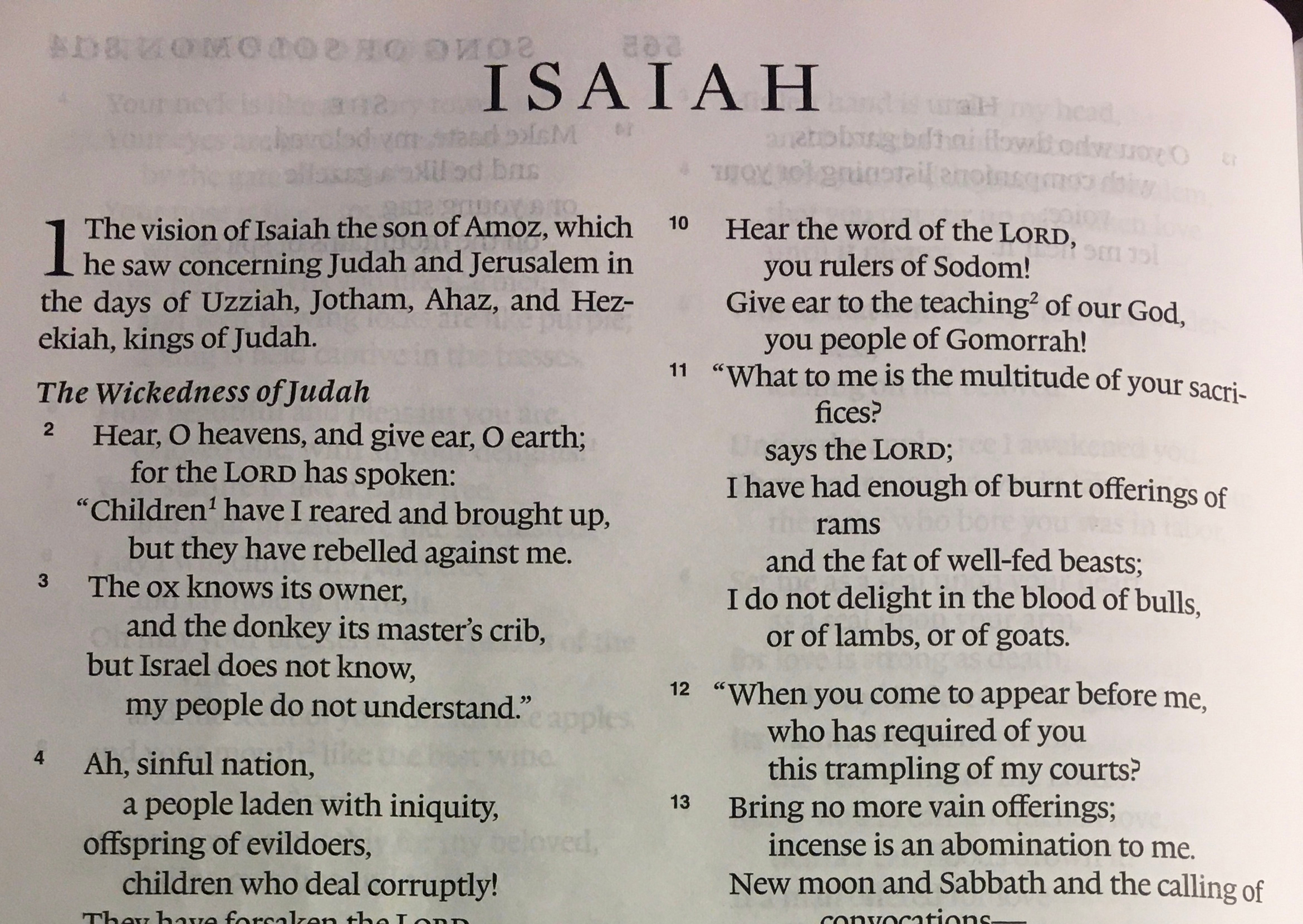
  • The first section includes sermon overviews by Mark Dever (1 message) and Trent Hunter (5 messages). They will help you get the big picture of the book.
  • The second section is composed of selected sermons by various preachers. I will continue to add to this list. If you know of any exemplary sermons on particular passages in Isaiah, please add them in the comments.
  • The third section is dedicated to the series sermons preached by Ray Ortlund. I can’t wait to listen to many of these sermons and I encourage you to do the same.

Listening to good expositional sermons is an excellent way to learn the book of Isaiah and to love the God who gave us this book. Take time to listen to some of these sermons and be sure to respond in prayer to them, even if you hear them on the go. Again, if there are other good sermons to add to this list, please let me know (viaemmaus@obc.org).

Soli Deo Gloria, ds Continue reading

Seven Ways to Read Isaiah

IMG_3712Tomorrow begins the first day of the Via Emmaus Bible Reading plan. However, because one facet of this plan is the absence of daily requirements, you could start today. You could also start on January 5 and not have to “catch up.”

At the same time, because there is not a prescribed daily regiment, I am writing this blogpost to offer a variety of ways to read Isaiah—a formidable first book with sixty-six chapters—so that you can have a sense of progress and planning in your reading this month. (First time Bible readers might find that the New Testament (Track 3 in this plan) is the best place to begin. This year, however, this blog will resource Track 2, which is comprised of the Prophets and Writings).

Not to be daunted by Isaiah’s sixty-six chapters, there are many ways to read Isaiah once or more than once this month, especially when we define ‘reading” as reading and listening to God’s Word. To help you plan read Isaiah within in the month of January, here are seven approaches. Continue reading

A Short Introduction to the Via Emmaus Bible Reading Plan

rod-long-DRgrzQQsJDA-unsplashLast week, I introduced a new reading plan called the Via Emmaus Bible Reading Plan. As I described it, the goal of this plan is to saturate ourselves with Scripture through repeated readings, listening, memorizing, studying, and discussing in community what we are learning.

The name of the plan from the fact this website (Via Emmaus) will, Lord willing, provide resources to a different focus book each month. In 2020, we will begin in Track 2 and offer resources on the Prophets, Writings, Mark, and Luke. Here’s the full layout.

Tracks[1] Old Testament 1

Law + Prophets

Old Testament 2

Prophets + Writings

New Testament
January Genesis Isaiah Matthew
February Exodus Jeremiah Mark
March Leviticus

Psalms

Ezekiel Luke

Psalms

April Numbers The Twelve[2] John
May Deuteronomy Psalms Acts
June John Proverbs Romans
July Joshua

Judges

Job 1–2 Corinthians
August 1–2 Samuel The Five Scrolls[3] Galatians–

2 Thessalonians

September 1–2 Kings

Proverbs

Daniel Pastorals

Proverbs

October Ezra-Nehemiah 1–2 Chronicles Hebrews
November Psalms Mark General Epistles[4]
December[5] Matthew Luke Revelation

If you are need of a Bible reading plan for 2020 or if this plan sounds like it would be helpful for your Scripture reading, please join us for reading the Bible in 2020.

You can learn more about the aims of this plan here and practical ways to put it into practice here. You can also find a printable Via Emmaus reading plan here. Tomorrow, I will outline a variety of ways to read Isaiah—something I will do each month for each focus book.

Also, if it helps, you can receive emails from Via Emmaus by signing up on the side bar. These emails will direct put in your inbox all the forthcoming resources on Isaiah, as well as other biblical-theological content from this website.

I started reading Isaiah this morning and I am looking forward to sharing this book with you and those in my local church family who will be following this plan.

Soli Deo Gloria, ds

________________________

[1] Pick 1, 2, or 3 tracks. The number of tracks you read at once determines the pace of your reading. You may consider starting with Track #3 if you want to begin with the New Testament. Alternatively, you may want to read two tracks, one from the OT and one from the NT. Whichever you chose, the goal is to read one book for one month. This allows for longer readings and more detailed study. Details on this approach will come out tomorrow.

[2] ‘The Twelve’ are the Minor Prophets read as one book, rather than 12 isolated books. The Minor Prophets include Hosea, Joel, Amos, Obadiah, Jonah, Micah, Nahum, Habakkuk, Zephaniah, Haggai, Zechariah, and Malachi.

[3] The ‘Five Scrolls’ (Megilloth) are a collection of “shorter OT books, brief enough to be read publicly at an annual religious festival: Song of Songs (Passover), Ruth (Pentecost), Lamentations (the ninth of Ab), Ecclesiastes (Tabernacles), and Esther (Purim).”

[4] The ‘General Epistles’ are the Epistles not written by Paul, namely, James, 1–2 Peter, 1–3 John, and Jude.

[5] We will also supply a Advent Reading Plan each December. These Old Testament selections will complement and support the reading of Matthew, Luke, and Revelation—each of which testify to the birth of Christ (Matt. 1–2, Luke 1–2, Revelation 12).

Photo by Rod Long on Unsplash