Gary Thomas on Marriage and Evangelism

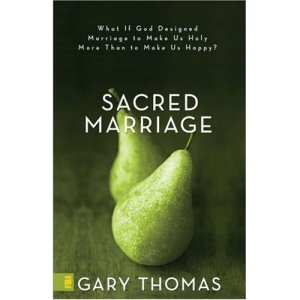
In his book, Sacred MarriageGary Thomasoffers an edifying manual for marriage.  Thomas considers God’s ultimate purpose for marriage and proposes that marriage is not just about self-gratifying happiness, but primarily about spiritual holiness.  His emphasis is that God has designed marriage in such a way as to use it for the sanctification of his saints.  This is main theme of his book, but in one chapter on “Finding God in Marriage: Marital Analogies Teach Us Truths About God,” Thomas goes beyond sanctification to speak about the ways in which enduring marriages show the gospel of Jesus Christ and the glories of his indestructible union with the church.

Since this topic of marriage and evangelism has been the subject of study for me this summer, this quote grabbed my attention and I share it here:

In a society where relationships are discarded with a frightening regularity, Christians can command attention simply by staying married. And when asked why, we can offer the platform of God’s message of reconciliation, followed by an invitation: “Would you like to hear more about the good news of reconciliation?”

In this sense, our marriages can be platforms for evangelism. They can draw people into a truth that points beyond this world into the next. Just by sticking it out in marriages, we can build a monument to the principle and practice of reconciliation.

Years ago Paul Simon wrote a best-selling song proclaiming “Fifty Ways to Leave Your Lover.” A Christian needs just one reason to stay with his or her ‘lover’: the analogy of Christ and his church (Gary Thomas, Sacred Marriage [Grand Rapids: Zondervan, 2000], 37).

May we who know Christ and are married look not only to grow in our marital relationships for the sake of one another, but may we also look to grow in our marriages for the sake of Jesus Christ, that his union with the church might be magnified in our unbroken unions and faithful, loving vows.

Sola Deo Gloria, dss

And his name will be…

Titus Stephen!

After a few months of deliberation, the decision has been made and is now made public. Titus, which means “big and strong” or “giant” (for Wendy’s sake we prefer the former) and Stephen, which means “crown,” both come from the New Testament. Both NT men were servants of the Lord and models of strong Christian character. This is what the New Illustrated Bible Dictionary (1995) says about our Titus’ namesake:

Titus was a man for the tough tasks. According to Paul, he was dependable (2 Cor 8:17), reliable (2 Cor. 7:6), and diligent (2 Cor. 8:17); and he had great capacity for human affection (2 Cor. 7:13-15). Possessing both strength and tact, Titus calmed a desperate sitaution on more than one occasion. He is a good model for Christians who are called to live out their witness in trying circumstances (1259).

Desiring great things for our son, I could not think of a more fitting description of the kinds of hopes and prayers that we have. As anyone who looks at the world today knows, these are trying times, and Christ’s church needs a resurgence of strong men who will be dependable, reliable, and diligent in the service of our king. I pray that Titus might be such a young man, and that Wendy and I might model before him and teach him such Christian traits.

Join with us in prayer for him as we await his imminent arrival. He keeps making himself known–hitting, kicking, and squirming in his mother’s womb. We pray that he will be just as active for Christ in his kingdom as he is now in utero.

Sola Deo Gloria, dss

Heaven on Earth: RDM’s reflections on heaven

Today, on his weekly blog, “commentary,” Russell Moore reflects on the “earthy”-ness of heaven. Sitting under his teaching at Southern Seminary and church, the Lord has used Dr. Moore in profound ways to shape my own understanding of eschatology and how good it will be to taste and see (both corporeal activities) the Risen Christ reigning bodily on earth and to participate with him in the earth he created and redeemed.

Dr. Moore’s point, in short, is that the goal of earth is not an ethereal pilgrimmage to the heavens above, but rather the age to come is to be that of a restored Eden–a renewed earth reclaimed by Jesus, shared with his followers, and enjoyed forever by all those who are found in Christ. It is a powerful vision and one that glorifies Jesus, the King of Glory, as eternal God and the firstborn Son. Here is a sampling of Dr. Moore’s reflection.

For believers, the intermediate state is blessedness, to be sure. But in heaven there is yet eschatology. The ultimate purpose of God is not just the ongoing life of believers but that his kingdom would come, his will would be done “on earth as it is in heaven” (Matt. 6:10). That awaits the end of all ends, the return of Jesus and the final overthrow of death.

What a thought to ponder that dwelling in the presence of God in heaven is a temporal thing to be improved upon. “In heaven there is yet eschatology“! At the end of the age, there will be a restored garden (Rev. 22), a universal gathering of the elect (Heb. 12), a wedding feast and a boundless celebration (Matt. 22:1-14; 25:1-3; Rev. 19:7-10; 21:1ff), and finally “the kingdom of the world men [will have become] the kingdom of our Lord and of his Christ” (Rev. 11:15). What a day that will be!

Read the whole thing here.

Poythress on Biblical Theology and Biblical Theologies


Vern Poythress, in the Westminster Theological Journal (70/1 [2008] 129-42), writes a thought-provoking article about different “Kinds of Biblical Theology.”  His aim is “to reassess the present-day possibilities for biblical theology’s relation to systematic theology” and to show how one cannot be done without the other.  To start, Poythress sketches a brief history of the term, “biblical theology,” contrasting Geerhardus Vos with Johann Gabler and James Barr.  Following Vos, and leaning on the earlier work of Richard Gaffin, Poythress argues for reading the Bible with attentiveness to the divine unity of ‘biblical theology’ and nuanced recognition of the different ‘biblical theologies’ espoused by various biblical authors.   He compares biblical theology to a historical, linear representation of Scriptures, while systematic theology attempts to encircle various biblical themes into logical spheres.  Both approaches are necessary and heuristically viable, and both should be employed by biblical exegetes.

Moreover, Poythress encourages faithful systematicians and biblical theologians to use both BT and ST to read the Bible.  This two-fold approach coheres with the unity and diversity, the history and the logic of the Scripture.  Speaking of this, he writes cautioning against oversimplifications in biblical theology:

Why not write the theology of Paul with resurrection and union with Christ as a central organizing theme, while a theology of the Synoptics would have as a central theme the coming of the kingdom of God? Then a theology of Hebrews would focus on the superiority of Christ, particularly in his high priestly ministry; a theology of John might make central the theme of the revelation of God in Christ; a theology of Revelation might choose theophany and spiritual war as central; a theology of James might make wisdom central; a theology of 1 Peter might choose suffering for Christ as central. A theology of 2 Thessalonians–why not contemplate such a thing?–might make central the hope for the Second Coming. A theology of the Pastoral Epistles might choose the theme of gospel ministry as central.

In laying out such a proposal, Poythress encourages us to read the Bible more carefully.  Affirming Scripture’s divine origin, inspiration, and coherence, he cautions that we should not force themes, systems, or concepts on the Bible. Instead, we should read each Spirit-breathed book, author, and genre with attention to the details of the text. BT and ST should work together to unpack the riches of God’s Word, and we should boldly proclaim the spiritual unity and contextual diversity that is found in God’s redemptive history.

May we do so with power and precision. 

(HT: Justin Taylor)

Theo-logy: Let us press on to know and love the Lord

When you put the emphasis on the wrong syllable, theology turns from the sanctifying, edifying, doxological study of the Trinitarian God to the self-absorbed, glory-seeking, academic discipline of God-study.  For in the compound word, theos and logos supply two possible centers of focusAttention to the former is good and right because it highlights and exalts God in all his manifold perfections; fixation on the latter, though, runs the risk of replacing the proper object of veneration with man’s ability to be scholastic, creative, and clever.   In this, the study of God becomes idolatry with biblical language. Only the first kind of study abides in Philippians 4:8, “Whatever is true, noble, right, pure lovely, and admirable, think about such things.” The second kind of theology corresponds to the spirit of this age, even if its gets the creedal formulations right, because its affections are heterodox.

In short, theology that does not have white-hot worship as its end, covenantal relationship as its context, and love as its fuel will fail in the end.   Pastors, theologians, and seminarians have the occcupational hazard of studying God cold, dry, and hard.  Such cannot be the way to pursue a knowledge of God.  For knowledge must be accompanied by love (1 Cor. 8:1), or with increased knowledge will come greater judgment.  

Consider the words of John Piper on knowing God in the book of Hosea, as he writes on the relationship between sexual purity and knowledge of God:

I think it is virtually impossible to read this (Hos. 2:14-16, 19-20) and then honestly say that knowing God, as God intends to be known by his people in the new covenant, simply means mental awareness or understanding or acquaintance with God.  Not in a million years is that what “knowing God” means hereThis is the knowing of a lover, not a scholar.  A scholar can be a lover.  But a scholar–or a pastor–doesn’t know God until he is a lover.  You can know about God by research; but until the researcher is ravished by what he sees, he doesn’t know God for who he really is.  And that is one great reason why many pastors can become so impure.  They don’t know God–the true, massive, glorious, gracious biblical God.  The humble intimacy and brokenhearted ecstasy–giving fire to the facts–is not there (John Piper, “Sex and the Supremacy of Christ” in Sex and the Supremacy of Christ, edited by Justin Taylor and John Piper [2005], 32).

Father in heaven, make us lovers, not just scholars.  Give fire to the facts.  Help all those who study your Word, become more deeply in love and loving.  Keep your pastors pure by giving them the gift of yourself.  And may we who pursue academic studies of You never settle for erudite answers only; may we always press on to know you–inquisitively, innocently, intensely, and intimately (Hosea 6:3).

Sex in the Service of God

When was the last time that you read a book or a chapter and had your worldview rocked?  Where as soon as you finished the chapter, you wanted to start it again?  When the result of extended meditation on the book actually changed your thinking and your view of life?  For me this has come from John Piper’s Desiring God, Robert Coleman’s The Master Plan of Evangelism, A.W. Tozer’s The Pursuit of God,  and only a handful of others.

This morning I would have to add Christopher Ash’s Marriage: Sex in the Service of Godto the list.    Like an unexpected earthquake, Ash set off a series of tectonic shifts in my thinking about marriage, sex, and the glory of God.  His premise is that the primary purpose of marriage is not human companionship to overcome loneliness or personal satisfaction derived from a heterogeneous coupling.  No, instead, the divine design of marriage is more cosmic, more missional, and larger than just two people in bed together. 

Going back to the Garden, God’s intention in creating mankind male and female has always been to perform a work that could not be done alone.  God’s command to mankind to till and cultivate the earth, to serve God and guard the garden has cosmic significance.  And today, after the Fall, it has a missions imperative.  This changes everything about marriage, because the blessed union is far more than simply two becoming one. 

The force of Ash’s chapter, “Sex in the Service of God,” comes from the fact that his argument is clear, intensely biblical, and incredibly relevant–not to mention inspiring in a Great Commission sort of way.  Marriage and sex as an act of proclaiming the glory of God and the kingdom of Christ has been something I have thought about before, but never with such clarity and potency as I had this morning.  I pray it will have a lasting effect.

So I commend you to pick up the book and read the chapter yourself and ponder its significance.  I know that I will, again and again. Here is a sampling to consider your marriage in the light of God’s glory:

Marriage is to be a visible and lived-out image of the love of the Lord for his people, and this relationship is so central to reality that the project of imaging it is seen as the primary purpose of marriage.  The paradox is that when we begin to think of the marriage relationship as an end in itself, or even as an end that serves the public signification of the love of God, we slip very easily into a privatization of love taht contradicts the open, outward-looking and gracious character of covenant love.  By this I mean that the covenant of the Creator for his people is a love that has the world, the whole created order, as its proper object; in loving his people with a jealous love he has in mind that this people should be a light to the nations and that through them blessing should spread more and more widely.  The moment we begin unquestioningly to treat marital intimacy as the primary goal of marriage, however, we contradict the outward-looking focus and the project becomes self-defeating (Christopher Ash, Marriage: Sex in the Service of God, 127).

Singing the Psalms

Do you sing the Psalms? If not, why not?

Joe Holland makes a strong argument for including the Psalms in our corporate worship and daily lives. His blog on “Rediscovering the Psalms” makes a case for the value and vitality of finding a good Psalter and singing God’s word.

He writes of an encounter with a Peruvian minister who challenged his thinking in the way he intentionally chose the Psalms as an instrument for renewing minds of his congregation with the biblical, theological, and missional content of the Psalms. He writes of the Peruvian pastor:

First, he was convicted that psalm singing was the biblical pattern of New Testament worship. Second, he was fighting heresy in his churches. False teaching slipped into his churches through folk songs slightly adjusted for worship. Psalm singing was his attempt to guard his people from heresy sung to a familiar tune. Third, he said, “I sing psalms because they are militant.” He wanted to teach his people that Christians daily engage in spiritual warfare. The psalms provided a war-time mentality to his young churches.

From there Holland goes on to give eight reasons why we ought to sing the Psalms. Here are his points:

1. When you sing psalms you literally sing the Bible.
2. When you sing the psalms you interact with a wealth of theology.
3. When you sing the psalms you are memorizing Scripture.
4. When you sing the psalms you guard against heresy.
5. When you sing the psalms you engage a collection of songs that address the full range of human emotions.
6. When you sing the psalms you praise the person and work of Jesus Christ.
7. When you sing the psalms you are training for spiritual warfare.
8. When you sing the psalms you are engaging the communion of saints.

May we considered his exhortations, find a good Psalter, and sing praises to our king, sing praises (Ps. 47:6).

(HT: Justin Taylor)

Biblical-Theological Resources on the Psalter

This summer our Adult Bible Fellowship, Wellum’s Couples, has been studying the book of Psalms. Attempting to read the Psalter as a canonical unit, instead of 150 disjointed praises and laments, Dr. Wellum has been showing us the themes and the biblical-theological connections established in the Psalms.  This weekend, I had the privilege of teaching Psalm 24.

In preparation for the lesson, I considered a number of books and articles that proved helpful in reading the Psalter canonically.  In contrast to the higher-critical scholarship done in the later nineteenth and twentieth century, the resources listed below mark a more recent turn in Psalm scholarship, seeking to point out the unity and structure of the Psalter. Not all the resources are equally helpful or detailed, but they are a place to start if you are desirous of reading the Psalter as one, God-inspired canonical unit.

Stephen Dempster, Dominion and Dynasty (IVP: 2003) pp. 194–202.

Dempster sees David as the main idea in the Psalter: “[The Psalter’s] fivefold structure echoes the first section of the canon, the five books of Moses. Seventy-three of the psalms have the name ‘David’ in their titles, and Davidic psalms are strategically placed in each book of the Psalter. The Psalter opens with a flurry of Davidic psalms and closes with a similar grouping, Ps. 3-9; 11-32; 34-41; 138-145 (194).

Jamie Grant, “Singing the Cover Version: Psalms, Reinterpretation and Biblical Theology in Acts 1–4” in The Scottish Bulletin of Evangelical Theology.

Grant’s journal article attempts to show how NT usage of the Psalter in Acts 1-4 could serve as a helpful paradigm for reading the Scriptures typologically. Grant also has another book,The King as Exemplar: The Function of Deuteronomy’s Kingship Law in the Shaping of the Book of Psalms (SBL: 2004), that looks helpful for reading the Psalter well.

Geoffrey W. Grogan, Psalms (Eerdmans, 2008)

Brand new commentary on the Psalms in the The Two Horizons OT Commentary series. Grogan spends the first half of the book commenting on individual psalms, and the second half considering the Psalter thematically, biblical-theologically, and then with regard to contemporary issues in evangelical theology. The second half of the book seems very helpful in drawing out themes in the Psalter, but it does not do as well in helping to understand the internal structure of the Psalms themselves.

Paul House, “The God Who Rules,” in Old Testament Theology (IVP:1998), p. 402–23.

Though only a chapter, this may have been the most helpful treatment. Citing John Walton’s JETS article on the Psalter (1991), House writes: “Psalms displays a ‘content agenda’ that includes an introduction (Ps 1-2), David’s conflict with Saul (Ps 3-41), David’s Reign (Ps 42-72), the Assyrian crisis (Ps 73-89), reflection on Jerusalem’s destruction (Ps 90-106), reflection on the return to the land (Ps 107-145) and concluding praises (146-150). These divisions and contentment statements keep faith with the shape of the Psalms ans offer ways by which major theological themes may be discussed. They also allow for both essential diversity and necessary unity in Psalms interpretation” (405).

David C. Mitchell, The Message of the Psalter: An Eschatological Programme in the Book of the Psalms  (Sheffield Academic:1997).

Mitchell’s work underscores the eschatological trajectory in the Psalms in general; chapter 2 considers the arrangement of the Psalter in particular. Recognizing “the headings and content of individual psalms, the sequence of the Psalms, the arrangement of the internal collections and the five-book arrangement” (89), Mitchell attempts to construct a reading the Psalter that is both tied to history and eschatological in emphasis. He sees Zechariah 9-14 as a key to understanding the Psalms, and he spends much time developing this intratextual link. Some of his connections seem speculative, but his work challenges us the reader to consider the Psalter more carefully.

Marvin Tate’s article in Peter Craigie’s Word Biblical Commentary, Psalms (Word: 2004) p. 438–72.

Found in the 2004 update of Peter Craigie’s commentary, Southern Seminary’s own Psalm scholar writes a helpful piece, tracing recent scholarship on the Psalter. He writes: “There is too much evidence of intention and design to assume that the Psalter was simply thrown together in a jumble out of disparate texts without regard to placement or design. We need not, and should not, expect the process to reflected in the Psalms to meet the standards of a modern artistically structured texts. A fully “systematic” redaction will not be found, but this need not deter us from a careful analysis of intertextual relationships between continguous psalms in pairs, clusters, blocks, books, and divisions, as well as the psalter as whole (468).

Soli Deo Gloria, ds

Land Ho!!! A Biblical Theology of the Land


Three years ago I had the privilege of traveling to Israel.  On a mission trip with my church, we spent nearly two weeks touring the country and participating in evangelistic efforts in places like Haifa, Tiberias, and Tel Aviv.  It was an incredible experience to tell a young Israeli whose barber shop opened up to the Sea of Galilee, “On that water Jesus walked, and in this Hebrew New Testament, you can learn more about the Messiah.”  Needless to say, I returned to the U.S. with a host of memories and incredible images of the countryside in which our Savior was lived and died.  

This weekend many of those bucolic scenes were recalled as I read O. Palmer Robertson’s book Understanding the Land of the Bible: A Biblical-Theological GuideRobertson’s premise in the book is that the land of the Bible which intersects the continents of Africa, Asia, and Europe was divinely designed to proclaim gospel truth.  Concluding his introduction he writes, “Let us allow this land in its uniqueness to reinforce for us today the truths that bring salvation for men” (4). 

In his book, he unfolds a biblical theology of the land.  In so doing, he considers the land from West to East and then from South to North and then by paying attention to many of the features of the land.   Without allegorizing or spiritualizing, he shows how consideration of the land really does reveal redemptive truth.  After laying out the latitudinal aspects of the region, Robertson summarizes, “Traveling across the Land of Promise from west to east can provide many insights into the purposes of God for the whole of the world.  In microcosmic fashion the design of the land serves as a means of embodying the truth of God intended for all nations” (24).  What is this intended truth?  Figuratively, that people dwelling in desolate wilderness will move into the hospitable presence of God within the Promised Land.  Clearly, this pattern of dwelling in the land plays itself out within the Bible (Abraham’s call to Canaan, Joshua’s entry into the land, the return from Exile, and Jesus crossing the Jordan into the land at his baptism are all physical-geographical moves that contain theological significance).

Moreover, moving from South to North recalls history and geography that carry historical and theological import.  The exodus drove north out of Egypt, the divided kingdom was split according to Northern tribes of Israel and the Southern tribes of Judah and Benjamin, after Babylon repopulated Samaria, the Northern Samaritans were disdained by the more Southern Judeans, Galilee of the Gentiles on the Northern-most end of the country, was filled with foreigners during Jesus day and became a microcosm of the diverse world He can to save.  In short, “The whole of the land was designed by the Lord for his good purposes as he determined them from before the foundation of the world” (37).

After considering the beautiful and rugged terrain of the Bible, Robertson surveys the cities of importance throughout the land of Canaan.  He does so chronologically, considering the role of each during the Patriarchs, the Judges, the united and divided monarchies, and finally at the time of Christ.  Taking a chapter on each epoch in redemptive history, he examines the Scriptures for significant references to these locales and shows how their particular placement in the land and in time shaped the biblical narrative. 

Overall, Robertson’s treatment, which at times seems more like a survey than a theology, does well to help the student of the Bible read the Scriptures with an awareness of God’s plan within the land.   He unveils the significance of geographic features and historic locations for the reader less attuned to such particulars.  And he shows how all Scripture and all creation points to its Creator and Redeemer.

This land was made for Jesus Christ.  All its diversity was designed to serve him.  Its character as a land bridge for three continents was crafted at Creation for his strategic role in history of humanity.  Even today all nations flow constantly to this place, for its is uniquely his land, the focal point of the world (109).

This point is worth considering further.   For it challenges us to think about the land of the Scriptures in way that many of us are slow to do.  It makes us come back to the Bible looking at it with renewed eyes.  For consider, Psalm 72:8 says, “May he [the king] have dominion from sea to sea, and from the River to the ends of the earth.”  Yet, how can we begin to understand such a sweeping statement without a particular understanding of the seas, the River, and the ends of the earth?  Indeed, we need to learn more about the land to understand this language.  Certainly, the Scriptures speaks to these things, but too often I overlook them.  Consequently, Robertson’s book is helpful in calling my (our) attention back to reading the Bible more faithfully, and better understanding all that it is saying about Jesus Christ.

So let me commend to Understanding the Land of the Bible, as it would help you read the Bible more completely or supply biblical-theological material to your next sermon.  Still, beyond reading another book, let me urge you to reflect on the significance of the land in the Scriptures.  It is steeped with history and with revelation concerning the redemptive plan(s) of God.  For, as Robertson reminds us, “It is Christ’s land” (cf. Psalm 2)!  Studying the Scriptures with a view to the land points us forward to a day when Jesus will return to have dominion over all the lands.   Until that day let us become more well-versed in the land in which he inhabited, so that when he comes he might find us faithful in the land in which we now reside.

Sola Deo Gloria, dss
Postfoundationalism as Spiritual Adultery

This last semester, I spent a good deal of time reading about, thinking through, and writing on the subject of “postfoundationalism,” the postmodern, postconservative, postevangelical theology of the late Stanley Grenz, John Franke, Roger Olson, and a handful of others.  In my readings, one recurring feature was the denial of Scripture’s sufficiency.  For instance in Beyond Foundationalism, Grenz and Franke propose a method of correlation that adopts an epistemic method “based upon” scripture and Tradition and culture, so that their theological method upholds its beliefs with an integrative mosaic web.

Reading Raymond Ortlund Jr.’s book on spiritual adultery this week, God’s Unfaithful Wife, has made me think back on postfoundationalism’s proposal and to reflect that this aberrant mode of interpreting Scripture is nothing more than spiritual adultery, akin to the ancient Israelites dissatisfaction with God’s Torah and their subsequent pursuit of pagan deities, foreign allegiances, and extra-biblical–to use a word anachronistically– revelation.

Consider some of Ortlund’s words.

Commenting on Leviticus 20:6, he says, “Consulting mediums and spiritists also amounts to whoredom, because, like idolatry, resorting to their ministrations denies Yahweh’s all-sufficiency.  Just as the counsels of a perfectly wise husband should be satisfying to a fair-minded wife, so Yahweh’s revelation in law, Urim and Thummim, prophetic word, and so on, should satisfy the questions and perplexities of his people.  To seek revelation beyond his provision insinuates failure in him, exposes a prying restlessness in the covenant people and subjects them to compromising guidance from degraded sources” (38).

Writing about God’s leadership and revelation in Judges, Ortlund goes on, “The period of the judges was infamous for its widespread moral confusion.  ‘Every man did what was right in his own eyes’ (21:25), and not even Gideon escaped the spirit of the times.  Rather than respect the unique prerogatives of the Levites at the tabernacle in Shiloh, Gideon made his own personal ephod in Ophrah.  As a device for enquiring of God” (43).  Adopting cultural practices of receiving communications from the divine, rather than humbling submitting to God’s prescribed means of revelation, Gideon “inadvertantly [led] the people of God into whoredom” (44).  “[Israel] trusted in it [the ephod] rather than in Yahweh and neglected his formally established means of grace” (44).

Continuing on this theme, Ortlund writes again concerning Israel’s metericious tendencies during the time of Jeremiah, “In real terms, Jeremiah sees the people of God as faddish and insecure, nervously searching the latest offerings from neomania, for they do not grasp the true meaning and abiding claim of covenant (87).

All in all, Ortlund’s biblical-theological treatment of spiritual adultery is a shocking exhortation that all types of revisionist theologies that dismiss the Reformation principle of Sola Scriptura are not just poor, they are prostitution.  Paul says of the church’s tendency towards unholy unions:

Do not be unequally yoked with unbelievers.  For what partnership has righteousness with lawlessness?  Or what fellowship has light with darkness?  What accord has Christ with Belial?  Or what portion does a believer share with an unbeliever?  What agreement has the temple of God with idols? For we are the temple of the living God…Therefore go out from their midst, and be separate from them, says the Lord, and touch no unclean thing, then I will welcome you (2 Cor. 6:14-16a, 17).

If marriage is to be protected from physical prostitution, so the doing of theology must be guarded against the perverting effects of worldly accomodation.  Theological methods that purport any kind of admixture, combining the biblical authority with tradition, culture, sociological reasoning, psychological sensitivity, or philosophical reasoning ultimately conjoin the unilateral revelation of God’s word with the fleshly calculations of fallen men.  The union is not binding and cannot be consider acceptable in God’s sight.  Grenz, Franke, and Olson call this revisionist theology postfoundationalism, but Scripture seems to call it something else–prostitution. 

May we be warned and wise to heed the singular message of God’s Word and to conform our lives to its gospel and its truth, so that we may not be deceived and “led astray from a sincere and pure devotion to Christ,” to whom we are singularly betrothed (2 Cor. 11:3).

Sola Deo Gloria, dss