Zondervan Quiz, Three Views Book, and Other Resources on OT/NT Hermeneutics

This Fall Zondervan is set to publish another book in its Counterpoints series.  The book, Three Views on the New Testament Use of the Old Testament, is a survey of differing ways evangelical Christians read the Scriptures.  Darrell Bock of Dallas Theological Seminary, Peter Enns formerly of Westminster Seminary, and Walter Kaiser formerly of TEDS and Gordon-Conwell are its three contributors. 

In preparation for this release, Zondervan’s Koinonia blog has set up a seven question quiz that can help you determine what position best describes your biblical-theological hermeneutic.  It will peg you as either a Fuller Meaning, Single Goal View (Enns), Single Meaning, Unified Referents View (Kaiser), or a Single Meaning, Multiple Contexts and Referents View (Bock).  According to my responses, I am the last–which means, that in reading the OT/NT, I consider the authorial intent of the Old Testament writers to have historical and literary significance for them and their audience in their varied Ancient Near Eastern settings.  At the same time, inspired by the Spirit, I believe that they were aware that what they wrote was eschatologically pointing forward to Jesus Christ.  In other words, they wrote better than they knew.  Peter says as much in 1 Peter 1:10-12 when he writes, “Concerning this salvation, the prophets who prophesied about the grace that was to be yours searched and inquired carefully, inquiring what person or time the Spirit of Christ in them was indicating when he predicted the sufferings of Christ and the subsequent glories. It was revealed to them that they were serving not themselves but you, in the things that have now been announced to you through those who preached the good news to you by the Holy Spirit sent from heaven, things into which angels long to look.”   Likewise, this seems to be the way that Jesus reads the OT, identifying himself by means of these OT writers who pointed forward to him (cf. John 5:39; Luke 24:27, 44).  Moreover, Paul and Jude employ this same hermeneutic when they read Christ into the OT (respectively, 1 Cor. 10:4; Jude 6).

All that to say, if these things interest you as they do me, and they should–putting the Bible together OT and NT is one of the most vital ways we can understand the God who has revealed himself and offered us salvation in his Son–then be sure to check out this multi-sided book.  In the meantime, you can also take the quiz here.

Other helpful resources on the subject include: G.K. Beale and D.A. Carson’s Commentary on the New Testament Use of the Old Testament; G.K. Beale’s The Right Doctrine from the Wrong Text? ; Graeme Goldsworthy’s Gospel-Centered Hermeneutics.

I look forward to reading the arguments in the upcoming Zondervan book, but i am still more excited to simply read my Bible and see Jesus in the Law, the Prophets, and the Writings. 

Sola Deo Gloria, dss

The Story of Marriage

Christopher Ash, in Married for God, writes:

The Bible tells many stories of human marriage, both good and bad, from Adam and Eve through Abraham and Sarah, David and Bathsheba, and countless others. All of them, one way of another, are stories of dysfunctional people in spoiled relationships.

But above these stories the Bible tells a bigger story, the story of a marriage which includes within itself the whole history and future of the human race. It is the story of God the Lover, the Bridegroom, the Husband, and his people his people Beloved, his Bride, and in the end his Wife. It is the story that John the Baptist had in mind when he spoke of Jesus as the ‘Bridegroom; (John 3:25-30), and the story that Jesus himself accepted when he spoke of himself as the ‘Bridegroom’ (e.g. Matthew 9:14-15). It is the story of Paul referred to when he spoke of the church in Corinth as being ‘engaged’ to Jesus Christ like a pure virgin (2 Corinthians 11:2) (Christopher Ash, Married for God, 166).

Supplying his line of thought with more biblical content, the biblical story of marriage is a story that begins with the first union in the Garden of Eden and climaxes with the marriage supper of the Lamb in the Book of Revelation. It is a story of love created, love lost, love promised, love received, and love consummated. It is a story that sounds too good to be true, and yet it is a story more true than any storybook love affair in novels or the news.  It is a story that centers around the king and his bride (cf. Psalm 45). It is a story of a lover and his beloved (i.e. Song of Songs). Tragically, it is also a story of wife who becomes a harlot and prostitutes herself to the nations (cf. Ezekiel 16 and Hosea). Yet, the love of the husband will not be overcome.  The rest of the story concludes with the husband’s redeeming, willing, and cleansing sacrifice restoring his bride to new life (cf. Eph. 5:22-33). Consequently, it is in the end a story of forgiveness, of a husband who searched the marketplace to find his estranged wife, who paid the highest price for her return, and who lovingly and mercifully restored her beauty and radiance to the kind never before seen in a bride. And it is the story of a wedding day that never ends for those who participate in the wedding of the Lamb (Rev. 19:6-10).

And it can be your story if you will turn to the pages of Scripture, read, and believe.  Christopher Ash continues:

It is the story that John speaks of in the visionary imagery of Revelation 19 and 21. The metaphors are mixed and the language is vivid and suggestive; we cannot read it literally and it would not be possible to make a film of this imagery. At the climax of human history John hears the announcement made, “The marriage of the Lamb has come, and his Bride has made herself ready” (Revelation 19:7). The Lamb, the Lord Jesus Christ himself, is to be married at last. His Bride is his people, every believer of all time, corporately to be joined to him forever in union of unmixed delight and intimacy. This is a time of joy and amazement” (166-67).

This is the story of marriage in the Bible. From the beginning, God’s aim with marriage was the final marriage–Christ and the church.  In the garden, the first marriage was for the purpose of the last, and every engagement, wedding, and marriage that has followed has been an eschatological image designed to reflect the final marriage. As a result, our marriages do not stand in the way to that final marriage, they are instead an invitation to come, taste, and see the goodness of the God’s marriage to humanity in the Christ-church mystery (Eph. 5:31).  This marriage is now offered to each husband, wife, or single who will respond to Jesus’ invitation to know him and love him and dwell with him forevermore.  In this way, all of our love stories–past, present, and future–fit into the grand narrative of the Creator of Marriage and the Redeemer of humanity.

As we abide in and enjoy our marriages, may we lift our eyes to a greater union, and with anticipation and hope look forward to our forthcoming union with our loving savior.  Until that day…

Sola Deo Gloria, dss

Fatherhood and the Field Essay

September 11, 2008 020

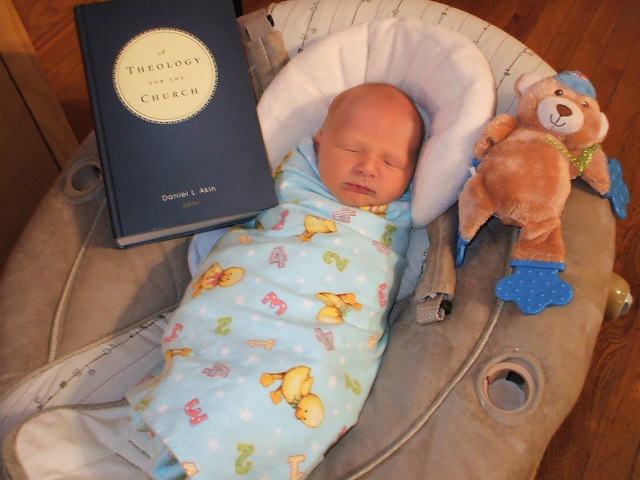
Tomorrow, I settle in for three hours of essay writing and an intensive interview as a part of the PhD application for Systematic Theology at SBTS.  Preparation for the essay(s) and interview have included reading much theology, outlining major doctrines, and rehearsing biblical, historical, and systematic arguments for each.  But unexpectedly (sort of), they have also included the earlier-than-expected arrival of our first son. 

For the last few days, theological preparation has been done while holding Titus, attending to his hiccups, and protecting his face from his flailing hands.  In other words, the studying has been intermittent and often interrupted.  But that is not a complaint.  More important than the non-stop cranium stuffing with facts about Moltmann, Bultmann, postmillenialism, and predestination, God has given me a far greater theology lesson in being a dad.

Consider, the amazing gift to fathers and sons, that they might enjoy a status original to the Trinity itself.  From all of eternity, God the Father has known and loved His Begotten Son (1 John 4:8,16; John 3:16); and God the Son, being equal to the Father, has gladly submitted himself to the hierarchical headship of the Father.  Truly, the mysteries of the Trinity are plenty, but familial relations in this life help pave the way to better appreciating the Godhead.

Likewise, in the history of redemption, God has made himself a father to Israel (Ex. 4:21; Deut. 32:9) and now to those who have trusted in Christ (Matt. 6:9; John 1:12; 1 John 3:1-3).  In other words, God is a Father, and he loves his children.  He does good for them.  He provides (Luke 12); disciplines (Heb. 12:5-11), and shapes his children into offspring who bear a striking resemblance (i.e. Christ-like conformity, cf. Rom. 8-29).  In this way, God is the first and the best daddy (Rom. 8:16ff). 

So more important this week than memorizing all the verses that will help me do well on this entrance exam–though that is important–being a dad is a far greater lesson in theological truth.  Not to say that I have mastered this theological subject, I am only beginning, but in the lifelong pursuit of godly character, this paternal training is an invaluable part–theologically and otherwise.

Reflecting on these two things–fatherhood and the impending field essay–I confess optimistic excitement about the prospect of a doctoral studies, but truth be told, I am all the more excited about being a dad.  Why?  Surely because of the implicit delights of fatherhood, but also because of theological purposes of fatherhood.  As the Spirit instructs in Titus 2:1-10, it is in God-ordained relationships (like fathers and sons) that God provides the greatest lessons in gospel theology.  He conforms us into his image as biblical truth is lived and practiced.  No matter how much theology we know, it is theology enacted in day-to-day relationships that matters most.  As Paul says, “Knowledge puffs up, but love builds up” (1 Cor. 8:1).  This does not put parenting at odds with a PhD (or any kind of rigorous work done for the Lord, cf. Col. 3:23), rather they complement one another.  And they should, for the Father who sent his Son to be mankind’s savior, is also the sovereign Lord who formed Titus in the womb of Wendy, and now gives me the sober joy of caring for his young life.  What could be better?  Truly this is a glorious theology–life lived in light of the Father, Son, and Holy Spirit.

May we who are a part of God’s household of faith, find delight in the relationships God has given us, and may we see the His glory all the more clearly as we live and move and have our being in familial relations.

Sola Deo Gloria, dss

The Schrock’s: A Pledge and A Prayer

Under the Lordship of Christ, a family of God living for the Kingdom: savoring the Scriptures; walking in the Spirit; speaking the truth in love; proclaiming the gospel to the nations.

It is a whole new day in the life of the Schrock household.  With the addition of Titus, priorities change, schedules change; jobs change; logistics change, sleep patterns change.  There is much change.  But one thing remains the same–living by faith in the gospel of Jesus Christ, praying and working for the glory of His name to be exalted in all aspects of our lives–in our home, in our church, across the street, and around the globe. 

One of the most exciting prospects of parenting is introducing our son to Jesus and the Bible’s message of salvation.  At the same time, this privilege is accompanied by monumental challenges.  Besides the day to day challenge of living out a model of Christian character (cf. 1 Cor. 11:1); the tireless work of teaching, explaining, and speaking the things of God (cf Deut 6), the societal dangers and systematic evils that threaten the shalom of family life;  there is the reality that Satan would love to kill, steal, and destroy this home–like all homes.  Left to ourselves, we cannot stand under the outward attacks and inner decay–in fact no one can (cf. John 15:5). 

Yet, we aspire to contend against these cosmic forces.  Why?  So that we can come up short, failing ourselves, damaging our son, disappointing our God? No, instead we trust in a greater reality, a better hope, and surer promise; we trust in the power of the Gospel of Jesus Christ.  With zero confidence in ourselves, we embark with confidence in Him who saved us, who called us to the task of parenting, and who calls us to train our child to fear the LORD.  We entrust ourselves to Jesus, who gave us his Spirit to enable us to do things that we on our own could never do.  With that rock solid foundation, we boldly approach the task of parenting with hope in one unwavering thing– the grace of God in the person and work of Jesus.  Without this we have no hope for survival or success.  This is the gospel we believe.  

The gospel alone can cover our mistakes–and there will be many; it alone can atone for our sins–which lie underneath every ‘mistake’; it alone can equip us with love, forgiveness, wisdom, and patience to disciple Titus; and it alone can comfort our souls when our plans have been rerouted by the roadblocks of this world and the sovereign wisdom of our God.  So, with unchanging commitment to the gospel and trust in its singular message of good news, we embark on this adventure of parenting. 

Despite the uncertainty of our days ahead in this age, I offer this humble pledge and desperate prayer, that the family unit that God has established in our home will shine for the glory of Christ.  To that aim we work and we pray, and we ask that Under the Lordship of Christ, we as a family of God would live for the Kingdom by savoring the Scriptures; walking in the Spirit; speaking the truth in love; and going to the nations.

May our home like your home; and your home like our home, bow the knee to the one who sanctioned all families (Eph. 3:14), who is able to do abudantly more than we ask or imagine (Eph. 3:20), and pray for the gospel to pervade every aspect of our family life.

With a sober pledge and a hopeful prayer, we ask that God would get the glory in our home.

Dave, on behalf of the Schrock’s

Palin, Posts, and Prayer

I don’t write much about politics, and for good reason. I am a political novice and a legislative skeptic, but since my google reader has been overflowing with recent ‘Palin’ posts,  I feel compelled to offer the obligatory political post.  So instead of talking better than I know about politics, I will simply link to a handful of reflective Christians who have offered insightful and sometimes irascible comments.

The importance of this issue to gender complementarity, women’s roles, and the local church is where I am most concerned, and it is interesting that concurrent minds have diverged over this issue.  Voddie Baucham and Doug Wilson see this as a deadly plague for the family.  Albert Mohler sees this as a unique opportunity to differentiate the church from the government office.  Denny Burk follows the President’s lead. David Kotter, and the folks at CBMW, seem to want to use this opportunity to clarify the biblical nuances of gender complimentarity. And Tim Challies offers a cumulative survery of these and other considerations.

All of this discussion is healthy and good. Yet, I wonder in the richness of the conversation how much, if any, prayer has been lifted for this VP candidate and her family. Personally, I have been convicted about my lack of intercession. As I wrestle to understand the impact this governmental decision has on gender roles and the local church, in addition to its effect on Sarah Palin’s own family, I have not prayed for her as a godly, complementarian man ought. Ironically, as gender issues arise in the wake of these events, one thing is clear from the passage that has caused so much debate–i.e. 1 Timothy 2–that godly men are to raise holy hands to the Lord in prayer. They are not to quarrel in anger, but rather are to labor in prayer for the good of the their family, their church, the gospel, and their country. Discussion is good but prayer is better. May we as we read, write, question, and speak about these recent events, lift holy hands to heaven and pray for Sarah Palin and for our government, so that the gospel of Jesus Christ might have free reign in our families, our churches, and our country.

Here is a list of recent posts:

Reforming Marriage author, Doug Wilson has four thought-provoking posts: Kind of Spooky When You Think About It , Palin Comparison , An Epistemological Pileup, John Slays His Thousands.

Voddie Baucham separates Pro-Life and Pro-Family and makes some provocative, but polarizing, comments about Sarah Palin’s VP selection in his post, “Did McCain Make a Pro-Family Pick?”

Offering a more balanced commentary, Dr. Al Mohler blogs on his website, and on the Washington Post’s eclectic “On Faith” website

Denny Burk follows Dr. Mohler’s lead and presents a balanced response to the issues his post: Southern Baptist Hypocrisy?

Also navigating the challenging terrain of complementarity, CBMW Director, David Kotter offers a two-part series, “Does Sarah Palin Present a Dilemma for Complementarians?” Part 1. Part 2. From speaking with him the other day, it sounds like more reflections on the biblical and cultural issues are forthcoming. Stay tuned.

Finally Tim Challies summarizes a long list comments in the blogosphere with his lengthy rundown.  You can read it all here.

May we who love the wisdom of gender complementarity pray for Sarah Palin, for our country, and for our churches as we continue to think biblically on this matter!

Psalm 137:9 and the Imprecatory Psalms

Here is a post from Wellum’s Couples“Wednesday Word.”  It is a summary of Dr. Wellum’s biblical-theological consideration of the Imprecatory Psalms from Sunday, August 31, 2008.

The imprecatory psalms are some of the most shocking words in the Bible. Take Psalm 137:9: “Blessed shall he be who takes your little ones and dashes them against the rock!” This week, Dr. Wellum walked through these challenging verses in the Psalter and encouraged students of the Bible to read these verses in the full context of God’s revelation.

A Christ-Centered Interpretation
Due to the shocking nature of many of these imprecatory psalms, three primary interpretive responses have been proffered. Some have attempted to dismiss the imprecatory psalms as vengeful cries from a primitive people. Unfortunately, in making this assertion they disregard Scripture’s unity and authority, and they make themselves self-sufficient arbiters of God’s Word. A second approach is similar. In the progress of redemption and revelation, the New Testament imperative to love your enemies has trumped this Old Testament ethic of retribution. While acknowledging the place of these psalms in history, they make them out to be obsolete. The problem again is that this method disjoints the Bible, when in fact the NT interprets these psalms in light of Christ.

A third approach, advocated by Dr. Wellum, is to read these imprecations in the light of Christ. As we put these Davidic words in Jesus’ mouth, we begin to understand his pleas from the cross. Likewise, we better understand the purpose of these troubled psalms. On this side of the cross, we can read these psalms fearfully as we consider the eschatological retribution that will be poured out on Christ’s aggressors, who have not trusted in his own wrath-bearing atonement. This nuanced approach is most faithful to the Bible and most in accord with the progress of revelation.

A Biblical-Historical Context
To understand these wrathful psalms it is necessary to put them in their proper place in redemptive history. Since the uprising in the garden, all creation has been sentenced under a curse to receive the judgment of God (Gen. 3:14-19; cf. Rom. 8:19-22). Appropriately, the imprecatory psalms excoriate those persons, nations, and societies that wage war with God—in truth, this is all humanity. Simultaneously, the imprecatory psalms assert the coming vindication of God. In Genesis 3:15, a ray of light shines in the cursed skies, “a seed of the woman would crush the head of the seed of the serpent.” This promise is embedded in the context of cosmic conflict—the serpent’s offspring will rage against the children of God (cf. Ps. 2). This spiritual warfare must be seen as the underlining context of the imprecatory psalms.

Carried out in the fullness of time, this head-crushing seed of the women is Jesus Christ. Contending in his life against the powers and principalities, he is hoisted on a cross to die. This act of weakness turns out to be his moment of triumph, for in his death delivers to Satan his death blow (cf. Col. 2:15; Rev. 12). The imprecatory psalms point to this eschatological event (Ps. 69; cf. Matt. 27:34; Jn. 19:28ff). On the cross, Jesus Christ endured the imprecatory wrath called down on the enemies of God, and he did this in order to reconcile enemies of God to the Father (cf. Rom. 5:10). In this light then, the destruction of the Babylonian children in Psalm 137 is seen as imagery depicting the serpent’s demise. Moreover, Psalm 137:9, written in under the skies of Babylon, retells the hope of the proto-evangelium, a seed-crushing son. This is also explains the counter-intuitive notion that the destroyer of reptilian infants is “blessed.”

Modern sensitivities may militate against such violent language, but the biblical notion of peace comes at the price of blood. The imprecatory psalms are cries of justice for the Righteous God to carry out his judgment. This was done through military conflict in the OT (i.e. the language of the imprecatory psalms), and in the NT it was finished on the cross. Today, as we read these challenging verses we are confronted to ask ourselves, “What Spirit shall we hear?” The spirit of this age tells us to dismiss these hard sayings as archaic folly, but the Spirit of Christ points us to swallow these bitter words and look to the cross and to the end of the age when Jesus will come again to put all things under his feet.

Application
As we close, consider three applications: 1) Renewing our minds with the message of these psalms affirms in our own hearts the righteousness of God and the sinfulness of humanity; 2) Embracing these imprecations moves us to exalt God in his mercy and in his justice; and 3) Petitioning God according to these Psalms prepares us for the Day of Judgment, and prompts us to cling to the cross.

May we this week cry out to God, Maranatha! Come Lord Jesus! And may we tell everyone we know how to escape the coming wrath foretold in the imprecatory psalms.

Listen to the whole lesson: The Imprecatory Psalms

The Creative Power of the God’s Word

When God’s people hear about God and what he requires, they will respond.

– Mark Dever

Meditate on this quotation with me for a minute, and consider the creative power of God contained in his life-giving, faith-inspiring, soul-saving Word.

“When” – in the fullness of time God sent his son (Gal. 4:4), and at just the right time God sends his Word to us on the lips of faithful saints.

“God’s people” – when the elect of God hear the Word of God, the power of God converts them and they are saved.  “You do not believe because you are not part of my flock,” Jesus says in John 10:26, for if you did believe you would prove to be sheep.  The good news of the gospel is that all that God intended to save, he in fact does save, and he does so as His word comes to them.  This is a missions imperative.  “I have many in this city who are my people,” God says to Paul (Acts 18:10), and the same is true for us (cf. John 10:16).

“hear” – The gospel comes by hearing (Rom. 10:17), and this hearing comes by the general and prolific call of the gospel.

“about God” – This is the good news.  We know God in and through and because and by way of Jesus Christ.  As we proclaim Christ and him crucified, we make known the love and justice of God.

“and what he requires” – This reflects both the law which leads us to cry out for mercy and the instruction necessary for believers to live lives pleasing to God.  Either way, God’s requirements are not left hazy for those who have the Word. 

“they” – The gospel is for the masses.  This plural reflects the countless millions who have not heard the name of Jesus, and the millions who have.  The gospel creates new covenant communities, and it nevers accomplishes salvation apart from drawing people into fellowship with one another (cf. Heb. 10:24-25; 1 John 1:5-8).

“will” – Positively, absolutely, the gospel will accomplish all that was intended to do (Is. 55:8-9).  It is the power of God for salvation (Rom. 1:16) and it effectually calls men and women to faith and effectively converts them from wrath-deserving enemies to reconciled children.  It will save and it will upbuild the church wherever it goes.

“respond” – The gospel requires a response of repentance and faith.  Nothing more, nothing less.  This response is singular event with lasting and life-changing effects.

Perhaps, in writing this sentence, Mark Dever did not pause to consider each word like this, but he could have.  God’s omnipotent Word calls dead souls from the grave to new creation lives filled with good works.  Likewise, God’s word creates and shapes the church.  May we never forget the potency of the Spirit-breathed Scriptures and may lay everything aside to participate in carrying this message across the street and all over the world.

Sola Deo Gloria, dss

reMARK’s on the Church

Reading Mark Dever’s section on the church in A Theology for the Church, I came across a couple stimulating quotations.  One about the already-but-not yet marks of a true church by Donald Bloesch, another from Robert Reymond about the mark of true church being found in its connection with the apostle message, and finally one from Mark Dever himself that displays the power of the Word to form and reform the church.  Consider them with me: 

One, Holy, Universal, and Apostolic: Already and Not Yet

The church is already one, but it must become more visibly one…in faith and practice.  The church is alread holy in its sources and foundation, but it must stirve to produce fruits of holiness in its sojourn in the world.  The church is already catholic [i.e. universal], but it must seek a fuller measure of catholicity by assimilating the valid protests against church abuse…into its own life.  The church is already apostolic, but it must become more consciously apostolic by allowing the gospel to reform and sometime even overturn its time-honored rites and interpretations” (Donald Bloesch, The Church [Downers Grove: InterVarsity Press, 2002], 103; quoted by Mark Dever, “The Church” in Theology for the Church, edited by D. Akin [Nashville: B & H Academic, 2007], 778).

The Continuity of the Church: Dependent on the Ink of the Word and not on the Trail of Blood

“Just as the true seed of Abraham are those who walk in the faith of Abraham, irrespective of lineal descent, so also the apostolic church is one which walks in the faith of the apostles, irrespective of ‘unbroken succession'” (Robert Reymond, A New Systematic Theology of the Christian Faith [Nashville: Thomas Nelson, 1998], 844; quoted by Mark Dever, “The Church,” 778).

This has implications for Catholic theology and for those Baptists who depend upon the trail of blood for the legitimacy of their church.  Mark Dever continues the thought, focusing on the presence of the Word as the demarcation of a true church.

The physical continuity of a line of pastor-elders back to Christ’s apostles is insignificant compared to the continuity between the teaching in churches today and the teaching of the apostles…God’s people in Scripture are created by God’s revelation of himself (cf. Gen. 1:30; 3:7; 3:15; 12:1-3; Ex. 3:4; Ex. 20; Ezek. 37)…The right preaching of the Word of God that creates the church is not only the Word from God; it is the Word about God [i.e. the Gospel of Jesus Christ]… When God’s people hear about God and what he requires, they will respond (Dever, “The Church,” 778, 780).

May our churches be built on the cornerstone of Jesus Christ and the steady foundation of the apostles and prophets teaching (cf. Eph. 2:20).

Hermeneutics: How should 21st Century Christians Read the Old Testament?

So here’s the question, posed by Josh Philpot: Should 21st century Christians reinterpret the OT in light of the NT the way the apostle’s did (in preaching and teaching)? Or, was there a specific hermeneutic used by the apostles (through divine revelation, of course) as the church began? Or, should we maintain the original intent of the OT author in the same way that we do for NT authors? Would this deemphasize the Messiah in the OT?

So much has been written on this subject lately.  These mere responses are just scratching the surface on a subject that has much history and much need for further exegetical examination.

My first thought is, Why would anyone want to intrepret the Scriptures, the OT in particular, in manner other than the apostles? Dividing the OT from the witness of the NT seems inherently Marcion, except with a priority given to the OT. With so many hazardous methods of correlation espoused throughout church history, the way that the apostles read the Scripture, as inspired readers and writers, seems best. Evaluating and judiciously employing their mode of interpretation seems to be the most biblically consistent way of reading the book that had a single Divine author.

I don’t think that the apostles ripped Scripture out of context, as some assert. Instead, being steeped in the Hebrew Scriptures, discipled by Jesus himself, and uniquely led by the Holy Spirit, I give them pride of place in being able to interpret the OT. We know Jesus saw himself in the Law, the Prophets, and the Writings, and it only makes sense that those who walked with him after the Resurrection had their eyes and minds opened to see (Luke 24:31, 45) and understand how all the OT pointed to Jesus (cf. 1 Cor. 10:6; 2 Cor. 1:20; 2 Pet. 1:19-21). While we twenty-first centuries may have difficulty putting the testaments together, so did the apostles–until Jesus Christ explained the Scriptures to them (cf. Luke 24).  At which point, it appears that the apostles with the finality of the resurrection, couple with the instruction of the Christ, and the leading of the Spirit saw the light.   So, I gladly sit at their feet.

Personally, my method of interpretation has been influenced by Richard Lints three-fold approach found in his book, The Fabric of Theology, introduced by Steve Wellum, where we must read the text in its literary context–exegetically, epochally, and canonically.  As Daniel Block, a strong proponent of authorial intent, once said, “We must put ourselves in the shoes of the author to discern his original intent.” I agree, however, we cannot stop there and draw mere moral principles. We must move to the second horizon, the epochal context. Like Walter Kaiser, we must read the text in light of its antecedent theology and see how the text fits into its immediate historical and cultural context and its place in the storyline of Scripture. Finally, though, we must see the text in light of the entire canon of Scripture. We cannot think that God is making up the story as he goes. Jesus completing fulfills the OT Law, because when Moses was receiving the Decalogue, God was making preparations for Jesus to come and as the telos of the law (Matt. 5:17-18; Rom. 10:4). Only when we read the Bible in light of all three contexts or horizons can we properly discern the authorial intent and the intention of the Author and Perfecter, Himself (cf. Heb. 12:2).  For instance, only in light of the coming of Jesus Christ does the annihilation Israel’s make sense. Without the “Big Picture” and the light of the NT, these ostensible commands for genocide do not have a context.

While I concede that the apostles, being inspired by the Spirit, had a measure of authoritative interpretation and inscripturation that we do not, I think that should encourage twenty-first century Christians to look to their interpretative model all the more, not discourage exegetes from looking at their model. Would it be better to look to the allegorical method of Alexandria? Or the demythologization of Bultmann? Or the trajectory hermeneutic of William Webb? Or even the historical-literary model of Robert Stein?  No, it seems much better to give attention to Peter, Paul, and John. Those who deny NT light to illuminate OT Scripture minimize the unity of the Bible, disregard Jesus’ statement that all Scripture points to him (Luke 24:26-27, 44-46; John 5:39), and neglect an interpretative method that maintains full biblical authority, encourages a forward-looking, hope-giving biblical eschatology, and esteems Jesus Christ.

All that to say, in reading the OT like the apostles (or at least attempting to), Jesus Christ is most highly exalted and most closely rooted in the biblical contours of the canon. So I affirm the apostolic reading of the Scripture, and humbling attempt to see how the OT and NT fit together, unified in Christ (Eph. 1:10).

I know I haven’t figured it all out.  I haven’t come close.  But as I read the Scriptures, the gospel of Jesus Christ comes alive as I see the shadows of Christ in the Old Testament and His substance in the New Testament.  To that end, I will keep reading the whole counsel of Scripture, looking for Jesus.  What about you?

Sola Deo Gloria, dss