DA Carson on Biblical Theology and Preaching

While speaking at a conference this weekend at Omaha Bible Church on the topic of suffering, D. A. Carson gave a trenchant overview of Biblical Theology and Preaching.  His points are worth pondering and applying.


1. Biblical Theology directly addresses massive biblical illiteracy now prevalent in many of our hearers.  Preachers who only preach small portions of Scripture, who take “six years to preach through Matthew,” do a disservice to their congregations and deprive them of large swathes of Scripture.  BT preaching contends against biblical illiteracy.

2. Biblical Theology considers the major turning points in the Bible, not just the raw chronological story.  Preaching that highlights the covenants, the exodus, the exile, the incarnation, the resurrection, and the cross help disciples of Christ understand his story and theirs.  This is not the same thing as mere bible story telling, like in Telling God’s Story (Vang and Carter, 2006), which simply retells the bible in survey fashion.  It is rather a forward-moving, eschatological narrative that has twists, turns, all pointing to Christ.

3. Biblical Theology enriches and encourages systematic Bible reading and is in turn enriched by those who faithfully read their Bible’s.  More than just reading the Bible for an emotional pick-me-up, congregants who see redemptive storyline in Scripture will delight in reading the OT narratives, the minor prophets, and Levitical codes with greater anticipation and understanding.  They become more accessible when they are put in biblical-theological context.  To illustrate this point, Carson expounded Genesis 39 and the biblical theological ramifications of the Joseph narrative with Potipher’s wife.  More than just an admonition to avoid sexual immorality, lust, and tempting situations (though it does affirm all of those); it shows how Joseph’s sexual purity preserved the people of Israel and advanced the kingdom of God.  Consider this quote: Humanly speaking, you and I are Christians today, saved by the blood of the lamb, because Joseph kept his zipper up!!!  This perspective is reinforced and elucidated by BT.

4. Biblical Theology demands inductive rigor in preaching Biblical books and corpora.  DAC argues that preachers must do more than systematically analyze biblical data.  In doing so, God’s progressive revelation is minimized, time and space are blurred.  Rather BT preachers must ask in every passage:  What time is it?   How does this passage fit in the biblical narrative?  On what antecedent revelation/theology is the author grounding?  And concerning biblical language, how does this particular author use his language?  Different authors at different times mean different things by their words, and so it is vital to understand the language in context.

5. Biblical Theology not only keeps historical-canonical-covenantal turning points in mind, but it also keeps inner-canonical tendons/connections tied together in Scripture, and these ineluctably point to Jesus Christ.  Carson alluded to about twenty explicit themes that run through Scripture and move the storyline framework along.  Some of these he listed were: covenant, temple, sonship, marriage, to name a few.  He cited a profitable exercise of going to Revelation 21-22, listing all of the themes and images in the two chapters and then tracing them out throughout the rest of the Bible.  This is an assignment he gives incoming students at TEDS, and it is surely something that would be beneficial to any reader of the Scriptures, for Revelation 21-22 sum up all things in the Scriptures.  William Dumbrell’s book The End of the Beginning does this very well, as does GK Beale’s The Temple and the Church’s Mission.

6. Finally, Biblical Theology helps avoid anachronism in your preaching by developing biblically warranted inter-connections. 

7. There was a seventh point in there somewhere, but I missed it.  I encourage you to listen for yourself, pick out the seventh point, and see how God would have you apply biblical theology to your preaching.

A few other resources that DA Carson names to better grasp these issues are The Unfolding Mystery by Edmund Clowney, (I would add Preaching and Biblical Theology by Clowney), Graeme Goldworthy’s Trilogy, and Bryan Chapell’s Christ-Centered Preaching (cf. Him We Proclaim by Dennis Johnson and Preaching Christ from the Old Testament by Sidney Greidanus).

May we who preach the Bible, preach the whole counsel of God, and point all of our hearers to Jesus Christ through the inspired language of Old Testament prophets and New Testament apostles. 

Sola Deo Gloria, dss

(HT: Unashamed Workman)

Colossians 1.6: Bearing Fruit and Growing!!!

The gospel,
which has come to you, as indeed in the whole world
it is bearing fruit and growing–
as it also does among you…
(Col. 1:6)

This Sunday I am preaching at Kenwood Baptist Church in South Louisville.  I am tremendously excited about the opportunity and about the chance to proclaim the message of the gospel which is “is bearing fruit and growing” all over the world.  In a day when economic forecasts are anything but prosperous and increasing, the hope that is found in heaven (Col. 1:5) promises to bear fruit in the lives of all those who believe.  Moreover, the proclamation of the gospel always accomplishes its fruit-producing task (cf. Mark 4), it never returns void (cf. Isa. 55:10-11).

Meditating on the truths of Colossians 1:1-8, I came across this succinct statement by New Testament scholar, Douglas Moo, in his recent commentary on Paul’s Christocentric epistle.  Consider the redemptive historical unity of his comments on Colossians 1:6 and ask how the gospel is bearing fruit in your life and all over the world.  

The language bearing fruit and growing is reminiscent of the Genesis creation story, where God commands human beings to “be fruitful and increase in number” (Gen. 1:28; see also 1:22).  After the Flood the mandate is reiterated (Gen. 8:17; 9:1, 7), and the same language is later used in God’s promises to Abraham and the patriarchs that he would ‘increase’ their number and ‘multiply’ their seed (e.g., Gen. 17:20; 28:3; 35;11).  The nation Israel attains this blessing in Egypt (Gen. 48:4; Exod. 1:7) but then, of course, suffers judgment and disperal.  So the formula appears again in God’s promises to regather his people after the exile (Jer. 3:16; 23:3).  Paul may , then, be deliberately echoing a biblical-theological motif according to which God’s orignal mandate to humans finds preliminary fulfillment in the nation Israel but ultimate fulfillment ini the worldwide transformation of people into the image of God by means of their incorporation into Christ, the “image of God.”  Colossians 3:10 echoes the same idea, referring to the ‘new self’ (the new people of God in Christ) as ‘renewed in knowledge of the image of its Creator’ (see also v. 10 and cf. 1:15) (Douglas Moo, The Letter to the Colossians and to Philemon in the PNTC [Grand Rapids, MI: Eerdmans, 2008], 88).

May the God of all life-giving grace bear fruit in our lives and may his glorious kingdom increase until it covers the earth!

Sola Deo Gloria, dss

Intimate Allies (pt. 3): A Call for Christian Maturity

Discipleship: Maturation Through Marriage

In addition to bolstering evangelism, Dan Allender and Tremper Longman posit the integral role that marriage has in discipleship.  Consider their words:

The purposes of our marriages are to create life and to shape life to maturity.  A marriage is no better than the vision we have for one another and the willingness we have to sacrifice for each other, to suffer to see growth occur.  Many marriages survive by merely providing a partner for activities–a resource to counter occasional biological and personal needs.  But God’s intention for marriage is to grow or subdue each partner in relation to the other in order to draw each–and eventually marriage itself–to reflect the character of his Son.  The high calling of God is to create life and then to shape it in his image.  Our marriages are not only the context for evangelism but also the soil for discipleshipAnd to what end?  Ultimately, our marriages are the foundation for the kingdom of God to grow on earth in anticipation of its full realization in the new heavens and new earth (Intimate Allies, 83-84).

Just as marriage opens doors for evangelism, it also creates environments for sanctification and discipleship.  Incredibly challenging is the notion that marriage is not just a relationship for recreation, “providing a partner for activities.”  Instead, it is a licensed endeavor to procreate God’s love, to picture divine grace, and to proclaim the mystery of Christ and the church.  This does not mean that your marriage has to be perfect to convey such a message, it just has to be honest, intentional, and gospel-rich.  The Good News has always been that Jesus came to set captives free and to heal the sick.  Therefore, Christian marriages that fail to give verbal credit to Jesus Christ, verge on cosmic plagarism because they do not footnote their source.  Similarly, those that do not admit their frailty, while testifying of Christ’s overcoming sufficiency, miss out on the life-giving joy of telling others of the power and kindness of God.  In other words, maturation occurs in an individual and in a marriage, when the gospel is believed and shared.

This idea of maturation that Allender and Longman highlight is vitally important.  If we have been born again (cf. John 1:12; 3:3-8) and are growing into the image and likeness of our savior, marriage serves as an opportune environment for Christian maturation.  Evangelism and discipleship are requisites of the Christian faith, and marriage is designed to improve these, not impoverish them.  However, too often marriage and Christian maturity are set at odds.  A hidden assumption is that the serious Christian must take on monastic commitments if they are too be holy.  (Gary Thomas addresses this in his book Sacred Marriage).  Some may claim, “the kids keep me from my quiet times,” or “being the bread-winner disallows me from church service.”  Yet, it does not have to be so.  In fact, it must not be so.  The Christian marriage, filled with children (if the Lord permits), should be a vehicle driving us to a greater need for the gospel and propelling us to share the love of God with others.  In this way, marriage enhances our discipleship, as we press towards our spouse in gospel-empowered love, taking on the yoke of self-denying discipleship (cf. Matt. 11:29-30; Luke 14:25-33).

May we pray to that end, that God may be most glorified in our marriages as we are daily conformed into the image of Christ.  May we evangelize and be discipled through one of God’s most precious gifts–marriage.

Sola Deo Gloria, dss

Intimate Allies (pt. 2): Marriage and Evangelism

Evangelism: Marriage Depicts the Mystery of Christ and the Church

In Intimate Allies, Dan Allender and Tremper Longman show how marriage reflects to the watching a world a picture of the gospel, while at the same time for those Christian couples committed to growing in Christ-like conformity, it provides powerful opportunities for discipleship and sanctification.  Consider first their observation on marriage’s gospel-depicting purpose(s):

Marriage must be a picture of or testimony to new birth.  Marriage must reflect the fruits of new birth and the creative, Trinitarian God who is he author of life.  In that sense, a marriage is the foundation of evangelism and the declaration of the possiblity of being a son and a daughter–being a member of the family of God.  The central task of a marriage is first to create and offer life and then to take new life and shape it in the direction of maturity (79-80).

What an incredible vision of marriage!  By participating in and continuing the work of creation in the world through child-bearing, marriage is a picture of new birth.  Likewise, as life is cultivated within the marriage, and as the fruits of marital love are seen with runny noses and dirty feet, God’s program of filling the earth is accomplished.  Consequently, marriage does not stand at odds with God’s plan of salvation, as some might assume from passages of Scripture like 1 Corinthians 7; rather, marriage is a primary means by which the Great Commission is accomplished.  Consequently, marriages that seek to reflect the overflowing love of Christ and the church, provide a powerful lead in to gospel conversations and testimony to the greater, more perfect marriage–one that married and singles alike, can look forward to.

Paul in writing to the Colossians asked for prayer, that God would open a door for more effective service.  He writes, “Pray for us also, that God may open a door for the word, to declare the mystery of Christ, on account of which I am in prison” (4:3).  This petition is a model prayer for all missions-minded believers, and for the married couple who long to see their marriage be a means of evangelistic witness, it should fill their hearts with hope.  For the very being of their marriage witnesses to the mystery now revealed–Christ and the church (Eph. 5:32).  So married couples can and should pray with boldness that God would open doors of for the word of God, pried open by unbelievers witnessing the effect of Christ on their marriage.

Sola Deo Gloria, dss

Intimate Allies (pt. 1): Marriage Means War

Why does the bridegroom stand on the right side of the bride? 

The legend goes:

Long ago, the right arm was considered the sword arm of most fighting men. If a man had to protect his bride, he would hold her with his left hand, and fight off attackers with his right arm.  The reason that men may have had to fight off others was because quite often women were kidnapped. Family members naturally wanted to rescue the stolen brides. Sometimes even during the wedding ceremony, the grooms had to fight off other men who were desirous of their brides, along with the bride’s family members. So having his right arm free was an important strategy.  This tradition is followed today by when facing the officiant, having the bride stand to the left, and the groom stand to the right.  (HT: Wikianswer).

This kind of readiness to defend makes sense in a time and place when marriages were threatened by violent thieves.  But what about today?  In light of the Scriptures, it still makes sense.  Such a posture illustrates the twin realities of love and war, and whether or not we consider marriage to be a violent affair, spiritually speaking, it is.  Marriage is warfare!

In their book, Intimate Allies: Rediscovering God’s Design for Marriage and Becoming Soul Mates for Life, Dan Allender and Tremper Longman make this very important connection.  Love is war!  And for Christian marriages to be strong they must participate in cosmic conflict against the enemies that seek to destroy their marriage.  Concerning marriage and warfare, they write:

The language of a battle may disturb many readers, but life is a war.  And marriage, at times, requires war if the battle of life is to be fought well.  But are our spouses non-combatants, people disengaged from the real battles of our life?  Or worse, are our spouses enemies whom we fight daily?

God’s intention is for our spouses to be our allies–intimate friends, lovers, warriors in the spiritual war against the forces of the evil one.  We are to draw strength, nourishment, and courage to fight well from that one person who most deeply supports and joins us in the war–our soulmate for life.  Husbands and wives are intimate allies (Intimate Allies, xvi).

Clearly strong marriages are not engaged in internecine conflicts, but they are drawing battle lines and contending with external threats.  From the foundation of the world, Satan has been seeking to kill, steal, and destroy (cf. Gen. 3; John 10:10).  He is the accuser, the robber, the murderer, and the home-wrecker.  He loves to pervert and destroy all things that God has created good, and he takes specific aim at marriage, sexuality, and the familial relations of the nuclear family.  One aspect of redemptive history is to re-establish the home.  This is evident in Paul’s letter to the Ephesians, where the fruit of the Spirit-filled life results a properly functioning marriage, where husbands lovingly lead their wives and wives respectfully submit to their husbands (Eph. 5:22-33).  In a return to the properly alligned marriage in the Garden, it seems evident from God’s Word that Spirit-led marriages are in cosmic conflict with the spirit of this age.  Allender and Longman elucidate this point:

What is the basis of the war between the sexes?  It is ultimately, of course, the war between God and his adversary, Satan.  We ought never to be naive.  The deepest struggles of life will occur in the most primary relationship affected by the Fall: marriage.  No one on earth will have more potential to do harm or to do good than your spouse.  Consequently, no relationship will be imbued with more desire and danger than your marriage.  No wonder most couples soon settle down into a distant, parallel existence in which the pain and the joy are kept at a minimum (287).

Sadly, their point is too often the case.  Couples, young and old, settle into patterns of coexistence rather than mutual edification.  Instead of conforming themselves into God’s intimate ideal for marriage, couples accept the luke-warm tensions of marriage, and make it up as they go.  In so doing, they ignore the marriage-transforming power of the gospel, and allow Satan to strip away the joys of marriage.  Yet, it does not have to be that way.  Allender and Longman contend that married is an environment for sanctification, spiritual growth, and gospel-empowered grace.  The battle that closes in on the home provides incentive and opportunity for the God’s power to be made manifest within the marriage, so that the flaming arrows of the enemy become refining fires that illumine and eradicate sin as Christ’s atoning work is applied to each act of sin.  They continue with optimism:

Our marriages are the ground for change.  It is the place where exposure of our need for the gospel is most profound; therefore, it is the relationship where depravity is best exposed and where our dignity is best lived out.  Marriage is the battleground of sin and the place where the Cross is revealed as the only hope for life and joy.  In the midst of the Curse, God promises that redemption will come as the seed of the woman crushes the head of the serpent.  [Therefore], the curse is a friend that drives us to the hope of redemption.  Marriage is the sweet wine and rich meat that heralds the final day and the wedding feast of the Lamb (288).

The first marriage was ruined by the slithering voice of the serpent, yet it was restored by the promise found within the curse: “the seed of the woman will crush the head of the seed of the serpent.”  Adam believed the promise and named his wife Eve, the mother of all living, and thus marital hope was restored, if only partially.  The same kind of redemptive hope is available for every marriage today, and in even greater ways since we know the rest of the story.  Sin still tears at marriage, but through the gospel of Jesus Christ, as depicted in marriage itself (Eph. 5:32), we know that the power of God can restore and reinforce every marriage under threat from sin and Satanic attack.  “Where sin has increased, grace has increased all the more” (Romans 5:21); and “the Son of God appeared to destroy the works of the devil” (1 John 3:8).  Consequently, the attacks of the enemy can in turn become the God’s means for mutual sanctification, as husband and wife humbly cry out to Jesus to come and work wonders in their marriage. 

This is not a civilian’s work (cf. 2 Tim. 2:4).  Picking up the sword of the Spirit, which is the word of God, and believing the promises of God takes courage and tenacity.  Putting to death the deeds of the flesh by the power of the Spirit is an act of war against the one to whom we were once held captive.  It is war, and it is the kind of war that is fueled by love (for God and for our spouse).  Perhaps it is counter-intuitive, but it is absolutely essential that every strong Christian marriage must employ a constant patrol on enemy activity encroaching against their marriage.  Every husband must stand guard, ready to go to war to protect their marriage by destroying every argument and [knocking down] every lofty opinion rasied agsint the knowledge of Christ; just as, every wife must combat Satan through prayers intercession for her home and for her husband.  Marriage is war!

Married people confront life as a battle.  As intimate allies, they push back the chaos.  With the power of God, marriage is an awesome calling and at times a delightful prelude of heaven.  But no matter what joy of what sense of meaning is found in marriage, it is always involved in a war.  At times marriage itself is part of the war… A successful marriage is one in which two broken and forgiving people stay committed to one another in a sacrificial relationship in the face of life’s chaos.  We are intimate allies in the war.  We rejoice together in our victories and cry together as we ecnounter setbacks.  But even in the setbacks, we can have joy because we know that the final victory is ours.  We look forward to the ultimate Wedding, which our own weddings only faintly reflect (346-47).

The pervading thesis of Intimate Allies is that marriage means war.  Once we realize this truth, it will re-adjust how we think of our own marital commitments.  It will re-allign the patterns of our daily interaction.  Our marriages require the daily posture of a pugilist–always ready to embrace our spouse with grace and forgiveness so that the devil does not get a foothold (Eph. 4:26-27).  Simultaneously, we are ever-ready to fight all those who would rend asunder what God has joined together.   Intimate Allies alerts us to the biblical reality of spiritual warfare attacking our marriages, and it implores us to put on our armor because the devil is coming to kill, steal, and destroy.

May the Lord grant us courage to fight sin, Satan, and the spirits of this age that would love to undo our marriages. 

Sola Deo Gloria, dss

Christ-centered, Old Testament Resources

This week Drs. Duane Garrett, Peter Gentry, and James Hamilton discussed the relationship of the Old Testament to the New Testament and the interpretation of Jesus Christ in the Old Testament.  The lively conversation was well-attended on the campus of Southern Seminary and the discussion raised a number of nuanced issues concerning sensius plenior, typology, allegory, interpretive methods, the duplication of apostolic hermeneutics, and the extent to which the Old Testament author’s knew they were writing of Jesus Christ.  In short, they covered a range of key interpretives features of biblical theology.  You can listen to the whole discussion here, while Jim Hamilton makes some follow up comments with pertinent link in his post: How much Christ in the Old Testament

Here are some other resources that may prove helpful in reading the Bible and seeing Christ and the gospel in the Old Testament.

First, James Grant highlights two helpful resources on the the Old Testament concerning its canonicity and its Narrative Structure.  You can find both of these on his blog, In Light of the Gospel: The first reference is to Richard Gaffins’ “Reading the Bible as Canon”.  The other is a link is John Woodhouse on the OT Narrative.

Second, a newer series of books offers to help biblical theologians and pastors see the gospel in the OT.  The Gospel According to the Old Testament Series looks like an incredible series of reflections that highlights, as the title says, the gospel in the Old Testament.  These books are not commentaries, though.  Instead, it seems that they take aim at OT characters.  Some of the books in the series focus on David, Ruth, Elijah & Elisha, Jonah, and others.  Some of the authors are Biblical Theology heavy hitters: Tremper Longman, Iain Duguid, Raymond Dillard, and David Jackson, to name a few. (HT: Chad Knudson)

Hope you find these prophetable!

Sola Deo Gloria, dss

Hapax Legomena? Six Resources to Help Read Biblical Literature Better

This weekend, September 26-28, Bethlehem Baptist Church will be hosting Desiring God’s National Conference for Pastors.  This years plenary sessions will discuss “The Power of Words and the Wonder of God.”  This is a grand subject and one that I look forward to considering more as the MP3’s become available.  Why?  Because the Words of God are the Words of Life, and while they are sufficient for life and godliness (2 Peter 1:3-4) and clear to the Spiritual man (1 Cor. 2:14-16; cf.  Deut. 29:29), they are not equally accessible.  In other words, reading the Bible requires a renewing of the mind (Rom. 12:1-2), able teachers (Eph. 4:11), and Spirit-empowered study (2 Tim. 2:7).  Just ask Peter about the difficulty of Paul’s writing (2 Peter 3:16).

The words of the Bible are not the only difficulty however in ascertaining a proper reading of Scripture.  Language employed to discuss the Bible can also be difficult.  When was the last time you were reading or listening to something about the Bible and got tripped up by unfamiliar langage–things like hypostatic union, pericope, or hapax legomena.  A dictionary sidebar or a parenthetical explanation might be helpful.  Biblical scholars and students of the Scripture have adopted a bevy of words, phrases, and descriptions to synthesize larger concepts and ideas.  Stepping into this river midstream can seem intimidating to the novice interpreter or the young Christian.  Hopefully what follows may help.

Spurred by Chad Knudson’s ‘Biblical Theological Glossary’, I have linked a number of cites that may be of assistance in reading the Bible better by having handy resources to give simple definitions of key terms and concepts in biblical theology, systematic theology, historical christology, archaeology, etc.  I hope these resources are helpful.  If you know of others, let me know and I will update the list.

Theological Word of the Day : A daily blog that provides helpful words, terms, and ideas in theology.  You can sign up to receive RSS feeds, or you can go to their website and browse previous terms.  Consider it a theological dictionary.com.

The Road to Emmaus Glossary: A short list of biblical-theological definitions for those beginning to study the Scripture’s diachronically.

Baker’s Evangelical Dictionary of Biblical Theology: This book is a helpful resource for biblical theology, and the whole of its contents can be found online.

Biblical Archaeology Glossary: Lots of terms about the history and exploration of biblical archaeology.

Biblical Studies Glossary: Contains many definitions and descriptions of terms and words associated with biblical interpretation, theology, and Church history.

Christological Dictionary: A helpful list of historical events, people, and discussions that helped formulate the Christology of the church leading up to Chalcedon.  (See also the Chart for Christological Heresies)

Sola Deo Gloria, dss

The Goal of Marriage is the Kingdom of God

THE PURSUIT OF PLEASURE IN THE PLEASURE OF ANOTHER


Here is a point to ponder.

Darby Livingston, pastor of Come As You Are Fellowship in Union City, OH, comments on 1 Corinthians 7:29, in his book The Pursuit of Pleasure in the Pleasure of Another: A Christian Hedonist Guide to a Happy Marriage (if you are not familiar with the term Christian Hedonism, coined by John Piper, see Pastor John’s explanation here).  Pastor Livingston writes:


“From now on, let those who have wives live as though they had none”  (1 Cor. 7:29)  What does that mean?  Are we supposed to leave our spouses?  NO! [Capital letters mine]… We’re just supposed to be gospel-centered whether single or married.  The gospel isn’t to be used to build better marriages, though sermons and books abound on that topic.  Just the opposite is true.  Marriage is to be used to expand the Kingdom of God through the gospel.  In saying that men with wives should live as though they had none, Paul is saying that the gospel has invaded this evil world and has flipped past priorities on their heads.  Our priority before believing the gospel may have been to build a comfortable little life with our spouse and pray we live long enough to enjoy the fruit of our labor [Ecclesiastes 9:9 does say as much].  Our priority since believing the gospel must be to use every temporal blessing, including marriage, as the means of advancing God’s Kingdom on earth (Darby Livingston, The Pursuit of Pleasure in the Pursuit of Another [USA: Xulon Press, 2007], 124).

In John Piper-esque fashion, Pastor Livingston challenges comfortable Christian marriages, to count the cost, pick up the cross, and carry the gospel.  This is not optional, this is essential.  Overstating his case, Livingston says that “the gospel isn’t to be used to build better marriages.”  Clearly this is not true in and of itself.  The gospel of Jesus Christ does build better marriages.  However, in context his point is dead on!  Good marriages are not the final goal.  The gospel is!  And marriages are to orient themselves around this reality.  As Jesus says with similar hyperbole, “If anyone comes to me and does not hate his own father and mother and wife and children and brothers and sisters, yes, and even his own life, he cannot be my disciple” (Luke 14:26).  In stating his case this way, Pastor Livingston is simply paraphrasing the words of our Lord, and challenging Christian couples to live lives of discipleship.  

Though, I have only read a few chapters of Livingston’s book, I commend it to you as a book that will help you see the glory of God in your marriage and to live radically for the kingdom of God.  If you are a Christian Hedonist, this book is for you; if you are not yet a Christian Hedonist, I would encourage you all the more to check it out.

Sola Deo Gloria, dss

God and Money

In his Sermon on the Mount, Jesus says this about God and money:

No one can serve two masters, for either he will hate the one and love the other, or he will be devoted to the one and despise the other.  You cannot serve God and money.  Therefore I tell you, do not be anxious about your life, what you will eat or what you will drink, nor about you body what you will put on.  Is not life more than food, and the body more than clothing?  … But seek first the Kingdom of God and his righteousness, and all these things will be added to you (Matthew 6:24-25, 33).

Addressing the subject of God and money in his blog today, Southern Seminary President, Dr. Albert Mohler reflects on “A Christian View of the Economic Crisis” .  His sweeping conversation about economic theory, materialism, and the Kingdom of Christ is a helpful reminder in a time of economic unrest that the God who clothes the field and feeds the sparrow will take care of his children.  I encourage you to read Dr. Mohler’s article for insight and to contemplate the field and watch the sparrow to remember the provision of our Lord.

Sola Deo Gloria, dss

Will Revelation 11:18 be Green?

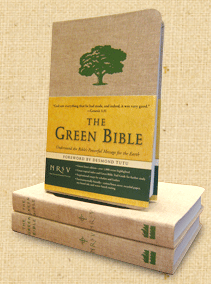
On October 7, Harper-Collins will release the newest “designer” Bible.  Written on recycled paper, using soy ink, and focusing on the eco-friendly aspects of the God’s Word, the Green Bible will draw attention to more than 1000 verses of Scripture that speak about the earth.  Drawing visual attention to these divine statements regarding creation, they will color these verses in a verdant green.  Like the traditional, red-letter Bible, this book will make its environmental mark by “going green.”  Concerning the project, Time Magazine reports:


Green runs through the Bible like a vine. There are the Garden and Noah’s olive branch. The oaks under which Abraham met with angels. The “tree standing by the waterside” in Psalms. And there is Jesus, the self-proclaimed “true vine,” who describes the Kingdom of Heaven as a mustard seed that grows into a tree “where birds can nest.” He dies on a cross of wood, and when he rises Mary Magdalene mistakes him for a gardener.

I would agree, sort of.  From Genesis to Revelation, the Scriptures are very creation-conscious, but always for a larger purpose.  God created the earth for humanity; God sustains and prospers the earth for his image bearers; and one day God will one day regenerate the cosmos so that Jesus Christ and his disciples will superintend that New Earth (cf. 1 Cor. 15:24-28; 2 Tim. 2:11-13). 

Trent Hunter, a good friend and the one who clued me in to the Green Bible’s release, makes several cogent points in his blog on the Green Bible.  He remarks:

Jesus did not enter the earth for the earth. Neither does he redeem humans for the sake of the earth. God’s creative and redemptive purposes are about God’s glory in the praise he receives from those who uniquely bear his image.

I agree.  The pinnacle of creation is the Image Dei, that is humanity, you and me.  However, I would add that while God did not redeem humans for the earth in an ultimate sense.  In another sense, he did.  Jesus died on the cross so that redeemed humanity would again reign over his creation with Him (cf. Revelation 2:28-29).  Thus God is greatly concerned about the earth and its restoration, but his aim in recovering the planet is for His Son and the humanity that his son saved for destruction.  Likewise, God’s wrath is poured out on those who destroy the earth.  This isolated point might be cheered by those who campaign “Reduce! Reuse! Recycle!”  But in truth, it may be those who are most outspoken about the earth that are in fact destroying it by their idolatrous hatred towards its Creator and Restorer.  Consider Revelation 11:15-18:

Then the seventh angel blew his trumpet, and there were loud voices in heaven, saying,
“The kingdom of the world has become the kingdom of our Lord and of his Christ, and he shall reign forever and ever.”
And the twenty-four elders who sit on their thrones before God fell on their faces and worshiped God, saying:

“We give thanks to you, Lord God Almighty, who is and who was,
for you have taken your great power and begun to reign.
The nations raged, but your wrath came,
and the time for the dead to be judged,
and for rewarding your servants, the prophets and saints,
and those who fear your name, both small and great,
and for destroying the destroyers of the earth
(Revelation 11:15-18)

In all this green-talk, I wonder what color Revelation 11:18 will be in the new Green Bible?

In John’s apocalyptic vision, the beloved disciple records the words of the saints who hear the announcement of the kingdom come!  They give praise to the Lord almighty, the one who created all things (see Revelation 4:11), and they exalt him for taking his place as the king of the world he created and established.  They praise because the terror of this age, namely the raging of nations, has come to an end, and they sing for joy because God has come to reward his faithful remnant.  And then they announce these prophetic and perhaps ironic words, “destroying the destroyers of the earth.”  In context, the passage reads: “We give thanks to you, Lord God Almighty, who is and who was…for destroying the destroyers of the earth.”  In other words, with the coming of the kingdom (Rev. 11:15), the time has come for the creator of the earth to judge the earth (Rev. 11:17-18), and this judgment is not upon the flora and the fauna.  It is on the quick and the dead! 

Clearly in this passage, the Green Bible would have linguistic reasons to mark the text green: Those who destroy the earth shall be destroyed!  Don’t miss that, Al Gore may say!  However, the question becomes: Who destroys the earth?  Is it those who litter?  Those who refuse to recycle?  Those corporate industries who emit toxins and dump chemicals into EPA-protected wetlands?  Or is it something else?  The Scripture does not blush.  The destroyers of the earth are those who rage against God (cf. Psalm 2).  The reason that the earth is groaning is not because of carbon dioxide, but because of the curse (cf. Gen. 3:14-19).  The curse that has been declared upon you and me, because of our creation-destroying  sin.  Romans 8 tells the story,

For the creation waits with eager longing for the revealing of the sons of God.  For the creation was subjected to futility, not willingly, but because of him who subjected it, in hope that the creation itself will be set free from its bondage to corruption and obtain the freedom of the glory of the children of God.  For we know that the whole creation has been groaning together in the pains of childbirth until now. And not only the creation, but we ourselves, who have the firstfruits of the Spirit, groan inwardly as we wait eagerly for adoption as sons, the redemption of our bodies.

From the beginning, the earth has been subjected to futility because of Adam’s sin and ours (cf.  Rom. 5:12ff).  And as the rest of Scripture indicates, the only atonement for sin is the life, death, and resurrection of Jesus Christ.  Consewquently, the earth will groan until all sin is dealt with and the sons of God are revealed.  Therefore, the environment will not be restored by legislative efforts to reduce the burning of fossil fuels; the earth will not be saved by green-thumbed gardeners, and it will not be saved by a Green Bible.  It will only be saved by the one man who can re-create and resurrect. 

The testimony of Scripture is clear, we are all destroyers of the earth, and we all deserve to be cast into the burning lake of fire (Rev. 20:14), but the good news is that God sent his son to redeem humanity and the earth.  Again, not through environmental policies, but through his son Jesus Christ–the vine, the gardener, and the second Adam–can humanity and all creation have new life (cf. Col. 1:20).  He alone is the hope of all creation. 

So, what about the Green Bible?  I hope that the Green Bible does well in its sales!  I hope that lovers of God’s creation will pour over the Scriptures that speak of creation and the only One who can bring about the new creation.  I pray that as they read the green and the black ink that they will see that the regeneration of the earth comes not by human effort and green verses, but by one man, Jesus Christ, who alone as the True Vine can save us from our earth-corroding sin.  He alones saves.  He alone restores.  This requires more than just green ink though, it requires red blood.  As Hebrews 9:22 says, “without the shedding of blood, their is no remission of sin,” and as Revelation 11:18 makes clear, without red blood there is no green earth!

May we who enjoy God’s creation and His redemption, praise him for saving the earth by saving a people who are saved by his death, burial, and resurrection.  May those who read the Green Bible come to know the resurrecting power of Jesus Christ purchased with Red Blood.

Sola Deo Gloria, dss

(For further reflection check out: Trent Hunter’s Blog “A Scripture for the Prius Age”, Robbie Sagers and Dr. Russell Moore message Environmental Protection and Animal Stewardship, taught at Ninth & O Baptist Church last year, and John Piper’s sermon on the subject, “God’s Pleasure in Creation.”)