Remembering November 22, 1963: JFK, C. S. Lewis, and Aldous Huxley

jfk2

Today marks the fiftieth anniversary of John F. Kennedy’s assassination. What many people do not know is that on that fateful day, two other “world leaders” also died—C. S. Lewis (Christian apologist and children’s literary giant) and Aldous Huxley (author of Brave New World and many other works).

In college, I came across these three fact from the book Between Heaven and Hell by Peter Kreeft. In that book, Kreeft imagines a conversation between JFK, Lewis, and Huxley. It is a compelling look into three different worldviews. Honestly, I cannot remember how the book ends—that is who goes to heaven and who doesn’t—according to Kreeft. But sitting fifty years out from these men’s deaths, Andrew Wilson captures the difference in less than 140 characters:

In memorial of November 22, 1963 and the deaths of John F. Kennedy, C. S. Lewis, and Alduous Huxley, here are a number of links furnished by Joe Carter, Albert Mohler, and a few others to help us make sense of these men’s lasting legacies.

Fifty Years After JFK’s Assassination. Albert Mohler reflects on the respective worldviews of Kennedy, Huxley, and Lewis. (The Briefing)

‘Brave New World’ was a Timely Warning. Allan Massie gives a brief accounting of Alduous Huxley, his Brave New World, and how Huxley’s vision is coming to fruition in the twenty-first century. (The Telegraph)

9 Things You Should Know About C.S. Lewis. In short order, Joe Carter gives us a Lewis trivia that range from his writing, to his friends, to his fondness for nicknames.(The Gospel Coalition)

The Tale of C. S. Lewis’ Imaginative Legacy. Dan Dewitt, Dean of Boyce College, explains how the ‘Elvis of evangelicalism,’ C. S. Lewis abandoned (writing) theology in order to capture the hearts and minds of readers with his most effective medium—literary fiction. (Southern Blog)

Finally, for those who want to go deeper, let me encourage you to pick up the illuminating book I mentioned at the beginning: Between Heaven and Hell: A Dialog Somewhere Beyond Death with John F. Kennedy, C. S. Lewis, and Aldous Huxley.

Soli Deo Gloria, dss
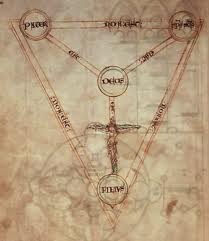
The Doctrine of the Trinity: Three Perichoretic Persons

trinityA few weeks ago I began a three part series on the Trinity. The first post affirmed God’s oneness. The second began to explicate how the one God is three persons. Today, I finish my series by looking at how the one God in three persons lives and moves in the world he created.

In Perfect Motion: How the Father, Son, and Spirit Work in the World

Because God created the world outside himself, creation is not a part of God. Yet, God in his omnipresence is present to bless, or curse, or to sustain his creation. In all places, at all times, and without diffusion of his deity or fluctuation of his power, God is active in the world.

However, as a triune God, each member of the Trinity performs a unique but unified role in creation. Together Father, Son, and Spirit created the universe; they preserve the cosmos; and they effect salvation for all the ones whom the Father gave the Son before the foundation of the world (see John 17). In short, their external activities are as harmonious, congruent, and seamless as their internal essence. Continue reading

The Incarnation: Getting a Handle on Five Heresies

cappadociansYesterday, I gave a short introduction to a number of terms related to the Incarnation of our Lord. Today, I want to offer a short description of five heresies that have infected the church throughout the centuries.

These five heresies are named after four people (Arius, Apollinarius, Nestorius, and Eutychius—can you tell these guys aren’t from Kansas?) and one Greek word (dokein meaning “to seem” and dókēsis meaning “apparition, phantom”). These heresies are related to one another in history, and some of them actually came by means of trying to correct another. What I have spelled out below is but the simplest explanation of each term, with practical application at the end. Continue reading

More Than Baby Talk: A Primer on the Incarnation

gloryPutting our children to bed is always a precious time to read the Bible, sing hymns, and talk about the day. But precious as it is, it is not always simple.

A few days ago, as our five year old was minutes from dream land, he began asking questions about Jesus’ birth. I listened to my wife explain that Jesus had always existed. And I heard him respond, “Yes, but he was also born,” exposing the challenge that if Jesus was born than he must have had a beginning. Right?

Perhaps, we have the making of a little Arian in our home (as in Arius from the fourth century Africa, not the Third Reich in twentieth century), or perhaps he is simply experiencing the challenge that we all face when we begin to press into the incarnation of Jesus Christ. What does it mean that the eternal Son of God who was with God before the beginning of time (John 1:1) took on flesh and became a man in time?

The Incarnation

The subject of the incarnation is puzzling for adults let alone little boys with active imaginations. Continue reading

Noonday Light: Biblical Theology

biblical theology

In the years before seminary, when God was awakening a hunger in my heart for the bible and theology, I was introduced to the subject of ‘biblical theology.’ Now that makes sense right? Biblical theology is the mashup of ‘bible’ and ‘theology.’ Only it is more specific than that.

As my doctoral supervisor, Stephen Wellum, recently defined it: Biblical theology is the “hermeneutical discipline,” that

Seeks to unpack God’s unfolding redemptive plan, doing justice to the diversity of it, while always remembering that despite the diversity it is one plan which reaches its fulfillment in the person and work of Jesus Christ. Biblical theology is concerned to discover how the parts of Scripture fit in terms of the whole, according to God’s intention and purposes, not our own imaginative constructions. Biblical theology is utterly essential to rightly interpreting and ‘putting together’ the whole counsel of God and thus learning to ‘think God’s thoughts after him.’

In truth, everyone has a biblical theology. But not everyone has a good biblical theology. Since living the Christian life depends wholly on knowing God, his gospel, and how God’s word relates to our lives today, biblical theology is crucial matter of consideration for pastors and those in the pew. In other words, its not an optional class some Christians might enjoy. It is central to our Christian walk.

In that vein, for those who are interested in learning how to think God’s thoughts after him according to the way that God has revealed himself over time in the Scriptures, let me suggest a few quick resources.

What the Big Idea Story? Why Biblical Theology Should Matter to Every Bible-Believing Christian. Credo Magazine has come out with their latest edition on the subject of biblical theology. It’s an up-to-date introduction on the subject. (Credo Magazine)

Biblical Theology by Gerard Von Groningen. Covenant Seminary (St. Louis, MO) offers a whole seminary class on biblical theology taught by the insightful OT scholar Gerard Von Groningen. You have to sign up for the class, but the cost is free. (Covenant Seminary)

What is Biblical Theology? A Guide to the Bible’s Stories, Symbols, and Patterns. Jim Hamilton has come out with a short introduction to the subject that helps students consider the literary structures and symbols of the Bible. These things are essential for any good biblical theology.

What’s in the Bible? Phil Vischer, the creator of Veggies Tales, has come up with a new and improved series that teaches biblical theology to young children. You can read about it here or watch a preview below. (The Gospel Coalition)

Via Emmaus. It is my meager attempt to provide on this blog a collection of biblical, theological, and biblical-theological fodder for your edification, so that you might read the Bible better.

Soli Deo Gloria, dss

Sermon Audio: The Great Exchange: How Jesus’ Life Trades Places with Our Death (John 11)


A-graveyard-at-dawn-002
Yesterday I finished my six-part series on God’s design for marriage and sex. Instead of finishing with an explicit word about sexuality, its dangers and delights, I spent our time considering God’s power to raise the dead and the devastated.

From John 11, we considered how Christ’s resurrection of Lazarus is a sign of his authority over the grave and a promise to all of us who trust in him, that he can raise us out of any miry pit, forgive us of any sin, and restore us from any deviation from God’s design. In short, Christ is the resurrection and the life, and all who look to him for the forgiveness of sins will find eternal life that does not begin at some unknown point in the future. Eternal begins with a true knowledge of Christ (John 17:3), that in turn empowers us to live a new kind of life today.

Here’s the audio for “The Great Exchange: How Jesus’ Life Trades Places with Our Death,” an exposition of John 11:1-53.

For the rest of the sermons in this series (‘God’s Design for Marriage and Sex’), go to Sermon Audio.

Soli Deo Gloria, dss

Lord’s Day Meditation: What Do We Really Need?


rainbow
What is it that we really need?

In a world full of felt needs and artificially created needs, there are plenty of commercial answers. But in a fallen world where death still reigns, there are also needs that go beyond anything that Wal-Mart sells or that Dr. Phil endorses. What do we really need?

Only Scripture gives us a true answer, and I suggest a few meditation for you on our Lord’s Day.

What Humanity Really Needs, No Man Can Provide

Is it a new start? No, Noah proves that a new start only delays the inevitable—sin, curse, separation, and death.

Is it a new place? No, Abraham was given a new place and promised a new people and a new land, yet the father of the nations still erred. His offspring include the line of Ishmael and in his own generation he died.

Is it a new law? No, God gave to Israel through Moses a new law, the best that was ever fashioned. Yet, Israel as a chosen race and a holy nation, failed to live up to their calling as a royal priesthood. They rebelled against God, and eventually experienced the exile on account of their covenant disobedience.

Is it a new leader? No, in David God chose a leader after his own heart. David was God’s man and was promised an eternal throne. Yet, the unfaithfulness of his sons eventually sealed Israel’s downfall. If the people were judged because of their law-breaking; they were equally condemned because of their fallen kings.

Is it renewed wisdom or unsurpassed riches? No again. David’s greatest son Solomon possessed wisdom and wealth. Greater than any man was this son of David. Kings and queens traveled far and wide to simply enter his presence. His people rejoiced to have him as king. Yet, still his heart was led astray, proving the mutability of man’s wisdom.

What then will resolve man’s problems? What will make wrong right? Atone for sins? Heal the hurting? Comfort the lonely? Reconcile enemies? Strengthen the weak? Make all things new?

What Man Really Needs, Only God Can Supply

As the entirety of the Old Testament testifies, the answer does not come from mankind. The answer is not found in a new start, a new place, a new law, or a new leader. Having the greatest wealth or wisdom will not cut it. What is needed?

A new life.

In 1 Corinthians 15, the first Adam, the prototype of Noah, Abraham, Moses, David, and Solomon, is contrasted with the last Adam, Jesus Christ, the greater savior, greater nation builder, greater mediator, greater king, and greater wise man. Paul writes and says,

The first man Adam became a living being; the last Adam (Jesus) became a life-giving spirit. (v. 45)

As the fulfillment of all the Old Testament types, Jesus has perfectly fulfilled the law, inherited the blessing of the law, won the right to sit on the throne, and rule the world with wisdom, justice, and compassion. He is the solution. He alone can make all things new. He alone has the power to raise the dead. And he alone gives devastated sinners hope that new life is possible.

Tomorrow, as we gather to worship, may God be pleased to open our hearts to see Jesus Christ, the desire of the nations, the hope of the world, the life-giving Spirit who alone can heal our wounds, forgive our sins, and straighten our paths. He alone gives life and ultimately, that is exactly what we need!

Tomorrow, our church considers the resurrecting power of God in Christ from John 11. I pray that many who are weak will be strengthened, many who are broken will be bound up, and that many who are dead will be made spiritually alive. This is what Jesus has the power to do. He did this for Lazarus two millennia ago, and he is still raising the dead to life today.

If you don’t know him, cry out to him that he might raise you up. If you do know him, thank him for his resurrecting power. And then go tell someone else about him.

Have a blessed Lord’s Day, dss


Prolegomena Matters: Engaging with Michael Bird’s Evangelical Theology

prolegomenaYesterday, I posted my review of the first section in Michael Bird’s Evangelical Theology: A Biblical and Systematic IntroductionAs with most theology textbooks, Bird opens with a discussion of how to do theology. In theological circles this is called the prolegomena and it portends to how the rest of the book will be developed.

As I mentioned in that review, I am encouraged by his focus on the gospel but concerned about how he is actually going to do his theology. In my review I mentioned in passing four general concerns. Today, I want to substantiate those concerns. Continue reading

Evangelical Theology’s Prolegomena: Strong on the Gospel, but Suspect on Its Sources

ET

Michael F. Bird. Evangelical Theology: A Biblical and Systematic IntroductionGrand Rapids: Zondervan, 2013. 912 pp. $49.99.

This month marks the release of Michael Bird’s new book, Evangelical Theology: A Biblical and Systematic Introduction (henceforth, ET). Professor Bird is lecturer in theology at Ridley Melbourne College of Mission and Ministry in Melbourne, Australia. He is the author of numerous books on topics ranging from the person of Christ to a commentary on Colossians—of which I gave high praise a few years ago. He also blogs at Euangellion.

Technically, Bird is a New Testament scholar. And yet, like another biblical scholar-turned-systematic theologian (Wayne Grudem), Bird is presenting the church with gospel-driven theology that stands on his careful exegesis. Yet, his book is not so much a desire to give an exegetical theology as much as he has written his book to provide an evangelical theology. You can see him speak to the need for a truly “evangelical” theology in the following video.

As a part of Zondervan’s blog tour, I’ve been commissioned to review the introductory section of ET, what is known as the prolegomena (“first words”). Fulfilling that commission, let me outline my review under three headings: (1) a summary of the section, (2) the strength of Bird’s gospel-centrality, (3) the stumbling block of his sources. Continue reading

Our Sovereign God

sovereign

Compatibilism is the term of choice for how God’s absolute sovereignty rules in the universe without stripping man’s responsibility to choose and make decisions that have real, live consequences. Like ‘Trinity,’ ‘inerrancy,’ and ‘homoousia,’ compatibilism is not a ‘Bible word,’ but it summarizes what the Bible teaches about God’s sovereignty and man’s responsibility.

Today, I want to look at a sampling of Scriptures to help explain how the Bible talks about God’s sovereignty and man’s responsibility. To begin with, it might be helpful to state exactly what compatibilism is. Here is D. A. Carson’s definition from his book on suffering: How Long, O Lord? Reflections on Suffering and Evil.

(1) God is absolutely sovereign, but his sovereignty never functions in such a way that human responsibility is curtailed, minimized, or [negated].

(2) Human beings are morally responsible creatures—[we] significantly choose, rebel, obey, believe, defy, make decisions… but this characteristic never functions so as to make God absolutely contingent.­[1]

With this definition in place, lets consider from Scripture how the Bible describes the relationship between God’s exhaustive, meticulous sovereignty and man’s freedom to choose.  Continue reading