On Baptism and Children

baptism1A recurring question that all pastors will face is this: Pastor, will you baptize my child? With the (all-too-common, but misguided) pressure to please parents and their young child, it is vital for pastors and churches to know what they believe about baptism and children. For parents too, when little Johnny shows interest in baptism, what should you do?

These are vital questions and ones that have received no little attention among Christians committed to believer’s baptism. To find good answers, we don’t need to recreate the wheel. We simply need to know where to turn. Therefore, in what follows, I have listed a number of helpful articles to help you and I think through this important issue.

A Biblical, Pastoral, Denominational, and Parental Perspective by Jason Allen

In a recent blog, Jason Allen (President of Midwestern Baptist Theological Seminary) urges pastors and parents (and the SBC, as well) to “joyfully and wholeheartedly press the accelerator on the gospel while tapping the brakes on the baptistery.” He rightly affirms the fact that it is wise and pastorally-sensitive to affirm children in their desires to follow Christ but to be slow in moving them towards baptism. Since “we must remember it requires more than agreeing to facts about Jesus to be saved,” it is unwise to baptize a young child, simply because they might be able to affirm the plan of salvation. Let me encourage you to read the whole thing.

“Reforming Baptism and Church Membership” by John Hammett (in Biblical Foundations for Baptist Churches)

In his excellent book on Baptist ecclesiology, John Hammett, professor of Systematic Theology at Southeastern Baptist Theological Seminary gives sage counsel on baptism as it relates to children. He writes,

Caution is especially appropriate in the case of very young children. Anyone who works with children knows that five-year-olds will readily ask Jesus into their hearts, but until very recently Baptist would never have considered baptizing them. Believers baptism was seen as virtually synonymous with adult baptism. To request baptism was regarded as a decision requiring a fair degree of maturity. For a church to grant it was to welcome the person into the responsibilities of church membership, which would include participation in the governance of the church, which seems inappropriate in the case of preschoolers. Overseas most Baptists delay baptism until the teenage years, but it is difficult to avoid arbitrariness in setting any specific minimum age for baptism. (Biblical Foundations for Baptist Churches, 122)


While it is true that delaying baptism does add a measure of subjectivity, if not arbitrariness, he lists at least four reasons for delaying.

Continue reading

From Noah’s Baptism to Jesus’ Crucifixion: A Study in Typological Escalation

fishJesus is the goal of redemptive history. In Ephesians 1:10 Paul observes that God has “[made] known to us the mystery of his will, according to his purpose, which he set forth in Christ, as a plan for the fullness of time, to unite all things in him.” In Galatians 4:4, Paul has the same eschatological view in mind: “When the fullness of time had come, God sent forth his Son . . .” And Hebrews too observes the climactic arrival of the Son of God: “In these last days he has spoken to us by his Son . . .” (1:1). In short, the apostles, as model interpreters, understand all redemptive history to be leading to Jesus.

Consequently, it is not surprising to find that the typological structures of the Old Testament escalate until they find their telos in Jesus. In other words, Scripture begins with glimpses of the pre-incarnate Christ and gradually adds contour and color to the biblical portrait of the coming Messiah.

Over time, such glimpses of grace are developed and made more concrete as the types (i.e., events, offices, and institutions of the Old Testament) repeat and escalate. One prominent event that is repeated in the Old Testament is that of “baptism.” As Peter observes in his first epistle, baptism corresponds (lit., is the antitype, or fulfillment) to Noah and his life-saving (make that humanity-saving) ark (1 Pet 3:20). It is this typological thread that I want to consider here. It is my aim to show that not only do Old Testament “types” prefigure Christ and his work of salvation, but they also grow in intensity and efficacy as the Incarnation of Christ nears. Continue reading

What is Calvinism?

Calvinism means different things to different people. Even to those who might call themselves “Calvinist,” what they mean by the term is not always the same. Typically, as a shorthand expression for what I believe about salvation, I am comfortable to call myself a Calvinist. And yet, because that label is so often misused, misunderstood, and misapplied, I am equally desirous to avoid it altogether.

Nevertheless, the question remains: What is Calvinism?

The answer to that question takes more than just two sentence, simple answer. Because it is a term that has historical, theological, and worldview meanings, it takes time to get a handle on it. Therefore, for those who have an interest and an ear to hear, let me give you a five-fold answer to that question: Calvinism is (1) a shorthand expression for the doctrines of grace, (2) a biblical-theological system, (3) an historical phenomenon, (4) a biblical worldview, and (5) an attitude of worship. As always, let me know what you think.  Continue reading

Thinking Biblically About Transgenderism

timeAfter last week’s primetime interview with Bruce Jenner, it is hard to ignore the normalization of transgenderism in our culture. With an ever-increasing advocacy of “erotic liberty,” Christians need to understand what transgenderism is and how the gospel of Jesus Christ brings hope to the trans community, even as the gospel brings pardon and purity to all of us.

To help you think about these matters, I’ve found and listed below a dozen helpful articles on transgenderism. Some of them introduce the subject and provide the medical details, others engage culture and provide insight on how to apply the gospel to this growing area of discipleship. I pray they may help you think biblically about this issue and even more to develop a loving burden for transgender people.

Introduction

Continue reading

Rescuing Jabez from the Soft Prosperity Gospel

jabezYesterday I had the privilege of preaching in chapel at Columbus Christian High School. Of all the texts I could have preached I decided to preach on a little, obscure passage in the book of 1 Chronicles—story of a man by the name of “pain.”Yes, that’s right, I preached “The Prayer of Jabez.”

Despite those who have written off Jabez and his prayer because of the way it has been used to promote the soft prosperity gospel, I am increasingly convinced Jabez is a type of Christ standing between Melchizedek and Jesus. More than that, his story gives us an overwhelming testimony of God’s grace to those who are in pain. For that reason, I preached “The Pain of Jabez and the Comfort of Christ.”

What follows is part of the interpretive outline I unpacked in the sermon.  Continue reading

The Gospel Is Better Than Amnesty

amnesty

Guest Post by Jonathon Woodyard

Good paintings tell stories.

Think of the Last Supper by Leonardo da Vinci. It tells the story of Jesus and his disciples sitting down for the final meal before the crucifixion. Jesus would drink the Passover cup before being sacrificed as the Passover lamb.

The good news of Jesus is more than a story. But it’s not less. It is the most important story on the planet. And it is the truest of true stories. Many have attempted to paint pictures that rightly tell the story of the gospel. Sometimes these paintings are painted with words, instead of paint and a canvas.

These gospel paintings are often necessary because the gospel must be explained. It is a message made up of propositional truth. That means it must be understood. John Piper writes, “the gospel is not only news. It is first news, and then it is doctrine. Doctrine means teaching, explaining, clarifying. Doctrine is part of the gospel because news can’t be just declared by the mouth of a herald—it has to be understood in the mind of the hearer” (Piper, God is the Gospel, 21).

In order for hearer’s to understand the gospel, a number of different word pictures have been painted. Some compare the gospel to paying your speeding ticket, or serving your prison sentence. Like creation itself, the word-pictures available are gloriously endless.

One such picture is that of amnesty. The good news of Jesus is compared to a government, possibly a king, declaring amnesty to those who have committed a crime against the state. The question is whether or not the picture of amnesty is the best picture to paint. Continue reading

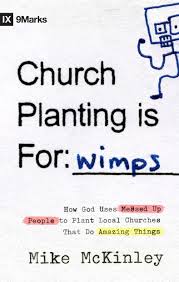
Book Notes: Church Planting is for Wimps

plantMike McKinley, Church Planting is for Wimps (Wheaton, IL: Crossway, 2010).

Church Planting is for Wimps by pastor Mike McKinleyis an encouraging look into the life of a new church planter / revitalizer.

Writing at the four year mark of a church revitalization in the suburbs of Washington, DC, Mike McKinley gives a look into the work God had done through his efforts. Discipled under Mark Dever and sent out from Capitol Hill Baptist Church, Mike’s approach to church revitalization puts a premium of expositional preaching, followed by attention to meaningful membership, elder leadership, the church constitution, and personal evangelism.

While not a long or heavily annotated book, Church Planting is for Wimps gives a winsome look at church planting / revitalization. In fact, one of the most illuminating parts of the book is his short analysis of those two approaches to “planting” a new church. Continue reading

Confronting Falsehood in the Church

falseIt is striking how often Jesus’ apostles warn the church about false teachers and divisive persons. In the Pastoral Epistles Paul calls Titus and Timothy to beware of false teachers in Crete and Ephesus, respectively. But it’s not just these two pastors who are to address falsehood, the entire New Testament calls out the darkness resident in the church. Because of the cosmic conflict between Christ’s church and Satan’s hordes, false doctrine and false living are regular threats to Christ’s kingdom.

Since many churches face such internal and internecine threats, we need to steel our minds with God’s Word so that we might boldly address the darkness around us. Continue reading

Life is Good? How God’s Goodness Redefines the Good Life

good life“And as he was setting our on his journey, a man ran up and knelt before him and asked him, ‘Good Teacher, what must I do to inherit eternal life?'” And Jesus said to him, ‘Why do you call me good? No one is good except God alone.”
— Mark 10:17-18 —

Knowing the difference between good and evil is fundamental to being made in the image of God. When God created Adam and Eve, he put them in a garden filled with delights and with a solitary tree that would instruct them how to know good and evil (Genesis 2:17).  Likewise, knowing the difference between good and evil is essential to maturation and becoming a responsible adult.  Isaiah 7:15, uses the idea to describe the difference between young children who do not know the difference between good and evil, and then those children who mature and begin to understand that difference.

Sadly, it is possible that many Christians fail to know what “the good” is.   Continue reading

Singing the TULIP from the Baptist Hymnal

baptist

One of the saddest effects of the Calvinism debate among Southern Baptists has been the way the discussion about predestination, etc. has moved from the realm of praise to that of polemics. Truly, the faith we hold must be defended. Christians are a people who are called to contend for the faith once for all delivered to the saints (Jude 3). Nevertheless, when we find election in the Bible it is often  a source of praise (Ephesians 1:4–6), a motivation for missions (John 10:16, 26; Acts 18:9–10), and a reason for comfort and assurance (Romans 8:29–39). Rarely, if ever, is election up for debate in the Scripture.

For this reason, discussions about “the TULIP,” which only swim in the pond of argument and persuasion, miss the genre and the goal of biblical election. While I cannot speak for all Calvinists, I can say the ones I know are far more interested in worship and winning the lost than winning the debate about “Calvinism.” For those who hold to the doctrines of grace, the doctrines of grace increase our affections for God and his mission to reach the world for Christ.

For Calvinists, unconditional election is a source of sheer amazement that God would set his love on such a worm as me. Limited atonement becomes a risk-empowering confidence that the cross will accomplish the salvation of all God’s sheep. And irresistible grace is the power God employs to free sinners, so that they can freely follow him.

To be sure, each of these points need sub-points, but the doctrines of grace—to those who delight in them—are not mere theological shibboleths; they are invitations to worship the omni-benevolent and all-powerful God. With this in mind, it is not surprising to find that the Baptist Hymnal (the old one) is filled with songs that not only touch on the TULIP, but praise God for the very doctrines espoused in that acronym.

Now, maybe you’ve never noticed just how many (not all) hymns are written by Calvinists. Once you begin to learn the backdrop to the Baptist Hymnal, however, it is hard to miss the rich hymnody produced by the likes of Isaac Watts, John Newton, William Cowper, and others who affirmed the TULIP. It is my hope that by drawing attention to the following songs, you might see the doctrines of grace in their native habitat—the praise and worship of the church. My prayer is that God may open your eyes to behold the beauty of his multi-faceted grace, what sometimes goes under the acronym TULIP. Continue reading