Martyn Lloyd-Jones on Preaching and Preachers, Revival and Religion

mljA few months ago I finished Iain Murray’s condensed version of his two-volume biography on Martyn Lloyd-Jones, The Life of Martyn Lloyd-Jones, 1899–1981. For those who do not know of “The Doctor,” Martyn Lloyd-Jones left the medical profession to be a preacher. From the late 1920s to the 1970s he was a powerful Calvinistic evangelist, whose pastoral labors took his to Wales and London, England.

Situated at Westminster Chapel, Lloyd-Jones impacted many prominent scholars (J. I. Packer and Iain Murray), interacted with dozens of evangelical leaders, and carried out a preaching ministry that shaped the likes of John MacArthur and John Piper. Though a generation removed from the Young, Restless, and Reformed crowd, his expositional commitment and doctrinal convictions have been carried on in his preaching, his writing, and his publishing house—the Banner of Truth Trust, which was begun under his ministry.

In short, Lloyd-Jones lived remarkable life as a man committed to prayer and evangelistic, expositional preaching. I benefitted greatly from reading his biography, especially in his treatment of subjects like preaching, revival, religion, and evangelism. In what follows, I have listed a number of his insightful comments on these and others subjects.

May they spur you on towards love and good deeds and (re)fuel in you a hunger for the Word of God rightly preached and warmly embraced. Continue reading


Spirit-Filled Worship is Christ-Centered Worship

spirit2How do you know if your church is Spirit-filled?

One answer, the charismatic one, is to equate passion with presence. The presence of the Spirit is displayed in a congregation’s passionate expression and rockin’ music—to use technical language. As an example, the other night I spoke to a local minister who raved about a church that was “simply on fire.” How so? According to him, God’s work was evident because of their large attendance, loud singing, and expressive worship. For his sake and theirs, I hope he is right. But if numbers and noise are all it takes to qualify as “Spirit-filled,” the prophets of Baal would be headlining Christian conferences (see 1 Kings 18).

Another answer moves in the opposite direction. Since the Holy Spirit is a Spirit of truth (not falsehood), order (not confusion), and holiness (not irreverence), a Spirit-filled church is properly organized, doctrinally-sound, and dedicated the service of the Lord. Certainly, holiness does mark the presence of the Spirit. Truth and testimony will be present in a Spirit-filled church, but we can all imagine (and many of us have experienced) churches where truth is present, but love and zeal are not.

Our charismatic friends rightly react against this kind of “spiritual lethargy.” Still, activity in the church is no more a proof of life than putting a corpse in an elevator. Neither vigorous activity, musical expression, or doctrinal precision guarantee a real sense of the Spirit.

So what does?

Three Marks of Christ’s Real, Spiritual Presence

In John’s Gospel, the beloved disciple three times indicates the kind of work the Holy Spirit will do when Jesus sends him from the Father. From John 14:26; 15:26; and 16:13 we get a real sense of what Spirit-filled looks like. Continue reading

Honoring a Father in the Faith

gloryjpegPay to all what is owed to them: . . .
respect to whom respect is owed,
honor to whom honor is owed.

— Romans 13:8 —

In God’s kind providence he has given me many fathers in the faith. Some have taught me how to read the Bible, others have showed me how to love my family and do the work of the ministry, and others have even helped me know where to stand. It is this last category that I am reminded of today.

More than five years ago, when I was newly called as pastor, Jim Downey told me where to stand and how to lead my first funeral service. To someone fresh out of seminary and nervous to conduct his first funeral, such simple instructions were truly invaluable. His fatherly advice was most welcome and would be the first of many funeral services he and I conducted together. But with sadness in my heart, we will not share that ministry again.

On Monday, July 6, Jim went to receive his reward in heaven. Yesterday, I stood next to the man who told me where to stand at a funeral. And today, I want to honor him for his service to the Lord. Continue reading

Reading the Bible Better: Developing a Strategy for Interpreting Scripture

lightFor the four years that I worked on my dissertation, it was my daily effort to read the Bible well. (N.B. This same priority continues to motivate my preaching and writing today too). While my dissertation defended definite atonement, it’s underlying premise was that a better strategy for reading the Bible would produce a more “biblical” doctrine. You’ll have to tell me if my reading is convincing, but the principle is sound—sound doctrine comes from sound exegesis. And sound exegesis comes from sound practices of reading.

Which raises the question: What are sound practices of reading?

Under the illumination of the Spirit, the task of interpretation is hard work. It requires diligent consideration of the biblical text and a willingness to labor to find the shape of the text. Learning the tools (what you might call “reading strategies”) is a vital part of pastoral ministry and should be something all Christians should be willing to grow.

For my part, when I find someone who reads Scripture well, I take note, and when I find those strategies well explained for others to imitate I am doubly encouraged. Such is the kind of approach I found in Ernst Wendland’s 1996 JETS article.

Focusing his attention on the challenge of interpreting Jonah, Wendland, a well-established biblical scholar, has a concise section on how to interpret the Bible. While the language is technical (sorry), his approach is solid and worth the read—especially if you are a pastor or teacher of the Bible. Continue reading

If Dietrich Bonhoeffer Were Your ‘Doktorvater,’ or, Seven Qualifications for Ministerial Students

seminaryIn doctoral studies doktorvater is a term for the direct supervisor who oversees your research and writing. It is not surprising that aspiring seminarians seek out a program based on the possibility of working under such a supervisor. For historically, it has often been the case that rising disciples take on the theology and ecclesial habits of their doktorvater.

Sadly, in seminary life there are many students who go through their studies without such a ‘father in the faith.’ Paul House has written about this trend in contemporary theological education, and his book about Dietrich Bonhoeffer is aimed at correcting it. I am sympathetic to his argument, as my forthcoming book review at TGC will show. In what follows I want to consider once slice of what seminary training with Bonhoeffer might have looked like.

Seven Requisite Qualities for Studying Under Dietrich Bonhoeffer

For now, I am especially intrigued by the program of study instituted by Bonhoeffer. What would it have been like to have Dietrich Bonhoeffer as your doktorvater? Based on Paul House’s book, Bonhoeffer’s Seminary Vision (44–45), here are seven things it might have entailed and what Bonhoeffer would have expected.

  1. Submissive to the Word. “Candidates would be committed persons, individuals who knew that their calling ‘demands the entire person. It demands a life under the word of God. Everyday must stand under the discipline of the word.'”
  2. Self-disciplined. Candidates must “foster daily habits of Bible reading, meditation, and holy living.”
  3. Willingly submissive to church authority. Candidates must “pledge themselves to brotherhood with one another and obedience to the church authorities.”
  4. Loyal Allegiance to Christ over Country. “As a citizen [in Nazi Germany], a candidate would ‘serve the truth alone and understand himself to be accountable only to the word of God.'”
  5. A Diligent Student of the Word. “‘The candidate should make it his duty to read a section of the New Testament and the Old Testament daily in the original language. The expectation is that by so doing, he will come to know the entire New Testament and important parts of the Old Testament in the original text and will have worked through several texts with scholarly aids (concordance, dictionaries, commentaries).” [emphasis mine]
  6. An Apt Theologian. “A candidate was to have ‘thorough acquaintance with the confessional writings of his church and be completely accountable with regard to them.” Additionally, “since the church [i.e., the German United Church] had both Lutheran and Reformed congregations, the directors wanted pastoral candidates to be familiar with both confessional traditions.”
  7. Pastorally-Discipled. “Each candidate was to have spent some time as an apprentice with a fellow pastor who prayed with him and guided his work.”

All in all, the men whom Bonhoeffer sought to train were those who gave themselves to the Word and gladly submitted themselves to Christ, his church, and the pastors of those flocks. Moreover, in the face of Hitler’s reign in Germany, Bonhoeffer was looking for those men who would stand against the grain of national opinion. To be a servant in Christ’s church, Bonhoeffer believed one had to be an apt theologian, student of the word, and disciple of the church, while at the same time not seeking a position among the world.

For Contemporary Application

In historical context, the training Bonhoeffer offered only lasted a few years. Beginning in 1935, the Third Reich shut down his school in 1940. Because many of his pupils would be drafted into Germany’s army, most of them never reached the fields of pastoral service. Nevertheless, his labors were not in vain. His two most influential books, Life Together and The Cost of Discipleshipwere born in these seminary years and addressed to men in seminary contexts.

One can hope that in the days ahead, as theological education becomes more imperiled and the costs of pastoral ministry increase, more pastor-theologians will see the need for such educations models. Already, this trend is beginning in schools like Bethlehem Seminary and Beeson Divinity School. Without denigrating larger schools (of which I owe my whole theological training), it is my hope that schools—large and small—will take serious the call to develop godly servant leaders, not just enlist large numbers of graduates.

Scripture reminds us that the qualifications for pastoral ministry are high (1 Tim 3:1–7; Titus 1:5–9), which means that the standards and structures for theological education should be equally high. Though this kind of standard may shrink enrollment, it may in the end raise up a stronger band of brothers. This, House argues, was Bonhoeffer’s vision for training gospel ministers, and it is one that we should seriously consider as we plan and pray to train the next generation.

May God be pleased to raise up a generation of stalwart biblical stewards. And may he at the same time, raise up local, pastor-led, church-centered theological schools to do such training.

Soli Deo Gloria, ds

Continue reading

A Prayer for America

thanksYesterday, I suggested we take time in our church services to pray for our country as Daniel and Nehemiah did for theirs. Last year, with those model prayers in mind, I offered this prayer at church. A year later it is just as appropriate, just as needed.

Holy God. You are right to demand holiness. Your will for all those made in your image is holiness. We confess that this is right and good.

And with that in mind, we confess we are not. In our city streets and in the corridors of our mind, we are unholy. Our nation and many in your church are drunk on impurity.

We are consumers of lewd entertainment.

We are led by an insatiable desire for more—more money, more sex, more fun, more stuff.

We legalize that which is a stench in your nostrils, and we outlaw that which pleases you.

Worse, our churches follow the ways of this world. We import the practices of our culture.

Instead of celebrating purity, we applaud celebrity.

Following the world, we mix your Word with a cocktail of psychology, leadership principles, and positive thinking.

Forgive us!

We thank you for the Christians who have gone before us, and been salt and light to preserve our nation.

We thank you for the legacy of Christian faithfulness that we have in this country. No country on earth has more churches, Bible schools, Christian publishers, and free access to you.

What a gift! What grace! Thank you for sharing your light with such undeserving and unthankful people.

But, oh how, we tremble at the way such blessings are trampled under foot.

Churches that were once committed to your Word are compromising.

Schools founded to glorify Jesus have exchanged light for darkness.

Leaders who once upheld truth, justice, and goodness are now controlled by moral relativism and whatever is popularity.

And what is popular is not holy. We deserve your judgment. If we learn anything from your words to Israel, we deserve to lose the lease on our land. We deserve to be vomited out. God forgive us!

Send your Holy Spirit. Revive your churches.

May the pulpits of America once again unashamedly declare Christ.

May the Christians in our country strive after holiness.

May we show the world a kind of love that makes God-haters thirst for Jesus.

Oh, be merciful to us! We are sinners. In your holiness, remember your Son’s atoning death. Be patient with us, and help us to be a light in this dark country.

Grant us sober hearts. Hearts that grieve not for the loss of Americana, but for the loss of your holiness.

Father in heaven, hallow your name in our country!

May God grant us, our churches, our nation a heart of repentance and renewed thirst for him and his righteousness.

Soli Deo Gloria, ds

Trading in Our Patriotic Hymns for Songs of Lament

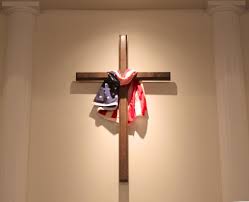
crossWith the Obergefell decision weighing heavy on our minds, I have been wondering how churches in America will worship this Sunday. Will they go on as usual singing patriotic hymns? Or will they, in light of recent days, reconsider their song selection?

For those involved in music ministry and church leadership, this is not a new question. And honestly, the Obergefell decision should not be the deciding factor. However, that ruling has solidified concerns Christians have with America, and thus raises the question again—Should a church incorporate patriotic hymns in a service of worship?

Thinking on that subject, I believe a church has 1 of 3 options—no incorporation (option #1), selective incorporation (option #2), and unqualified incorporation (option #3). I think the first two options are valid with #1 outweighing #2, while option #3 is troubling and in need of revamping—something that could be done as soon as tomorrow. Let’s consider together. Continue reading

Entering the Land: Peter Leithart on the ‘Three Environments’ in Creation

leithartFew biblical commentators have a more fruitful mind than Peter Leithart. Sometimes his observations take off on a flight of fancy; other times they open fresh vistas of  biblical glory. In both cases, the judicious reader will find plenty to chew on. Personally, I have frequently initially disagreed with his reading only to be convinced later. Make no mistake, however, you should read his commentaries.

Right now I am reading his commentary on 1–2 Samuel, entitled A Son to Me. In it he makes a compelling argument for seeing Saul as a New Adam (81). He shows many ways how Saul, as a royal figure, falls from grace and repeats the fall of Adam—the first royal son. To set up his argument, he makes a compelling argument with regard to the land, and it is that argument I want to cite here.

What Leithart suggests is that the whole of biblical history (and geography) must be understood according to a tripartite division of the land. I have seen this kind of argument before (cf. G. K. Beale, T. D. Alexander, etc.) with regards to three parts of the tabernacle/temple, but I haven’t seen it so concisely described with regards to the “three environments” of the land.

Because the temple is made to mirror the rest of creation and vice versa, this argument should not surprise us. But, for most of us situated over three millennia from Moses and David, it is likely that we haven’t thought of the land in the way Leithart describes. Therefore, to better understand God’s geography, it is vital to have our minds renewed by the Bible when it comes to understand the world we inhabit.

Consider Leithart’s illuminating comments: Continue reading

Expositional Preaching is ‘Empowered Preaching’

empoweredLast month I attended a Charles Simeon Trust workshop with about 40–50 pastors in Indianapolis, Indiana. As a preacher unapologetically-committed to expositional preaching, I was deeply encouraged to join such large number of other ‘expositors.’

In the three-day seminar, we walked through the whole book of 2 Timothy and ‘worked out’ with a number of hermeneutic tools (i.e., reading strategies) for understanding and preaching epistles. Space doesn’t permit me to share all the highlights of seminar, but one thing is worth mentioning: In defining expositional preaching, David Helm reshaped my thinking about exposition with his emphasis on “empowered preaching.” He defined expositional preaching as “empowered preaching that rightfully submits the shape and emphasis of the sermon to the shape and emphasis of a biblical text.”

Helm’s point is that “expositional preaching” is not just limpidly restating the truths of Scripture. Empowered preaching is Spirit-filled preaching that reveals the living Christ through the faithful exposition of God’s Word. And this kind of preaching comes not just from solid hermeneutics; it comes from the Spirit of God and prayer—a point he well explains in his compact book on preaching, Expositional Preaching Continue reading

Opening Our Eyes to Obergefell and Its Effects: A Pastoral, Cultural, and Legal Round-Up

SCOTUSOn June 26, 2015, in a 5–4 decision, the Supreme Court of the United States (SCOTUS) ruled that same-sex marriage was legal in all 50 states. In the hours that have passed, Christians have been praying and wondering aloud what comes next and how we should respond. To aid our collective understanding of the Supreme Court’s decision, I’ve listed dozens of resources under the following headings:

  • The Decision: What Did the Court Decide?
  • On the Pastoral Front: What do we say to our church?
  • On the Cultural Front: What do we say to our neighbor?
  • On the Legal Front: What about religious liberty?

I am so thankful for the men and women who have been reporting and commenting on these issues. May their wise words aid you—as they have me—to think and pray and act with grace and courage for truth in these days. Still before reading any of these posts, let me encourage you to watch this two minute exhortation from Russell Moore, president of the ERLC.

Continue reading