Reading the Minor Prophets Together: Ten Observations from Paul House’s ‘The Unity of the Twelve’

12By 1990 there was no consensus on the structure of the Minor Prophets. Observing this fact, Paul House, in his book The Unity of the Twelve, surveyed the way scholars looked to chronology and regional location as possible ways “the Twelve” were ordered. Such approaches were significantly lacking, however, and so he concluded: “It is probable that historical research has not successfully uncovered the structure of the Twelve because that structure is governed by literary principles” (67).

In conversation with literary critics and scholars employing methods of canonical criticism, House shows why we should read the Twelve as more than 12 similar but separated oracles. Rather, by examining the structure and plot of the Twelve we can come to a clearer understanding of the unified message that the Minor Prophets is seeking to convey.

As others have observed in the Psalms, there is an intentional ordering in the Minor Prophets, better termed The Twelve. Historically, these 12 books are always found together and typically in the same order (63). For that reason, a unified study of their message is valid and valuable. And Paul House’s book, though technical, is an important for helping read and understand the Minor Prophets.

To get a sense of his argument and how the twelve prophets are unified, let me share some of his observations—first on the structure of the Twelve, then on the plot of the Twelve. Continue reading

Getting into Jonah by Seeing the Book’s Literary Structures

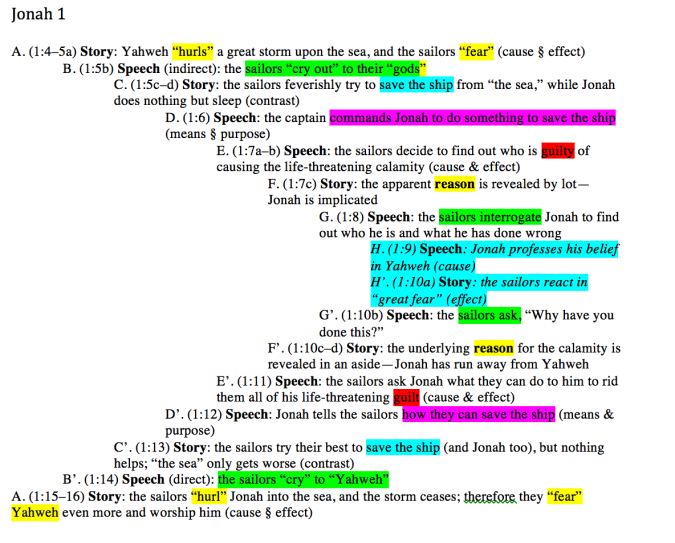
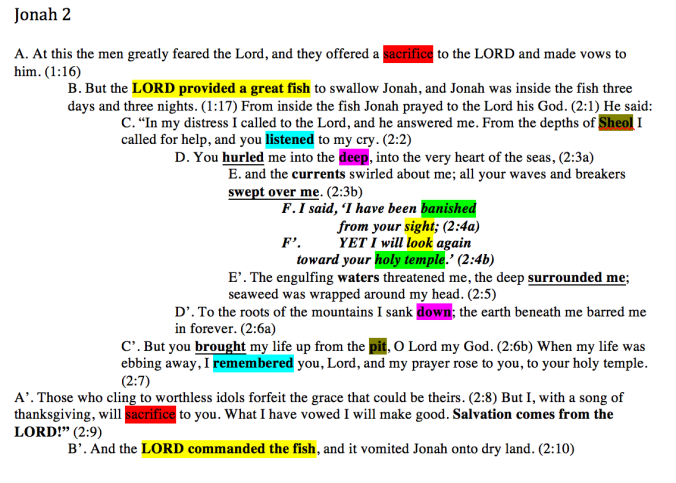
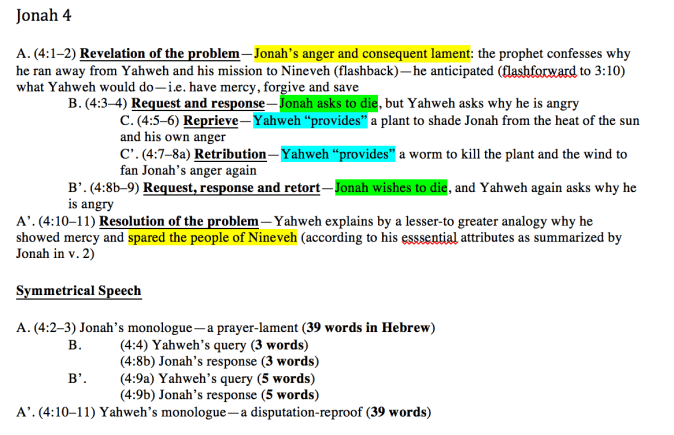
chiasm_textIn a pair of articles on literary structure and the book of Jonah, Ernst Wendland argues for what makes a chiasm valid, with a test case in the book of Jonah. As our church begins to study Jonah, I share the outlines from his second article. You can find his reflections on chiasms here.

They demonstrate how much the biblical authors, in this case Jonah or another prophet well-acquainted with Jonah, incorporated literary devices to express their arguments. For casual readers of the Bible, these outlines suggest that their are depths untold in the meaning and message of Scripture. For teachers, these are the structures we must find as we seek to understand the author’s original intent.

All the chiastic structures outlined below come from Ernst Wendland’s Text Analysis and Genre of Jonah (pt 2) (JETS 1996). The highlights are my own.

The Overall Structure of Jonah

A. (1:1–3) Yahweh calls Jonah the first time and he flees from Nineveh

B. (1:4–16) A life/death crisis; exhortation by the captain; Jonah’s unwilling message to the pagan sailors of the ship; result: they all repent and pray

C. (1:17) Surprising transition: Yahweh saves Jonah by means of a great fish

D. (2:1–9) Jonah’s response, a pious prayer: thank you—for letting me live

E. (2:10) Instruction: Yahweh’s miraculous object lesson is complete—Jonah is safely delivered

A’. (3:1–3) Yahweh calls Jonah the second time and he travels to Nineveh

B’. (3:4–9) A life/death crisis; Jonah’s unwilling message to the pagan people of the city; exhortation by the king; result: they all repent and pray (an even greater number)

C’. (3:10) Surprising transition: Yahweh saves Nineveh by “repenting” himself

D’. (4:1–4) Jonah’s response, a peeved prayer: please—just let me die

E’. (4:5–9) Instruction: Yahweh’s miraculous object lesson in the plant, worm and wind—Jonah is sorely afflicted

F’ (4:10–11) Conclusion (thematic peak): Yahweh’s last word to Jonah and to every current listener: “Salvation belongs to Yahweh” (cf. 2:9)

Four Chiasms in Jonah

In addition to the overall storyline of Jonah, each chapter shows remarkable literary arrangement. Again, following the work of Ernst Wendland, consider how each chapter is structured.

Screenshot 2018-03-15 10.28.45Screenshot 2018-03-15 10.32.25Screenshot 2018-03-15 10.34.39Screenshot 2018-03-15 10.36.16

Reading Jonah

With these structures in mind, you are now better equipped to read this fascinating book. Even more, with these structures in mind, we find more clearly the original emphases. For more the literary structures of Jonah, see

Soli Deo Gloria, ds

Red Carpet Christianity: A Summary and Conclusion to the Book of Ephesians

more-than-we-can-imagine_Red Carpet Christianity (Ephesians 6:21–24)

Since September our church has studied the book of Ephesians. This week, we finished the sermon series with a summary and reflection on Paul’s letter. In particular, I argued that the gospel creates communities of faith that learn how to walk together in love. It’s this love that displays the wisdom of God to the world and that builds up the individual Christian.

To turn it the other way, Ephesians teaches us that individuals need gospel communities (i.e., local churches) to grow in grace and truth. We need one another to grow up in Christ and we need others who model for us what it means to walk in wisdom. This is what we find in Ephesians 5–6, models of godliness in various situations in life.

Still, because the ideals of Ephesians 5–6 are not always found in our homes and workplaces, we also need Christians who have faithfully applied the lines of Scripture to difficult situations. Hence, Christians are built up when they consider the lives of other saints and seek to imitate their faith (Hebrews 13:7). This is a main point in this sermon and one that unites all that we have seen in Paul’s glorious letter to the Ephesians.

You can listen to the sermon online. Information about the individuals mentioned in the sermon can be found below, as well as links to all the previous sermons in this series. Continue reading

“As Unto the Lord”: Work with Christ at the Center (Ephesians 6:5–9)

more-than-we-can-imagine_

“As Unto the Lord”: Work with Christ at the Center

Paul is unashamedly Christ-centered. And it seems that in whatever subject he is discussing, he brings it back to the Lord who saved him and commissioned him to preach his gospel.

On this note, we see in Ephesians 6:5–9 how Paul teaches us to bring Christ to work. In five verses written to slaves and masters, he gives us at least five motivations for the workplace. While we have to think carefully about how Paul’s context is similar and different from our own, these verses give us many practical applications for doing work to the glory of God.

You can listen to the sermon online. Discussion questions and additional resources, including how to think carefully about Paul’s approach to slavery, are included below. Continue reading

“In the Lord”: Children, Obedience, and the Gospel (Ephesians 6:1–3)

more-than-we-can-imagine_

“In the Lord”: Children, Obedience, and the Gospel (Ephesians 6:1–3)

In Ephesians Paul calls the church to walk in wisdom by the power of the Spirit. This includes children. And in this week’s sermon, we saw how children in the Lord (believing children) are motivated to obey and honor their parents.

Indeed, in only three verses (Ephesians 6:1–3) there are a lot of things to consider, especially with the way Paul uses Exodus 20:12 to motivate children to obey their parents. Take time to listen to the sermon online, as it considers how the promise of inheritance in Exodus 20:12 is applied to believing children. You can read the sermon notes here. Discussion questions and further resources can be found below.  Continue reading

Learning to Love One Another: The Gospel, Racial Reconciliation, and Burden-Bearing (Galatians 1–6)

crawford-ifland-86286

Learning to Love One Another: The Gospel, Racial Reconciliation, and Burden-Bearing (Galatians 1–6)

In recent years, it’s been hard to miss our country’s rise in racial tensions. Or maybe we are just seeing what’s been there under the surface all along. Our country seems overwhelmed by all kinds of racialized sentiments. And in the church, Christ’s multi-ethnic bride continues to bear the scars of deep-seated racial division and hurt that goes back decades and centuries.

By contrast, the Bible presents a glorious vision of multi-ethnic worship, centered around the throne of God (see Revelation 5, 7, 21–22). And in Paul’s letters, there is a constant refrain for a diverse people to be unified in the work of Christ and the gift of the Spirit.  

On this point, this Sunday’s sermon focused on the gospel message in Galatians and how it relates to racial reconciliation. From Galatians’ six chapters, I drew out six gospel truths. In six points, we see that Galatians

  1. is all about the gospel;
  2. identifies a kind of division (in the church) that denies the gospel;
  3. proclaims a gospel that is international in scope and content;
  4. prioritizes faith as the fundamental community marker;
  5. teaches those who have been justified by faith alone to be passionate about justice;
  6. and calls the gospel community to seek justice in love, service, and burden-bearing to one another.

This sermon marks the second time I’ve preached on this subject. (The first was a biblical theology of race). As before, this subject is an incredibly heavy one, and one that still raises more questions than I have answers. That being said, the gospel of Jesus Christ is the answer that can give hope and help to the body of Christ bruised and broken by racism.

My prayer is that God would use this sermon as one small step to help our church grow as community compelled by the vision of Revelation and led by the directions of Galatians (and the rest of Scripture). May God bring healing to his church and may the power of gospel be see in multi-ethnic communities of faith. You can listen to the sermon online. Discussion questions and further resources are below.  Continue reading

Four Ideas That Led Margaret Sanger and Others to Deadly Consequences

sangerBecause ideas have consequences, it matters what a leader believes. This is true in general, but it is also true with the mother of abortion in America, Margaret Sanger.
Over the last week, I read the book Killer Angel: A Biography of Planned Parenthood’s Margaret Sanger by Presbyterian pastor George Grant. The book, commended by R.C. Sproul and Michael Milton, uncovers the dark life of Margaret Sanger. In Grant’s book, he exposes many of the underlying ideologies which fueled Sanger. To understand what drove her and what still drives her disciples, its vital to know her story, and Grant’s book is excellent. (Here’s my summary of it).

In what follows, I want to make four summary observations from Sanger’s life and legacy that show how her views of sex, culture, eugenics, and money led her to start an organization that continues to prey upon the most vulnerable in our country. My prayer is that by knowing more of her story it will help us to be better equipped to expose Planned Parenthood’s lies and bring hope to those who women targeted by their organization. Continue reading

True Religion Defends Life Against Abortion (James 1:19–27)

george-hiles-189441True Religion Defends Life Against Abortion (James 1:19–27)

Since 1973 60 million babies have been killed through the legal practice of abortion. Tragically, the legal nature of abortion doesn’t change its lethal nature, nor does it change the fact that abortion unfairly targets minorities in our country. In other words, abortion is not unjust, in general; abortion’s injustice specifically targets black and Hispanic babies.

Since 2010 I have preached a sanctity of human life message every January. This year, my sermon considered the historic racist aims of abortion and the deadly influence of Margaret Sanger, the found of Planned Parenthood, on our country. Sanger’s reputation has been whitewashed through the years, but her lethal ideology shows its true colors when we learn more of her history.

In this years Sanctity of Human Life sermon, I trace some of her history and explain why it pleases God, protects the image of God, and produces Christlikeness to stand for life. Please take time to listen to this important message. You can find the sermon notes here. Discussion questions and additional resources are below. Continue reading

Ten Looks at Christ: A New Year’s Meditation on Isaiah 61:1–3

Ten Looks at Christ: A New Year’s Meditation on Isaiah 61:1–3

Robert Murray McCheyne said famously and wisely: “For every look at yourself, take ten looks at Jesus.” On this last day of 2017, we spent our Sunday considering the person and work of Christ from Isaiah 61:1–3.

This sermon wraps up a three-part series on Isaiah 59–61 and encourages us to look to Christ as we enter the new year. Indeed, whether we are coming off a great 2017 or a horrible 2017, we need to remember the gospel as we enter 2018. And today’s sermon aimed to help us do that.

You can listen to the sermon here or read the sermon notes. Discussion questions and additional resources can be found below. May Christ grow large in your eyes and your hear in 2018. Continue reading

The Divine Warrior in Mary’s Womb (Isaiah 59)

Torah

The Divine Warrior in Mary’s Womb

Perhaps Isaiah 59 is not the first passage that comes to mind when you think of Christmas. A month ago, it wasn’t on my radar as a “Christmas passage,” either. However, after doing some preliminary study the armor of God in Ephesians 6, which quotes Isaiah 59:17, I soon realized how much Isaiah 59 (with the rest of Isaiah 56–66) prepares the way for Christ.

Today, we began a three-part series on Isaiah, where we considered how the promise of salvation in Isaiah 59:15–21 resolved the problem of sin in Isaiah 59:1–9. Indeed, in response to Israel’s confession and plea for mercy (Isaiah 59:9–15), Yahweh promised that he would bring salvation. And as Isaiah 59 and the rest of Isaiah foretells, this promise ultimately leads to the birth of Christ in a Bethlehem stable.

You can listen to this sermon online. Discussion questions are below, along with some additional resources on Isaiah and the meaning of Christmas. Continue reading