10 Things You Should Know About the Priesthood

priestcolorCrossway has a helpful series of blog articles called “10 Things You Should Know . . .” These articles summarize key ideas from some of Crossway’s recent books. And this week, they posted my contribution about the priesthood.

Here are the first three things you should know. The rest you can find here. The book you can find here. And a sermon series on the priesthood can also be found here.

1. The Edenic origin of the priesthood.

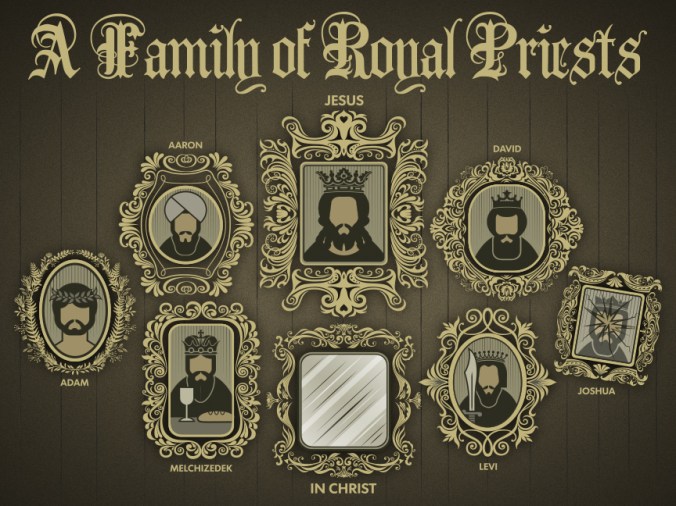
In Eden, God created mankind in his image to reflect his glory. In this setting, God crowned man with glory and honor (Ps. 8:5), authorized him to subdue and rule (Gen. 1:28), and gave him priestly instructions for serving in his garden-temple (Gen. 2:15; cf. Num. 3:8). This is the prototype of royal priesthood from which all other priests will be molded. In other words, when the priesthood is legislated in Israel, it will pick up language and imagery from Eden. At the same time, the Law of Moses divided the royal and priestly roles originally united in Adam. Thus, only a second Adam can unite priesthood and kingdom in a manner similar to Eden.

2. The cosmic fall of the priesthood.

When Adam sinned and fell short of God’s glory (cf. Rom. 1:21–23; 3:23; 5:12, 18–19), God expelled him from God’s garden-sanctuary (see Ezek. 28:11–19), destroying any chance of Adam serving God as priest-king. In the fall, Adam’s sin made sacrifice necessary, as indicated by the events of Genesis 4. Because death was the punishment for sin, blood must be shed. To be certain, the full consequence of sin and the need for a priest would require later revelation to explain (see Leviticus), but it is worth noting the original intent and downfall of the priesthood. For the rest of the Bible, we find a search for someone who could stand before God and serve as a mediator (cf. Job 9:33–35).

The Royal Priesthood and the Glory of God

The Royal Priesthood and the Glory of God

David S. Schrock

David Schrock traces the theme of priesthood throughout the Bible and displays how Jesus, the great high priest, informs the worship, discipleship, and evangelism of the church.

3. The fraternal development of the priesthood.

From Eden to Sinai, priestly ministration continued, but in a very ‘itinerant’ fashion. In the days of the Patriarchs, firstborn sons grew up to be mediators for their families. Job is a good example of this (Job 1:5), as is Abraham. In the Abraham narrative (Gen. 11:27–25:18), we find Abraham building altars (Gen. 12:7, 8; 13:4, 18), interceding for others (Gen. 18:22–33), and obeying God by offering a sacrifice (Gen. 22:1–18). While Abraham and his sons lacked the title of priest, these “priests” play an important role in understanding the earthly “priesthood” of Jesus—a priest in function, but without legal title. At the same time, the priestly service of firstborn sons helps explain Israel’s role as a royal priesthood (Ex. 19:6).

For the last seven points, see Crossway’s 10 Things You Should Know About the Priesthood in the Bible.

Soli Deo Gloria, ds

Preach Hebrews the Next Time You Don’t Have a Preacher, Plus a Post-Script on Answered Prayer

dawn-mcdonald-2RADIf5oR28-unsplashWhat will you do the next time you do not have a preacher? Oh, I am not talking about planning for an upcoming Sunday when you, or your pastor, will be absent, or when multiple teaching elders are unavailable. I am talking about when it becomes apparent 10 hours or 10 minutes before Sunday morning that the man called to preach simply cannot do it.

In such a situation, you have a few options. You could call on someone to preach something already prepared. Such preparation includes having a sermon ready, but it could also mean calling on a “prepared” person who could open a text and give a faithful exposition. Elder-qualified pastors and Bible teachers would fall into this category. And one of the best Resurrection Sunday expositions I ever heard came from a seminary professor who was called to preach 10 minutes before service as the teaching pastor lay ill in his office—literally, he was writhing in pain on the floor. (He’s okay now).

Extreme moments call for extreme measures. And churches shouldn’t be surprised that in a fallen world where clay pots preach the glories of God that sometimes those vessels of dust cannot stand and speak. Yet, knowing that, we can still be caught off guard, or in need of immediate relief. And this last weekend was such a case in our church.

What We Did When the Preacher Couldn’t Preach

As many readers of this blog know, I am not a full time blogger—hence, the regular but not absolutely consistent blog schedule. Day to day, I have the joy of serving at Occoquan Bible Church, located in Northern Virginia. Since 2015, I have been pastor for preaching and theology. So, most Sundays I am the one standing up and preaching.

At the same time, we have a deep bench of gifted preachers. And if you check our website, you will find messages from Ben, Rod, Jared, Dave, Ron, and Jeff. All of our elders have preached multiple times to our church. And by conviction, we do this because we believe the pulpit is the Lord’s, not man’s. It is God’s Word that is preached, not our own. And it is the faithful preaching of God’s Word that builds his church, not the gifting of any one pastor. For that reason, we intentionally share the pulpit. And by design I preach about 40 times a year, not 52.

Continue reading

Getting Back Into John’s Gospel: An Introduction to Jesus Christ in John 1–2

john03When John Calvin returned to Geneva, after being exiled from the city for three years, he picked up right where he left off. Rather than preaching some preacher-centered ‘I’m Back” message, he simply preached the next verse in the Bible. So great was Calvin’s commitment to verse-by-verse exposition, he made no fanfare for his return to the pulpit. Rather, he preached the next verse in the text and pointed people to Christ.

This week, our church did something similar. In March 2020, we were forced to stop gathering for two months. And though we continued to preach the Bible (online at first and soon after together), we moved from John to Psalms and Joel and other scriptures. In leaving John, we always planned to come back, and by God’s grace we were able to do that on Sunday.

Picking up where we left off, we overviewed John 1–2 to remember what those chapters said. In seven portraits from those two chapters, we saw a beautiful picture of Christ. And in return, we learned two important things about ourselves. You can find those nine truths in this sermon: Getting Back Into the Gospel of John. You can also find our earlier sermons here, plus other resources on John’s Gospel.

May the Lord bless this series and permit us to continue to study the Gospel of John.

Soli Deo Gloria, ds

How John’s Prologue Placards the Glory of God’s Son: 10 Things About John 1:1–18

john03Sunday we begin a new sermon series on John’s Gospel. Whereas other sermon series may need an introductory sermon, John gives us his own in his opening “prologue.” In what follows, we will note ten things about those opening 18 verses.

1. John 1:1–18 introduces us to themes that will run throughout John’s Gospel.

In his commentary on John, Colin Kruse paints two word pictures to describe John’s opening verses. He says that the prologue functions like (1) an overture that introduces an opera or (2) a foyer to a theater “where various scenes from the drama to be enacted inside are placarded” (John, 52). With these visual aids in place, he helps us “see” how John 1:1-18 previews many themes in John’s Gospel.

These themes include,

  • Jesus’s pre-existence (1:1a / 17:5, 24)
  • Jesus’s union with God (1:1c/8:58; 10:30; 20:28),
  • the coming of life in Jesus (1:4a/ 5:26; 6:33; 10:10; 11:25-26; 14:6),
  • the coming of light in Jesus (1:4b, 9/ 3:19; 8:12; 12:46),
  • the conflict between light and darkness (1:5 / 3:19; 8:12; 12:35, 46),
  • believing in Jesus (1:7, 12 / 2:11; 3:16, 18, 365 5:24 6:69; 11:25; 14:1; 16:27; 17:21; 20:25),
  • the rejection of Jesus (1:10, 11/ 4:44; 7:21; 8:59; 10:31; 12:37-40; 15:18),
  • divine regeneration (1:13/3:1-7),
  • the glory of Jesus (1:14/ 12:41; 17:5, 22, 24),
  • the grace and truth of God in Jesus (1:14, 17/ 4:24; 8:32; 14:6; 17:17; 18:38)
  • Jesus and Moses/the law (1:17/ 1:45; 3:14; 5:46; 6:32; 919; 9:29),
  • only Jesus has seen God (1:18/ 6:46), and
  • Jesus’ revelation of the Father (1:18/ 3:34; 38; 12:49-50; 14:6-11; 17:8). (52)

2. John 1:1–18 demonstrates a very clear chiastic structure.

In his article, “The Pivot of John’s Prologue,” Alan Culpepper makes a compelling argument for a chiastic structure in the prologue. Continue reading

Seeing is Believing: Returning to John’s Gospel

john03In the Spring of 2020, our church began a new sermon series on the Gospel of John. Little did we know that things would get really weird in March of that year, when the onslaught of Covid-19 led us to stop gathering for eight weeks. During that time and after, we looked Psalm 90–106 and Joel. Thereafter, our church studied Daniel, 1 Peter, and Proverbs 1–9, to name a few. Yet, it has always been the hope to resume our sermon series in John.

Thankfully, and under the Lord’s providence, we plan to restart this series next Sunday. In that sermon, I will give an overview of the whole Gospel. The following week, I will (Lord willing) restart a verse-by-verse exposition of John’s Gospel. That first message will begin where we left off in John 3 with the incredible encounter between Jesus and Nicodemus. Today, for those in our church or others who might benefit from a sermon series on John’s Gospel, I share the five messages that we preached in 2020.

Continue reading

Returning to Romans: An Epistle of Faith, Hope, and Love

kelly-sikkema-GPoh17DxqdM-unsplashIn the Fall of 2019 our church began a Bible study in the book of Romans. It ran through the first seven chapters of Paul’s magnum opus, but in March 2020, when the world shut down, we pushed pause on this book. When we returned to church, our Bible study shifted to Leviticus. But with that study completed, we are now returning to Paul’s largest letter. And for those interested in following along, they can find previous lessons here. New lessons will also be posted on the same page each week through the Spring.

For this blogpost, I want to offer a brief sketch of the book and how Paul’s triad of Faith, Hope, and Love organize his magnificent exposition of the gospel. For those studying Romans (again), this will help acquaint you with the book as a whole. And it also will provide a way of seeing the gospel, and what the gospel achieves, in this whole letter. Additionally, this approach to Romans may also remind us of how Paul brought unity to the church of Rome, when it was facing divisions. Today, we face the same. And thus, we need to learn as much from Paul as we can about what the gospel is and what the gospel does.

Continue reading

Doctrine and Life: Let Us Not Divorce What God Has Joined Together

jonathan-simcoe-pSjwUXBMnlc-unsplashKeep a close watch on yourself and on the teaching [doctrine].
Persist in this, for by so doing you will save both yourself and your hearers.
— 1 Timothy 4:16 —

Doctrine and life. Life and doctrine.

In Paul’s first letter to Timothy, he calls his pastoral protegé to embrace both and not let go of the other. And for anyone who cares about life or doctrine, we must also care about the other also. For doctrine without life is dead and life without sound doctrine is leading to death.

In truth, when doing theology, if it does not lead someone to the giver of life, it is dead theology. But simultaneously, life that downplays doctrine is equally deadly. This is why Paul repeatedly refers to sound doctrine in his Pastoral Epistles. He knows that sound (lit. healthy) doctrine does not give life; the Spirit of God does. But anyone born of the Spirit needs to know and grow in the life-giving doctrines of God. This is why he says that by paying attention to doctrine, “you will save both yourself and your hearers.”

Simultaneously, because he knows that knowledge by itself can puff up (1 Cor. 8:1), and that not all studies in the Law are lawful (1 Tim. 1:3–11), he calls for Timothy to guard his life and his doctrine. Too many are the knowledgable theologians who did not guard their lives. And too many are the false professors who have general sense of theology but no life. Thus, we must always pursue doctrine for the sake of knowing the life-giving God. To expound this idea further, let me turn to two theologians who knew both doctrine and life. Continue reading

Brother-Theologians: Preach the Word!

samuel-zeller-432101A few years ago I wrote this article on David Prince’s website. As I go to teach Systematic Theology 1 this week, I am reminded of it, and the need for theologians to be preachers.

In theology, we are not just called to study and store up knowledge of truth. We are called to study to show ourselves approved so that we may preach—or teach, or write, or counsel, or anything else that qualifies as heralding the good news—sound doctrine. To that point, I repost this article, in hopes that God may continue to raise up men sound in doctrine who will preach the Word.

*********

When I came to seminary, I wanted to study the Bible and theology. Having never “preached” a Sunday morning message, I was uncertain as to the role preaching would have in my life. Ten years later, through a combination of providential opportunities and willingness to preach whenever I was asked, I have finished my theological education  (Yes, it took a decade!) and have preached more Sundays than not.

For nearly five years I have filled the pulpit at my current church—first as a supply preacher, then an interim pastor, and last as the senior pastor. In the lustrum before serving at our church, I like so many of my seminary peers preached in nursing homes, urban missions, country parishes. It was a wonderfully painful time, one where precious little flocks like Corn Creek Baptist Church endured my preaching and helped me learn how to preach.

During that time, preaching was a priority, but so was theology. By training, I am a systematic theologian, or at least, that’s what my degree says. Therefore, as a pastor and a theologian, I feel a measure of familiarity with both vocations. And I feel a fraternal affection and responsibility to exhort aspiring theologians with what Paul commanded Timothy: Preach the Word! Continue reading

A Grace That Endures: Eleven Words of Comfort in Times of Crisis (Psalm 119:25–32)

boat out at sea at dusk

Amazing grace, How sweet the sound / That saved a wretch like me.
I once was lost, but now I am found, / Was blind, but now I see.
‘Twas grace that taught my heart to fear, / And grace my fears relieved.
How precious did that grace appear / The hour I first believed.

These lyrics are the opening words to John Newton’s famous hymn Amazing Grace. And they recall his miraculous conversion from a trader of slaves to a slave of Christ. And if you have tasted the grace of Christ  in your life and experienced the forgiveness of sins, the regenerating work of the Spirit, and the undeserved love of the Father, then his lyrics are precious beyond words. For in Newton’s hymn, we find a testimony of grace that recalls our salvation as well.

Yet, Amazing Grace is not only a hymn of salvation, it is also a hymn of preservation. For it continues . . . Continue reading

From Death to Life: How Joshua Gives Us Resurrection Hope in the Midst of Loss

photo-1416958672086-951aa7064010 2Moses was dead to begin with.
— Joshua 1:1 —

Marley was dead to begin with.
— Charles Dickens —

When Charles Dickens wrote the opening line to A Christmas Carol, he touched off one of the most wonderful Christmas stories ever told. Marley, the miserly associate of Ebenezer Scrooge, was dead and now all eyes turned to his living partner. Though the story begins in the darkness of Scrooge’s heart, by the end the light of Christmas opens the heart of this old sinner.

Something similar occurs when we read the opening line of Joshua. The titanic figure of Moses, the servant of Yahweh—the prophet, priest, and leader of Israel; the one who led Israel out of Egypt, received the Law, and stood before the wrath of God to seek Israel’s pardon—this incredible Moses was gone. Now, all eyes were set on Joshua, Moses’s Spirit-filled associate. Would he be able to lead the people into the light of the Promised Land?

Strikingly, both A Christmas Carol and Joshua are comedies. Meaning, that both find resolution and good cheer by the end of the book. In Dickens’ case, Scrooge is “converted” through the three Christmas spirits. In Joshua’s case, the Spirit of God is promised to Moses’s successor, such that Joshua’s glory, by the end of his life, is arguably greater than that of Moses. While Moses brought Israel out of the land, he died in the wilderness because of his sin. But Joshua, who contributed to Israel’s flight from Egypt, added to his credentials the successful deliverance of Israel into the land. Continue reading