 This month our Bible reading plan takes us to the Minor Prophets. To help us assemble these books and understand their message, here are a number of resources to Amos, the first book of The Twelve. You can find more information about the Minor Prophets here. Continue reading
Author: davidsschrock
Via Emmaus Bible Reading Plan: A Few Resources on Joel
 This month our Bible reading plan takes us to the Minor Prophets. To help us assemble these books and understand their message, here are a number of resources to Joel, the first book of The Twelve. You can find more information about the Minor Prophets here.
The Historical Context of Joel
While no definitive date can be assigned to Joel, the ESV Study Bible provides a helpful explanation for dating Joel after the exile.
Estimates for dating the book of Joel range from the ninth to the fourth centuries B.C. While no consensus has been reached, most scholars hold to a date after the exile (586 B.C.) for the following reasons: (1) the exile is treated as a past event (3:2–3); (2) the conquest of Jerusalem is mentioned (3:17); (3) no king is mentioned; (4) the temple plays a positive role, while there is no prophetic denunciation against the idolatry and syncretism mentioned in Hosea and Amos; and (5) the anger expressed toward Edom is best explained by its treatment of Judeans during the Babylonian conquest (Joel 3:19; Obad. 1–21). (p. 1643)
The Message of the Twelve (pp. 17–18, 51) dates Joel to 500 BC on the basis of the locust plague described in Joel 1:4 and the historical locust plague that occurred in 500 BC. Continue reading
Via Emmaus Bible Reading Plan: A Few Resources on Hosea
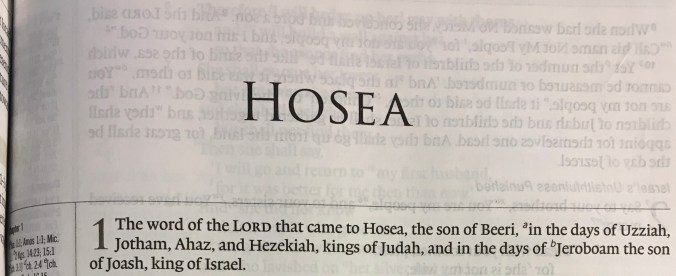 This month our Bible reading plan takes us to the Minor Prophets. To help us assemble these books and understand their message, here are a number of resources to Hosea, the first book of The Twelve. You can find more information about the Minor Prophets here. Continue reading
Be Slow to Judge and Quick to Make Peace: What Pastors Can Learn from Doubting Thomas

19 Know this, my beloved brothers: let every person be quick to hear, slow to speak, slow to anger; 20 for the anger of man does not produce the righteousness of God.
— James 1:19–20 —
In the Bible Thomas gets a bad rap. In the face of seeing Christ’s death on the cross and not seeing Christ’s resurrection, the apostle, who previously volunteered to die with Christ (John 11:16), is unable to believe. For a whole week this beloved follower of Christ is kept in the dark, and not until Jesus returns to the Upper Room does he believe. But when Thomas does believe—he offers one of the most illuminating testimonies of Christ’s identity: “My Lord and my God” (John 20:28).
There are many lessons we can draw from Thomas’s delayed faith, but one of the most important is that faith is based on evidence. The Christian faith is not a leap in the dark; it is based on the evidential history that Jesus rose from the grave, walked on the earth for forty days, so that he could teach his disciples about the kingdom of God (1 Cor. 15:1–8; Acts 1:1–8). In that time, Jesus revealed himself to 500 disciples at one time, before his ascended to heaven in the presence of his followers (Acts 1:9–11). In short, God granted to those who saw the resurrected Christ.
With respect to Thomas’s doubt, his request for the physical body does not deny his faith; it ensures his faith is placed rightly in the resurrected Christ. Even today, faith is dependent on the eye-witness account of Christ’s physical resurrection (1 John 1:1–3). Thomas did not have that yet, and thus his delayed faith testifies to the need for eye-witness testimony.
At the same time, there’s second lesson to be learned from Thomas and his doubt. It relates to faith and evidence too, but it is not about believing the gospel but believing other believers. Until Jesus showed himself to Thomas, there was a division in the household of faith. Ironically, this is a division caused by Christ himself, as he revealed himself to his disciples at different times. But it is a division nonetheless, and one Jesus remedied when he returned to the Upper Room a week later.
Truth Takes Time to Perceive
Today, believers do not find themselves in the same position as the original disciples. For us, the gospel has come fully formed. Christ is exalted to God’s right hand of God, the Spirit has been poured out, and the New Testament has been finished. Hence, the transitional nature (which led to the temporary division between Thomas and the disciples) is not repeated today.
What is repeated are events in the life of the church where one member or one group come to see or understand something that others have not (yet) understood. This knowledge and belief may be a theological truth, a decision for ministry, or a situation of church discipline.
In such cases, believers may come to understand a doctrine or a situation at different times. Like runners traversing the same course, they may have different opinions on the race—not because they are on different paths but because they are looking at different sections of the course. In such instances, painful divisions can occur and tear apart the body of Christ. But unlike the division which Christ intended in the days following his resurrection, this division is not intended by Christ. Or is it?
Could it be that God plans temporary divisions in the church that cause his people to learn how to listen to one another? Could it be that various churches or individuals have different degrees of theological understanding or practical wisdom on various issues? And could it be that God wants his people not only to be at peace, but to learn how to make peace with one another?
Indeed, if we listen to the Bible, we see that God’s children are not just at peace with God (Rom. 5:1) and one another (Eph. 4:1–3), we are to be peacemakers (Matt. 5:9). And pastors are to be the ones who lead in making peace in the church. Continue reading
The Theological Message of the Twelve
In his book The Unity of the Twelve, Paul House argues that sin, judgment, and restoration are three themes extant in each prophet. He argues these themes also organize the Twelve (i.e., the Minor Prophets), where the first six books stress sin, the next three judgment, and the last three judgment. For him, this is the plot line that puts the Twelve together.
Complementing that vision, while not completely affirming, Richard Alan Fuhr and Gary E. Yates, in The Message of the Twelve, present four themes that repeat through the Twelve: (1) repentance and return, (2) the Day of the Lord, (3) a new covenant, and (4) the coming messiah can be found in the Twelve. I will outline these below. Continue reading
Putting the Prophets in Their Place: An Introduction to the Historical Background of the Minor Prophets
 There are four “major prophets” in the Old Testament—Isaiah, Jeremiah, Ezekiel, and the Twelve. While the first three major prophets are each associated with one prophet, the Minor Prophets (i.e., the Twelve) is a collection of twelve different prophets. Together, the twelve Minor Prophets compose a book of prophecy approximately the same size as the other Major Prophets.
Focusing our attention on the Minor Prophets, we can see that these twelve books originated over the course of four centuries (approx. 770 BC to 430 BC). Through this chronology, the Minor Prophets provide a unique perspective on the spiritual welfare of God’s people over time. While there are challenges to discerning the unity of the twelve, their chronology is especially important for understand God’s message.
Because the prophets are forth-tellers of God’s law, more than fore-tellers of God’s future, the prophets addressed the sinfulness of Israel/Judah, called for repentance, and promised mercy in a time to come. To rightly perceive their message, we must know the historical setting. Indeed, because prophets are given to Israel throughout their history (Jer. 7:25), it is vital to learn some basic events in Israel’s history if we are to learn the message of the prophets. Continue reading
Woman, Behold Your Son . . . : A Good Friday Meditation on Jesus’s Third Saying from the Cross (John 19:26–27)
 26 When Jesus saw his mother and the disciple whom he loved standing nearby, he said to his mother, “Woman, behold, your son!” 27 Then he said to the disciple, “Behold, your mother!” And from that hour the disciple took her to his own home.
— John 19:26–27 —
This week our church did a series of devotions on Holy Week. You can find them here. Here’s my message on Jesus’s third saying from the cross.
Found in John 19:26–27, Jesus said to his mother, “Woman, behold your son,” and to John, his beloved disciple, he said, “Behold your mother.”
While this verse shows how Jesus care for his mother, it does more than that. It shows how Jesus is forming a new family from all those who will trust in him. If you trust in Christ, this is your family—a family that is created by shared faith in the crucified Christ and resurrected Lord.
On Good Friday, our good news is found in this fact: Jesus died alone on the cross, receiving in his body the wrath of God, so that we would spend eternity together with him, as children forgiven by his sacrifice. In light of our world’s current pandemic and its associated self-isolation, this news is exceedingly good. What we experience now—isolation from one another—is what Jesus came to take away for all those who trust him. Though we taste the bitterness of disease, death, and distance, Jesus is going to one day remove all of these effects of sin.
On this Good Friday, may our hearts find rest in Christ and his finished work. And may his words to Mary and John teach us how to find a place in God’s family, so that for all of eternity we will be with him and all those who love the appearing of the Son of God.
Soli Deo Gloria, ds
Seeing the Bigger Picture by Seeking the Most High God: Three Meditations on Psalms 90–92
 In these strange days of social distancing, sheltering at home, and seeking the Lord without the gathered assembly of God’s people, I have been led to meditate on the eternal perspective that Psalms 90–92 provide. These three psalms should be read together, and together they provide a ladder to climb out of current crisis to see a greater vision of life that extends beyond our current horizon and runs into eternity.
At a time like this, when all of life is shutting down and projecting fear, we need to see this vision of God and his greatness. For only a true vision of God on high can give us the strength to trust God and love neighbors and serve others, as we are being led to protect ourselves at all costs.
Here are three messages on these psalms. May they bolster your faith in the sovereign Lord during this time of global pandemic and panic.
Eternal Perspective in a Time of Isolation: A Meditation on Psalm 90
Five Keys to Security in an Insecure Age: A Meditation on Psalm 91
Two Ways to Flourish: A Meditation on Psalm 92
This week, you can also find a daily devotion from the elders of Occoquan Bible Church. These video devotions remember the events of Holy Week and prepare our hearts to remember the death of Christ and celebrate his triumphant resurrection. Give them a listen and be encouraged in the finished work of Christ.
Soli Deo Gloria, ds
Eternal Perspective in a Time of Isolation: A Meditation on Psalm 90 (with Sermon Video)
[This is the first message in a series, Steadfast Psalms for a Scattered People]
This week our church was “cancelled.”
Praise around the throne of God went on unceasing, but our church didn’t gather because of the now-infamous and still-dangerous Coronavirus. With this unwanted hiatus, our elders decided to offer a devotional meditation for our congregation. This was not an attempt to replace church—an online “gathering” cannot reproduce what the body of Christ gathered does. Yet, we wanted to feed the flock from the scriptures. And this week that word came from Psalm 90, a prayer of Moses, the man of God.
You can watch the video here. What follows is a more fulsome meditation on this Psalm.
In these days of self-imposed and government mandated isolation, we need to learn from those who have walked the path of isolation and walked it well.
In the Bible, few have experienced soul-crushing isolation like Moses. At forty, Moses was a prince in the household of Pharaoh. Yet, in the blink of an eye, Moses went from the center of power in Egypt to the backside of the dessert, where he would chase sheep for another forty years. Continue reading
The Light is Dawning on Those Whom God is Saving: 10 Things about John 3:1–21
 For God so loved the world that he gave his only begotten Son,
that whoever believes in him shall not perish but have everlasting life.
— John 3:16 —
John 3:16 is a glorious diamond, but it only one jewel in the crown of John 3.
Many times we quote, hear, and share John 3:16 without its context in John’s Gospel. This is not a bad thing. A single diamond is beautiful, but set in an engagement ring or on a king’s crown, the placement makes the diamond better. The same is true when we put John 3:16 back into the Bible and see what comes around it.
In what follows, I outline ten things about John 3:1–21 to help us better understand this whole section of John’s Gospel.
1. The flow of John 2–4 moves from light to darkness.
It is well recognized that John’s Gospel turns on the themes of light and darkness. Already in John 1:9 we heard John say, “The true light, which gives light to everyone, was coming into the world.” Later, Jesus will say, “I am the light of the world” (8:12). But what about in between? Is there a theme of light dawning in chapters 2–8? I believe there is, or at least we see a progression of light in John 2–4. Consider this outline: Continue reading
 Via Emmaus