Seven Good Words: The Work Jesus Did on the Cross

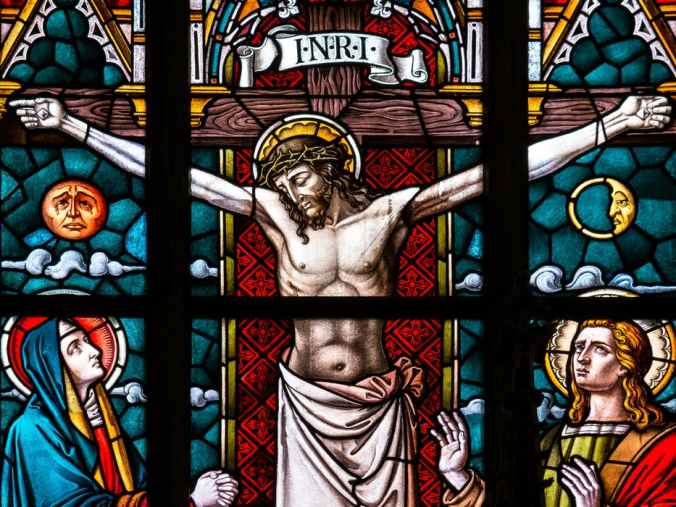
goodfriday04.jpg. . . they crucified him . . .
— Luke 23:33 —

For six hours Jesus body hung on the cross. Nailed to the tree, another crucified enemy of the state, Jesus labored to breathe as pain racked his body and mockers filled the air with vitriol. Tempted by Satan one last time to save himself (see the words in Luke 23:35, 37, 39), Jesus remained, inching closer death. Still, the end of Jesus’ life was not a passive surrender to the inevitable. Just the opposite, it was the climax of his earthly labor.

Indeed, Luke only uses three words to speak of his crucifixion. He revels not in the physical agony Jesus experienced. Rather, the good doctor focuses on what the cross meant. His testimony is a work of theology, not autopsy. For him, the importance of Jesus’s death was not found in the physical pain, but in the message it sent to the world. Like the other Evangelists, he tells us that Jesus came to seek and save the lost (19:10), and on the cross we find the climax of Jesus’ work of salvation.

And thus, to understand the cross we must ponder what his cross means and what the final work of Christ meant to accomplish. And to do that we can and must follow the lead of Luke and the other Gospels, who capture the final moments of Jesus’ life with seven different sayings on the cross. Continue reading
How the Cross of Christ Crucifies Sin

crossAs we prepare for Good Friday and Resurrection Sunday, consider this meditation from Alexander Watson, a 19th Century British curate in the Church of England. In the 1840s he preached a week-long series of sermons on  Christ’s seven words from the cross. And in his first sermon on Luke 23:34 (“Father, forgive them, for they know not what they do”), he closed with a powerful reflection on what Christ accomplished on the cross—namely, salvation from sin.
In other words, Christ’s death does more than grant clemency to guilty sinners. Christ’s death justifies guilty sinners and frees sinners to pursue a life of increasing holiness. In other words, Christ’s death does not just save us in our sin; it saves us from our sin. While awaiting the redemption of the body, the cross of Christ effectively saves us from the consequences, causes, and corruptions of sin so that we can flee from sin, crucify our flesh, and pursue good works.

Tragically, the life-giving message of holiness can be lost in a truncated message that only focuses on guilt removal. Therefore, we need to give attention to every aspect of the cross, including the hopeful message of holiness exemplified by Watson.

On the finished work of Christ that empowers Christians to pursue holiness, he writes,

The atonement for sin is a finished act. The application of that atonement is a continual work. That portion of our Lord’s priestly office which consisted in his giving himself a ransom for the sins of the world has been accomplished, and can be no more repeated. “By one offering he has for ever perfected them that are sanctified, and there remains no more sacrifice for sin’’ (Heb. 9:26). But this consecration of his redeemed by his one offer does not exclude—but rather it involves, and requires—the continued mediation and intercession of him who is our great high priest, the one who offers prayer for us continually. And since it is his death upon the cross which gives to Christ’s mediation its meritorious efficacy and acceptable savor in God’s sight, we may be well assured that it will not avail for those in whom it does not work the conquest of sin and the presence of penitent desires after holiness.  Continue reading

Adam as Prophet, Priest and King, and the Bible as the Story of ‘Three Sons’

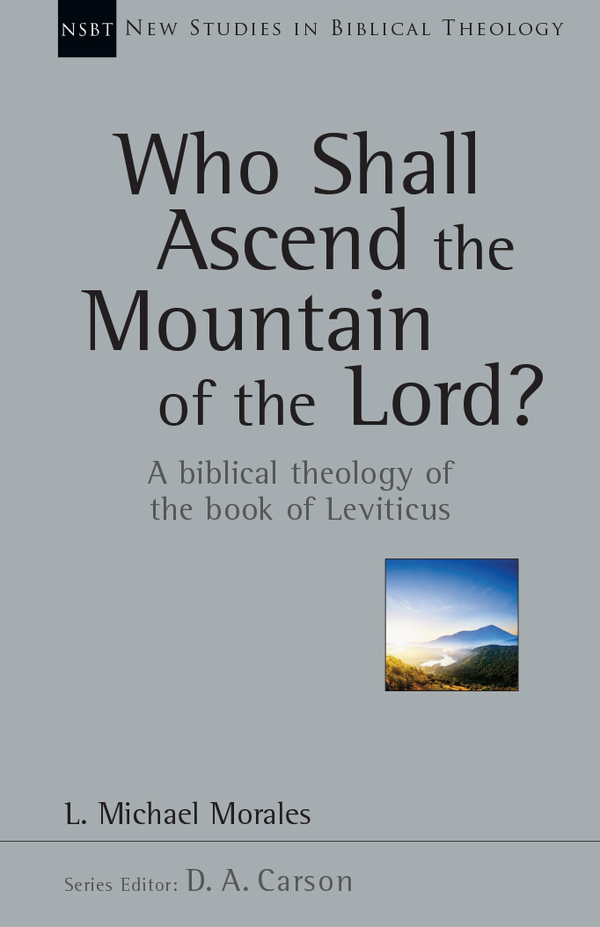
leviticusWhat has been the best book you have read in 2018? For me, it has been a 300+ page study on Leviticus. Yes, Leviticus!

In Who Shall Ascend the Hill of the Lord? A biblical theology of the book of Leviticus, Michael L. Morales gives the reader a biblical feast. From considering the literary shape of the Pentateuch to the goal of the Yom Kippur (The Day of the Lord), from considering the typology of the tabernacle to the priestly role of Adam, Morales’ book is a must read for anyone who wants to understand the system of mediation outlined in the books of Moses.

Even more, the whole book helps the Bible student to learn how to read the Bible and to understand God’s covenantal purposes for bringing his people into his presence. For these reasons, I would highly recommend this book. For now, let me share a quotation that demonstrates the richness of his study.

Adam as Prophet, Priest and King, and the Bible as the Story of Three Sons

Making a bevy of intra-biblical connections, Morales explains how Adam functioned as a prophet, priest, and king. Moreover, he explains how the whole story of the Bible can be explained along the lines of God’s Son—from Adam to Israel to Christ.

Without comment, I will share his words. I pray they stir up your affections for God as much as they did me.

Davidic kingship, then, is (1) rooted in YHWH’s kingship and (2) an inheritance of Adam’s roles as son of God. In reality, all three offices of anointing (prophets, priests, and kings) possess an Adamic role, and are oriented by the mountain of God. Indeed, as to the Adamic role, it is possible to comprehend the progress of redemptive history according to what we may call ‘God’s three sons’:

  • Adam was the first firstborn, who functioned as prophet, priest, and king.
  • Secondly, God created a corporate firstborn son, Israel. (Due to humanity’s estate of sin and misery there was a separation of powers, as it were, with the distribution of the offices of prophet, priest and king among the members of Israel distinctly.)
  • Finally, as the last Adam and true Israel, the Son of God dawned, as prophet, priest and king, now conforming humanity to himself as the image and likeness of God.

As to the offices being oriented by the mountain of God, we have already observed in a previous chapter how the high priest’s office is focused upon and validated by his annual entrance into the summit of the architectural mountain of God, the holy of holies, on the Day of Atonement (Lev. 16). Similarly, kings were enthroned upon God’s holy mountain, and prophets were sent from it. The king, at his coronation, was installed upon God’s holy mountain, reigning from the earthly Zion as a reflection of YHWH’s reign from the heavenly Zion (Ps. 2). And to become a servant of YHWH, a prophet had first to encounter him at the mountain of God and then be sent forth from it as a messenger (Isa. 6; Exod. 3:1-10). Since all three offices are cultic, functioning distinctly for the same divine goal, one may see how kingship in ancient Israel accorded with what I have argued to be the Pentateuch’s major theme: the Davidic king reigned to shepherd humanity to the house of God upon the mountain of God. (Who Shall Ascend the Hill of the Lord?, 235–36. Bullet points mine.)

Soli Deo Gloria, ds

Eight Principles for Holding the Truth in Love

hands.jpegAt the end of 2 Peter 3:18 Peter prays that the church might grow in grace and knowledge. Truly, when that happens Christians not only learn truths about God, they come to know God and share his character through studied communion with him. Likewise, in becoming like our heavenly Father we learn what is most important to God, and how, in our fallen world, can and should give grace to people who do not perceive as we do (rightly or wrongly) what is most important.
Extending grace to others has application in all areas of life, including theology. Yet, too often in an attempt to give grace to others, well-meaning (and well-deceived) Christians can compromise the truth. Therefore, learning to contend for the faith while growing in the fruit of the Spirit can be a difficult. Yet, nothing is more important than knowing how to hold the sound doctrines God has given to us.

lutzer

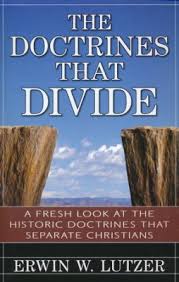
On this subject, how to hold the truth in love, there are very few books. Albert Mohler’s article on Theological Triage is instrumental here, but for books, the list is short. One book that should be included, however, is Erwin Lutzer’s The Doctrines that Divide: A Fresh Look at the Historic Doctrines that Separate Christians. In this book published in 1998, Lutzer considers nine different theological debates. They include

  • Is Christ Truly God?
  • Is Christ Truly Man?
  • Was Mary the Mother of God?
  • Was Peter the First Pope?
  • Justification: By Faith, Sacraments, or Both?
  • Why Can’t We Agree about the Lord’s Supper?
  • Why Can’t We Agree about Baptism?
  • Predestination or Free Will?
  • Can a Saved Person Ever Be Lost?

With pastoral wisdom, Lutzer explains various angles to the subject and argues with great winsomeness for his own position. In fact, showing the complexity of the predestination and free will question, he spends four chapters, considering differences that arose at different points in church history. Continue reading

Into the Depths: An Introduction to the Book of Jonah

jonah04

Into the Depths: An Introduction to the Book of Jonah (Jonah 1:1–4:8)

Jonah is an amazing book, but one that requires repeated readings, a willingness to learn, and a commitment to the God who created the world, controls the nations, and directs all history to the true prophet, priest, and king—Jesus Christ.

On Sunday we started a six week journey through the story of Jonah. Let me encourage you to read the book in one sitting—it’s only 48 verses—and consider how this book exposes the hardness of our hearts, even as it displays the mercy and grace of God.

For an introduction to the book, you can listen to the sermon online. But don’t miss some of the resources below. They will help you get a greater sense of the book in its historical, literary, and canonical contexts (i.e., how it fits in the Minor Prophets). Discussion questions and additional resources are below. Continue reading

Reading the Minor Prophets Together: Ten Observations from Paul House’s ‘The Unity of the Twelve’

12By 1990 there was no consensus on the structure of the Minor Prophets. Observing this fact, Paul House, in his book The Unity of the Twelve, surveyed the way scholars looked to chronology and regional location as possible ways “the Twelve” were ordered. Such approaches were significantly lacking, however, and so he concluded: “It is probable that historical research has not successfully uncovered the structure of the Twelve because that structure is governed by literary principles” (67).

In conversation with literary critics and scholars employing methods of canonical criticism, House shows why we should read the Twelve as more than 12 similar but separated oracles. Rather, by examining the structure and plot of the Twelve we can come to a clearer understanding of the unified message that the Minor Prophets is seeking to convey.

As others have observed in the Psalms, there is an intentional ordering in the Minor Prophets, better termed The Twelve. Historically, these 12 books are always found together and typically in the same order (63). For that reason, a unified study of their message is valid and valuable. And Paul House’s book, though technical, is an important for helping read and understand the Minor Prophets.

To get a sense of his argument and how the twelve prophets are unified, let me share some of his observations—first on the structure of the Twelve, then on the plot of the Twelve. Continue reading

Sovereignty, Satire, and Second Chances: An Introduction to the Book of Jonah

jonah04For being only four chapters and 48 verses, the book of Jonah demands a lot from its readers. In the original language, it becomes clear how well-crafted the book is. In four chapters, there are at least four chiasms that organize the book, and on the whole, Jonah is a literary masterpiece. At the same time, the book is best understand in combination with the rest of the Minor Prophets—consider the way Jonah’s rebellion mirrors that of Edom in Obadiah, or the way the king of Nineveh preaches Joel 2:12–14 (see Jonah 3:6–9).

Still, if Jonah demands a lot from its readers, it gives even more. In its four scenes, it gives its readers an incredible vision of God, his grace, his power, and his purpose among the nations. In other words, in the rebellion of Jonah, a (false) prophet of the Lord, we find much about God’s grace.

Over the next two months, our church will be spending ample time in this book, along with a few other Minor Prophets. So in this post, let me introduce a few themes we will see again and again—namely, God’s sovereignty, the book of Jonah’s satire, and the promise of second chances for sinners who repent and turn to God. Continue reading

Getting into Jonah by Seeing the Book’s Literary Structures

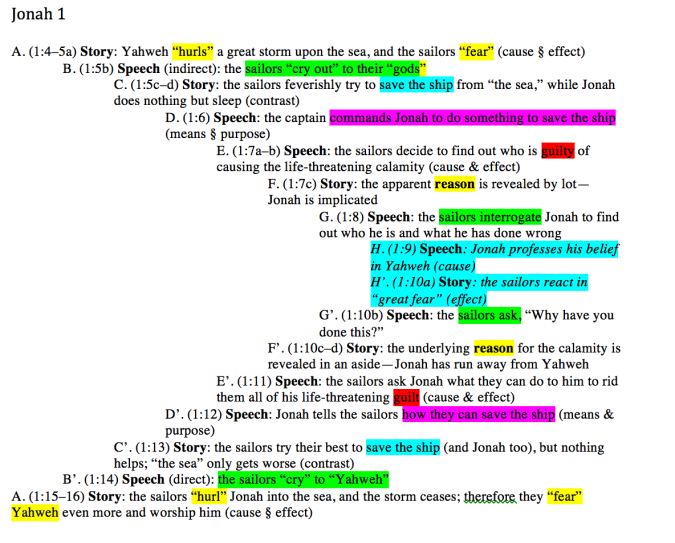
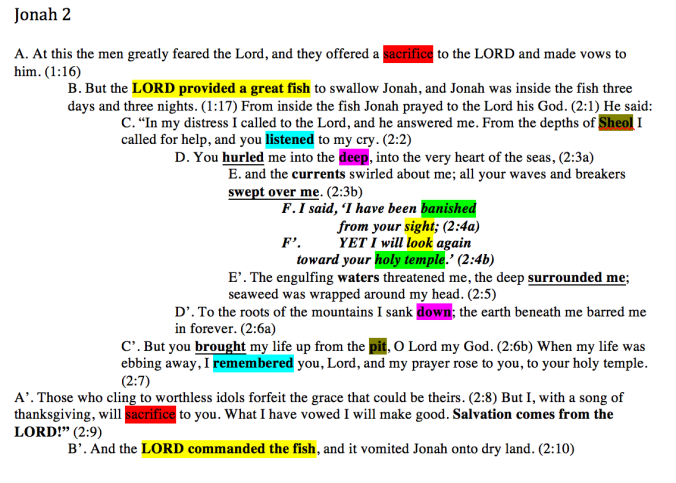
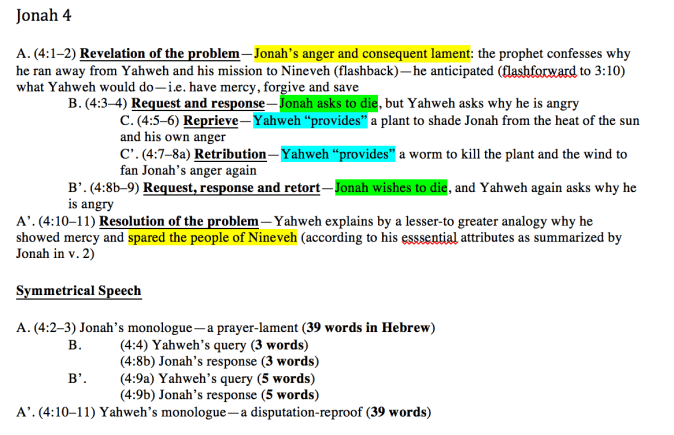
chiasm_textIn a pair of articles on literary structure and the book of Jonah, Ernst Wendland argues for what makes a chiasm valid, with a test case in the book of Jonah. As our church begins to study Jonah, I share the outlines from his second article. You can find his reflections on chiasms here.

They demonstrate how much the biblical authors, in this case Jonah or another prophet well-acquainted with Jonah, incorporated literary devices to express their arguments. For casual readers of the Bible, these outlines suggest that their are depths untold in the meaning and message of Scripture. For teachers, these are the structures we must find as we seek to understand the author’s original intent.

All the chiastic structures outlined below come from Ernst Wendland’s Text Analysis and Genre of Jonah (pt 2) (JETS 1996). The highlights are my own.

The Overall Structure of Jonah

A. (1:1–3) Yahweh calls Jonah the first time and he flees from Nineveh

B. (1:4–16) A life/death crisis; exhortation by the captain; Jonah’s unwilling message to the pagan sailors of the ship; result: they all repent and pray

C. (1:17) Surprising transition: Yahweh saves Jonah by means of a great fish

D. (2:1–9) Jonah’s response, a pious prayer: thank you—for letting me live

E. (2:10) Instruction: Yahweh’s miraculous object lesson is complete—Jonah is safely delivered

A’. (3:1–3) Yahweh calls Jonah the second time and he travels to Nineveh

B’. (3:4–9) A life/death crisis; Jonah’s unwilling message to the pagan people of the city; exhortation by the king; result: they all repent and pray (an even greater number)

C’. (3:10) Surprising transition: Yahweh saves Nineveh by “repenting” himself

D’. (4:1–4) Jonah’s response, a peeved prayer: please—just let me die

E’. (4:5–9) Instruction: Yahweh’s miraculous object lesson in the plant, worm and wind—Jonah is sorely afflicted

F’ (4:10–11) Conclusion (thematic peak): Yahweh’s last word to Jonah and to every current listener: “Salvation belongs to Yahweh” (cf. 2:9)

Four Chiasms in Jonah

In addition to the overall storyline of Jonah, each chapter shows remarkable literary arrangement. Again, following the work of Ernst Wendland, consider how each chapter is structured.

Screenshot 2018-03-15 10.28.45Screenshot 2018-03-15 10.32.25Screenshot 2018-03-15 10.34.39Screenshot 2018-03-15 10.36.16

Reading Jonah

With these structures in mind, you are now better equipped to read this fascinating book. Even more, with these structures in mind, we find more clearly the original emphases. For more the literary structures of Jonah, see

Soli Deo Gloria, ds

Behold *the Man*: B.B. Warfield on the Perfection of Christ

raphael-nogueira-519766-unsplashWhat a straightedge is to a carpenter’s board, Jesus is to the human soul.
— Fred Zaspel —

In his summary of B.B. Warfield’s theology, Fred Zaspel observes the unique way Warfield presents the humanity of Jesus Christ. Instead of just showing the weaknesses and limitations of Christ, he portrayed our Lord as fully and wonderfully human. In other words, while defending the full deity of Christ, he also insisted on capturing the full and glorious humanity of Christ. Jesus came to identify himself with fallen humanity, yet in himself he was humanity par excellence. Jesus was the perfect man and an image of what mankind was supposed to be and, amazingly, what humanity will be once again, when we see our resurrected Lord.

To get a sense of what Warfield’s view of Christ’s humanity consider these three truths, accompanied by Warfield quotations. Continue reading

Writing Better, Writing More: Three Helpful Voices

aaron-burden-64849-unsplash.jpgIn recent days, I’ve seen two excellent posts on writing better from David Gunderson and Charles Spurgeon, via Lucid Books. I also came across a helpful list of ways to write more from Samuel Miller, one of the founding professors of Princeton Seminary.

Since writing is something I do and try to improve, I found these three lists helpful. I share them here for others to consider their content and apply their wisdom. If you know of other lists, please feel to add them in the comments.  Continue reading