Worship Tests Truth :: Doctrine Determines Doxology

In Richard Bauckham’s book Jesus and the God of Israel (2008), the British NT scholar quotes John MacIntrye to make his final appeal that the worship of Jesus in the early church signifies a first-century consensus that Jesus was God, and that the notion of Jewish monotheism included Jesus.  Though Bauckham’s presentation deals with the history of theology, his point bears personal inquiry and application for those in the church today.  Here is the illuminating quote:

[We] shall not be satisfied with any christological analysis which eliminates from its conception of who he [Jesus Christ] is all valid basis for an attitude of worship to him.  It is on this very score that humanistic interpretations [read: the Jesus Seminar, Protestant liberalism, and strands of the emergent church] of the person of Jesus Christ fail, that they present to us someone who cannot sustain human worship; admiration, perhaps, even a sense of wonder at the courage he had in the face of danger and death, but never worship.  That is given only to God.

Theology that does not purify and empower doxology is false!  For worship is a telling litmus test for doctrine; and the veracity of any truth-claim must always generate worship.  Remember, believers worship in spirit and truth (John 4:24), and if our worship is weak, the cause may be the truths we believe.

Sadly, this worship-doctrine connection is often overlooked.  Many Christians have substandard beliefs about God and wonder why they struggle to have a quiet time.  They assume that their failing worship requires a newer and more sensational experience, but in truth, their hunger for God lags, because they have tasted vaporous imitations and turn again to empty substitutes.  Moreover, they, we, buy into the latest fads in evangelicalism, without considering how these new spiritualities of theological notions might impact their worship.  But as we are created to worship, surely, true truth must convince the mind and move the heart. 

So, the next time you encounter something about Jesus the Christ, ask yourself, is this a vision of God that will fuel my worship.  If the answer cannot be quickly affirmed, reconsidered the matter, and take pause before buying into the speaker, the system, or the soundbite.  Instead, return to the Scriptures to see the inspired revelation of God, Jesus Christ, who is the glorious Son of God, the eternal lamb, the desire of the nations, and the only one who can sustain a lifetime of white-hot worship.  Fill your heart with truths about Jesus, for nothing else will satisfy (cf. John 10:10).

May our worship purify our theology, and may all of our theology fuel worship.

Sola Deo Gloria, dss

Carl Trueman on Academics and the Local Church

Lately, I have been thinking about my entrance into the PhD program and the impact such heavy-duty training has on the edification of the local church.  Such academic equipping is certainly not required.  Most biblical prophets and apostles were “regular joe’s.”  Amos was  a shepherd.  Peter and John were fisherman, “uneducated, common men” who had been with Jesus (cf. Acts 4:13).  Jesus himself was an unschooled carpenter, while his cousin, John the Baptist, was a self-taught wilderness prophet.  According to the Bible, theological education is no panacea for heresy (cf. John 5:39ff); nor is it the golden key that unlocks the mysteries of God’s word.  All true understanding is Spiritually given (1 Cor. 2:1-16). 

Nevertheless, assiduous study has its place and the church has benefitted greatly from the likes of its church doctors.  Augustine, Luther, Machen, and Mohler have each benefitted the church in God-honoring ways because the Sovereign Lord of all wisdom (Col. 2:3) has been pleased to use their scholarly gifting and theological training for purification and expansion of his church.

In a recent edition of Themelios, Carl Trueman in hi article, “Minority Report: The way of the Christian academic,” reflects on the relationship between theological academic(ian)s and the church.  He concludes with an exhortation to wannabe theologians:

The calling of a Christian academic is a high one, for anyone charged with the teaching of God’s truth will, as the Bible tells us, be held to a higher level of accountability than others. The path is marked with difficulties and challenges; but none are insurmountable, and the basic disciplines of the Christian life are in fact more, not less, important and useful. You want to be a Christian academic? Work hard, pray, read your Bible, and go to church.

Personally, I am still working out how my own theological training serves the local church.  However, the question is not own of principle, but of specification.  The church is central, not theological education.  This is an absolute: all investments in biblical and theological studies must be for the church (cf. Eph. 4:11-16).  Why?  Because I, along with all those pursuing doctorates in theology, will be judged accordingly (cf. James 3:1). To those who have been given much, much will be required (cf. Luke 12:48), and those of us who have had the privilege of studying the Bible for years are accountable for sharing the riches. 

When we stand before our Lord and beneficient giver of all Truth, may we be found faithful.  Until then, may we labor to tell the Good News to the lost and build up the church with the nourishment of God’s Holy Word.  Theological training and biblical institutions of higher learning must be committed to the local church.  Until that end, may we pray and labor.

Sola Deo Gloria, dss

(HT:JT)

More Gregory Nazianzen: The Historical Revelation of the Trinity

In The Holy Trinity, Robert Letham quotes Gregory Nazianzen’s cogent statement on the Trinity’s progressive revelation within the history of the Bible:

The Old Testament proclaimed the Father openly, and the Son more obscurely.  The New manifested the Son, and suggested the deity of the Spirit.  Now the Spirit himself dwells among us, and supplies us with a clearer demonstration of himself.  For it was not safe, when the Godhead of the Father was not yet acknowledged, plainly to proclaim the Son; nor when that of the Son was not yet received to burden us further…with the Holy Spirit…[I]t was necessary that, increasing little by little, and as David says, by ascensions from glory to glory, the full splendor of the Trinity should gradually shine (Robert Letham, The Holy Trinity, 33).

Gregory’s insights draw attention to the the wisdom of Christianity’s Triune God as he has gradually revealed himself  as he really is and always (read: eternally) has been–God the Father, God the Son, and God the Holy Spirit.  While all three existed in eternity together, only in the fullness of time is Triune Godhead seen in his manifold perfections.  For those who read and teach the Bible, it must be kept in mind that God’s revelation is accomplished over time, and that the unchanging deity of the Bible is more clearly disclosed at the end of the story than at the beginning. While Gen. 1:1, 2, 3 arguably contain allusions to all three members of the Trinity, their disclosure is opaque, at best.  This does not make Scripture contradictory or confused; it must be read in time (diachronically).  

The progressive act of Trinitarian revelation shows God’s wisdom in teaching  us, finite creations, who he is through escalating stages of revelation (cf. Heb. 1:1-3).  Until we see how redemptive-history develops the Trinity over time, we will not be able to fully appreciate the oneness and the threeness of God–one Trinitarian being, three consubstantional persons; co-eternal in nature, fully revealed in their inter-penetrating distinctives in time. 

There is so much here to fathom.  May we continue to marvel at the uniqueness, the mystery, and the revelation of our living and true God.

Sola Deo Gloria, dss

Albert Mohler on Study Bibles

bibleAre you looking to purchase or use a Study Bible? Which one should you choose?  And how should you use it? On his blog,  Dr. Albert Mohler offers a helpful guide on “How to Use Study Bibles.”  He lists three steps that will maximize the use of these excellent resources:
1. Read the text of the Bible first.  Meditate upon the text and read it with care. Apply your own knowledge of the Bible in order to understand the particular text within its context and place in the biblical story-line. Consider and note other texts that come to your mind as directly related to this text. Read the text with full attention and conviction.

2. Look carefully at the cross-references… Do not look only to the citations, but read the actual passages. This assistance is till the main contribution of the study Bible — making related and parallel passages more accessible. A first principle of interpreting the Bible is to interpret the Bible by the Bible. In other words, to allow the Bible to interpret itself text by text.

3. Take full advantage of the notes, articles, and other helps printed with the text. In some cases, short articles will help in understanding contested issues or matters that might otherwise require a Bible dictionary or encyclopedia. Where appropriate, maps can be very useful, along with tables of measurement and similar points of reference. The very best of the study Bibles will also offer some level of commentary within the notes.

I think Dr. Mohler’s comments are very important for Christians who use Study Bibles (SB), because he affirms the primacy of the inspired, inerrant, and authoritative Scriptures.  This must not be lost.  The dangers of SB’s are that they become a crutch and a competing authority.  “I am of Lucado.” or “I am John MacArthur;” or “I am of Ryrie.”  This cannot be our affiliation.  However, when used rightly, SB’s function as a blessed tool to better read Scripture and understand God’s Word.  Currently, the best edition, in my opinion, is the ESV Study Bible, but there are many others that are helpful and some that offer specialization in Archaelogy, Apologetics, and Literature .  Each of these make unique contributions, and should be judged not by the name on the cover, but on the faithfulness to the Name on the inside.

Sola Deo Gloria, dss

Gregory Nazianzen on the Trinity

In The Holy Trinity, Robert Letham refers to T.F. Torrance’s assertion that John Calvin’s Trinitarian theology was developed, in part, by the Trinitarian formulations of Gregory Nazianzen.  That is a mouthful, and an amazing pedigree–Gregory Naz, John Calvin, T.F. Torrance, Robert Letham (p. 267).  Though Torrance’s connection between Gregory and Calvin  has been debated by some (cf. Tony Lane), Calvin was at least familiar with Greg Naz, as is shown in the following quotation in Calvin’s writings.

I encourage you to meditate on Gregory’s unity and diversity held together in this Trinitarian reflection.  Speaking of God the Father, God the Son, and God the Holy Spirit, the Cappadocian father writes:

No sooner do I conceive of the one than I am illumined by the splendour of the three; no sooner do I distinguish them than I am carried back to the one.  When I think of any one of the three I think of him as the whole, and my eyes are filled, and the greater part of what I am thinking escapes me.  I cannot grasp the greatness of that one so as to attribute a greater greatness to the rest.  When I contemplate the three together, I see but one torch, and cannot divide or measure out the undivided light.

May we continue to delight in the immeasurable perfections of our Triune God.

Sola Deo Gloria, dss

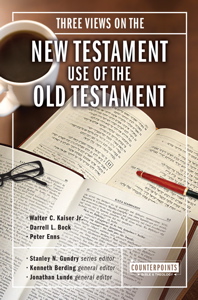
Three Views on the NT Use of the OT: Final Thoughts

nt-ot1Final Thoughts

Overall, the book is helpful.  It is laced with exegetical examples and principles for interpretation.  I am not a big fan of the 3, 4, 5-views kind of books, but this book may be an exception.  It showed the value of rigorous exegesis and developing antecedent theology from the OT to understand NT passages in their context (Kaiser), it demonstrated how historical-exegetical and canonical-theological readings of the text are not at odds with one another, but together help interpret the whole Bible (Bock), and in a shorter piece than his controversial Inspiration and Incarnation,  it showed some of the extra-biblical tendencies that Peter Enns espouses in his reading of Scripture.  For those reasons, I commend the book for pastors and students of the word who want to read their Bible’s more faithfully.

For those interested in the subject of hermeneutics, biblical exegesis, and systems of interpretation, I would encourage you to look at these other helpful books (the first two are very basic and accessible; the last four are more technical):

According to Plan: The Unfolding Revelation of God in the Bible by Graeme Goldsworthy.

Let the Reader Understand by Dan McCartney and Charles Clayton.

Continuity and Discontinuity: Perspectives on the Relationship Between the Old and New Testament edited by John Feinberg.

The Fabric of Theology: A Prolegemona to Evangelical Theology  by Richard Lints.

The Right Doctrine from the Wrong Texts? Essays on the Use of the Old Testament in the New compiled and edited by G. K. Beale (who is supposed to be coming out with a book on this subject; that should be an excellent treatment)

Commentary on the New Testament Use of the Old Testament edited by D.A. Carson and G.K. Beale.

 Sola Deo Gloria, dss

Three Views on the NT Use of the OT: Darrell Bock

nt-ot[In Three Views on the New Testament Use of the Old Testament, Peter Enns, Darrell Bock, and Walter Kaiser present three different approaches to biblical interpretation.  They address questions concerning sensius plenior, typology, Jewish methods of interpretation, matters of contextual interpretation, and whether or not we today can interpret the Bible like the New Testament authors.  Some of the discussion involves technical concepts and language, but anyone who reads the book will have a better understanding of matters to consider in reading the Bible in context.]

Darrell Bock: Single Meaning, Multiple Contexts and Referrents

Bock, Dallas Theological Seminary professor and recent lecturer at SBTS, offers, in my opinion, the strongest argument for putting together the Old and New Testaments.  He is absolutely committed to grammatical-historical exegesis that seeks to understand each author, book, and passage in context (like Kaiser); at the same time, he is attuned to the impact that historical context (i.e. temporality) has on reading the Bible, thus he pays attention to the interpretive nuances of Second Temple Judaism (like Enns); but in contradistinction to both of Kaiser and Enns, he employs a textually-rooted, progressively developed biblical theology.  This can be seen in two ways:

First in his six presuppositions for reading Scripture: The Bible is God’s Word, 2) The one in the many (corporate solidarity), 3) Pattern of history (correspondence or typology), 4) these are the days of fulfillment, 5) now and not yet (the inaugurated fulfillment of Scripture), and 6) Jesus is the Christ (111).  These six elements are necessary to read Scripture canonically.  Second, Bock shows great understanding of the multi-faceted ways that the OT is “reused” in the NT: prophetic fulfillment, typological-prophetic, authoritative illustration, principle, allegory (though Bock limits this to Gal. 4), and OT ideas, language, and summaries (118-121)

Still the most helpful element of Bock’s chapter is his biblically-derived demonstration of the way Scriptural meaning retains “stability” while experiencing referential change–hence “single meaning, multiple contexts and referents.”  Much like Richard Lints three horizons (contextual, epochal, canonical) in The Fabric of Theology (which I highly recommend), Bock shows from Acts 4’s use of Psalm 2, Romans 10’s use of Deuteronomy 30, and 1 Corinthians 7’s use of 2 Samuel 7 and Leviticus 26 that the sense always remains the same, but the referents may vary.  So that in the second example, the sense remains the revelation of God, but the referent changes from the covenantal law of Deuteronomy to Jesus Christ who is the telos of the law (Rom. 10:4).  This explanation of sense and referent was very helpful in describing how God’s word remains the same and yet develops over time and in history.

On the whole, there was very little that I found to critique of Bock.  Interestingly, even Kaiser’s final response lacked argumentative force.  He found a few things with which to disagree but finished saying, “Yes, the meaning of the Bible is stable.  Later applications of that meaning can expand the field of referents.  But whether there are ‘fresh meanings’… need[s] more work” (158).  On the whole, Kaiser and Bock are similar in the way that they see the NT recapitulating OT people, events, promises, etc.  What Kaiser calls principalizing and analogous, Bock speaks of as typological patterns.  In this, I think Bock is more helpful because he expounds the meaning of the text and he also sees how the text can be interpreted at varying levels–epochal and canonical.

Sola Deo Gloria, dss

Three Views on the NT Use of the OT: Walter Kaiser

nt-ot

[In Three Views on the New Testament Use of the Old Testament, Peter Enns, Darrell Bock, and Walter Kaiser present three different approaches to biblical interpretation.  They address questions concerning sensius plenior, typology, Jewish methods of interpretation, matters of contextual interpretation, and whether or not we today can interpret the Bible like the New Testament authors.  Some of the discussion involves technical concepts and language, but anyone who reads the book will have a better understanding of matters to consider in reading the Bible in context.]

Walter Kaiser: Single Meaning, Unified Referrents

Kaiser, Old Testament scholar and former president of Gordon-Conwell, is a careful theologian and true biblical exegete.  Citing a host of OT-NT connections, Kaiser’s chapter simply unpacks Scripture to make his case.  The other scholars cite Scriptural examples, but appeal more often to hermeneutical philosophies (Bock) and second temple Judaism’s methods of interpretation (Enns).  In fact, both Bock and Enns chastise Kaiser for his simplistic reading of Scripture (92, 97). 

The great strength of Kaiser’s chapter is his demonstration of how to interpret the OT in its context and then to show that the NT authors read their OT correctly.  He argues for an antecedent theology that informs every OT passage.  As opposed to Enns, who must go to the NT to find ultimate, Christotelic meaning, Kaiser goes to Genesis 3:15ff to show the “Promise-Plan” of God provides ample Messianic witness in the OT itself.  This is a crucial distinction, and for me at least, a tremedously convincing argument for Kaiser and against Enns: the gospel is not just explained in the NT, it is to be found from the very beginning, pointing forward to the Promised Seed. 

To summarize, Kaiser argues for reading each passage in its historical context, he denies Sensius Plenior, he appeals to making analogy between OT and NT (in this way there is a sense of greater fulfillment, when NT patterns or echoes (R. Hays) are picked up), and he appeals to the unfolding plan of God within the OT to make sense of the OT context and that NT writers did that very thing.  The problems of reconciling OT with NT do not lie with the writers themselves; they lie in us and our inability to rightly divide the word, so that we can say that the OT writers did not write better then they knew (Sensius Plenior), rather they wrote better than we know.  As biblical interpreters, it is our prayerful responsibility to learn from them what they knew and what the Spirit was testifying to them and through them (cf. 1 Peter 1:10-12; 2 Tim. 3:16-17).

May we, with Walter Kaiser, labor to understand the grammar and historical setting of the Bible, and may we go on to see how all Scripture is fulfilled in Christ (John 5:39).

Sola Deo Gloria, dss

Three Views on the NT Use of the OT: Peter Enns

nt-otIn Three Views on the New Testament Use of the Old Testament, Peter Enns, Darrell Bock, and Walter Kaiser present three different approaches to biblical interpretation.  They address questions concerning sensius plenior, typology, Jewish methods of interpretation, matters of contextual interpretation, and whether or not we today can interpret the Bible like the New Testament authors.  Some of the discussion involves technical concepts and language, but anyone who reads the book will have a better understanding of matters to consider in reading the Bible in context.

What follows is simply a synopsis of their arguments, plus a list of further reading.

Peter Enns: Fuller Meaning, Single Goal

Enns, former Old Testament professor at Westminster Seminary, before being let go because of his questionable methods of interpretation (cf. Inspiration and Incarnation), spends exorbitant detail on matters unhelpful for putting the OT and NT together–a 15 page discussion on Deuteronomy 33:2 and the problem of understanding the law, angels, and traditions in Judaism.  He emphasizes Second Temple Judaism as a pre-requisite for understanding the NT.  Understanding this historical period and its literature and worldview nearly trumps OT reading and understanding.  Shocking!  He writes:

Rather, from a hermeneutical point of view at least, it is better to think of the NT as part of a larger group of texts of Jewish provenance–all of which, despite their real and important differences, together make up a distinct but diverse collection of texts we call ‘Second Temple literature’ (178)

The problem with this is that Enns blurs the boundaries of canon.  He reformulates the NT documents into a portion of a larger and more important (?) body of literature.  He goes on: “The focus of this essay is more on similarities between the NT and other Second Temple texts” (178).  I thought that this book was about the Old Testament and the New?  Clearly, Enns is shaping his reading of the Bible along the lines of extra-biblical literature–this trend always leads to hermeneutical and doctrinal deviation.  This kind of deviation can be seen more evidently in his statement on the previous page (177) that again confuses inspired revelation and other Second Temple literature when he says that both are “God-given.”  Is this a 2 Timothy 3:16 kind of “God-given”?

To be fair, Enns does make some positive contributions.  His emphasis on reading the Bible eschatologically and in light of the death and resurrection of Christ show how important the whole storyline of Scripture is to understanding individual passages and the Bible’s inter-textuality.  Still, Enns roots all his meaning in the NT, almost stripping the OT of any content or standing on its own.  I appreciate his Christotelic view, but he begins in the wrong place.  It would be better to begin in Genesis 1 and move forward finding God’s progressive revelation of the Promised Seed, the son of blessing, the prophet like Moses, the royal Davidite; instead he goes straight to the NT and returns to explain the OT.  To borrow a technological metaphor, he makes the programs of the OT absolutely dependent on the applications of the NT.

In sum, he supports typology and sensius plenior and he makes mention of them in passing, but the takeaway from his essay is the need to understand the NT in the light of Second Temple Judaism and to read the Scriptures knowing the rest of the story.  After reading his section, I was more convinced of Kaiser’s exegetically secure position, that may lack modern nuances in interpretive method, but that exalts in the sufficiency of the Scriptures.  Moreover, I was appreciative of Bock’s recognition of Second Temple Judaism, but also his ability to put on the brakes and not be completely swept away by extra-biblical informants.

Finally, I will say that I appreciate Enns ecclesial sensitivity and pastoral admonition to take more time in church to teach our people the whole counsel of Scripture (216).  This concluding word is a fitting way to end a chapter on how to read the OT and the NT.  Since our churches are filled with biblically illiterate people today, we who teach God’s Word must be willing to patiently and wisely instruct them with all 66 Christ-centered books of the canon.  This is not optional, but essential and part of the task of being a faithful expositor–to help church members read the Bible better.

More to come…

 Sola Deo Gloria, dss

Irenaeus of Lyons: A Faithful Church Father

A Man Worthy of Consideration and Imitation (Heb. 13:7)

After surveying Irenaeus Against Heresies it is evident that the Bishop of Lyons is a man committed to Scriptures and thus worthy of emulation in many ways. His vehement opposition to Gnostic heresies, his unwavering commitment to the Word of God as authoritative, inerrant, and sufficient, and his robust biblical theology are examples worthy of ponder and imitate. In his grasp of the Bible and in his bold proclamation thereof, Irenaeus incarnates Titus 1:9 admonition to elders, “holding fast the faithful word which is in accordance with the teaching, so that he will be able both to exhort in sound doctrine and to refute those who contradict it.”

Nevertheless, there are things that Irenaeus did in his exposition of Scripture that modern expositors should be cautious to repeat. First, Irenaeus’ habit of allegorizing details within narrative passages is not a legitimate hermeneutic procedure. Finding more than three allegorical meanings to the ax head in Elisha narrative, and comparing the three spies sent to Jericho to the Trinity[1] are spurious interpretations at best and potentially harmful.

Second, his pattern of making typology fit the most intricate detail of the event is problematic (i.e. Lazarus’ clothes, clean and unclean animals). Though Irenaeus was constrained from major error because of a strong apostolic doctrine, those who have weak doctrine and strong imaginations will be the next generation of Gnostics, or liberals, or postmoderns. Patience, humility to admit we don’t know everything,[2] and increasing textual evidence based on ongoing exegesis must be required for all typological interpretations.

Finally, there is wisdom in focusing on the main details of the Gospel and not on peripheral non-essentials. In a handful of instances, Irenaeus taught peculiar doctrines (i.e. Christ living to the age of 50; six days of creation correspondent to six millennia) by defining one passage of Scripture with another, that in all likelihood should not have been combined. The causes of this are manifold, but the principle lesson is that doctrinal formulation should be founded on the clearest and most abundant biblical evidence. Such Scriptural data must recognize the unfolding nature of progressive revelation and form its doctrines in accordance with the canonical shape of the Bible.

Today, the church stands on the shoulders of men like Irenaeus, and benefits from his stalwart commitment to the truth and the right interpretation of Scripture. Yet, there is one other aspect of his theological enterprise that should not go unnoticed. At the end of Books III and IV, Irenaeus prays for his opponents. He was not cold theologian, but a doctrinally-committed pastor whose theology shaped his prayer and his polemics.  This too, and perhaps, this most is worthy of emulation.  I fear too much pugilism and too little prayer is offered today in debates that surround interpretation of the Bible.

So, as we close our evaluation of Irenaeus of Lyons, may we give thanks to God for this faithful saint and consider his life and imitate his biblical faith.[3]

Sola Deo Gloria, dss


[1] Ibid., 4.20.12.

[2] Something that Irenaeus demonstrated in his own position of ecclesial authority (see. Adversus haereses 2.28.3).

[3] For the Gnostics, Irenaeus prays, “We do indeed pray that these men may not remain in the pit which they themselves have dug, but separate themselves from a Mother of this nature, and depart from Bythus, and stand away from the void, and relinquish the shadow; and that they, being converted to the Church of God, may be lawfully begotten, and that Christ maybe formed in them, and that they may know the Framer and Maker of this universe, the only true God and Lord of all. We pray for these things on their behalf, loving them better than they seem to love themselves” (Adversus haereses 3.25.7).