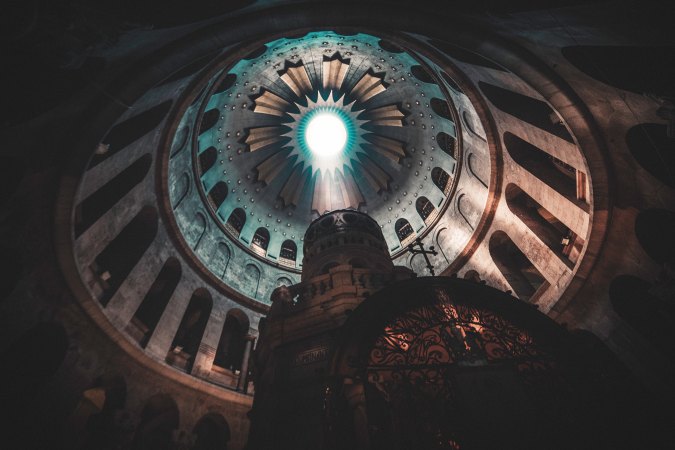
 The MacArthur Study Bible is a treasure trove for commentary on the Bible. Many weeks in preparation for preaching I look at its notes, and profit from its historical, grammatical, and theological observations. This week, however, as I read its commentary on Haggai, I couldn’t help but notice some biblical data missing from a table on the temples in the Bible.
While not expecting comprehensive commentary in a study Bible, I was puzzled by the way the dispensational theology of the editors may have led them to excise some key biblical data. For those familiar with Simeon Trust, this is a classic example of the framework running over the text—in this case, the text is the whole Bible.
From the looks of it, this otherwise helpful table on the temples in the Bible—well, except for the dispensational stuff, again—has left some significant holes in the Holy Temple. In other words, as the following chart defines the terms, a temple must be “a place of worship, a sacred or holy space built primarily for the national worship of God” (italics mine).
Italicized are two words/ideas that encapsulate the problem. Are temples only built for national worship? What about the heavenly temple where God abides and angels and all nations worship God? Also, must a temple be built with physical materials? What about Jesus’s words in John 2, where he said that this temple would be torn down and he would raise it up in three days? Does built apply to flesh and blood?
What’s missing in this chart are key elements of a biblical theology of the temple, which touches on so many other elements of Christology, ecclesiology, and eschatology. Moreover, even within the chart the definition at bottom does not hold up for all the data given.
So, to fill in the holes, I’ve modified the chart below, explained the distortions in this table, and outlined why five additions should be included in any temple. From this modified chart, we do get a more complete sense of all the temples in the Bible, although I’m still not convinced about the two temples associated with the Millennium. But I’ll save that for another day.
For now, let’s consider all the temples in the Bible. If you can think of another one, please let me know. Continue reading
 It has been said that on the cross God’s wrath and mercy meet. Indeed, on the cross the full revelation of God’s undivided attributes are manifested. As just and justifier, Jesus receives in his body the full outpouring of God’s wrath. Yet, as God Incarnate, he simultaneously displays the love of God, as 1 John 3:16 states, “By this we know love, that he laid down his life for us, and we ought to lay down our lives for the brothers.” Accordingly, all other moral attributes (e.g., truthfulness, justice, goodness, mercy, peace, righteousness) are revealed in perfect proportion.
 . . . they crucified him . . .
 At the end of 2 Peter 3:18 Peter prays that the church might grow in grace and knowledge. Truly, when that happens Christians not only learn truths about God, they come to know God and share his character through studied communion with him. Likewise, in becoming like our heavenly Father we learn what is most important to God, and how, in our fallen world, can and should give grace to people who do not perceive as we do (rightly or wrongly) what is most important.
 What a straightedge is to a carpenter’s board, Jesus is to the human soul.
 Free will.
 Jesus said to them, “I am the bread of life; whoever comes to me shall not hunger, and whoever believes in me shall never thirst. But I said to you that you have seen me and yet do not believe. All that the Father gives me will come to me, and whoever comes to me I will never cast out.
 This year I am reading through the works of Princeton theologian B.B. Warfield. As I find various important points or quotes, I’ll try to put them up here. Today I offer this first quotation that pertains to the task of systematic theology and its relation to exegesis and biblical theology.
 Few places in Scripture are more important, more debated, or more theologically-rich than Genesis 1–11. As to their importance, they introduce the Bible to God and his purposes in the world; as to debate, they were polemical from the start, as Moses wrote these chapters to combat other creation stories in the ancient Near East; and as to theology, these eleven chapters introduce nearly every doctrine found in the rest of Scripture.
 8 For by grace you have been saved through faith. And this is not your own doing; it is the gift of God, 9 not a result of works, so that no one may boast. 10 For we are his workmanship, created in Christ Jesus for good works, which God prepared beforehand, that we should walk in them.
 Via Emmaus