reMARK’s on the Church

Reading Mark Dever’s section on the church in A Theology for the Church, I came across a couple stimulating quotations.  One about the already-but-not yet marks of a true church by Donald Bloesch, another from Robert Reymond about the mark of true church being found in its connection with the apostle message, and finally one from Mark Dever himself that displays the power of the Word to form and reform the church.  Consider them with me: 

One, Holy, Universal, and Apostolic: Already and Not Yet

The church is already one, but it must become more visibly one…in faith and practice.  The church is alread holy in its sources and foundation, but it must stirve to produce fruits of holiness in its sojourn in the world.  The church is already catholic [i.e. universal], but it must seek a fuller measure of catholicity by assimilating the valid protests against church abuse…into its own life.  The church is already apostolic, but it must become more consciously apostolic by allowing the gospel to reform and sometime even overturn its time-honored rites and interpretations” (Donald Bloesch, The Church [Downers Grove: InterVarsity Press, 2002], 103; quoted by Mark Dever, “The Church” in Theology for the Church, edited by D. Akin [Nashville: B & H Academic, 2007], 778).

The Continuity of the Church: Dependent on the Ink of the Word and not on the Trail of Blood

“Just as the true seed of Abraham are those who walk in the faith of Abraham, irrespective of lineal descent, so also the apostolic church is one which walks in the faith of the apostles, irrespective of ‘unbroken succession'” (Robert Reymond, A New Systematic Theology of the Christian Faith [Nashville: Thomas Nelson, 1998], 844; quoted by Mark Dever, “The Church,” 778).

This has implications for Catholic theology and for those Baptists who depend upon the trail of blood for the legitimacy of their church.  Mark Dever continues the thought, focusing on the presence of the Word as the demarcation of a true church.

The physical continuity of a line of pastor-elders back to Christ’s apostles is insignificant compared to the continuity between the teaching in churches today and the teaching of the apostles…God’s people in Scripture are created by God’s revelation of himself (cf. Gen. 1:30; 3:7; 3:15; 12:1-3; Ex. 3:4; Ex. 20; Ezek. 37)…The right preaching of the Word of God that creates the church is not only the Word from God; it is the Word about God [i.e. the Gospel of Jesus Christ]… When God’s people hear about God and what he requires, they will respond (Dever, “The Church,” 778, 780).

May our churches be built on the cornerstone of Jesus Christ and the steady foundation of the apostles and prophets teaching (cf. Eph. 2:20).
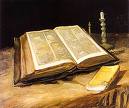
A Biblical Meditation on God’s iBible (1): Illumination and Intervention

In a informational age, where “data smog” threatens to pollute the air we breathe, where iPods, iPhones, and iGoogle have become part and parcel of daily living, and where keeping up with the Jones requires 24-hour instant information, it is salubrious to be still and know that our Lord is still God (Ps. 46:10) and that His Word remains fixed in the heavens (Ps. 119:89).  Yet, God’s Word is not a static, concrete fixture of law, suspended in time and space; it is living and active (Heb. 4:12), it has taken on flesh and dwelt among us (John 1:14), and as we will consider over the next three days, it has come to God’s people over an extended period of time that has been marked by a number of progressive steps.  By means of nmenonic device, these stages included: general illumination (i.e. general revelation), historical intervention, divine inspiration, and Spirit-wrought inscripturation, transmission of information, and personal illumination.  Taking these “I” steps together, you might say that God has given us his own iBible.  Let us consider together the amazing process by which God has given us his Word:

Illumination (in General): In the beginning God created the heavens and the earth (Gen. 1:1). With the power of his voice he breathed life into being (Ps. 33:6; cf. Gen. 2:7) and with the command of his voice he spoke light into existence (Gen. 1:3ff). In a very real sense, the first day began with a massive burst of light, a grand illumination. From this moment in time until now God has illuminating his world with his glory and has been making himself known (cf. Rev. 22:5).  He maintains the existence of all things by the power of His Word (Heb. 1:3), and in his creation he has made his divine nature and infinite power known (Rom. 1:18-20).  As Psalm 19 says: “The heavens declare the glory of God, and the sky above proclaim his handiwork; day to day pours out speech, and night to night reveals knowledge; there is no speech, nor are there words, whose voice is not heard.”  In other words, God’s general revelation, or general “illumination,” has transcended the cosmos.

Intervention (in History): Throughout the Scriptures, the God of the Bible is a God who reveals Himself. This is seen in his creation (Ps 19:1-7) and in his written Word (Ps 19:8ff); this is evident in the Imago Dei and in the mystery of marriage. In every area of life and in each stage of creation he gives more light to view ponder his nature and understand His work in the world. As the author of Hebrews says, “Long ago, at many times and in many ways, God spoke to our fathers by the prophets, but in these last days he has spoken to us by his son, who he appointed heir of all things, through whom also he created the world (Heb. 1:1-2)” This progressive revelation can be seen in the way that each stage of Scripture offers are more complete picture of who the Triune God is:

Pentateuch: The God who is (Ex. 3:14)
History: The God who acts in love on behalf of his people (Ex. 34; Deut. 7)
Psalms: The God who reigns and deserves all worship (Ps. 93, 97, 99)
Prophets: The God who keeps his Word; the Covenantal God (Jer. 31; Ezek. 36)
Gospels: The God who is with us (Matt. 1:23)
Epistles: The God of Glory seen in the face of Jesus Christ (Eph. 1:1-14)
Revelation: The Creator and Redeemer God; the Alpha and Omega (Rev. 1:8)

(For a more complete discussion of theocentric revelational see Timothy George’s chapter on God in Theology for the Church, edited by Danny Akin [Nashville: B & H Academic, 2007]).

Perhaps today is the day to be still and once again know that he is God, to turn off the iPod and pick up God’s inspired Word. If that is hard, as it so often is, there is all the more reason and need to once again hear the voice of God in his eternal Word. Or perhaps, instead of opposing one against the other, download God’s Word on you iPod. Listen to it as you go, drive, workout, or whatever. In any case, wherever the word finds you, may we together make sure that we find the Word; may we have ears to hear what the Spirit of Christ is saying in God’s holy book.

Sola Deo Gloria, dss.