A Mountain, A Map, and a Mercy Seat: An Introduction to the Sermon on the Mount (Matthew 4:23–8:1)

sermon05

A Mountain, A Map, and A Mercy Seat (Matthew 4:23–8:1)

This Sunday we started a new series on the Sermon on the Mount. In this introductory message, I sought to outline the whole message and to highlight the center section, where Jesus gives us the Lord’s Prayer.

You can listen to the sermon online. But be sure to listen with this visual aid. Discussion questions and additional resources can be found below.
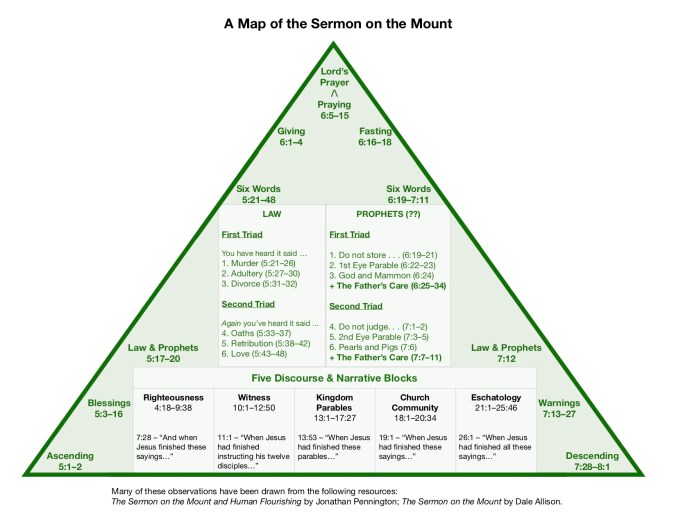
Sermon on the Mount Overview copy

Discussion Questions Continue reading

Three Wrong Ways to Read the Sermon on the Mount

jazmin-quaynor-36221-unsplash.jpgThe Sermon on the Mount is probably the most famous sermon ever preached, and for good reason. Its speaker is the Lord Jesus Christ; its location on a hill overlooking the Sea of Galilee is unique; and its language is both beautiful and profound. Even non-believers are familiar with many of the words Jesus spoke in this sermon.

Yet, for as well-known as the Sermon is, it is often misunderstand and misused. Therefore, as we begin to study this passage of Scripture, we should look at three common, but misguided ways to approach the sermon. Continue reading

Seeing the Mountain-Like Structure of the Sermon on the Mount

jeremy-bishop-248837-unsplash.jpgEarlier this week, we considered the way Matthew organized his Gospel with careful literary structures. Today, we look more closely at one part of his work, the Sermon on the Mount. And in that section of Scripture (4:23–8:1), we learn a number of things about how Matthew organized Jesus’ sermon in order to direct our attention to the main point of the sermon—namely, communion with the Father in the Lord’s Prayer.

Returning to the helpful work of Jonathan Pennington, we see in his The Sermon on the Mount and Human Flourishing, that he organizes Jesus’s Sermon on the Mount into a chiastic structure that looks something like this—this arrangement here abbreviates his original outline (see pp. 132–33). Continue reading

The Significance of the Sermon on the Mount: 10 Reflections from Herman Ridderbos

sermon05What is the Sermon on the Mount about?

That question has puzzled pastors, theologians, and Bible scholars for centuries. While large volumes have been written on the subject, sometimes a slimmer response is helpful. On that note, one finds great help from the late Dutch New Testament scholar Herman Ridderbos.

Writing a chapter on the Sermon on the Mount (“The Significance of the Sermon on the Mount,” in When the Time Had Fully Come: Studies in New Testament Theology26–43), Ridderbos explains the eschatological nature of Christ’s kingdom and how the arrival of Christ’s kingdom as a fulfillment of the Law and Prophets helps us understand and apply Jesus’ famous words.  Continue reading

The Artistic Evangelist: Seeing the Structure of Matthew’s Gospel

quino-al-110318-unsplash.jpgIn his theological commentary on the Sermon on the Mount, The Sermon on the Mount and Human Flourishing, Jonathan Pennington spends chapter five outlining the structure of Matthew’s Gospel and the Sermon on the Mount, in particular. Following Robert Gundry’s observation that Matthew is a book filled with “literary and theological art,” Pennington alerts the careful reader to the way Matthew organized his Gospel.

What follows are a few observations about the way Matthew wrote his Gospel and how the whole book is held together with a discernible fivefold structure. Tomorrow, I’ll provided a detailed outline of the Sermon on the Mount. Continue reading