Via Emmaus on the Road: Hebrews 4

Further Resources


Hebrews 4 (ESV)

Therefore, while the promise of entering his rest still stands, let us fear lest any of you should seem to have failed to reach it. For good news came to us just as to them, but the message they heard did not benefit them, because they were not united by faith with those who listened. For we who have believed enter that rest, as he has said,

“As I swore in my wrath,

‘They shall not enter my rest,’ ”

although his works were finished from the foundation of the world. For he has somewhere spoken of the seventh day in this way: “And God rested on the seventh day from all his works.” And again in this passage he said,

“They shall not enter my rest.”

Since therefore it remains for some to enter it, and those who formerly received the good news failed to enter because of disobedience, again he appoints a certain day, “Today,” saying through David so long afterward, in the words already quoted,

“Today, if you hear his voice,

do not harden your hearts.”

For if Joshua had given them rest, God would not have spoken of another day later on. So then, there remains a Sabbath rest for the people of God, 10 for whoever has entered God’s rest has also rested from his works as God did from his.

11 Let us therefore strive to enter that rest, so that no one may fall by the same sort of disobedience. 12 For the word of God is living and active, sharper than any two-edged sword, piercing to the division of soul and of spirit, of joints and of marrow, and discerning the thoughts and intentions of the heart. 13 And no creature is hidden from his sight, but all are naked and exposed to the eyes of him to whom we must give account.

Jesus the Great High Priest

14 Since then we have a great high priest who has passed through the heavens, Jesus, the Son of God, let us hold fast our confession. 15 For we do not have a high priest who is unable to sympathize with our weaknesses, but one who in every respect has been tempted as we are, yet without sin. 16 Let us then with confidence draw near to the throne of grace, that we may receive mercy and find grace to help in time of need.

Soli Deo Gloria!

Via Emmaus on the Road: Hebrews 3

Further Resources


Hebrews 3 (ESV)

Jesus Greater Than Moses

Therefore, holy brothers, you who share in a heavenly calling, consider Jesus, the apostle and high priest of our confession, who was faithful to him who appointed him, just as Moses also was faithful in all God’s house. For Jesus has been counted worthy of more glory than Moses—as much more glory as the builder of a house has more honor than the house itself. (For every house is built by someone, but the builder of all things is God.) Now Moses was faithful in all God’s house as a servant, to testify to the things that were to be spoken later, but Christ is faithful over God’s house as a son. And we are his house, if indeed we hold fast our confidence and our boasting in our hope.

A Rest for the People of God

Therefore, as the Holy Spirit says,

“Today, if you hear his voice,

do not harden your hearts as in the rebellion,

on the day of testing in the wilderness,

where your fathers put me to the test

and saw my works for forty years.

10  Therefore I was provoked with that generation,

and said, ‘They always go astray in their heart;

they have not known my ways.’

11  As I swore in my wrath,

‘They shall not enter my rest.’ ”

12 Take care, brothers, lest there be in any of you an evil, unbelieving heart, leading you to fall away from the living God. 13 But exhort one another every day, as long as it is called “today,” that none of you may be hardened by the deceitfulness of sin. 14 For we have come to share in Christ, if indeed we hold our original confidence firm to the end. 15 As it is said,

“Today, if you hear his voice,

do not harden your hearts as in the rebellion.”

16 For who were those who heard and yet rebelled? Was it not all those who left Egypt led by Moses? 17 And with whom was he provoked for forty years? Was it not with those who sinned, whose bodies fell in the wilderness? 18 And to whom did he swear that they would not enter his rest, but to those who were disobedient? 19 So we see that they were unable to enter because of unbelief.

Soli Deo Gloria!

Twelve Ways to Order Your Week by the Son (Part 2)

Last week, in application of a recent sermon, I outlined six ways to set your watch by the Son. In order, these included.

  1. Start your day with God.
  2. Consume God’s Word on the way and make plans to feed on his faithfulness.
  3. Pray without ceasing.
  4. Make a midweek gathering a priority.
  5. Preserve and protect the altar.
  6. Make space in your calendar to meet with other Christians.

By and large, these six orientations were given as guides for making the most of the time between the time you gather for worship on the Lord’s Day. Today, I am adding six more ‘Helio’-centric orientations. Here they are.

  1. Enter the darkness of the city with the light of Christ.
  2. Lead others (family, friends, peers, strangers) to the altar of God on the Lord’s Day.
  3. When home (on Sundays), look for ways to bless the people who gather at your altar.
  4. When traveling (on Sundays), look for other faithful altars to visit and encourage.
  5. When sick (on Sundays), lament your absence.
  6. In each season, solidify your schedule and guard your time with God.

As you can tell, four of these orientations are directly related to the Lord’s Day (8–11). And three of them are directed to ways to make the best use of the Lord’s Day (9–11). In all, I hope these 12 orientations help you reflect on the best ways to order your week in a way that is centered on Christ. For a further reflection on these twelve points, you can listen to my Sunday School lesson.

Continue reading

Take Up Your Bed and Walk: Seeing Jesus as the End of the Sabbath in John 5

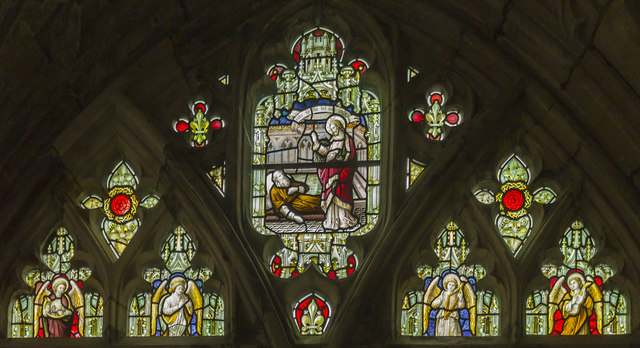
Window N6, Cloisters, Gloucester CathedralWhen Jesus said “I have come not to abolish the Law, but to fulfill it” (Matthew 5:17), what did he mean? Specifically, what did he have in mind with respect to the Sabbath? Is the Fourth Commandment (Remember the Sabbath, to keep it holy”) an enduring command mutatis mutandis? That is, once we make the necessary changes to the day, the place of our worship, and the full revelation of God in Christ, do we keep this day? Or do we not?

This question has generated entire books and led to more than a few fissures in the Church? And one of many arguments for Sabbatarianism (i.e., the ongoing practice of the Fourth Commandment) is that the New Testament does not need to reissue a command for the Sabbath, if it is laid out plainly in the Old Testament. But what if the New Testament actually issues a command that stands against the Fourth Commandment? Is it possible that the New Testament doesn’t reissue a command for the Sabbath, because there are places where it abrogates the old covenant system of Sabbath?

In answer to that question, one may think of Colossians 2:16–17 or Romans 14:5, or even Matthew 5:17. If Jesus fulfills the Sabbath in himself (see Matthew 11:28), then does that bring the old covenant practice to an end? This is where my reading of Scripture, informed by the likes of Steve Wellum and Thomas Schreiner leads, but recently I have found another passage that confirms this reading—one that I have not seen elsewhere. And so, I offer this reflection on John 5:1–18 and its copious use of Jeremiah 17:1–29, a passage that bears directly on the Sabbath. Continue reading

The True Sabbath-Giver: Finding Eternal Rest in Our Superstitious, Secular Age (John 5:1–18)

close up shot of bible text

The True Sabbath-Giver: Finding Eternal Rest in Our Superstitious, Secular Age

In his book, A Secular Age, Charles Taylor takes a long time to make a simple argument: Five hundred years ago it was impossible not to believe in God. Whether it was Christianity or some other religion, the world was filled with the divine. Today, however, the influences of science, technology, modern life and postmodern thought, have made belief in God nearly impossible. Or at least, it has become impossible to submit to a view of God and the world that is transcendent over places and true for all people.

Recently, we have seen this denial of God and his world in national news.  When a highly educated supreme court appointee doesn’t know what a woman is she – a woman – is feigning ignorance of biology in order to not offend the masses. Clearly, our civilization is not the same as it was when the light of Christ was brighter. Yet, darkness of the world does not diminish the spiritual need that humans have. Indeed, our secular age is not less religious. Instead, people just worship things that don’t deserve worship.

To say it differently, where the worship of a true and living God is lost superstitions abound. This is true for individuals, families, nations, and churches. Nature abhors a vacuum and so does the human heart. And if this is true today, it was equally true in Jesus day.

In John 5, we find something odd. Sitting just outside the temple was a group of invalids waiting for the waters to be stirred up in the pool of Bethesda. According to verse 7, and later clarified by the addition of verse 4, we find that many in Jerusalem sought healing not through prayer but through practices associated with other pagan mysterious religions. Clearly, something is wrong!

Indeed, entering a new part of John’s Gospel, the reader is brought back to Jerusalem, but instead of finding people in God’s city awaiting Israel’s restoration, like we see in Luke’s Gospel. We find a multitude of invalids waiting for a miracle that will never come. As Edward Klink notes,

With the abundance of evidence [around the Mediterranean] that pagan religion regularly used healing shrines with water as a regular component, it is not unlikely that [the tradition reported by John] is rooted in folk legend, possibly even a popular Jewish tradition.  (John, 269–70)

Wherever these pagan ideas came from, superstition has gripped a large number in Jerusalem. Even worse, the Jews – i.e., Jewish leaders – have done nothing about it. Rather like the priests condemned in the Old Testament, these guardians of the temple have permitted false worship and errant superstition. Even more, as they patrol the city watching for Jews who might be violating Sabbath, they have no care or compassion for those who are truly suffering.

So that’s the situation we find in John 5, and it will continue until John 11. For seven chapters, Jesus will be confronted by Jewish leaders even as he exposes their hypocrisy. In John 5:1 we read “After this [i.e.. the second sign in Galilee] there was a feast in Jerusalem.” The feast is not named, presumably because John wants to focus on the Sabbath, which is named in verse 9.

So in John 5, Jesus enters the scene on an unmarked Sabbath day. And in all that follows he is going to expose the weakness of the Sabbath under the old covenant, and he is going to give Sabbath rest to the man in ways anticipating the new covenant. That is to say, he is going to heal this man and send him to the temple, so that he can truly come to know the God of Israel (see John 5:14). And for us reading John 5, we come to learn something about superstitions, our Savior, and the Sabbath.

On Sunday, I preached on John 5 and you can find that sermon here. And in that message you will find the good news of Jesus Christ who is our true and better Sabbath-giver. Check back tomorrow too, where I will try to show why John 5, among other passages, does not permit me to be a Sabbatarian. Until then you can read this and leave comments below.

For now, may we give praise to God that the Son invites us to find rest in him and that such rest is not contingent upon our works but his.

Soli Deo Gloria, ds

Photo by Joshua Hurricks on Pexels.com

A Brief Meditation on the Minister’s Rest

farmerWhen I lived in Indiana I was surrounded by fields and farmers. From spring planting to fall harvesting, these men and women worked hard to bring fruit from the soil. As Paul indicates in 2 Timothy 2:6, “It is the hard-working farmer who ought to have the first share of the crops.” In Paul’s day, like ours, farmers are known for their hard work. The same is true for those who sow and water with the word of God. Like the farmer, early mornings, long nights, and constant concern for the Lord’s harvest are a heavy burden.

Fortunately, God gives seasons to farmers. In the winter months, hard-working farmers receive a time of rest and recovery. But at the same time, these hard-working farmers take time to plan for the next year, for the increase of the harvest. I remember talking to them in the winter months as they would be making their seed orders, learning more about new techniques, and equipping themselves with the latest machinery. Sure, there were trips to the beach, holiday celebrations, and the ability to take an afternoon nap. But far more, these men and women spent their time preparing for the upcoming harvest.

This imagery is helpful when we think about a sabbatical. In the Old Testament, Israel was commanded to take a sabbatical from the land every seven years (Exodus 23:10–11). Following in the footsteps of their heavenly father (Genesis 2:1–3), they were called to rest. Rest in the Bible is never a time of inactivity or lethargy. Rather it is a time when God and his people enjoy one another. Such is the background for ministers of the gospel who occasionally take a season of rest and refreshment. The goal is not to pull away from the church, the Lord, or his work. But rather, it is a time of reflection, rest, and refreshment for future ministry.

Indeed, Charles Spurgeon spoke of the necessity for “holy inaction and consecrated leisure.” In his Lectures to My Students, the London pastor said,

It is wisdom to take occasional furlough. In the long run, we shall do more by sometimes doing less. On, on, on for ever, without recreation may suit spirits emancipated from this ‘heavy clay’, but while we are in this tabernacle, we must every now and then cry halt, and serve the Lord by holy inaction and consecrated leisure. Let no tender conscience doubt the lawfulness of going out of harness for a while.” (161)

This principle of rest is true for all Christians, and especially those who labor to feed and tend the flock.

Personally, rest is a difficult practice for me. That being said I am growing to see my need to schedule “holy inaction” and “consecrated leisure.” Though my go-go-go mentality fights against it, taking time to periodically unstring the bow and sharpen the axe does not steal away from productivity. It actually does the opposite—it ensures that I trust in God to give the growth (1 Corinthians 3:7), even as I labor in the strength he provides (Colossians 1:28–29). Yes, he gives spiritual strength, but such grace is not divorced from our responsibility to care for our physical body’s.

While the work of the ministry is a spiritual endeavor, it is not immaterial. Lest we deny our own created-ness or become neo-Platonists who pit the spirit against the flesh, we must learn how to pace ourselves as we run God’s race. This includes scheduling physical rest, sometimes even a prolonged sabbatical like we recently gave to one of the pastors at our church. Because we are vessels of clay, we must establish a rhythm of work and rest, lest we invite physical exhaustion and spiritual/emotional collapse.

Therefore, as we strive to abide in his rest (Hebrews 4:11), may God grant us strength through the appointed means of holy inaction and the spiritual discipline of consecrated rest. May we find Sabbath rest in Christ (Hebrews 3–4) and take time to let our physical bodies recover for more fruitful service.

Soli Deo Gloria, ds