Via Emmaus on the Road: 2 Corinthians 13

Further Resources


2 Corinthians 13 (ESV)

Final Warnings

13 This is the third time I am coming to you. Every charge must be established by the evidence of two or three witnesses. I warned those who sinned before and all the others, and I warn them now while absent, as I did when present on my second visit, that if I come again I will not spare them— since you seek proof that Christ is speaking in me. He is not weak in dealing with you, but is powerful among you. For he was crucified in weakness, but lives by the power of God. For we also are weak in him, but in dealing with you we will live with him by the power of God.

Examine yourselves, to see whether you are in the faith. Test yourselves. Or do you not realize this about yourselves, that Jesus Christ is in you?—unless indeed you fail to meet the test! I hope you will find out that we have not failed the test. But we pray to God that you may not do wrong—not that we may appear to have met the test, but that you may do what is right, though we may seem to have failed. For we cannot do anything against the truth, but only for the truth. For we are glad when we are weak and you are strong. Your restoration is what we pray for. 10 For this reason I write these things while I am away from you, that when I come I may not have to be severe in my use of the authority that the Lord has given me for building up and not for tearing down.

Final Greetings

11 Finally, brothers, rejoice. Aim for restoration, comfort one another, agree with one another, live in peace; and the God of love and peace will be with you. 12 Greet one another with a holy kiss. 13 All the saints greet you.

14 The grace of the Lord Jesus Christ and the love of God and the fellowship of the Holy Spirit be with you all.

Soli Deo Gloria!

Via Emmaus on the Road: 2 Corinthians 7

Further Resources

2 Corinthians 7 (ESV)

Since we have these promises, beloved, let us cleanse ourselves from every defilement of body and spirit, bringing holiness to completion in the fear of God.

Paul’s Joy

Make room in your hearts for us. We have wronged no one, we have corrupted no one, we have taken advantage of no one. I do not say this to condemn you, for I said before that you are in our hearts, to die together and to live together. I am acting with great boldness toward you; I have great pride in you; I am filled with comfort. In all our affliction, I am overflowing with joy.

For even when we came into Macedonia, our bodies had no rest, but we were afflicted at every turn—fighting without and fear within. But God, who comforts the downcast, comforted us by the coming of Titus, and not only by his coming but also by the comfort with which he was comforted by you, as he told us of your longing, your mourning, your zeal for me, so that I rejoiced still more. For even if I made you grieve with my letter, I do not regret it—though I did regret it, for I see that that letter grieved you, though only for a while. As it is, I rejoice, not because you were grieved, but because you were grieved into repenting. For you felt a godly grief, so that you suffered no loss through us.

10 For godly grief produces a repentance that leads to salvation without regret, whereas worldly grief produces death. 11 For see what earnestness this godly grief has produced in you, but also what eagerness to clear yourselves, what indignation, what fear, what longing, what zeal, what punishment! At every point you have proved yourselves innocent in the matter. 12 So although I wrote to you, it was not for the sake of the one who did the wrong, nor for the sake of the one who suffered the wrong, but in order that your earnestness for us might be revealed to you in the sight of God. 13 Therefore we are comforted.

And besides our own comfort, we rejoiced still more at the joy of Titus, because his spirit has been refreshed by you all. 14 For whatever boasts I made to him about you, I was not put to shame. But just as everything we said to you was true, so also our boasting before Titus has proved true. 15 And his affection for you is even greater, as he remembers the obedience of you all, how you received him with fear and trembling. 16 I rejoice, because I have complete confidence in you.

Soli Deo Gloria!

With Genuine Repentance Comes Pardon: John Calvin on How to Seek and Grant Forgiveness

alex-shute-b7QwXDDEwv8-unsplashThen Peter came up and said to him,
“Lord, how often will my brother sin against me,
and I forgive him? As many as seven times?”
Jesus said to him, “I do not say to you seven times,
but seventy-seven times.
– Matthew 18:21–22 –

What happens when someone asks for forgiveness, but all outward signs indicate anything but a willing spirit? Is the offended party obligated to grant forgiveness the moment the offender says, “Will you forgive me,” or does it depend? If forgiveness depends on repentance, as Jesus says in Luke 17:3, just how much fruit is requisite for such repentance to be deemed genuine?

To put it into actual situations: Does the offended child whose sibling is forced to say “I’m sorry” have to mechanically say, “I forgive you”? Or to take it one step further, does the parent need to discipline the hesitating child for not offering forgiveness immediately?

What about the Christian family of a victim of violent crime, do they need to automatically grant forgiveness when the judge forces the criminal to issue an apology? Or are they permitted to consider the sincerity of the apology? Equally, should Christians forgive terrorists, who go to their deaths spewing hatred against their victims?

Or more basically, when pastors mediate conflict in the church, what is the proper response to a church member whose longstanding self-justification is suddenly reversed? Does the offended party need to issue an immediate grant of forgiveness? Or does the newfound repentance need time to settle? Equally, if the member will not forgive when repentance is genuine, what must be done then?

Fortunately, we are not the first generation to wrestle through such questions. And most recently, I came across an incredibly illuminating passage from John Calvin on Jesus’s teachings on forgiveness and repentance. Ever pastoral, Calvin provides some important qualifications for offering forgiveness, granting forgiveness, and even withholding forgiveness until repentance is deemed genuine.

Strikingly, Calvin does not suffer from our modern captivity to making others feel affirmed. Instead, he affirms the need to offer forgiveness to any and all who ask. But wisely, he also cautions Christians from mistakenly granting forgiveness prematurely. In his comments on Jesus’s teaching on forgiveness, he rightly urges Christians to extend grace in the same way they received grace. But also, he holds the line on repentance, stressing the importance of making sure repentance is genuine.

Having recently thought quite a bit about this very point, I offer six reflections on Calvin’s views on forgiveness, repentance, and reconciliation. I have added his full comment at the bottom. Continue reading

A Repentant Prayer or a Faithless Fake? What Jonah 2 Teaches Us About Our Hearts

kristine-weilert-88989-unsplash.jpgEarlier this week, I observed the way Jonah’s prayer of thanksgiving cited or alluded to many Psalms. Today, I want to consider what this may mean for Jonah and for us who read his book.

To get a handle on the meaning of Jonah’s prayer, we must answer this question: Is Jonah’s prayer a genuine word of repentant thanksgiving, one that faithfully cites many Psalms? Or is his prayer a faithless fake that masquerades under a smokescreen of Scripture? To answer that big question lets look at four smaller questions.

  1. What do we know about the historical Jonah?
  2. What do the Minor Prophets indicate about Jonah?
  3. What does the book of Jonah say about Jonah?
  4. What does the prayer itself reveal about Jonah?

By answering these questions, we should have good chance of rendering a verdict on Jonah’s prayer and what it is intended to communicate to us. Continue reading

An Evidence of Repentance or Hypocrisy: Why Does Jonah 2 Cite So Many Psalms?

aaron-burden-534684-unsplashIt is striking the way Jonah 2 employs language from the Psalms. For those familiar with the Hebrew Psalter, it would be difficult to hear Jonah’s prayer of thanksgiving without reflecting on other inspired Psalms. Just as songs which recycle older lyrics or melodies remind us of previous songs, so Jonah’s prayer should bring to our memory many lines in the Psalter.

Here is a verse by verse comparison. Clearly, the use of the Psalter is intentional, but I wonder why. Is the use of the Psalms an evidence of Jonah’s return to righteousness? Or is it something else? Could it be an instance where the Jonah’s lips draw near to God, but his heart remains far away? Should we automatically assume his use of Scripture is a sign of repentance? Or could it be that his prayer of thanksgiving without any stated repentance, as in Psalms 32 and 51, is actually an indicator of Jonah’s unrepentance.

Tomorrow, I’ll circle back to answer that question. But today, let me know what you think. Why does Jonah’s prayer recycle so many Psalms? Check on the comparison below and let me know what you think.
Continue reading

Six Marks of True Repentance

repent

For even if I made you grieve with my letter, I do not regret it—though I did regret it, for I see that that letter grieved you, though only for a while. As it is, I rejoice, not because you were grieved, but because you were grieved into repenting. For you felt a godly grief, so that you suffered no loss through us.
— 2 Corinthians 7:8–9 —

Repentance is a eminently biblical word and a necessary (if graciously-given) prerequisite for salvation (see Acts 5:31; 11:18). But often when some sheds tears over sin, it is difficult to know if this repentance in its biblical form, or a counterfeit sorrow for the bitterness of sin. Indeed, as Paul indicates in 2 Corinthians 7:8–9, there is a sorrow that leads to godliness, but as Pharaoh (Exodus 9:27; 10:16) and other false professors reveal, there is a sorrow for sin devoid of any spiritual grace.

For that matter, wise counselors, pastors, parents, and Christian encourager need to know the signs of genuine repentance. In short, because repentance means turning from sin; genuine repentance is seen in the abiding desire and effort to continually flee from sin by the power of the Spirit. As John the Baptist puts it, true believers “bear fruit in keeping with repentance” (Matthew 3:8).

In this way, a simple principle for repentance is that time not tears is the mark of genuine repentance. But beyond time, what marks genuine, God-given repentance?

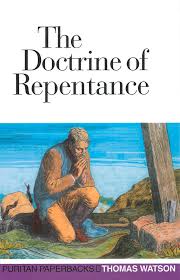
In answer to that question, Thomas Watson in his classic little book, The Doctrine of Repentance, suggests six things that accompany true repentance. In these six marks, which I summarize and expand below, Watson helps us see how sorrow for sin leads to abiding repentance. Continue reading

A Prayer for America

thanksYesterday, I suggested we take time in our church services to pray for our country as Daniel and Nehemiah did for theirs. Last year, with those model prayers in mind, I offered this prayer at church. A year later it is just as appropriate, just as needed.

Holy God. You are right to demand holiness. Your will for all those made in your image is holiness. We confess that this is right and good.

And with that in mind, we confess we are not. In our city streets and in the corridors of our mind, we are unholy. Our nation and many in your church are drunk on impurity.

We are consumers of lewd entertainment.

We are led by an insatiable desire for more—more money, more sex, more fun, more stuff.

We legalize that which is a stench in your nostrils, and we outlaw that which pleases you.

Worse, our churches follow the ways of this world. We import the practices of our culture.

Instead of celebrating purity, we applaud celebrity.

Following the world, we mix your Word with a cocktail of psychology, leadership principles, and positive thinking.

Forgive us!

We thank you for the Christians who have gone before us, and been salt and light to preserve our nation.

We thank you for the legacy of Christian faithfulness that we have in this country. No country on earth has more churches, Bible schools, Christian publishers, and free access to you.

What a gift! What grace! Thank you for sharing your light with such undeserving and unthankful people.

But, oh how, we tremble at the way such blessings are trampled under foot.

Churches that were once committed to your Word are compromising.

Schools founded to glorify Jesus have exchanged light for darkness.

Leaders who once upheld truth, justice, and goodness are now controlled by moral relativism and whatever is popularity.

And what is popular is not holy. We deserve your judgment. If we learn anything from your words to Israel, we deserve to lose the lease on our land. We deserve to be vomited out. God forgive us!

Send your Holy Spirit. Revive your churches.

May the pulpits of America once again unashamedly declare Christ.

May the Christians in our country strive after holiness.

May we show the world a kind of love that makes God-haters thirst for Jesus.

Oh, be merciful to us! We are sinners. In your holiness, remember your Son’s atoning death. Be patient with us, and help us to be a light in this dark country.

Grant us sober hearts. Hearts that grieve not for the loss of Americana, but for the loss of your holiness.

Father in heaven, hallow your name in our country!

May God grant us, our churches, our nation a heart of repentance and renewed thirst for him and his righteousness.

Soli Deo Gloria, ds

Trading in Our Patriotic Hymns for Songs of Lament

crossWith the Obergefell decision weighing heavy on our minds, I have been wondering how churches in America will worship this Sunday. Will they go on as usual singing patriotic hymns? Or will they, in light of recent days, reconsider their song selection?

For those involved in music ministry and church leadership, this is not a new question. And honestly, the Obergefell decision should not be the deciding factor. However, that ruling has solidified concerns Christians have with America, and thus raises the question again—Should a church incorporate patriotic hymns in a service of worship?

Thinking on that subject, I believe a church has 1 of 3 options—no incorporation (option #1), selective incorporation (option #2), and unqualified incorporation (option #3). I think the first two options are valid with #1 outweighing #2, while option #3 is troubling and in need of revamping—something that could be done as soon as tomorrow. Let’s consider together. Continue reading

‘My Inheritance’: A Necessary Approach to the Scriptures

goldThere is a dangerous tendency in the life of any Christian, and especially among those who labor to teach the Word, to read the Bible for the sake of someone else. I experienced this recently as I was teaching on the glories of the cross of Christ. Admittedly, my spirit was not exulting in the doctrines I was teaching as much as I was encouraging others to exult in them. Like a dutiful usher, I was leading others to find room at the table, but I was too busy to sit down myself.

It is a scary thing when we lead others to see the glories of God, all the while failing to enjoy them ourselves. Continue reading

Beholding the Beauty of Christ in Wal-Mart: The Backstory

Christmas is a beautiful time of year, one that prompts giving, singing, family gatherings, and worship of our Savior born in Bethlehem.  Contemplating these things, I wrote an article for our church newsletter that The Gospel Coalition also ran on God’s hidden beauty revealed at Christmas.

To give a little backstory, I wrote it on a day when I had walked through the aisles of Wal-Mart and sadly had a bah-humbug spirit.  Surrounded by God’s image-bearers my sinful heart was not loving my neighbor.  It was simply wanting to get in, get out, and get done with what I had to do.  Such an attitude is sinful and selfish, and it stems from a vision problem–I was not seeing the people around the way Christ sees them.

Accordingly, I wrote the piece “Beholding the Beauty of Christ in Wal-Mart” as a means of preaching the gospel to myself.  I need the gospel everyday to remind me of my ugliness before the Lord, and how in Christ he has showered his beautiful grace on me.  If there is anything good in me, it is from the Lord (John 15:5; 1 Cor 4:7). Prayerfully, such amazing love and forgiveness will result in greater love for others.

As I walked out of Wal-Mart that day, I was confronted with the ugliness of my un-love.  I still groan over the fact that I am drawn to worldly beauty more than heavenly beauty, and that this causes me to slight people and make much of me.  Ugh! I praying that God would continue to renew my mind and change my heart, and I to do so, I keep looking to the person and work of Christ.  He alone is beautiful, and in his light we see light.  As we behold him, we become like him.  I wrote this article for that reason, and I share it with you that you might benefit too.

Here is how it begins,

Beauty is in the eyes of the beholder, so the old saying goes. Just the same, we choose to behold (read: pursue and acquire) what we think is beautiful. Unfortunately, for so many of us, we have given little attention to what the Bible says about beauty. While Christians may have read the Bible for years, I wonder, when it comes to beauty, how many of us have been shaped by magazine covers, movies, and prom nights more than God’s inspired Word?  Christmas may be one exception.

You can read the whole thing at The Gospel Coalition website.

Repentant and Repenting, dss