Via Emmaus on the Road: James 2

Further Resources


James 2 (ESV)

The Sin of Partiality

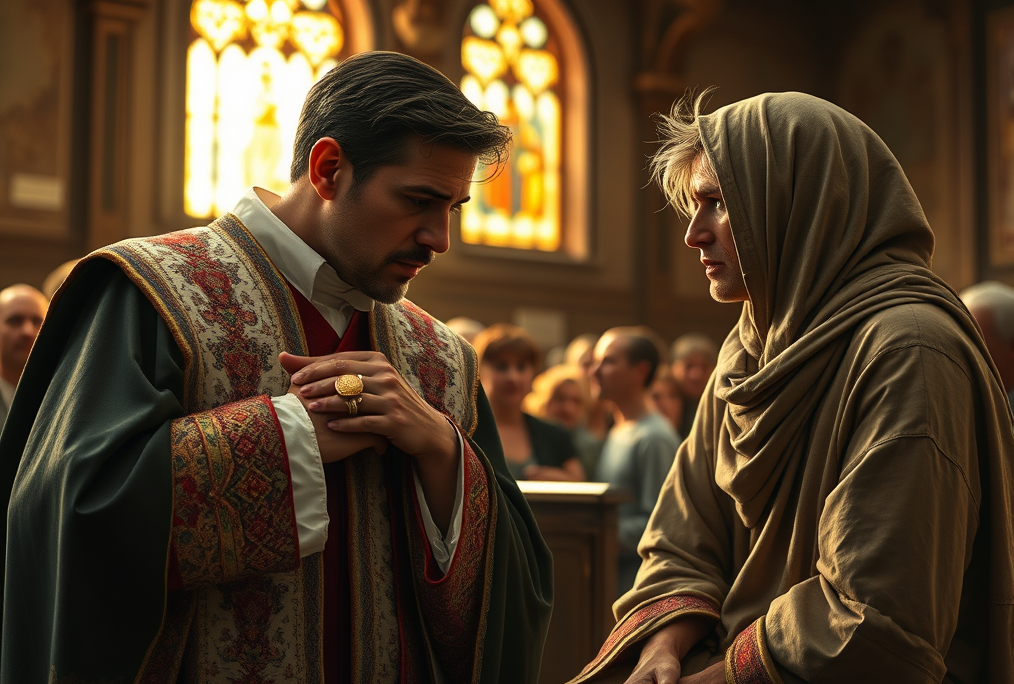
My brothers, show no partiality as you hold the faith in our Lord Jesus Christ, the Lord of glory. For if a man wearing a gold ring and fine clothing comes into your assembly, and a poor man in shabby clothing also comes in, and if you pay attention to the one who wears the fine clothing and say, “You sit here in a good place,” while you say to the poor man, “You stand over there,” or, “Sit down at my feet,” have you not then made distinctions among yourselves and become judges with evil thoughts? Listen, my beloved brothers, has not God chosen those who are poor in the world to be rich in faith and heirs of the kingdom, which he has promised to those who love him? But you have dishonored the poor man. Are not the rich the ones who oppress you, and the ones who drag you into court? Are they not the ones who blaspheme the honorable name by which you were called?

If you really fulfill the royal law according to the Scripture, “You shall love your neighbor as yourself,” you are doing well. But if you show partiality, you are committing sin and are convicted by the law as transgressors. 10 For whoever keeps the whole law but fails in one point has become guilty of all of it. 11 For he who said, “Do not commit adultery,” also said, “Do not murder.” If you do not commit adultery but do murder, you have become a transgressor of the law. 12 So speak and so act as those who are to be judged under the law of liberty. 13 For judgment is without mercy to one who has shown no mercy. Mercy triumphs over judgment.

Faith Without Works Is Dead

14 What good is it, my brothers, if someone says he has faith but does not have works? Can that faith save him? 15 If a brother or sister is poorly clothed and lacking in daily food, 16 and one of you says to them, “Go in peace, be warmed and filled,” without giving them the things needed for the body, what good is that? 17 So also faith by itself, if it does not have works, is dead.

18 But someone will say, “You have faith and I have works.” Show me your faith apart from your works, and I will show you my faith by my works. 19 You believe that God is one; you do well. Even the demons believe—and shudder! 20 Do you want to be shown, you foolish person, that faith apart from works is useless? 21 Was not Abraham our father justified by works when he offered up his son Isaac on the altar? 22 You see that faith was active along with his works, and faith was completed by his works; 23 and the Scripture was fulfilled that says, “Abraham believed God, and it was counted to him as righteousness”—and he was called a friend of God. 24 You see that a person is justified by works and not by faith alone. 25 And in the same way was not also Rahab the prostitute justified by works when she received the messengers and sent them out by another way? 26 For as the body apart from the spirit is dead, so also faith apart from works is dead.

Soli Deo Gloria!

 

Did Rahab Lie? An Exegetical Answer

emily-morter-8xAA0f9yQnE-unsplash.jpgHere’s my preliminary answer to the question, Did Rahab lie?

It comes from a larger consideration of Joshua, “Ten Things About Joshua 2.” Admittedly this answer does not deal with all the passages that relate to bearing false witness or speaking truth in love. Rather, it seeks to understand how we might read Joshua 2 at the textual horizon.

My twofold answer to the question is that, first, the text leads us to focus on the truth she confessed, rather than the falsehood she (may or may not have) told. Second, the answer is not wholly apparent. The text conceals her motives, even as it reveals her faith. In this way, I do not believe Joshua 2 is written to answer this question.

That said, it is an important question and one that we should consider. With those caveats in place, let’s consider Rahab’s faithful actions and whether or not we should see them as a “lie.”

Continue reading

A Harlot’s Hope: The Gospel in One Chapter (Joshua 2)

joshua07

A Harlot’s Hope: The Gospel in One Chapter (Joshua 2)

Tamar and Judah. Rahab and Salmon. Ruth and Boaz. Bathsheba and David. The Church and Jesus.

What do these couples have in common? They are all in the Bible? Yes. They are all in Jesus genealogy? Yes.

And most astoundingly, each had a history with harlotry. Respectively, the dress, the (former) identity, or the actions of these couples contain some element related idolatry, adultery, or prostitution.

Finding a place in this redemptive story, Sunday’s sermon considered the incredible story of Rahab and how God saved her from a life of prostitution and a city on the verge of destruction. With many themes that touched on the fabric of salvation, we saw God had mercy on this woman and can have mercy on anyone who believes.

You can listen to the sermon online. Response questions and additional resources can be found below.

Response Questions

  1. How do the spies of Joshua 2 contrast with the spies of Numbers 13?
  2. What observations can you make about Rahab?
  3. Do any aspects of this story surprise you?
  4. What does Rahab believe about God?
  5. How do you see the mercy of God in this story?
  6. Do you see any significance in the scarlet cord?
  7. What does the New Testament testify about Rahab in Matthew 1:5, Hebrews 11:31, and James 2:25?
  8. What truths are visible in this story? What might application of this narrative look like?

Additional Resources

Rahab’s Redemption: 10 Things About Joshua 2

michel-porro-vfaFxFltAvA-unsplash

Joshua 2 is filled with exegetical, ethical, and biblical theological challenges. Here are ten things that begin to wade into the richness of Joshua 2.

1. Joshua 2 appears to be an “unnecessary” story in the framework of the book.

Nothing is unnecessary in Scripture. Every jot and tittle is inspired by God and useful for teaching, reproof, correction, and training in righteousness (2 Tim. 3:16). However, there are facts and even chapters that may appear to be unnecessary, as in the case of Joshua 2.

In the flow of Joshua, the second chapter interrupts Israel’s entry into the land. Chapter 1 speaks of the preparation for entry; chapter 3 records the entry itself. Chapter 2 stands in the middle of this continuous story, and thus it stands out. For the sensitive reader, the placement of the story does not mean Rahab and the spies are out of place. On the contrary, they are exactly where they need to be. And they demonstrate the great importance of this chapter.

As Dale Ralph Davis observes, this “non-essential” story is necessary for showing how God saved a Gentile harlot (Joshua, 28–29). The story is not necessary for demonstrating God’s power or justice in overthrowing the wickedness of Jericho. His faithfulness would stand upon the giving the land to Israel, as he had promised. But his mercy is highlighted by this inclusion of Rahab’s redemption, and hence the main point of this whole chapter will center on God’s unexpected grace and undeserved mercy. Continue reading