Via Emmaus on the Road: Hebrews 10

Further Resources


Hebrews 10 (ESV)

Christ’s Sacrifice Once for All

10 For since the law has but a shadow of the good things to come instead of the true form of these realities, it can never, by the same sacrifices that are continually offered every year, make perfect those who draw near. Otherwise, would they not have ceased to be offered, since the worshipers, having once been cleansed, would no longer have any consciousness of sins? But in these sacrifices there is a reminder of sins every year. For it is impossible for the blood of bulls and goats to take away sins.

Consequently, when Christ came into the world, he said,

“Sacrifices and offerings you have not desired,

but a body have you prepared for me;

in burnt offerings and sin offerings

you have taken no pleasure.

Then I said, ‘Behold, I have come to do your will, O God,

as it is written of me in the scroll of the book.’ ”

When he said above, “You have neither desired nor taken pleasure in sacrifices and offerings and burnt offerings and sin offerings” (these are offered according to the law), then he added, “Behold, I have come to do your will.” He does away with the first in order to establish the second. 10 And by that will we have been sanctified through the offering of the body of Jesus Christ once for all.

11 And every priest stands daily at his service, offering repeatedly the same sacrifices, which can never take away sins. 12 But when Christ had offered for all time a single sacrifice for sins, he sat down at the right hand of God, 13 waiting from that time until his enemies should be made a footstool for his feet. 14 For by a single offering he has perfected for all time those who are being sanctified.

15 And the Holy Spirit also bears witness to us; for after saying,

16  “This is the covenant that I will make with them

after those days, declares the Lord:

I will put my laws on their hearts,

and write them on their minds,”

17 then he adds,

“I will remember their sins and their lawless deeds no more.”

18 Where there is forgiveness of these, there is no longer any offering for sin.

The Full Assurance of Faith

19 Therefore, brothers, since we have confidence to enter the holy places by the blood of Jesus, 20 by the new and living way that he opened for us through the curtain, that is, through his flesh, 21 and since we have a great priest over the house of God, 22 let us draw near with a true heart in full assurance of faith, with our hearts sprinkled clean from an evil conscience and our bodies washed with pure water. 23 Let us hold fast the confession of our hope without wavering, for he who promised is faithful. 24 And let us consider how to stir up one another to love and good works, 25 not neglecting to meet together, as is the habit of some, but encouraging one another, and all the more as you see the Day drawing near.

26 For if we go on sinning deliberately after receiving the knowledge of the truth, there no longer remains a sacrifice for sins, 27 but a fearful expectation of judgment, and a fury of fire that will consume the adversaries. 28 Anyone who has set aside the law of Moses dies without mercy on the evidence of two or three witnesses. 29 How much worse punishment, do you think, will be deserved by the one who has trampled underfoot the Son of God, and has profaned the blood of the covenant by which he was sanctified, and has outraged the Spirit of grace? 30 For we know him who said, “Vengeance is mine; I will repay.” And again, “The Lord will judge his people.” 31 It is a fearful thing to fall into the hands of the living God.

32 But recall the former days when, after you were enlightened, you endured a hard struggle with sufferings, 33 sometimes being publicly exposed to reproach and affliction, and sometimes being partners with those so treated. 34 For you had compassion on those in prison, and you joyfully accepted the plundering of your property, since you knew that you yourselves had a better possession and an abiding one. 35 Therefore do not throw away your confidence, which has a great reward. 36 For you have need of endurance, so that when you have done the will of God you may receive what is promised. 37 For,

“Yet a little while,

and the coming one will come and will not delay;

38  but my righteous one shall live by faith,

and if he shrinks back,

my soul has no pleasure in him.”

39 But we are not of those who shrink back and are destroyed, but of those who have faith and preserve their souls.

Via Emmaus on the Road: Hebrews 4

Further Resources


Hebrews 4 (ESV)

Therefore, while the promise of entering his rest still stands, let us fear lest any of you should seem to have failed to reach it. For good news came to us just as to them, but the message they heard did not benefit them, because they were not united by faith with those who listened. For we who have believed enter that rest, as he has said,

“As I swore in my wrath,

‘They shall not enter my rest,’ ”

although his works were finished from the foundation of the world. For he has somewhere spoken of the seventh day in this way: “And God rested on the seventh day from all his works.” And again in this passage he said,

“They shall not enter my rest.”

Since therefore it remains for some to enter it, and those who formerly received the good news failed to enter because of disobedience, again he appoints a certain day, “Today,” saying through David so long afterward, in the words already quoted,

“Today, if you hear his voice,

do not harden your hearts.”

For if Joshua had given them rest, God would not have spoken of another day later on. So then, there remains a Sabbath rest for the people of God, 10 for whoever has entered God’s rest has also rested from his works as God did from his.

11 Let us therefore strive to enter that rest, so that no one may fall by the same sort of disobedience. 12 For the word of God is living and active, sharper than any two-edged sword, piercing to the division of soul and of spirit, of joints and of marrow, and discerning the thoughts and intentions of the heart. 13 And no creature is hidden from his sight, but all are naked and exposed to the eyes of him to whom we must give account.

Jesus the Great High Priest

14 Since then we have a great high priest who has passed through the heavens, Jesus, the Son of God, let us hold fast our confession. 15 For we do not have a high priest who is unable to sympathize with our weaknesses, but one who in every respect has been tempted as we are, yet without sin. 16 Let us then with confidence draw near to the throne of grace, that we may receive mercy and find grace to help in time of need.

Soli Deo Gloria!

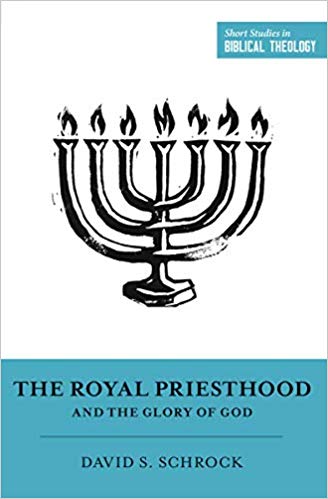
The Royal Priesthood and the Glory of God: Book Announcement

41gzmdxgXRL._SX326_BO1,204,203,200_

If the Lord wills . . .
— James 4:15a —

James 4:13–16 reminds us that the future is in the Lord’s hands, not our own. But that doesn’t mean we can’t plan or set dates. It just means we do so with a strong sense of the Lord’s sovereignty, not our own. With that in mind, I mention the following date: February 8, 2022.

At present, Crossway is set to publish my book, The Royal Priesthood and the Glory of God, on that date. As of today, you can read the first chapter online. And you can get a sense of the book in the following chapter outline.

Introduction: Recovering the Glory of the Royal Priesthood

Chapter 1: In the Beginning: The Royal Priesthood Patterned
Chapter 2: The Law: The Levitical Priesthood Legislated
Chapter 3: The Prophets: The Priesthood Promised, Compromised, and Promised Again
Chapter 4: The Writings: The Royal Priesthood Anticipated
Chapter 5: The Gospels: The Royal Priesthood Arrives
Chapter 6: Acts through Revelation: The Royal Priesthood Multiplies

Epilogue: Royal Priesthood Yesterday, Today, and Forever

That’s the outline of my book which adds to the Short Studies in Biblical Theology series, a collection of accessible studies that trace various themes (like covenants, marriage, work) through Scripture. If you are looking to grow in your knowledge of the Bible and how various strands tie together in Christ, any of these short books would be edifying. For me, the theme of priesthood has been a blessing to study over the last decade, and I am delighted to share my findings with others.

On the book itself, here’s what a few friends and professors have said in their endorsements. You can read all the endorsements here.

“With the recent surge in biblical-theological studies, especially thematic developments across the canon, it is a little surprising that the theme of priesthood has not received more attention. David Schrock’s work fills this gap beautifully! Specifically, this book probes the significance of the priesthood for a precise understanding of the gospel, as well as our own calling as royal priests through Jesus. Essential reading on this major biblical theme!”
Nicholas G. Piotrowski, President and Academic Dean, Indianapolis Theological Seminary

“The biblical teaching on the priesthood seems foreign and forbidding to many readers today. David Schrock helps us see how a theology of the priesthood permeates the storyline of the Bible and how the priesthood climaxes in Christ and finds its fulfillment in him.”
Thomas R. Schreiner, James Buchanan Harrison Professor of New Testament Interpretation, The Southern Baptist Theological Seminary

In all, my book is just under 200 pages. It encapsulates a lot of the teaching I have done on the priesthood over the last ten years, but it also offers a few new lines of argument that are fresh to the body of literature on the priesthood. More importantly, however, this book is written for the church and I pray it will bless pastors, teachers, and faithful students of the Bible to see with greater clarity the glory of God witnessed in the royal priesthood.

If you are interested in this subject, the priesthood of Christ, biblical theology, or what it means to be a royal priest made in the image of God, this book will be of interest. May it will bless all you who read it. And if you want to pre-order it, you can now do so at Crossway, Amazon, or even Target.

Soli Deo Gloria, ds

The Beginning of the Priesthood: Revisiting Levi in Genesis 34

41gzmdxgXRL._SX326_BO1,204,203,200_If anyone has spent anytime reading this blog, they know that I have written a fair bit about the priesthood. In January of next year, Lord willing, I will even have a book coming out on the topic. One note that I didn’t put in that manuscript, however, begins with the choice of Levi and his backstory in Genesis 34. As I have been reading Exodus this month I was reminded of this note and the textual connection between Moses and Aaron in that book with the historical figure of Levi. Here’s the note. Let me know what you think.

The Sword of Levi and Redemption of God

To understand the Levitical priesthood, we need to know Levi. In Genesis 28 we find his birth, but Genesis 34 records the defining moment of his life—the violent execution of Shechem. If you do not remember the story, go read the deceptive and deadly tale, where Dinah the daughter of Jacob is violated by Shechem a foreign prince. In response, Simeon and Levi struck down Shechem and the men of Hamor when they were “sore” from circumcision (v. 25). Feigning peace, these two brothers used their swords to avenge their sister’s defilement. Continue reading

What Does It Mean That Jesus is the ‘Son of David’? Nine Stars in the Constellation of Jesus’s Kingdom

three kings figurines

This month, Track 2 in the Via Emmaus Reading Plan—which is going to get a refresh before the new year—takes us through the book of Luke. And as I reading Luke this month, I am also looking at Volume 6 in the Scripture and Hermeneutics Series, Reading Luke: Interpretation, Reflection, Formation. In one essay, “Kingdom and Church in Luke-Acts,” Scott Hahn traces the theme of Jesus’s Davidic kingship in Luke and Acts. Then bringing order to his observations, he identifies a “constellation of concepts, locations, and institutions that were immediately related to David, his legacy, and [to] one another” (299).

For those interested in studying the theme of Jesus as the Son of David, or knowing what Jesus kingship and kingdom are like, it is imperative to see how Scripture speaks of David, Jesus, and the Jesus relationship to David. As the New Testament declares with great emphasis and repetition, Jesus is David’s son and thus, it teaches us to see Jesus’s kingship as a fulfillment of David’s, only greater.

Thus to know Jesus as Scripture presents him requires a growing knowledge of David. In his essay, Hahn does the exegetical work in Luke-Acts to show where Luke identifies Christ with David (297–99, cf. Luke 1:27, 32–33, 69; 2:4, 11, 8–20; 3:21–22, 23–28; 6:1–5; 9:35; 18:35–43; Luke 22:29–30; 23:37–38; Acts 2:14–36, esp. vv. 25–36; 13:16–41. esp. vv. 22–23, 33–37; 15:13–21). Then, he outlines eight stars in the constellation of Christ’s kingship. Below, I share those with you, as they present in short order what David’s/Jesus’s kingdom is like. Then, I will add one more star to the constellation—the oft-neglected priestly nature of David’s kingship. From this ninth star, we will see why Christ’s kingship stands out against all the other kingdoms of the earth.

Continue reading

You Were Made for This: An Introduction to the Priesthood (and Yourself)

priestcolor“You were made for this!”

This phrase seems to be thrown around quite a bit these days: Sports commentators talk this way about athletes; teachers about pupils; mentors about those they coach. In short, it is a way of speaking that comes from a recognized “authority” on someone who is ascending in their field. It is language meant to boost esteem and put everyone on alert, that the next star is rising.

In our celebrity-crazed culture, everyone wants to be special. Indeed “special” is the carrot that has motivated so many to aspire to greatness. I’ve felt this pull and have thanked God that my dreams of athletic glory were mercifully cut short. Still, the hunger for this kind of glory remains.

And it remains with such a strong pull because we were made for glory! Not just some of us, but all of us were made to enjoy and exhibit the glory of God. And thus, until we discover the true source of glory, we will chase glory in vain. Therefore, we must see what Scripture says about the glory of God.   Continue reading

My ETS Presentation: “You Can Make Me Clean,” The Matthean Jesus as Priest and the Biblical-Theological Results

ets

Update: This paper has been accepted for publication in a future edition of the Criswell Theological Review.

Tomorrow, my good friend Nicholas Piotrowski and I will present our paper (“You Can Make Me Clean”: The Jesus as Priest and the Biblical-Theological Results). Our argument in brief is the Gospel writers, and Matthew in particular, presented Jesus in priestly actions, even as they  withhold the title “priest” from him. Our test case is the healing of the leper in Matthew 8:1–4, where Jesus proves to be a greater priest than the sons of Levi who were supposed to adjudicated cases of leprosy (Leviticus 13–14).

We’ve been working on this paper, a mashup from our two dissertations, for the last two years—yes, that’s how academic writing goes. We’re convinced that this minority view shines light on the way the Gospels are written and even more on the work that Christ did in his earthly life and sacrificial death.

Here’s the introduction. Let us know what you think.

The munus triplex [Jesus’ triple office of prophet, priest, and king] is an important biblical-theological and systematic category. While it is common to observe in the Gospels Jesus’ role as “the prophet who is to come into the world” (John 6:14; cf. also Matt 17:5 and parallels with Deut 18:15) and the royal “Son of David” (cf. esp. Matt 1:1; 21:9), theologians often turn to Hebrews for Christ’ priestly office.  Lately, however, scholars are increasingly appreciating the historical Jesus’ self-consciousness as a priest.[1] The result is to bring more attention to the Gospels for understanding Jesus’ munus sacerdotal. This paper singles out Matthew specifically where Jesus is put forward as Israel’s eschatological priest.­[2] From this flow several biblical-theological considerations.[3]

The reason scholars dismiss Christ’s earthly priesthood is manifold.  Linguistically, in all four Gospels, Jesus is not once called a priest.[4] Covenantally, Christ does not qualify as a priest. Born under the old covenant, Jesus’ Judean lineage would disallow him from serving in the temple.­[5] Theologically, there is strong reason for denying Christ’s earthly priesthood: his priestly service would come to depend upon his resurrection and his appointment as a better priest.[6] This is the argument in Hebrews, and many scholars reason that it is anachronistic to read Christ’s priesthood back into the Gospels. Philosophically, since the Enlightenment an academic aversion has existed towards any notion of “priest-craft.”[7] Proportionately, due to the extensive attention given to other aspects of his person and work, it is understandable how Christ’s priesthood can be overlooked. For these reasons and more, the idea that Christ is a priest in the Gospels is underrepresented.[8]

It is our contention, however, joining the growing chorus, that the Gospels are filled with evidence for Christ’s earthly priesthood. . . .

Looking forward to make our case tomorrow. If you’re at ETS, we’d love for you to come join us in Room 402 at 8:30AM. If you’re not, I will (probably) post a PDF tomorrow for the seven people in the room and anyone else interested in considering this argument.

Soli Deo Gloria, ds

_________________

[1] Citing a handful of exceptions, Brant Pitre rightly observes, “If there is any single subject which modern historical scholarship on Jesus has almost completely neglected, it is the subject of Jesus and the Jewish priesthood” (“Jesus, the New Temple, and the New Priesthood,” in Letter and Spirit, vol 4., Temple and Contemplation: God’s Presence in the Cosmos, Church, and Human Heart, ed. Scott Hahn and David Scott [Steubenville, OH: Emmaus Road Publishing, 2008], 71). Crispin H. T. Fletcher-Louis has outlined several reasons for the prior neglect of this subject, and contributed greatly to redressing it (“Jesus as the High Priestly Messiah: Part 1,” JSHJ 4 [2006]: 155–75; idem, “Jesus as the High Priestly Messiah: Part 2,” JSHJ 5 [2007]: 57–79).

[2] Jesus is not “presented” exclusively as a priest in Matthew, but as prophet, priest, and king. The onus of this paper is to show the ways he functions as a priest.

[3] To be sure, however, this is not a “redaction-critical” study.  The final form of Matthew, nonetheless, is the result of redacting forces; either of Mark, Q, the oral tradition, or some inexorable web of all of them.  We do not attempt to ferret out how the redaction occurred, but to explore to rhetorical results once it was done.

[4]A word study of the Gospels and Acts finds 122 occurrences of “priestly terminology” (priest, high priest, priesthood, etc.). However, the number of times that such language refers to Christ or Christians is zero, which would understandably lead anyone dependent on that method of research to abandon the effort (Vanhoye, Old Testament Priests and the New Priest, 63–66).

[5]Technically, if Karl Deenick (“Priest and King or Priest-King in 1 Samuel 2:35,” WTJ 73 [2011]: 325-39) is correct that 1 Samuel 2:35 points to a Davidic priest, Jesus’ Davidic lineage would not disqualify him from priesthood. It would do the opposite. But it is still necessary to show, as Hebrews 5 does, how a son of David could supersede the Levitical priesthood.

[6]See David Schrock, “Resurrection and Priesthood: Christological Soundings from the Book of Hebrews,” SBJT 18.4 (2014): 89–114.

[7]Peter J. Leithart, “Attendants of Yahweh’s House: Priesthood in the Old Testament,” JSOT 85 (1999): 3–4.

[8]For a survey of how scholars understand Christ’s priesthood in the gospels, see Crispin H. T. Fletcher-Louis, “Jesus as the High Priestly Messiah: Part 1,” Journal for the Study of the Historical Jesus 4 (2006): 155–75; idem, “Jesus as the High Priestly Messiah: Part 2,” JSHJ 5 (2007): 57–79.

The Biblical Story of Priestly Glory

priesthoodOn Monday, I made the case that we should understand the imago dei in priestly terms. To develop that idea a bit, let me show how the biblical story line can be understood through the lens of the priesthood, as well.

Creation

In creation Adam was made to be a royal priest. Genesis 2:15 says, “The LORD God took the man and put him in the garden of Eden to work it and keep it.” Or it could be translated “to serve it and guard it.” In other words, the man in the Garden was more than a prehistoric gardener. He was a royal priest. And we know he was a priest because the language used in Genesis 2:15 is used repeatedly of priests in Numbers 3. Moses, the author of both books, is making the point that Adam was stationed in the Garden as a priest—to serve the Lord by cultivating the Garden (even expanding its borders) and to guard the Garden from unclean intruders (a key work of the priest and one he failed to do in Genesis 3). In short, redemptive history begins with a priest in the Garden, one whose righteous appearance and holy vocation was breathtaking, as Ezekiel 28:12–14 describes,

You were the signet of perfection, full of wisdom and perfect in beauty. You were in Eden, the garden of God; every precious stone was your covering, sardius, topaz, and diamond, beryl, onyx, and jasper, sapphire, emerald, and carbuncle; and crafted in gold were your settings and your engravings. On the day that you were created they were prepared. You were an anointed guardian cherub [A better translation is the NET: “I placed you there with an anointed guardian cherub]; I placed you; you were on the holy mountain of God; in the midst of the stones of fire you walked.

Sadly, this glorious beginning did not last long. Continue reading

‘I Will Give You as a Covenant’ (Isaiah 42:6; 49:8): The Suffering Servant as Covenant Mediator

As I worked on my dissertation, one of the things that struck me was the importance of the covenant mediator for any covenant. Structurally, every covenant needs a mediator; and with regard to effectiveness, every covenant depends on the personal integrity of the covenant mediator (alternately called a federal head). Continue reading

The Ongoing Priesthood of Jesus Christ

The kingdom of Christ and the kingship of Christ have received most scholarly attention in recent years.  (In truth, the kingdom of Christ has rightly received great emphasis since the Christ declared that the kingdom of God was drawing near).  Comparatively, the priesthood of Jesus Christ has often been slighted, misrepresented, or put in second (or third) place behind Christ’s status as king or prophet.  However, this ought not be so.

The New Testament frequently displays Christ doing priestly activities (atonement, intercession, teaching, etc.), and in places like Hebrews, the author displays him as the high priest par excellence.  On this important role, John Murray provided an insightful reflection on the “inter-permeation” between Christ’s priesthood and kingship.  While Christ’s kingship is often affirmed, it is often disfigured because of its separation from Christ’s kingdom.  Murray nicely unites the two.

In context, he points to 1 John 2:1-2; Rom 8:34; and Heb 7:24-25 as places where Christ’s ongoing priesthood is explicitly mentioned.  He argues that Christ’s priesthood should be recaptured if we are to fully appreciate the exalted work of Christ. Here is his main argument.

Truly Christ executes his kingly office as head over all things to his body the church. But Christ is a priest upon his throne, and we must not allow the consideration of his kingly office to eclipse that aspect of Christ’s heavenly activity with which we are now concerned. There is here an inter-permeation of the various offices. What we are concerned with now is to recognize that his specifically high priestly ministrations are more operative and pervasive in the church upon earth than we are frequently disposed to to appreciate. And when his specifically priestly function is duly appreciated, new perspectives are opened up in the interpretation of the activity of our exalted Lord. . . . This adds new richness to our conception of the relation he sustains to his people and enhances our understanding of the significance for us, as individual believers and as members of the body which is the church, of the activity which Christ in heaven continues to exercise in reference to God on behalf of those whom he has purchased with his blood (John Murray, “The Heavenly, Priestly Activity of Christ,” in Collected Works of John Murray, vol. 1 [Edinburgh: Banner of Truth, 1976], 47).

In light of the attention given to the papal election of Pope Francis and the Catholic Church’s confused understanding of priesthood (and kingdom), it is vital that Protestants recapture a biblical understanding of priesthood.  It begins with understanding what Murray has argued.  We must understand how the ongoing priesthood of Christ, the priesthood of believers continue to this day and how those two realities are related.  Murray’s article is a helpful starting place.  Hopefully, in the days ahead, Protestants will be better equipped to affirm the finished work of Christ’s atonement and the ongoing work of his intercession and royal-priestly session.

Soli Deo Gloria, dss