Via Emmaus on the Road: 1 Timothy 4


Further Resources

1 Timothy 4 (ESV)

Some Will Depart from the Faith

Now the Spirit expressly says that in later times some will depart from the faith by devoting themselves to deceitful spirits and teachings of demons, through the insincerity of liars whose consciences are seared, who forbid marriage and require abstinence from foods that God created to be received with thanksgiving by those who believe and know the truth. For everything created by God is good, and nothing is to be rejected if it is received with thanksgiving, for it is made holy by the word of God and prayer.

A Good Servant of Christ Jesus

If you put these things before the brothers, you will be a good servant of Christ Jesus, being trained in the words of the faith and of the good doctrine that you have followed. Have nothing to do with irreverent, silly myths. Rather train yourself for godliness; for while bodily training is of some value, godliness is of value in every way, as it holds promise for the present life and also for the life to come. The saying is trustworthy and deserving of full acceptance. 10 For to this end we toil and strive, because we have our hope set on the living God, who is the Savior of all people, especially of those who believe.

11 Command and teach these things. 12 Let no one despise you for your youth, but set the believers an example in speech, in conduct, in love, in faith, in purity. 13 Until I come, devote yourself to the public reading of Scripture, to exhortation, to teaching. 14 Do not neglect the gift you have, which was given you by prophecy when the council of elders laid their hands on you. 15 Practice these things, immerse yourself in them, so that all may see your progress. 16 Keep a close watch on yourself and on the teaching. Persist in this, for by so doing you will save both yourself and your hearers.

Soli Deo Gloria!

Via Emmaus on the Road: 1 Corinthians 2

Further Resources

1 Corinthians 2 (ESV)

Proclaiming Christ Crucified

And I, when I came to you, brothers, did not come proclaiming to you the testimony of God with lofty speech or wisdom. For I decided to know nothing among you except Jesus Christ and him crucified. And I was with you in weakness and in fear and much trembling, and my speech and my message were not in plausible words of wisdom, but in demonstration of the Spirit and of power, so that your faith might not rest in the wisdom of men but in the power of God.

Wisdom from the Spirit

Yet among the mature we do impart wisdom, although it is not a wisdom of this age or of the rulers of this age, who are doomed to pass away. But we impart a secret and hidden wisdom of God, which God decreed before the ages for our glory. None of the rulers of this age understood this, for if they had, they would not have crucified the Lord of glory. But, as it is written,

“What no eye has seen, nor ear heard,

nor the heart of man imagined,

what God has prepared for those who love him”—

10 these things God has revealed to us through the Spirit. For the Spirit searches everything, even the depths of God. 11 For who knows a person’s thoughts except the spirit of that person, which is in him? So also no one comprehends the thoughts of God except the Spirit of God. 12 Now we have received not the spirit of the world, but the Spirit who is from God, that we might understand the things freely given us by God. 13 And we impart this in words not taught by human wisdom but taught by the Spirit, interpreting spiritual truths to those who are spiritual.

14 The natural person does not accept the things of the Spirit of God, for they are folly to him, and he is not able to understand them because they are spiritually discerned. 15 The spiritual person judges all things, but is himself to be judged by no one. 16 “For who has understood the mind of the Lord so as to instruct him?” But we have the mind of Christ.

Soli Deo Gloria!

Via Emmaus on the Road: Acts 17

Further Resources


Acts 17 (ESV)

Paul and Silas in Thessalonica

17 Now when they had passed through Amphipolis and Apollonia, they came to Thessalonica, where there was a synagogue of the Jews. And Paul went in, as was his custom, and on three Sabbath days he reasoned with them from the Scriptures, explaining and proving that it was necessary for the Christ to suffer and to rise from the dead, and saying, “This Jesus, whom I proclaim to you, is the Christ.” And some of them were persuaded and joined Paul and Silas, as did a great many of the devout Greeks and not a few of the leading women. But the Jews were jealous, and taking some wicked men of the rabble, they formed a mob, set the city in an uproar, and attacked the house of Jason, seeking to bring them out to the crowd. And when they could not find them, they dragged Jason and some of the brothers before the city authorities, shouting, “These men who have turned the world upside down have come here also, and Jason has received them, and they are all acting against the decrees of Caesar, saying that there is another king, Jesus.” And the people and the city authorities were disturbed when they heard these things. And when they had taken money as security from Jason and the rest, they let them go.

Paul and Silas in Berea

10 The brothers immediately sent Paul and Silas away by night to Berea, and when they arrived they went into the Jewish synagogue. 11 Now these Jews were more noble than those in Thessalonica; they received the word with all eagerness, examining the Scriptures daily to see if these things were so. 12 Many of them therefore believed, with not a few Greek women of high standing as well as men. 13 But when the Jews from Thessalonica learned that the word of God was proclaimed by Paul at Berea also, they came there too, agitating and stirring up the crowds. 14 Then the brothers immediately sent Paul off on his way to the sea, but Silas and Timothy remained there. 15 Those who conducted Paul brought him as far as Athens, and after receiving a command for Silas and Timothy to come to him as soon as possible, they departed.

Paul in Athens

16 Now while Paul was waiting for them at Athens, his spirit was provoked within him as he saw that the city was full of idols. 17 So he reasoned in the synagogue with the Jews and the devout persons, and in the marketplace every day with those who happened to be there. 18 Some of the Epicurean and Stoic philosophers also conversed with him. And some said, “What does this babbler wish to say?” Others said, “He seems to be a preacher of foreign divinities”—because he was preaching Jesus and the resurrection. 19 And they took him and brought him to the Areopagus, saying, “May we know what this new teaching is that you are presenting? 20 For you bring some strange things to our ears. We wish to know therefore what these things mean.” 21 Now all the Athenians and the foreigners who lived there would spend their time in nothing except telling or hearing something new.

Paul Addresses the Areopagus

22 So Paul, standing in the midst of the Areopagus, said: “Men of Athens, I perceive that in every way you are very religious. 23 For as I passed along and observed the objects of your worship, I found also an altar with this inscription: ‘To the unknown god.’ What therefore you worship as unknown, this I proclaim to you. 24 The God who made the world and everything in it, being Lord of heaven and earth, does not live in temples made by man, 25 nor is he served by human hands, as though he needed anything, since he himself gives to all mankind life and breath and everything. 26 And he made from one man every nation of mankind to live on all the face of the earth, having determined allotted periods and the boundaries of their dwelling place, 27 that they should seek God, and perhaps feel their way toward him and find him. Yet he is actually not far from each one of us, 28 for

“ ‘In him we live and move and have our being’;

as even some of your own poets have said,

“ ‘For we are indeed his offspring.’

29 Being then God’s offspring, we ought not to think that the divine being is like gold or silver or stone, an image formed by the art and imagination of man. 30 The times of ignorance God overlooked, but now he commands all people everywhere to repent, 31 because he has fixed a day on which he will judge the world in righteousness by a man whom he has appointed; and of this he has given assurance to all by raising him from the dead.”

32 Now when they heard of the resurrection of the dead, some mocked. But others said, “We will hear you again about this.” 33 So Paul went out from their midst. 34 But some men joined him and believed, among whom also were Dionysius the Areopagite and a woman named Damaris and others with them.

Soli Deo Gloria!


Four Loves: The Path to True Fellowship

Unknown

Four Loves: The Path to True Fellowship (A Sermon on 2 John)

In 2020, ESPN published a ten-part series call The Last Dance. The series followed the 1998 Chicago Bulls, the team led by Michael Jordan. This was the sixth and final championship series, the one that ended the dynasty.

As a basketball player growing up in the 1990s, this series was pure nostalgia. Every episode brought back memories and added backstories. It was the best of the old and the new. It returned me to a period of basketball glory, and it scratched a prevalent modern itch—the need to know all the details of what happened behind the scenes.

It’s funny a thing that today we live at a time when people think they need to know everything. Undercover surveillance, tell-all documentaries, and best-selling books by whistle-blowers are all uber-popular, and all of these feed the belief that we deserve all the facts.

Yet, such a god-like desire to know everything is confronted by the fallout of The Last Dance. That is to say that by bringing everything out the open, The Last Dance did untold harm. For not only did it reveal tensions and troubles from the 1990s, but it also started new fires. Continue reading

Worshiping Christ at Christmas: Two Christmas Sermons (Isaiah 60 and Matthew 2)

three kings figurines

This year, Christmas Day afforded the church a double blessing. Each Lord’s Day, the saints gather to celebrate the resurrection of Christ. And on that day, the first day of the week, the day of new creation, we (God’s new creations) bear testimony to the world that Jesus Christ is Lord.  This we do every Sunday, in order to worship God and bear witness to his gospel.

This year, however, with Christmas on the Lord’s Day, we also gathered to declare that Jesus Christ, the Lord, is born. Indeed, Christmas is the holiday that reminds us of the Lord come to earth, such that those of earth might come to heaven. Wonderfully, our church gathered twice in less than 24 hours to rejoice in all that Christ is and has done.

On Christmas Eve, we gathered to meditate on what it means that the Magi came to worship Christ, the king of the Jews (Matt. 2:1-12). Then, on Christmas morning, we gathered again to see how the Magi’s gifts of gold, frankincense, and myrrh fulfilled the prophecy of Isaiah 60. Indeed, Isaiah tells us that light has come into the world (vv. 1–3) and that light will one day engulf creation (vv. 19–22)—a prophecy that Revelation 21–22 picks up and applies to the new creation. In between the first coming of the light (in Christ’s birth) and its final establishment (in the new creation), we can continue to see how the light of God is coming into all the world, as the nations come to Zion and worship the Lord.

Those were the themes of our Christmas celebration. And I share the sermons below, so you might be able to dwell on these glorious truths. You can also find a pair of theological reflections on Isaiah 60 here and here. And if you need more Christological gold, take a look at what Christ Over All has published this month—Christology at Christmas. These essays are some of the best things I’ve read on the meaning of Christ and Christmas.

Come and Worship the True King (Matthew 2:1–12)

Let Us Come to Zion and Worship Christ (Isaiah 60)

Indeed, Christmas is one day behind us, or 364 days ahead us, if you are already counting. But the realities of Christ’s Incarnation, as well as his Lordship, abide year round. Therefore, may we continue to worship the Lord who was born in Bethlehem and the Lord who now reigns in Zion.

Soli Deo Gloria, ds

Photo by Jonathan Meyer on Pexels.com

Faith, Hope, Love, and a True Savior: Four Questions of Life and Death (Isaiah 36–39)

Seed of the Woman 1024x1024

Faith, Hope, Love, and a True Savior: Four Questions of Life and Death (Isaiah 36–39)

In Isaiah, the middle of the book presents us with a series of questions: Will you trust God when you are under threat? Will you turn to God when your life is in peril? Will you see God’s discipline as an act of love? And who is the king that can save you?

Truly, the book of Isaiah is not only one that foretells the coming of the messiah. It is also one that calls us to trust in the God who promised to send his Son as our messiah. In the events of Hezekiah’s life, which take center stage in Isaiah 36–39, we find an example of how one man trusted God and then failed to trust God. Indeed, Isaiah 36–39 is both a living parable for believers and a series of historical events that moves the story along in Isaiah’s long book.

On Sunday I preached a sermon these four chapters, complete with a spiritual parable about squirrels. If you are looking to learn how to have faith, hope, and love in the midst of hard times, this sermon may serve you well. In looking at Hezekiah’s faith and folly, we learn how to trust God and how to look for the greater king to come, the son of David who is greater than Hezekiah, the greatest of Israel’s kings (2 Kgs. 18:5).

Indeed, during this advent season, we continue to walk through Isaiah’s Gospel in order to see God’s plan of salvation. And in God’s plan of salvation, we not only find the promise of a king who will save his people (Matt. 1:21). We also find instructions for how the people of God shall respond to this Savior-King. To that end, you can listen to this sermon on Isaiah 36–39 to see how God calls us to trust him even when it costs us. This handout on Isaiah 36–39 may also help you to see what is in the text.

Until next time, let us continue to proclaim Christ from all Scriptures in order to make disciples of all the nations.

Soli Deo Gloria, ds

Don’t Take the Bait: Three Reasons Pastors Must Avoid The Booby Trap of Pulpit Plagiarism

FM-mini-series-4x6-covers-768x1152

Earlier this year, Founders Press released my book Brothers, We Are Not Plagiarists. When it released Dave Jenkins at Servant of Grace asked me to write a related piece for his online theological magazine, Theology for Life. Here’s that piece, which likens plagiarism in the pulpit to a booby trap—an unseen explosive device that does untold damage to the un-expecting.

Let the reader understand, plagiarism in the pulpit is a big deal in the church. Since writing my book, I have received multiple emails reporting it, which only increases in my mind the need to address this subject. It is with sadness that I have received these reports. Yet, such incidents only reinforce the need for this book and for churches to dismantle the dangerous practice. May the Lord help pastors and churches do just that, and may this shorter article show why pulpit plagiarism matters so much.

********

Dad, what is a booby trap?

Recently, in conversation with one of my sons, the subject of guerilla warfare came up, which in turn led to explaining how booby traps have often been used in war. Because my son has not seen the classic primer on booby traps, the 1980s treasure-seeking adventure Goonies, I proceeded to explain some of the ways booby traps worked in during the Vietnam Conflict.

Speaking outside my area of expertise, I cobbled together some explanation that passed for the time. If I had to speak further on the subject, a quick Google search might lead me to a Field Army Manuel like this one. And in this case, I would share with my son the following facts that I learned from Chapter 13: Booby Traps and Expedient Devices. I’d also share the fact that I am quoting.

From the world wide web, we discover that booby traps

  • Are usually explosive in nature.
  • Are actuated when an unsuspecting person disturbs an apparently harmless object or performs a presumably safe act.
  • Are designed to kill or incapacitate.
  • Cause unexpected, random casualties and damage.
  • Create an attitude of uncertainty and suspicion in the enemy’s mind, thereby, lowering his morale and inducing a degree of caution that restricts or slows his movement.

Now what do booby traps have to do with preaching?

The answer is that booby traps are an apt illustration for plagiarism in the pulpit. Continue reading

How Sheep Get Saved: Jesus as the Door, the Good Shepherd, and the Sovereign Sacrifice (A Sermon on John 10:1–21)

john03How Sheep Get Saved: Jesus as the Door, the Good Shepherd, and the Sovereign Sacrifice (A Sermon on John 10:1–21)

In Luke 15 we come across a parable told by Jesus, directed at the Pharisees, where a shepherd leaves his ninety-nine sheep to go save the one lost sheep. In that parable Jesus says something about himself and the lost sheep he has come to save. Even more, in that parable, Jesus speaks against the Pharisees who have refused to find the lost sheep. Simultaneously, he reveals the kingdom he is bringing, a kingdom filled with lost sheep, now found by Christ.

Just in case you have not read Luke 15 in a while, here it is again.

Now the tax collectors and sinners were all drawing near to hear him. 2 And the Pharisees and the scribes grumbled, saying, “This man receives sinners and eats with them.” 3 So he told them this parable: 4 “What man of you, having a hundred sheep, if he has lost one of them, does not leave the ninety-nine in the open country, and go after the one that is lost, until he finds it? 5 And when he has found it, he lays it on his shoulders, rejoicing. 6 And when he comes home, he calls together his friends and his neighbors, saying to them, ‘Rejoice with me, for I have found my sheep that was lost.’ 7 Just so, I tell you, there will be more joy in heaven over one sinner who repents than over ninety-nine righteous persons who need no repentance.

In Luke’s Gospel everyone agrees this is parable. Jesus is using sheep to speak about the conditions in Jerusalem, which he was going to change soon.

In John 10 we have a similar parable, though the word parable (parabolē) is replaced by the word “figure of speech” (paroimian, v. 6). Ironically, many who read Jesus’s words in verses 1–6 do not recognize the parabolic nature of Jesus’s language. Instead, they see his words about the sheep as a mere illustration or metaphor. But in so doing, these commentators miss the context of Jesus’ sharp words.

So let me begin by saying that on the last day of the Feast of Booths, Jesus addresses his adversaries, the ones seeking to kill him, and he tells a parable that describes God’s coming judgment on the temple courts of Jerusalem. At the same time, his parable identifies Jesus as the only Savior who can lead his sheep away from this impending disaster.

This is the context of John 10:1–6, and in these six verses, we find at least three reasons for reading this passage in this way.

First, Jesus is not speaking to shepherd-peasants. He is speaking to the leaders of Jerusalem (9:40–41). As we read in John 8–9, Jesus is speaking to the Pharisees who were leaders in Israel. And as John has shown from the beginning, when Jesus drove out the traders from the temple (John 2:13–22), Jesus is bringing a message of judgment against such false leaders.

So, as Jesus speaks here, he is not speaking literally about sheep and pens, he is using a figure of speech to condemn the shepherds in Jerusalem. And this is the second reason I don’t see vv. 1–6 as mere illustration. In verse 6 Jesus tells us how to interpret his words: “This figure of speech Jesus used with them, but they did not understand what he was saying to them.”

So Jesus’s opponents don’t understand his words. And like all the parables Jesus told, this was the purpose. The reason Jesus spoke in parables was to reveal and conceal, to save and judge. And so here, Jesus’s sheep hear his voice, but his enemies will be confounded. And this was as it was designed by God.

So again, Jesus is speaking to the false shepherds of Jerusalem, and second he is speaking in a parable to them. But then, third, Jesus is speaking of events foretold in the Old Testament.

That is to say that when Jesus spoke of shepherds, sheep, sheepfolds, and strangers, we was digging into a rich tradition of biblical imagery and biblical prophecy. As we read in Ezekiel 34, the reason why God brought judgment on Jerusalem was largely a result of shepherds fleecing the sheep and failing to protect the flock.

So too in Jesus day, the Jewish leaders were not protecting the flock from sin but were robbing them and defiling God’s house. And accordingly Jesus came with this figure of speech aimed directly at the priests. In short, it is a word filled with warning.

At the same time, it was a word filled with hope and salvation for those sheep who have ears to hear. In fact, as John 10 continues, Jesus explains further how he will bring salvation to his sheep, even as the judgment comes. And for those today seeking to find salvation, shelter, and security from a world under threat of God’s judgment, this chapter is filled with gospel promises.

On Sunday, our church considered these promises and what it means that Jesus is the Door (John 10:7, 9), the Good Shepherd (John 10:11, 14), and the Sovereign Sacrifice—the Son who had authority to lay down his life and take it back up again (John 10:17–18). Indeed, these are just some of the truths found in John 10:1–21 and you can hear the whole sermon here.

May the Lord continue to open the ears of his sheep, so that they are led from the courts of destruction to the eternal courts of God. This is the promise of John 10 and one we need today.

Soli Deo Gloria, ds

The Crack in the Cosmos: Letting the Light of John 8:12–59 Expose the Divide in Humanity

brown and green grass field during sunset

31 So Jesus said to the Jews who had believed him,
“If you abide in my word, you are truly my disciples,
32 and you will know the truth, and the truth will set you free.”
— John 8:31–32 —

 I don’t know about you, but when I read lengthy dialogues in Scripture, especially in the Gospels, I find them hard to follow until I have a sense of structure of the argument. In John 8, this has been especially true. After Jesus announces that he is the light of the world (v. 12), his opponents (Pharisees in v. 13 and Jews in vv. 22, 31, 48, 52, 57) object, question, and reject his statements. Yet, this massive disputation is a jumble of back and forth, until you begin to see the order of the court.

As many commentators have observed, John’s Gospel has many elements of a trial in it. And if the whole book is a court case written to show that Jesus is the Son of God (John 20:31), it should not surprise us to find witnesses, evidence, and other elements of a law court. Indeed, that is how I take John 8:12–59, and in the outline included here, I offer a court case in two parallel parts.
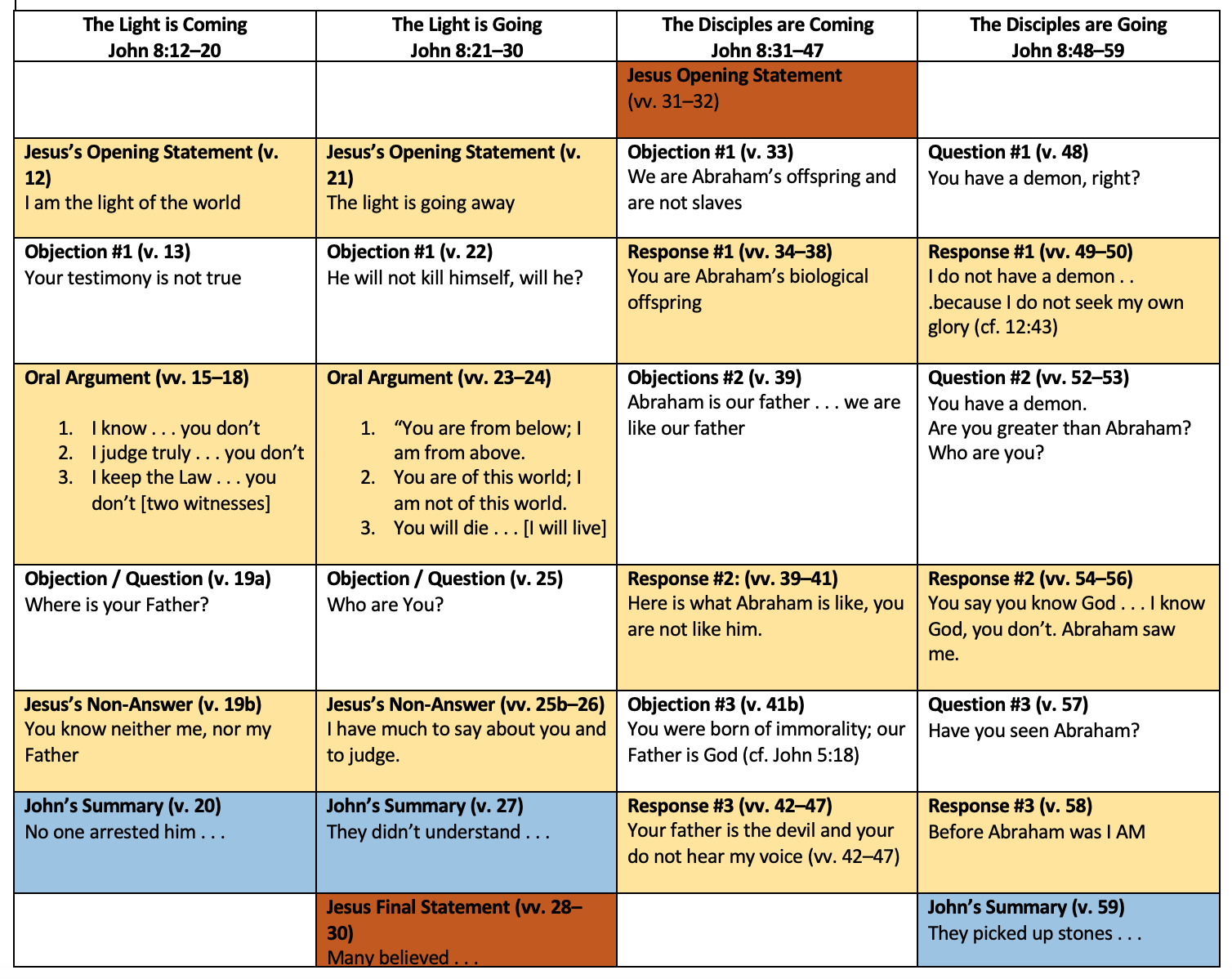
Screen Shot 2022-06-30 at 12.48.41 PM

From this outline, let’s consider a couple things.

The Legal Brief in John 8

First, there is, in John 8:12–30, two arguments that run in parallel. This parallel is found in the order of the speech and the shape of the argumentation. Compare verses 12–19 and 20–27. In these two sections, we find Jesus making an opening statement in each. Remarkably these statements should be read together, and give us a sense of what the first trial is addressing. In verse 12, Jesus announces that he is the light coming into the world, and in verse 20 he says that he (the Light of the World) will be departing. Commiserate with so much in John, this trial is about Jesus and the light he brings.

Importantly, Jesus’s statement are met with hostile unbelief, expressed in two objections—one long, one short. This is how the trial proceeds until, in verses 28–30, Jesus points to his coming cross, when he will be lifted up. As verse 30 indicates, many believed in him, even though moments earlier (v. 27), they didn’t understand. So clearly, this faith lacks understanding, which Jesus will proceed to show as false.

Stopping here in the middle of the chapter, notice how this response of faith is the turning point of the chapter. Quite possibly, the faith of his hearers is based upon the hope that Jesus “lifting up” would be an exaltation to glory, which they might enjoy too. What Jesus has in mind with respect to his lifting up, however, is his coming crucifixion. But these disciples do not understand that (v. 27), they simply believe in Jesus for other purposes. This is a warning to us today and to any who believe in Jesus for their own reasons, not his.

In the context of John, we will see that the people of Israel were seekers of glory, and it seems Jesus’s words of lifting up could have invited such a misplaced faith. Accordingly, this is where the next section begins, as it moves to reveal the darkness of Jesus questioners. Like before, the second section has another mirrored debate, a legal dispute in two parts.

Verses 31–32 begins with another opening statement, but this time Jesus’s statement covers the two parts of the trial. As to the content of his statement, Jesus tells his would-be followers how they prove themselves them true. If they remain in his word, they will have life eternal, but if they refuse him and his words, they are false, darkened, and spiritually dead. Tragically, this is what the chapter proves.

Let’s following the argument in order. First, in vv. 31–47, the Jews ask three questions, to which Jesus responds three times. And in that legal debate, Jesus splits the difference between biological seeds of Abraham (which these Jews are) from spiritual heirs of Abraham (which these Jews are not). The result of this distinction is Jesus’s famous and forceful declaration that these “believers” are actually children of the devil. “You are of your father the devil, and your will is to do your father’s desires” (v. 44a).

Next, these devilish sons of Abraham accuse Jesus of demonic activity and Samaritan origins (v. 48), even as they reject his self-identification with Abraham. Again, this legal debate turns on three questions, followed by three responses from Jesus. Ironically, once identified with the devil, these interlocuters do the work of the accuser, questioning Jesus, his identity, and his eternity (i.e., his ancient knowledge of Abraham). But in context, all they do by questioning Jesus is to show their own spiritual ignorance and lifeless religion.

Consequently, when they pick up stones to throw at Jesus, a symbol that the trial has moved from deliberation to execution, John reveals that these accusers of Jesus are the ones who stand condemned by God. They do not know God and this is evident in the fact that they cannot recognize God’s Son. Accordingly, the chapter closes not with a guilty verdict for Jesus, but a guilty verdict for his legal opponents.

All in all, John uses a tight literary structure to lead the reader to see what he is doing. And more, he reveals who Jesus is by contrasting him with those who accuse him. Jesus is the light of the world who will be extinguished on the cross, so that in the light of his resurrection, all who truly believe in him will be saved. Yet, such faith does not come from the selfish will of men who want to glorify themselves by Jesus. Saving faith comes to those who are truly heirs of Abraham, sheep who hear Jesus voice, and children born of God.

John 8 and the Crack in the Cosmos

The division between biological seeds and spiritual heirs is a division, a crack in the cosmos, that ranges across the whole of humanity. And in John, this spiritual division between two kinds of people is seen by paying attention to the trial. In questioning and condemning Jesus, the Jewish leaders show themselves to be men of darkness. By contrast, those who abide in the words of Christ will walk in the light, as he is in the light, because God gives light to those who are children of light.

Again, this spiritual division is what we face in every conflict—whether familial, ecclesial, societal, legal, or political. As Jesus teaches, there are two kinds of people in the world. And as John 8, the sides are determined by God and detected by how one responds to the Son. Ultimately, John 8 reveals much about who Jesus is, but it also reveals much about who we are.

With that realization in mind, let us seek God’s mercy and pray for his light to lead us to Christ. Jesus is the light of the world, and if you rejoice in his light, he will reveal to you his truth, and his truth alone will set you free. Just as he says in John 8:31–32.

Soli Deo Gloria, ds

Photo by Jonathan Petersson on Pexels.com

Go And Preach No More? Six Contextual Problems With John 7:53–8:11

close up shot of bible text

Few passages in the Bible are more beloved than the story of the adulterous woman being brought to Jesus, condemned by the scribes and Pharisees, and then set free by the wisdom and compassion of Christ. At the same time, few passages in the Bible are more debated. Should John 7:53–8:11 be included in the Bible, or not?

In the early church, it was recognized that this passage was not present in the earliest Greek manuscripts. And Augustine and others suggested that the teaching in the passage is what led to exclusion. In On Adulterous Marriages (2.7.6), he writes, “Some men of slight faith” and others “hostile to true faith” removed the passage for fear that it would encourage adultery.[1]

In the modern era, the problem of the Pericope Audulterae (PA)[2] has not been a matter of questionable ethics, so much as questionable evidence. As most translations admit, “The earliest manuscripts does not include John 7:53–8:11” (ESV). Likewise, a majority of evangelical scholars also question the inclusion of this passage in the Bible. See, for instance, Daniel Wallace, Jim Hamilton, and a list of others.

On the other hand, there are biblical scholars who do argue for the inclusion of the PA in the biblical canon. This would include advocates of the King James Version, Majority Text advocates, and others who would point to the Byzantine text tradition. For instance, Maurice Robinson, a retired professor from SEBTS, who is not KJV-Only, has done the most extensive work on this subject.[3] And he has made the case for including this passage as original.

Still this is the minority report. And accordingly, Bible readers and preachers are left to wonder: How do we handle this text? Continue reading