Politics According to the Bible (3): Biblical Principles

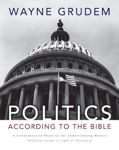
[This is the third in a series of posts on Wayne Grudem’s Politics According to the Bible: A Comprehensive Resource for Understanding Modern Political Issues in Light of Scripture].

Before we can examine specific political questions in light of the teachings of the Bible, it is necessary to study what the entire Bible teaches about civil government.  Where did the idea of government come from? What should be the purpose of government? How should governments be chosen? What kind of government is best? What are the responsibilities of governmental rulers? (77)

This is how Wayne Grudem introduces his third chapter, “Biblical Principles Concerning Government.”  In the pages that follow, Grudem offers a positive view of politics from the Bible.  He begins with three keys texts, he wrestles with the laws of Old Testament Israel applied today; he expounds what the goal of government should be, he makes a biblical case for democracy, and he discusses some of the issues regarding church state.

THREE KEY BIBLICAL TEXTS

Genesis 9:5-6 is the foundational passage in the Bible for the role of government to wield the sword.  It says, “And for your lifeblood I will require a reckoning: from every beast I will require it and from man.  From his fellow man I will require a reckoning for the life of a man. ‘Whoever sheds the blood of man, by man shall his blood be shed, for God made man in his own image” (Gen 9:5-6).  By extension, Grudem extrapolates, “Once this principle is established, then the imposition of lesser penalties for crimes is also validated” (78).  In time, this ideal would be fleshed out in the law of Moses.  The Lex Talionis established degrees of punishment, but it goes back to this fundamental teaching in Genesis 9.  Because man is made in the image of God, harm done against another human is a criminal act, and is punishable by death, says the Lord.  Thus in establishing a basis for government, Grudem points out that from the very beginning, God was a law-maker, who entrusted men to rule well on the earth–this after all is part of what it means to be made in the image of God (cf. Gen 1:26-28).

From this passage, Grudem lists 3 principles: (1) Anarchy is a highly destructive evil; (2) Governments should execute justice and defend the weak (cf. Ps 82:2-4); and (3) Government should execute swift punishment as a deterrent to crime (cf. Ecc 8:11) (78-79).

Next, Grudem turns to the New Testament, where he examines Romans 13:1-7 and 1 Peter 2:13-14.  These read as follows:

Romans 13:1-7
[1] Let every person be subject to the governing authorities. For there is no authority except from God, and those that exist have been instituted by God. [2] Therefore whoever resists the authorities resists what God has appointed, and those who resist will incur judgment. [3] For rulers are not a terror to good conduct, but to bad. Would you have no fear of the one who is in authority? Then do what is good, and you will receive his approval, [4] for he is God’s servant for your good. But if you do wrong, be afraid, for he does not bear the sword in vain. For he is the servant of God, an avenger who carries out God’s wrath on the wrongdoer. [5] Therefore one must be in subjection, not only to avoid God’s wrath but also for the sake of conscience. [6] For because of this you also pay taxes, for the authorities are ministers of God, attending to this very thing. [7] Pay to all what is owed to them: taxes to whom taxes are owed, revenue to whom revenue is owed, respect to whom respect is owed, honor to whom honor is owed.

1 Peter 2:13-14
[13] Be subject for the Lord’s sake to every human institution, whether it be to the emperor as supreme, [14] or to governors as sent by him to punish those who do evil and to praise those who do good.

Spending most of his time on Romans 13, Grudem lists 6 principles:

(1) God has appointed the authorities who have governmental power. (cf. John 19:11)
(2) Civil rulers are a “terror to bad conduct.” (cf. Genesis 9:5-6)
(3) They give “approval” or praise.
(4) Governmental officials serve God.
(5) Government officials are doing “good” as they carry out their work.
(6) Government authorities execute God’s wrath on wrongdoers and thereby carry out a task of retribution.

Grudem is quick to point out that these elements of government do not result in “good” governments, but they do show the way God has instituted governments to function in the world.  Grudem also shows how governmental authority relates to personal ethics.  Reading Romans 13 in context, he notes that three verses prior to this instruction, Paul says, “Beloved, never avenge yourself, but leave it to the wrath of God…” (Rom 12:19).  It is appropriate to see this negative command towards personal vengeance in two ways: (1) God will avenge all injustice at the end of the age (and by means of the cross of Jesus Christ for the sins of believers), but also (2) God institutes kings and elected officials to dispose his wrath in this age.  Grudem articulates,

While Paul tells Christians not to take personal vengeance when wrong has been done to them, he tells them they should rather allow the wrongdoer to be punished by “the wrath of God.” Then just a few sentences later (in Rom. 13:4) he explains that “God’s wrath” against wrongdoers is carried out by civil government when it inflicts punishment on them. This means that it is often right for Christians to turn to the civil government to ask for justice to be done when they have suffered wrong at the hands of others. The civil government, in this life, is the means that God has established to carry out justice in such cases (81).

OLD TESTAMENT LAWS AND MODERN POLITICS

Next, Grudem asks the question: What about the detailed laws for Israel given in Exodus, Leviticus, Numbers, and Deuteronomy? (83-85).  In short, he distinguishes the covenantal differences between Old Testament Israel and every other nation that has ever existed. Only Israel was a true theocracy.  Therefore, there are principles to be gleaned from the Torah, but many specifics are impossible to implement without a temple, a Davidic king, an Aaronic priesthood, and an ark of the covenant.  Moreover, he sees in the New Testament a move away from the Old Testament laws when Paul instructs the Galatians and the Colossians that celebrating particular days will not save (cf. Gal 4:10-11; Col. 2:16-17).

THE GOAL OF GOVERNMENT

So what is the goal of government?  Romans 13:4 tells us that rulers are in place as “God’s servant for your good.”  In other words, government exists to promote the good of the people.  Grudem points to the difference between Samuel’s good leadership (1 Sam 12:3-4) and his warning about the greed of the kings of the nations (1 Sam 8:11-17).  According to the Bible, rulers who serve themselves are not fit for the office.  Sadly, this practice is commonplace in our country and in every civilization that has existed since Cain built the first city (cf. Deut 16:19; Ps 26:10; Prov 15:27; 17:23; Isa 33:15; Ezek 22:12; Amos 5:12; Hab 1:2-4).

Instead of personal gain, governments are instituted to defend and promote the liberty of human beings.  Grudem again goes to the Bible to make his case appealing to pattern in Scripture that loss of freedom is always a kind of judgment or curse, while liberation is a blessing.  He then points at passages like Deuteronomy 30:19 and  Joshua 24:15, to argue that God intends that men and women are created and called to make free moral choices (92).  This applies today to the measure of governance a country should have, and makes a case for limited government, based on the principle that the more a government  increases regulations, the more it obstructs the freedoms of the people (94).  He sees this as an increasing problem and gives numerous contemporary examples (94-95).

Therefore, since the goal of government is societal good, citizens (Christian and otherwise) should submit themselves to their ruling leaders (1 Pet 2:13-14), but this command is not absolute.  Pointing to Peter and John (Acts 4:18-20; 5:29), Shadrach, Meshach, and Abednego (Daniel 3:13-27), and the Hebrew midwives (Exod 1:17, 21), Grudem shows that at times it is appropriate to “obey God rather than man” (Acts 5:29).  This is always true when the government commands Christians to do things that go against the Bible and conscience.  And sometimes, this civil disobedience leads to overthrowing governments in power.  To prove his point, Grudem examines the history of America’s birth and gives a compelling case for the “morality” of of lower government officials resisting higher officials for the sake of the greater good (89).  Moreover, “the Bible does not ever say that it is wrong to change an existing government” (90), and in fact it even “gives examples where God raised up leaders to deliver his people from the rule of tyrants” (91).

With that said, it must be cautioned that the biblical deliverances in the Bible are in a totally different category than anything that would take place today.  Liberation theologians will appeal to Moses and the exodus to affirm the radical resistance of the powers that be, but they are applying the commands to Moses in ways that are not consistent with the whole counsel of Scripture.  So while, there may be moral grounds for overthrowing a government based on the ethical teachings of the Bible, it is another thing to say that any “chosen people” have the right to resist governing powers the way that Moses did, because they are some kind of New Moses.  There is only one New Moses, and his name is Jesus, and his church uses spiritual weapons (2 Cor 10:3-6).

CHURCH AND STATE RELATIONS

Grudem gives three straight forward points on how the church and state should relate: (1) “The church should not govern ‘things that are Caesars.'”  Based on the distinction Jesus made in Matthew 22:21 and Jesus refusal to arbitrate between a man and his brother over the distribution of property (Luke 12:13-14), we should see two different spheres of governance in the world–the church and the state.  (2) The civil government should not govern “the things that are God’s” for the same reason as number 1–church and state are two different “systems of government” (100). (3) “Civil government should support and encourage churches and bona-fide religious groups in general” because this promotes the greater good of the society.

Finally, in Grudem’s third chapter he also addresses the idea that powers should be separated and that a democratic system can be inferred from Scripture.  On this first, point he appeals to the wickedness of humanity and the fact that absolute authority is shown throughout the Bible to corrupt (e.g. Saul, David, and Solomon).  Moreover, as Scripture establishes governance in local churches, it does so with plural eldership (cf. Acts 14:23; Titus 1:5; 1 Peter 5:1-4).  This positive example of the ‘separation of powers’ commends itself to national governance.  Along the same lines, even the rulers should be subject to the laws of the nation.  Here Grudem quotes Deuteronomy 17, where kings are called to copy the Mosaic Law in order to rule in accordance with its commandments.

On the second point–democratic government–Grudem says that a number of concepts coalesce to commend a broadly democratic form of government–though it should be noted that he doesn’t affirm this as strongly as the previous points. He insists that while no one system is commanded in Scripture, he urges that a government that has the consent of the people, will do better than any other.  He bases this on the equality of mankind, the need for rulers to be accountable, and the fact Scripture shows many positive examples of kings gaining consent from their people (Exod 4:29-31; 1 Sam 7:7:5-6; 10:24) and negative examples where kings failed to gain their people’s consent (e.g. Rehoboam in 1 Kings 12:15).  The result of Rehoboam’s dictatorial rule resulted in a fractured kingdom.  On this point, Grudem concludes with a fascinating world statistic.  In 1950, 22 democracies existed; today 120 (out of 192) countries hold a democratic process in governance.  What could this mean?  Perhaps, it is another example of the way that God’s wisdom has permeated as salt and light into the world. But then again, that might be too optimistic and even sounds a bit post-millenial.

FINAL THOUGHTS

As it concerns the Bible and democracy, I think that Grudem is working with biblically-informed concepts to be applied in a fallen world, and for the most part they are helpful.  Still it must be remembered that the Bible’s overarching purpose is explicitly theocratic–with a Davidic Son reigning over the nations.  Democratic government is derived from the Bible’s teaching, not explicitly mandated; and cannot be, because the system of government that the whole Bible is driving at is the one that begins when Christ comes to reign in Zion.  The Bible assists in evaluating today’s forms of government, but the only one that it fully commends is the one that has not yet been established.

On the whole, this chapter is packed with biblical perspectives on government and makes a great resource on the subject.  These are important matters that must be weighed with care, and while I might emphasize the kingdom of God and rule of Christ more than Grudem does, I believe he presents a positive, biblical framework to think about the Two Kingdoms.

For a recent sermon on this subject, see Mark Dever, “Pay Your Taxes But Trust in Christ.”

Soli Deo Gloria, dss
Politics According to the Bible (2): Significant Christian Influence

[This is the second in a series of posts on Wayne Grudem’s Politics According to the Bible: A Comprehensive Resource for Understanding Modern Political Issues in Light of Scripture].

In his second chapter, Wayne Grudem advocates “A Better Solution,” what he calls “Significant Christian Influence on Government.”  In his proposal, he surveys the Bible to enumerate a host of biblical examples who were used by God to influence their respective political leaders.  He also points out passages of Scripture that give Christians instruction on how to interact with government and governors, before raising a number of debated questions, not the least of which include, “Is America a Christian Nation?”

After addressing the preliminary matter of how to rightly interpret the Bible in a way that denies liberal distortions, Grudem enlists biblical support for his position.  Moving from the Old Testament to the New, he lists numerous saints who have been used by God to impact government.  Some of these include Daniel, Joseph, Moses, Nehemiah, Esther, and Mordecai.  While each of these saints trusted in God to accomplish his work in the world, they were also steadfast to plead with their respective “government officials.”  Moreover, the prophets in the Old Testament regularly addressed the kings of Israel (e.g. Isaiah and Jeremiah) and the rulers and conduct of foreign nations (e.g. Isa 13-23; Jer 46-51; Ezek 25-32; Amos 1-2; Hab 2; Zeph 2; and Obadiah addressed Edom, while Jonah and Nahum addressed Nineveh).

In the New Testament, John the Baptist (Matt 14:3-4; Luke 3:18-20) and the apostle Paul (Acts 24:24-25) both addressed the conduct of their government officials.  More precisely though, in the New Testament, Paul devotes the first 7 verses in Romans 13 to the God-ordained place of government.  It is helpful to remember the context of this letter was to a people who were oppressed by their government leaders.  Nevertheless, Paul affirms the goodness of government as an institution and calls Christian to submit themselves to these “ministers of God” (Rom 13:6).  Likewise, Peter in his first epistle instructs Christians to submit themselves to the governing authorities (2:13-14).  In these inspired letters, God has given Christians guidelines for interacting and influencing government.

Grudem then applies these teachings to the democratic process in America.  While waiting to develop his thoughts further until chapter 3 and following, he does mention the fact that Christians in America share in the governance of the nation through the system of representation.  He writes,

To be able to vote is to have a share in the ruling power.  Therefore all citizens who are old enough to vote have a responsibility before God to know what God expects of civil government and what kind of moral and legal standards he wants government to follow.  But how can citizens learn what kind of government God is seeking? They can learn this only if churches teach about government and politics from the Bible (62).

Grudem also raises the issue of whether or not America is a “Christian Nation.”  He does well to define precisely what that means, and gives a balanced answer of yes and no.  His overall conclusion is the question is not all that helpful, because it “leads to arguments, misunderstanding, and confusion” (65).  His point is well taken, and he helpfully shows that America has always been a nation “significantly influence by Christianity” and still should be as the biblical data teaches.

He tackles a number of other questions that concern the way the church and its members should exercise their citizenship to influence the government.  He makes the point that different persons will have different roles and involvement in government, just like different Christians have different gifts and roles in the church.  Nevertheless, he urges that all Christians play a role in influencing government for justice and good.

One final note, he raises the issue of whether or not Christians should vote for non-Christians.  His discussion is helpful and perhaps challenging to many believers who always vote Christian.  He includes an article that he wrote in the fall of 2007, in preparation for the 2008 presidential election.  His letter can be found on http://www.townhall.com and he argued for why Christians should vote for Mitt Romney, a mormon.  His argument is sound and it shows the difference between the biblical qualifications for elected office and the biblical qualifications for pastors–they are not the same.

Going back to the Bible again, Grudem expounds,

[H]ave we come to the point where evangelicals will only vote for people they consider Christians? I hope not, for nothing in the Bible says that people have to be born again Christians before they can be governmental authorities who are used greatly by God to advance his purposes. God used Pharaoh, King of Egypt to raise Joseph to a position of authority over the whole country, so he could save his people from famine (Genesis 41:37-57). God used Nebuchadnezzar, King of Babylon, to protect and raise up Daniel and his Jewish friends to positions of high authority over Babylon (Daniel 2:46-49). God used Cyrus, King of Persia, to restore the Jewish exiles to their homeland (Isaiah 45:16; Ezra 1:1-4), and used Darius, King of Persia, to protect the Jewish people as they rebuilt the temple in Jerusalem (Ezra 6:1-12). God used Ahasuerus, King of Persia, to raise up Esther as Queen and to give Mordecai high authority and honor in his kingdom (Esther 6:10-11; 8:1-2, 7-15). In the New Testament age, God used the peace enforced by the secular Roman Empire, the Pax Romana, to enable the early Christians to travel freely and spread the Gospel throughout the Mediterranean world.

Here in the United States, God used not only Founding Fathers who were strong Christians, but also Deists such as Benjamin Franklin and Thomas Jefferson, to build the foundation of our nation. Jefferson even became our third President in 1801, a demonstration of the wisdom of Article 6 of the Constitution, which says, “no religious test shall ever be required as a qualification to any office or public trust under the United States.” (page 68)

Grudem’s point challenges the way many Christian’s think about politics and voting.  The point worth noting is that it requires more than simply answering the question, “Are they Christian or not?” to make an informed decision around election time.  It takes time to consider the issues biblically and to be well-informed with the candidates who are running to know whether or not they are qualified for the office of elected official.  It may mean that a conservative but unbelieving candidate with a proven track record of defending life and upholding justice is more qualified than an inexperienced evangelical.  That is to say, there seems to be a biblical distinction between who we have leading our country and who we have joining our church.  The two are not always synonymous, and this view is surely one that raises questions.  So, let the discussions begin.

Overall, Grudem’s chapter is a helpful in two ways.  (1) It shows us from the Bible the way God’s people have always sought to influence governmental officials for the good; and (2) it challenges Christians to think more precisely on the matters faith and politics.  Furthermore, it challenges uninvolved Christians (and pastors) to be more involved in influencing the government for good–something that is greatly needed in our day.

May God continue to help us think biblically about politics, government, and the world in which we live.

Soli Deo Gloria, dss

Politics According to the Bible (1): Five Wrong Views

[This is the first in a series of posts on Wayne Grudem’s Politics According to the Bible: A Comprehensive Resource for Understanding Modern Political Issues in Light of Scripture].

Wayne Grudem begins his discussion of politics and the Bible by outlining five wrong views.  These include: (1) Government Should Compel Religion, (2) Government Should Exclude Religion, (3) All Government Is Evil And Demonic, (4) Do Evangelism, Not Politics, and (5) Do Politics, Not Evangelism.  Lets look at each of these unbiblical approaches.

Government Should Compel Religion

First, Grudem appeals to the State Church’s that have arisen in Christendom where citizenship and religious affiliation are coterminous.  He relates these to the similar models of government found in Islamic nations today.  He shows that these are not Scriptural as he points to Jesus making significant distinction between the sphere of Caesar’s kingdom and the sphere of God’s kingdom (Matt 22:20-21).  He argues that this view is not tenable according to the Bible, nor does it result in the kind of faith and repentance, that Christ requires.

Government Should Exclude Religion

Second, he argues against the kind of secular government that denies any place to faith.  This is the kind of government promoted by the ACLU and Americans United for Separation of Church and State.  In the United States, this view is often grounded on the misunderstood statement about separation of church and state made by Thomas Jefferson in his letter to the Danbury Baptist Church (Danbury, CT).  It demands religion to be voiceless in the public sector and it “changes freedom of religion to freedom from religion.”  Yet, this was not Jefferson’s intention in 1802, nor is it compatible with the Bible which features numerous examples of God’s people influencing kings and rulers (Joseph, Daniel, John the Baptist, and Paul, to name a few).  This kind of regime is also seen in other countries that have persecuted Christians.  It is clearly unbiblical.

All Government Is Evil and Demonic

Third, the view that demonizes government does so from a misreading of Luke 4:6 which quotes Satan as saying, “To you I will give all this authority and their glory, for it has been delivered to me…” Proponents of this view include Gregory Boyd, who argues that every form and function of government is evil.  However, as Grudem points out, Boyd and his ilk, fail to consider the whole counsel of Scripture.  For explicitly in Romans 13 and 1 Peter 2, Paul and Peter instruct Christians to submit to governing authorities who are discharging God’s ‘ministry’ of government.  Moreover, Grudem points out that this view depends on the reliability of Satan’s description of his own authority in Luke 4:6, which is a highly speculative reality based on the deceitful character of Satan (cf. John 8:44).

In the end, Grudem points out that this view fails to recognize the difference between good and evil systems of government, and by extension it calls good evil and evil good.  Thus, it leaves citizens paralyzed and unable to resist or reform governmental structures for the good.  It results in an insipid pacifism that is not what the Bible requires.

Do Evangelism, Not Politics

Fourth, Grudem challenges evangelicals who distance themselves from political engagement due to the ‘hopeless’ enterprise that it is.  He suggests that those who advocate evangelism over against politics “narrow an understanding of ‘the Gospel’ and the kingdom of God” (45).  He warns that those who take this approach undervalue the effect that political involvement has for the gospel.  He provides a helpful illustration of the difference between heavily evangelized South Korea and repressive North Korea, and the resulting effect this has had in their respective countries.  He writes,

Governments can allow churches to meet freely and evangelize or they can prevent these things by force of law (as in Saudi Arabia and North Korea). They can hinder or promote literacy (the latter enabling people to read a Bible). They can stop murderers and thieves and drunk drivers and child predators or allow them to terrorize society and destroy lives. They can promote and protect marriages or hinder and even destroy them. Governments do make a significant difference for the work of God in the world, and we are to pray and work for good governments around the world (46).

While agreeing with his main objection, I think Grudem shows uncharacteristic imprecision on this point.  He argues that “the whole Gospel includes a transformation of society” (47).  I am not convinced this is “necessarily” true.  For instance, in countries where Christianity is outlawed, societal transformation may not come to fruition, because Christians may be martyred before they are ever able to transform their nation.  Even in situations where the blood of the martyrs brings change in time, it may take generations, so that to say the gospel “includes a transformation” is a little misleading.

On this point, he continues, “Forgiveness of sins is not the only message of the Gospel” (47).  But is that biblically the best way to say it?  If Grudem had said, “Forgiveness of sins is not the only message of the Bible,” or “Forgiveness of sins is not the only ministry of the church,” I would agree.  The Bible certainly teaches Christians how to love their families, serve their employers, and fight for justice.  Likewise, the ministry of the church does include caring for orphans, widows, and the unborn.  So then, in these ways, the Bible says more than “Believe on Jesus Christ, and you will be saved.” However, when the gospel is defined as “forgiveness” and “societal transformation,” it enlarges the gospel in unbiblical ways.

In fact, Mark Dever preached against this very thing in his 2008 Together For the Gospel message, “Improving the Gospel: Exercises in Unbiblical Theology,” when he warned of making the gospel more than the salvation of sinners (see his chapter in Proclaiming a Cross-Centered Theology, pp. 106-109).  Grudem seems to make the gospel message coterminous with the whole counsel of Scripture, and by implication he includes gospel entailments within the message of the gospel.

I think Grudem, when he argues against  the “Do evangelism, Not politics” view, but his treatment of the gospel in this section needs more attention. (For more on the central tenets of the gospel, see Greg Gilbert, What is the Gospel?)  Within this section, however, Grudem does present some other helpful points, namely that God has intended the church and the government to work in tandem to effect positive change against the evil that is resident in our society.

Another point worth pondering in this section is the way that church history has demonstrated countless ways that Christians have influenced government for good.  He cites from Alvin Schmidt’s book How Christianity Changed the World, and lists dozens of social improvements from the discontinuation of the Roman gladiatorial games to the prohibition of burning widows alive in India.  Then Grudem names a number of Christians who have effected social justice in the world to show how has positively shaped our country (50).

Still, it would be helpful at this point to make a distinction that not all these “Christians” were orthodox, gospel-believing brothers in Christ.  No doubt, Martin Luther King, Jr. was used by God to bring about civil rights throughout the United States, but it must be asked, “Was Dr. King’s doctrine orthodox and evangelical?”   Grudem doesn’t make that distinction, which is an unfortunate lacuna.

Do Politics, Not Evangelism

Finally, his fifth wrong view is the one that says “Do Politics, Not Evangelism.”  According to Grudem, few respected evangelicals hold this Social Gospel view (53), however pastors Rob Bell and Brian McLaren are two influential proponents of a sub-standard gospel message who are advocating political and social change.  Their popular books and speaking tours are infecting many with a “New Kind of Christianity” that aims to advance the kingdom of God through social and political involvement and that denudes the gospel of its saving message.

Overall, Grudem’s first chapter is a helpful taxonomy of wrong views of government and politics.  It sets the stage for chapter 2, where he will develop “a better solution,” one that urges “significant Christian influence on government” (54). Preparing for this view, he closes his first chapter with a balanced statement on politics according to the Bible.

Genuine, long-term change in a nation will only happen (1) if people’s hearts change so that they seek to do good, not evil; (2) if people’s minds change so that their moral convictions align more closely with God’s moral standards in the Bible; and (3) if a nation’s laws change so that they more full encourage good conduct and punish wrong conduct. Item 1 comes about through personal evangelism and the power of the Gospel of Jesus Christ. Item 2 takes place through personal conversation and teaching and through public discussion and debate. Item 3 comes about through Christian political involvement. All three are necessary (54).

Soli Deo Gloria, dss

Politics and the Bible

Wayne Grudem has come out with a massive volume on politics and the Bible (619 pages).  It is entitled Politics According to the Bible: A Comprehensive Resource for Understanding Modern Political Issues in Light of Scripture, and it contains biblical exegesis, theological reflection, and ethical discussion about ‘everything’ that one may encounter in the world of politics.

It is a great resource for someone who likes to read but has done little reading in the area of politics–someone like me!  Moreover, it is a tremendous guide for Christians to think through the matter of politics–a subject many Christians discuss with regularity and passion–with the light and wisdom of the Bible, and not simply conservative or progressive rhetoric.

Thus in an attempt to learn more about “politics according to the Bible,” I am going to endeavor to read a chapter a day between now and election day (Nov 2) to better understand a biblical view of politics and to discern how and where a pastor should be involved in the process (see Grudem pp. 71-73).  And as a measure of discipline, or self-inflicted perspiration, I am aiming to catalogue my thoughts from each chapter as I go, giving a synopsis of each chapter and the helpful biblical analyses provided by Professor Grudem.

I hope this may help others think through political matters biblically (especially those in my own church) and that others may be encouraged to pick up and read, or reference, Grudem’s new book.  At this point, I cannot commend or condemn Politics According to the Bible, I can only suggest it as an important subject (especially at this time) and Grudem as a reliable teacher–he is a conservative, Bible-believing, advocate of sound doctrine (see his Systematic Theology).  I anticipate it being a helpful book, and one that certainly has the right foundation on which to build–the word of God.

I hope you will join me in thinking through these matters biblically, so that we would better understand what the whole counsel of God says concerning the political enterprise.  And maybe, if you are so inclined, you will pick up Grudem’s volume and read along– right now it is 40% off at the WTSBookstore.

Soli Deo Gloria, dss

7 Things Not To Sip At The Tea Party: Doug Wilson’s Sound Advice

Doug Wilson gives sound advice for evangelicals as election day nears and political fervor increases in his article “Seven Things for Christians to Not Sip at the Tea Party.”  It is pithy and practical and worth reading in full.  Here is the outline.

1. Keep your head…
2. Conservative forms of postmodern relativism are no better than the others kinds…
3. Do not make the mistake of thinking that anything that makes the socialists, liberals, progressives, and commies froth at the mouth must be biblical. What they are advancing is evil, sure enough, but that doesn’t mean that anyone who fights them must be good…
4. Always act, and never react. Action needs to proceed from a biblically based framework of political principles, and not from fauxoutrage over the fact that your gored ox is not covered by Medicaid.
5. Don’t support any political movement in such a way that eliminates your ability to protest the inevitable compromises that will follow in the train of electoral victory, such compromises being undertaken and advanced by Republicans ten minutes after the election.
6. Take note of the fact that pastors, theologians and writers alive today, who actually embody the principles held by the Founders, will usually not be allowed anywhere near the microphones, at least not while the television crews are still there…
7. Above all, beware the idolatry of a Christless civil religion…We are Christians and the worship of a generic Deity is prohibited to us. There is no way to the Father except through the name of Jesus. But there are manifestations of the American civil religion that are seductive to evangelicals. And so we must be told, again and again, little children, keep yourselves from idols (1 John 5:21).

Wilson’s counsel is helpful.  Like Moore’s article, it encourages evangelical engagement, but engagement that proceeds from a mind renewed by the whole counsel of God and one that is jealous to guard itself from the idol of civil religion.  As we protest for liberty, may we never forget our greatest liberty comes from Jesus Christ alone (John 8:32; Galatians 5:1).

Soli Deo Gloria, dss

God, The Gospel, and Glenn Beck: Russell Moore Weighs In

Whatever your thoughts about Glenn Beck’s rally in Washington, Russell Moore’s analysis, God, the Gospel, and Glenn Beck, is worth reading.  Especially, if your Christianity and political interests intersect (which they should — the question is “How should they intersect?”), Moore’s commentary is salient reminder that the advance of the gospel and the advance of conservative politics are not one and the same.  While promoting an active role in politics, Moore distinguishes between populist “God and country” rhetoric and the gospel of Jesus Christ crucified, buried, and dead.

On the topic, Moore writes,

We used to sing that old gospel song, “I will cling to an old rugged cross, and exchange it some day for a crown.”  The scandalous scene at the Lincoln Memorial indicates that many of us want to exchange it in too soon. To Jesus, Satan offered power and glory. To us, all he needs offer is celebrity and attention.

Mormonism and Mammonism are contrary to the gospel of Jesus Christ. They offer another Lord Jesus than the One offered in the Scriptures and Christian tradition, and another way to approach him. An embrace of these tragic new vehicles for the old Gnostic heresy is unloving to our Mormon friends and secularist neighbors, and to the rest of the watching world. Any “revival” that is possible without the Lord Jesus Christ is a “revival” of a different kind of spirit than the Spirit of Christ (1 Jn. 4:1-3).

Because the gospel is about a kingdom, the gospel is political.  And politics do matter.  Paul urges us to pray for leaders and the peace of our nations, but because the gospel is empowered by a heavenly Spirit and is establishing a subversive kingdom, it is not advanced through national organizations and political machinations. The church is the wisdom of God for growing his kingdom and for bringing genuine peace into the world.

While Christians should engage politics, and take a stand as individual (and organized) citizens, we must not confuse the call of disciple-making (Matthew 28:19-20, Acts 1:8) with that of conservative politics.  Moore’s article shows evangelical Christians should confront the world with a nuanced understanding of the Bible, and not just slogans passed down by winsome leaders.  We must renew our minds and examine our hearts, even as we vote our conscience.

Check out the whole thing: God, the Gospel, and Glenn Beck

Soli Deo Gloria, dss

Hollywood and the Holy Word: Substance, Supplication, and the President-Elect

What if Barack Obama were white?  Would he have been elected by such a large margin?  I’m uncertain.  It’s interesting that this election was decided as much, if not more, by the color of Obama’s skin than the content of his character.  From the polling data broadcast tonight, it seems many voted for Barack Obama for the sole reason that it is time to elect an African-American president. I don’t disagree. I rejoice in that our country has a black president. But if that is only qualifier for office, it mutes the political, ideological, moral, and even theological issues at stake.

(Interestingly, if people voted only on the superficiality of skin color, it is the converse of MLK Jr’s famous speech, which advocated human appraisal based on the content of our character and not the color of our skin.  With that said, let me say Obama’s election is a milestone inconceivable 100 years ago and unforeseen even within recent decades.  Thus, today’s election stands as a victory for civil rights. For that we give God praise).

Nevertheless, in opposition to those who laud Obama with Messianic ascriptions, I am concerned about the substance of his character and what he stands for in his personal morality and in his political agenda(s).  He is smooth talker, an ear tickler, and a heart warmer, but is he a man of righteous character, integrity, and political justice?  Time will tell.  Every tree bears fruit.

But time has already begun to tell, and much observable fruit has already fallen.  So that in electing Obama as the 44th president, the American people have willfully elected the most pro-abortion, pro-homosexual (and thus anti-family) president in the history of the United States.  Barack’s unwillingness to defend the unborn and his positive affirmation of homosexuality do not just invite the Lord’s wrath they extend it (cf. Rom. 1).  The judgment of God has already been at work in our nation, as more than 40 million children’s lives have been snuffed out since 1973; likewise, the increase in homosexuality is a demarcation of a people that has lost its moral compass and has embraced a pernicious kind of lifestyle.  Abortion and sodomy do not only solicit solicit, they are in themselves part of God’s judgment.  Consequently, unless Obama’s stance on these issues changes radically, I fear that his rule will only further a culture of death and sacrifice decency and life on the altar of autonomous liberty and freedom of expression.  This is not true freedom (cf. John 8:31-32; Gal. 5:1).

His culpability is not isolated, however.  Since the American people hold in our collective grip the sword of government to defend the innocent and to promote justice, we as a nation will give an account to God for our disregard of His standards of justice and law, written on the hearts of men (cf. Rom 2:14-15).  Therefore, America as a whole, is responsible for the election of public officials who use the God-ordained sword of he state to shed the blood of those they are responsible to protect (cf. Rom. 13:1ff).  Sadly, based on previous statements and voting records, our president-elect will move ahead to deny life to the unborn and will promote legislation to obscure God’s design for marriage–hence implicitly distorting the gospel of Jesus Christ (cf. Ephesians 5:32).

As I reflect on the events of today, I am more convinced than ever that the American people are deceived by what they see and by what is put before their eyes (cf. 2 cor. 4:4).  The polls today reflected what I would call the “Hollywood Effect.”  Because Barack Obama looked presidential, the American people type-cast him for the role.  In this, the voters acted less like a responsible republic and more like a studio casting agency.  Obama’s speech, his demeanor, his poise, and his looks won him the part.  Compared to the track-record of John McCain, Barack’s political history lacks substance, but his crowd-pleasing performances captured his critics glances and overcame his diminutive experience.  In a world of special effects, scripted speeches, cyberspace, flash photography, and sound bites, our next President is a Hollywood star.

So, substance? Doubtful. Time will tell.  But, screenplay?  Absolutely.  The audience at home has voted.

While I am concerned with the next President of the United States, I will pray for him.  1 Timothy 2:1-4 tells me that God wants me to pray for rulers, that they might come to know Jesus Christ as their personal Lord and Savior.  I have been convicted by this.  My own lack of prayer for political legislation and political leaders has become increasingly evident as election day arrived.  I have, myself, too often lacked substance in my life–looking spiritual but failing to lift holy hands and prayer.  Yet, in response to recent events, that must change.  I do not want to be a Hollywood Christian, one who could be typecast for the part; I want to be a genuine believer shaped by the Holy Word.

As we close this day and begin a new season in the life of our country, may Christians redouble their prayers for the new president.  May we pray for his salvation and that God would change his mind about abortion, marriage, and other issues of justice.  May we cry to the Lord for mercy, because Americans as a nation are the ones who turns the sword on its own children, who glories in the shame of same-sex unions, and rejoices in both as autonomous freedoms and cultural rites of passage.  May we, the people of God, cry to God for mercy so long as these Christ-rejecting evils persist, and may we pray that our next President not add to the horror but wield the sword well.

Sola Deo Gloria, ds

Palin, Posts, and Prayer

I don’t write much about politics, and for good reason. I am a political novice and a legislative skeptic, but since my google reader has been overflowing with recent ‘Palin’ posts,  I feel compelled to offer the obligatory political post.  So instead of talking better than I know about politics, I will simply link to a handful of reflective Christians who have offered insightful and sometimes irascible comments.

The importance of this issue to gender complementarity, women’s roles, and the local church is where I am most concerned, and it is interesting that concurrent minds have diverged over this issue.  Voddie Baucham and Doug Wilson see this as a deadly plague for the family.  Albert Mohler sees this as a unique opportunity to differentiate the church from the government office.  Denny Burk follows the President’s lead. David Kotter, and the folks at CBMW, seem to want to use this opportunity to clarify the biblical nuances of gender complimentarity. And Tim Challies offers a cumulative survery of these and other considerations.

All of this discussion is healthy and good. Yet, I wonder in the richness of the conversation how much, if any, prayer has been lifted for this VP candidate and her family. Personally, I have been convicted about my lack of intercession. As I wrestle to understand the impact this governmental decision has on gender roles and the local church, in addition to its effect on Sarah Palin’s own family, I have not prayed for her as a godly, complementarian man ought. Ironically, as gender issues arise in the wake of these events, one thing is clear from the passage that has caused so much debate–i.e. 1 Timothy 2–that godly men are to raise holy hands to the Lord in prayer. They are not to quarrel in anger, but rather are to labor in prayer for the good of the their family, their church, the gospel, and their country. Discussion is good but prayer is better. May we as we read, write, question, and speak about these recent events, lift holy hands to heaven and pray for Sarah Palin and for our government, so that the gospel of Jesus Christ might have free reign in our families, our churches, and our country.

Here is a list of recent posts:

Reforming Marriage author, Doug Wilson has four thought-provoking posts: Kind of Spooky When You Think About It , Palin Comparison , An Epistemological Pileup, John Slays His Thousands.

Voddie Baucham separates Pro-Life and Pro-Family and makes some provocative, but polarizing, comments about Sarah Palin’s VP selection in his post, “Did McCain Make a Pro-Family Pick?”

Offering a more balanced commentary, Dr. Al Mohler blogs on his website, and on the Washington Post’s eclectic “On Faith” website

Denny Burk follows Dr. Mohler’s lead and presents a balanced response to the issues his post: Southern Baptist Hypocrisy?

Also navigating the challenging terrain of complementarity, CBMW Director, David Kotter offers a two-part series, “Does Sarah Palin Present a Dilemma for Complementarians?” Part 1. Part 2. From speaking with him the other day, it sounds like more reflections on the biblical and cultural issues are forthcoming. Stay tuned.

Finally Tim Challies summarizes a long list comments in the blogosphere with his lengthy rundown.  You can read it all here.

May we who love the wisdom of gender complementarity pray for Sarah Palin, for our country, and for our churches as we continue to think biblically on this matter!