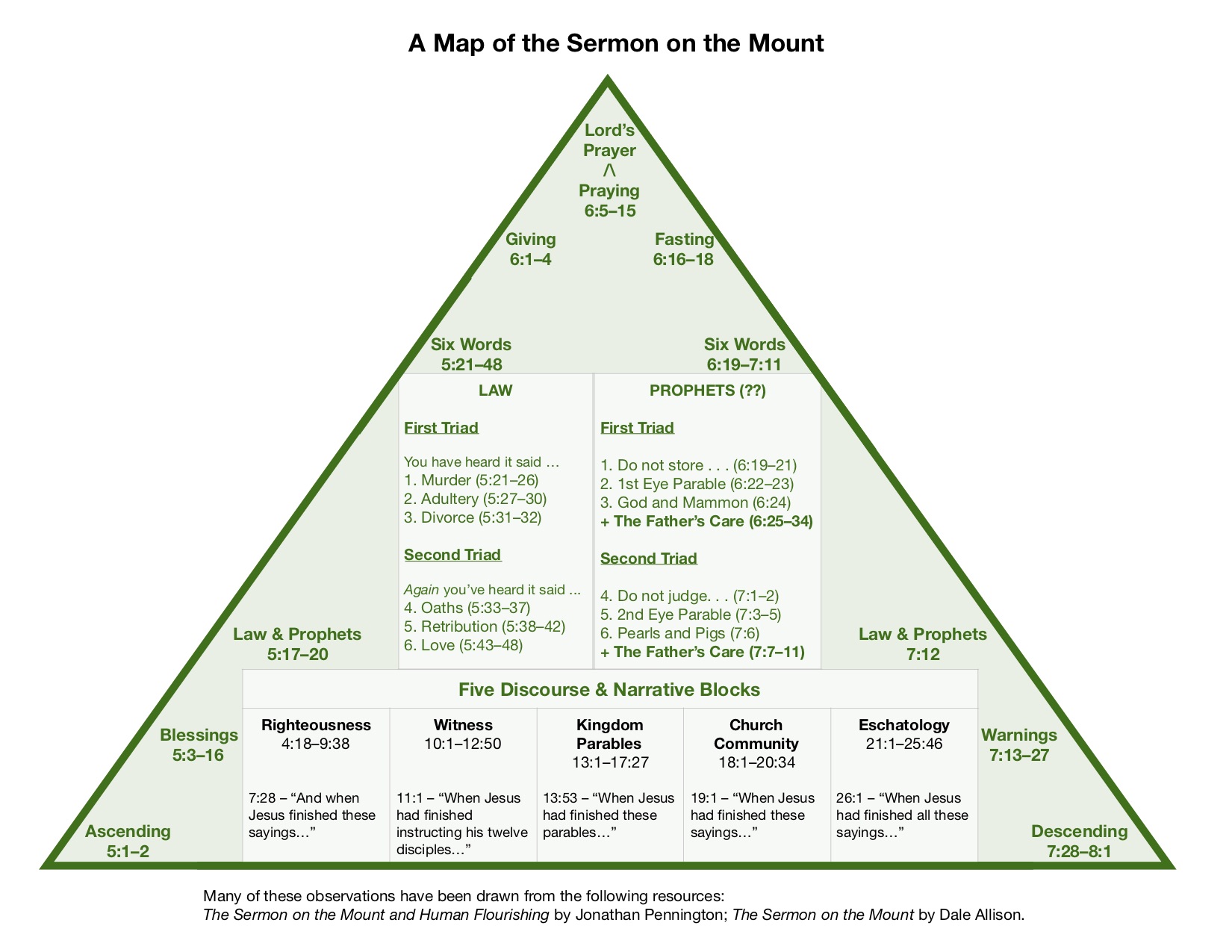
Via Emmaus on the Road: Matthew 5

Further Resources


Matthew 5 (ESV)

The Sermon on the Mount

Seeing the crowds, he went up on the mountain, and when he sat down, his disciples came to him.

The Beatitudes

And he opened his mouth and taught them, saying:

“Blessed are the poor in spirit, for theirs is the kingdom of heaven.

“Blessed are those who mourn, for they shall be comforted.

“Blessed are the meek, for they shall inherit the earth.

“Blessed are those who hunger and thirst for righteousness, for they shall be satisfied.

“Blessed are the merciful, for they shall receive mercy.

“Blessed are the pure in heart, for they shall see God.

“Blessed are the peacemakers, for they shall be called sons of God.

10 “Blessed are those who are persecuted for righteousness’ sake, for theirs is the kingdom of heaven.

11 “Blessed are you when others revile you and persecute you and utter all kinds of evil against you falsely on my account. 12 Rejoice and be glad, for your reward is great in heaven, for so they persecuted the prophets who were before you.

Salt and Light

13 “You are the salt of the earth, but if salt has lost its taste, how shall its saltiness be restored? It is no longer good for anything except to be thrown out and trampled under people’s feet.

14 “You are the light of the world. A city set on a hill cannot be hidden. 15 Nor do people light a lamp and put it under a basket, but on a stand, and it gives light to all in the house. 16 In the same way, let your light shine before others, so that they may see your good works and give glory to your Father who is in heaven.

Christ Came to Fulfill the Law

17 “Do not think that I have come to abolish the Law or the Prophets; I have not come to abolish them but to fulfill them. 18 For truly, I say to you, until heaven and earth pass away, not an iota, not a dot, will pass from the Law until all is accomplished. 19 Therefore whoever relaxes one of the least of these commandments and teaches others to do the same will be called least in the kingdom of heaven, but whoever does them and teaches them will be called great in the kingdom of heaven. 20 For I tell you, unless your righteousness exceeds that of the scribes and Pharisees, you will never enter the kingdom of heaven.

Anger

21 “You have heard that it was said to those of old, ‘You shall not murder; and whoever murders will be liable to judgment.’ 22 But I say to you that everyone who is angry with his brother will be liable to judgment; whoever insults his brother will be liable to the council; and whoever says, ‘You fool!’ will be liable to the hell of fire. 23 So if you are offering your gift at the altar and there remember that your brother has something against you, 24 leave your gift there before the altar and go. First be reconciled to your brother, and then come and offer your gift. 25 Come to terms quickly with your accuser while you are going with him to court, lest your accuser hand you over to the judge, and the judge to the guard, and you be put in prison. 26 Truly, I say to you, you will never get out until you have paid the last penny.

Lust

27 “You have heard that it was said, ‘You shall not commit adultery.’ 28 But I say to you that everyone who looks at a woman with lustful intent has already committed adultery with her in his heart. 29 If your right eye causes you to sin, tear it out and throw it away. For it is better that you lose one of your members than that your whole body be thrown into hell. 30 And if your right hand causes you to sin, cut it off and throw it away. For it is better that you lose one of your members than that your whole body go into hell.

Divorce

31 “It was also said, ‘Whoever divorces his wife, let him give her a certificate of divorce.’ 32 But I say to you that everyone who divorces his wife, except on the ground of sexual immorality, makes her commit adultery, and whoever marries a divorced woman commits adultery.

Oaths

33 “Again you have heard that it was said to those of old, ‘You shall not swear falsely, but shall perform to the Lord what you have sworn.’ 34 But I say to you, Do not take an oath at all, either by heaven, for it is the throne of God, 35 or by the earth, for it is his footstool, or by Jerusalem, for it is the city of the great King. 36 And do not take an oath by your head, for you cannot make one hair white or black. 37 Let what you say be simply ‘Yes’ or ‘No’; anything more than this comes from evil.

Retaliation

38 “You have heard that it was said, ‘An eye for an eye and a tooth for a tooth.’ 39 But I say to you, Do not resist the one who is evil. But if anyone slaps you on the right cheek, turn to him the other also. 40 And if anyone would sue you and take your tunic, let him have your cloak as well. 41 And if anyone forces you to go one mile, go with him two miles. 42 Give to the one who begs from you, and do not refuse the one who would borrow from you.

Love Your Enemies

43 “You have heard that it was said, ‘You shall love your neighbor and hate your enemy.’ 44 But I say to you, Love your enemies and pray for those who persecute you, 45 so that you may be sons of your Father who is in heaven. For he makes his sun rise on the evil and on the good, and sends rain on the just and on the unjust. 46 For if you love those who love you, what reward do you have? Do not even the tax collectors do the same? 47 And if you greet only your brothers, what more are you doing than others? Do not even the Gentiles do the same? 48 You therefore must be perfect, as your heavenly Father is perfect.

Soli Deo Gloria!

With Genuine Repentance Comes Pardon: John Calvin on How to Seek and Grant Forgiveness

alex-shute-b7QwXDDEwv8-unsplashThen Peter came up and said to him,
“Lord, how often will my brother sin against me,
and I forgive him? As many as seven times?”
Jesus said to him, “I do not say to you seven times,
but seventy-seven times.
– Matthew 18:21–22 –

What happens when someone asks for forgiveness, but all outward signs indicate anything but a willing spirit? Is the offended party obligated to grant forgiveness the moment the offender says, “Will you forgive me,” or does it depend? If forgiveness depends on repentance, as Jesus says in Luke 17:3, just how much fruit is requisite for such repentance to be deemed genuine?

To put it into actual situations: Does the offended child whose sibling is forced to say “I’m sorry” have to mechanically say, “I forgive you”? Or to take it one step further, does the parent need to discipline the hesitating child for not offering forgiveness immediately?

What about the Christian family of a victim of violent crime, do they need to automatically grant forgiveness when the judge forces the criminal to issue an apology? Or are they permitted to consider the sincerity of the apology? Equally, should Christians forgive terrorists, who go to their deaths spewing hatred against their victims?

Or more basically, when pastors mediate conflict in the church, what is the proper response to a church member whose longstanding self-justification is suddenly reversed? Does the offended party need to issue an immediate grant of forgiveness? Or does the newfound repentance need time to settle? Equally, if the member will not forgive when repentance is genuine, what must be done then?

Fortunately, we are not the first generation to wrestle through such questions. And most recently, I came across an incredibly illuminating passage from John Calvin on Jesus’s teachings on forgiveness and repentance. Ever pastoral, Calvin provides some important qualifications for offering forgiveness, granting forgiveness, and even withholding forgiveness until repentance is deemed genuine.

Strikingly, Calvin does not suffer from our modern captivity to making others feel affirmed. Instead, he affirms the need to offer forgiveness to any and all who ask. But wisely, he also cautions Christians from mistakenly granting forgiveness prematurely. In his comments on Jesus’s teaching on forgiveness, he rightly urges Christians to extend grace in the same way they received grace. But also, he holds the line on repentance, stressing the importance of making sure repentance is genuine.

Having recently thought quite a bit about this very point, I offer six reflections on Calvin’s views on forgiveness, repentance, and reconciliation. I have added his full comment at the bottom. Continue reading

The Coming of Christ is the Fulfillment of the Pentateuch: A Christmas Meditation on Matthew 1–7

gareth-harper-dABKxsPTAEk-unsplashDo not think that I have come to abolish the Law or the Prophets;

I have not come to abolish them but to fulfill them.
— Matthew 5:17 —

When we say that Jesus fulfilled the law, we often abstract what the law means. That is, instead of letting “the Law” be the five books of Moses (Genesis–Deuteronomy), we often put the law into the paradigm of the law and the gospel, or some other theological construct. Such formulations are good, but they are also one step removed from the biblical text.

In Matthew 5:17, the place where Jesus says that he has fulfilled the law, he actually identifies “the Law” and “the Prophets,” which tells us he has the five books of Moses in mind when he says “law.” Jesus does the same in Matthew 7:12. And throughout Matthew’s Gospel, when Jesus speaks about the Law (see 11:13; 22:40; cp. 5:18; 12:5; 22:36; 23:23), we find an ongoing focus on Moses’s five books. In fact, this focus on the five books of Moses, what we call the Pentateuch, is seen not just in the way Jesus uses the word nomos (Law) in Matthew, but in the way Matthew himself introduces Jesus.

Here’s my thesis: In the first seven chapters of Matthew, the tax collector-turned-apostle presents Jesus as the fulfillment of the Pentateuch. In canonical order, Jesus fulfills each book of the Law in each of the opening chapters of Matthew. Here’s my argument at a glance.

Matthew 1 Genesis Jesus is the New Adam
Matthew 2 Exodus Jesus is the New Moses
Matthew 3 Leviticus Jesus is the New Priest
Matthew 4 Numbers Jesus is the New Israel
Matthew 5–7 Deuteronomy Jesus is the New Covenant

Such a comparison between Matthew and Moses requires a thorough acquaintance with the Law, but for those familiar with Matthew, we know he has an intimate knowledge of the Law and employs it to structure his book and to tell the story of Jesus. And here, as we meditate of the birth of Christ, I want to sketch in brief how the coming of Christ fulfills each book of the Pentateuch. Continue reading

How Does Jesus Fulfill the Law? Christ, His Teaching, and the New Covenant

jon-tyson-195064-unsplashIn Matthew 5:17 Jesus says that he has not come to abolish the Law or the Prophets, but to fulfill them. And as D. A. Carson has observed about these verses, “The theological and canonical ramifications of one’s exegetical conclusions . . . are so numerous that discussion becomes freighted with the intricacies of biblical theology” (“Matthew,” 141).
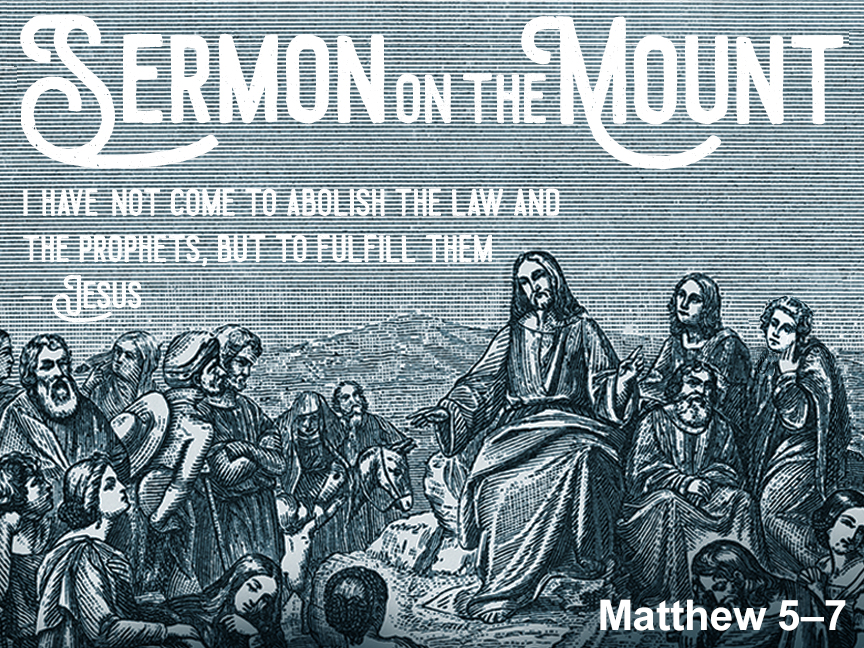
In other words, it is really easy to import one’s biblical framework into Jesus’s words. For how one understands the law and its use in the New Testament and how the New Testament relates to the Old Testament, will in large measure impact the way one understands Jesus’s words, which in turn reinforces, or reforms, our biblical-theological framework.

Therefore, the question before is, “How do we stay on the line of Scripture when we interpret Matthew 5:17”? By comparison with Matthew 10:34 (“I have not come to bring peace, but a sword”) and Matthew 5:9 (“Blessed are the peacemakers, for they shall be called sons of God”), we learn that Jesus “non-abolishment clause” in Matthew 5:17 may not be absolute. Sharing the same structure as Matthew 5:17, Matthew 10:34 does not mean Jesus has forsaken his peace-making ways. Rather, his peace-making will include the restructuring (and severing) of family relations in order to make a new family of  peace.

From this analogy, we learn there are some things in the Law that have come to an end—e.g., Hebrews indicates that Christ’s sacrifice ends the old covenant system of animal sacrifice. Therefore, we should go back to Jesus’s words to learn how to apply the Law. And thankfully, because of Matthew’s repeated and technical usage of the word “fulfill”/”fulfillment” (pleroō), we can get a good idea of how to understand the relationship of the Law to Christ and from Christ to us.  Continue reading

Blessed are the Pure in Heart, For They Will See God (Matthew 5:27–30)

sermon05

Blessed are the Pure in Heart, For They Will See God (Matthew 5:27–30)

Sexual sin. It is a destructive issue we face more often than we like to admit.

Whether it is lust, pornography, adultery, same-sex attraction, or any number of other desires that deviate from God’s good design, we are inclined to bury these parts of our lives in the dark. Yet, in Sermon on the Mount, Jesus wisely and lovingly shines a light on our hearts. Getting to the heart of sexual sin, he explains what lust is, where it comes from, and how, by God’s new covenant grace, it be put to death.

This Sunday we looked at Matthew 5:27–30 to learn from Jesus what lust is and how to combat it. And the answer, which may or may not come as a surprise, is to look more at the beauty and goodness of God than to merely turn away from the flesh. While external barriers and accountability are helpful, it is a heart full of Christ that empowers us to flee from sexual lust.

You can listen to this sermon online, and you can find discussion questions and related resources below. In particular, there are notes below that deal directly with the subject of pornography. Continue reading

Razing Cain: How Christ Crucifies a Heart of Anger (Matthew 5:21–26)

sermon05Razing Cain: How Christ Crucifies a Heart of Anger

This Sunday we looked at Matthew 5:21–26, where we saw the first of six lessons Jesus gives us about the law of Moses applied to his new covenant disciples.

Interpreting the sixth commandment, “Do not murder” (Exod 20:13; Deut 5:17), Jesus stressed the importance of making peace with those whom we have sinned against. In Sunday’s sermon we looked briefly at how Jesus applied Moses Words, but more importantly we considered a multitude of applications found in Jesus Words.

You can listen to the sermon online. Discussion questions and additional resources are listed below. Continue reading

Circumcising the Heart: Eleven Things Jesus Teaches Us About Anger

angerIn Matthew 5:21–26 Jesus outlines his interpretation and application of the sixth command, “Thou shall not murder” (Exod 20:13; Deut 5:17). And though Jesus words are only six verses in length, we can learn at least eleven truths about anger from Christ’s wise words.

1. Anger is a matter of the heart.

As the cliche goes, the heart of the matter is the matter of the heart. And in Jesus first of six “antithesis” he clarifies that the point of command, “thou shall not murder,” is not really an antithesis at all. Rather, the command to not shed another’s blood is meant to awaken the heart of someone prone to anger. In other words, it is misguided to believe the Lord only cared about the heart in the New Testament.

The Lord has always cared about the heart. Each of the ten commandments were instructed to train the hearts of the Israelites. Deuteronomy 10:16 called upon the Israelites to “circumcise their hearts.” And the common indictment against Israel, under the old covenant, was the problem of their hearts (cf. Isaiah 29:13; Psalm 95).

Hence, Jesus is not giving a new commandment here, but reminding his disciples what the intentions of God were, are, and forever will be. In the law, God called his people to not murder so that it would awaken in them a desire to love, serve, and protect their neighbor. Therefore, Jesus rightly recalls the laws original intent and that the sixth command addresses a heart of anger. Continue reading

The Good News of the Law: “Getting” the Law, So That the Law Gets Into You (Matthew 5:17–20)

sermon05

The Good News of the Law: “Getting” the Law, So That the Law Gets Into You

What is the purpose of the Law? How are we supposed to apply Moses’ commands to our lives? How does Jesus read the Old Testament? Is there any good news for Christians in Law of Moses?

These questions and more have been raised by Christians for centuries. And one of the most challenging passages on the relationship of the Old Testament to the New is Matthew 5:17–20. This Sunday we considered these words of Jesus and how he helps us to read the Bible and apply the Law to our lives.

You can find the sermon audio online. Discussion questions and additional resources are also available below. Continue reading

Getting Into the Beatitudes (Matthew 5:1–12)

sermon05

Getting Into the Beatitudes (Matthew 5:1–12)

This Sunday we started walking through the Sermon on the Mount. Considering the question of true happiness, we first looked at how we should read Jesus’ words. And then we looked at the nine statements of blessing/happiness known as the Beatitudes.

After stating that the Beatitudes are not entrance requirements for the kingdom, but words of wisdom given to Christ’s disciples who are in the kingdom, we looked at each of the beatitudes. These words of Christ are meant to comfort us and challenge us and help us walk with our Lord, for the glory of our Father in heaven.

You can listen to the sermon online. Discussion questions and additional resources, including a sermon series on the Beatitudes, can be found below. Continue reading