Via Emmaus on the Road: Luke 23

Further Resources

  • Questions for Luke 22–John 2 (Week 14)

Luke 23 (ESV)

Jesus Before Pilate

23 Then the whole company of them arose and brought him before Pilate. And they began to accuse him, saying, “We found this man misleading our nation and forbidding us to give tribute to Caesar, and saying that he himself is Christ, a king.” And Pilate asked him, “Are you the King of the Jews?” And he answered him, “You have said so.” Then Pilate said to the chief priests and the crowds, “I find no guilt in this man.” But they were urgent, saying, “He stirs up the people, teaching throughout all Judea, from Galilee even to this place.”

Jesus Before Herod

When Pilate heard this, he asked whether the man was a Galilean. And when he learned that he belonged to Herod’s jurisdiction, he sent him over to Herod, who was himself in Jerusalem at that time. When Herod saw Jesus, he was very glad, for he had long desired to see him, because he had heard about him, and he was hoping to see some sign done by him. So he questioned him at some length, but he made no answer. 10 The chief priests and the scribes stood by, vehemently accusing him. 11 And Herod with his soldiers treated him with contempt and mocked him. Then, arraying him in splendid clothing, he sent him back to Pilate. 12 And Herod and Pilate became friends with each other that very day, for before this they had been at enmity with each other.

13 Pilate then called together the chief priests and the rulers and the people, 14 and said to them, “You brought me this man as one who was misleading the people. And after examining him before you, behold, I did not find this man guilty of any of your charges against him. 15 Neither did Herod, for he sent him back to us. Look, nothing deserving death has been done by him. 16 I will therefore punish and release him.”

Pilate Delivers Jesus to Be Crucified

18 But they all cried out together, “Away with this man, and release to us Barabbas”— 19 a man who had been thrown into prison for an insurrection started in the city and for murder. 20 Pilate addressed them once more, desiring to release Jesus, 21 but they kept shouting, “Crucify, crucify him!” 22 A third time he said to them, “Why? What evil has he done? I have found in him no guilt deserving death. I will therefore punish and release him.” 23 But they were urgent, demanding with loud cries that he should be crucified. And their voices prevailed. 24 So Pilate decided that their demand should be granted. 25 He released the man who had been thrown into prison for insurrection and murder, for whom they asked, but he delivered Jesus over to their will.

The Crucifixion

26 And as they led him away, they seized one Simon of Cyrene, who was coming in from the country, and laid on him the cross, to carry it behind Jesus. 27 And there followed him a great multitude of the people and of women who were mourning and lamenting for him. 28 But turning to them Jesus said, “Daughters of Jerusalem, do not weep for me, but weep for yourselves and for your children. 29 For behold, the days are coming when they will say, ‘Blessed are the barren and the wombs that never bore and the breasts that never nursed!’ 30 Then they will begin to say to the mountains, ‘Fall on us,’ and to the hills, ‘Cover us.’ 31 For if they do these things when the wood is green, what will happen when it is dry?”

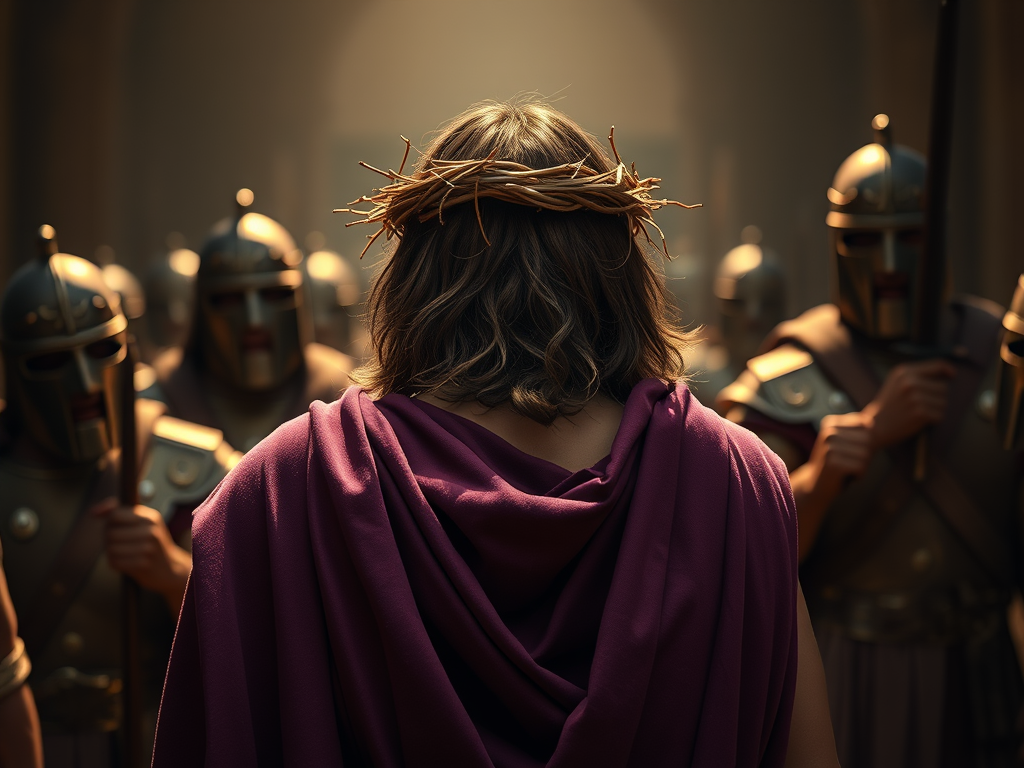
32 Two others, who were criminals, were led away to be put to death with him. 33 And when they came to the place that is called The Skull, there they crucified him, and the criminals, one on his right and one on his left. 34 And Jesus said, “Father, forgive them, for they know not what they do.” And they cast lots to divide his garments. 35 And the people stood by, watching, but the rulers scoffed at him, saying, “He saved others; let him save himself, if he is the Christ of God, his Chosen One!” 36 The soldiers also mocked him, coming up and offering him sour wine 37 and saying, “If you are the King of the Jews, save yourself!” 38 There was also an inscription over him, “This is the King of the Jews.”

39 One of the criminals who were hanged railed at him, saying, “Are you not the Christ? Save yourself and us!” 40 But the other rebuked him, saying, “Do you not fear God, since you are under the same sentence of condemnation? 41 And we indeed justly, for we are receiving the due reward of our deeds; but this man has done nothing wrong.” 42 And he said, “Jesus, remember me when you come into your kingdom.” 43 And he said to him, “Truly, I say to you, today you will be with me in paradise.”

The Death of Jesus

44 It was now about the sixth hour, and there was darkness over the whole land until the ninth hour, 45 while the sun’s light failed. And the curtain of the temple was torn in two. 46 Then Jesus, calling out with a loud voice, said, “Father, into your hands I commit my spirit!” And having said this he breathed his last. 47 Now when the centurion saw what had taken place, he praised God, saying, “Certainly this man was innocent!” 48 And all the crowds that had assembled for this spectacle, when they saw what had taken place, returned home beating their breasts. 49 And all his acquaintances and the women who had followed him from Galilee stood at a distance watching these things.

Jesus Is Buried

50 Now there was a man named Joseph, from the Jewish town of Arimathea. He was a member of the council, a good and righteous man, 51 who had not consented to their decision and action; and he was looking for the kingdom of God. 52 This man went to Pilate and asked for the body of Jesus. 53 Then he took it down and wrapped it in a linen shroud and laid him in a tomb cut in stone, where no one had ever yet been laid. 54 It was the day of Preparation, and the Sabbath was beginning. 55 The women who had come with him from Galilee followed and saw the tomb and how his body was laid. 56 Then they returned and prepared spices and ointments.

On the Sabbath they rested according to the commandment.

Soli Deo Gloria!

Via Emmaus on the Road: Luke 22

Further Resources

  • Questions for Luke 22–John 2 (Week 14)
  • An Outline of Luke 22: A Chiastic Structure Centered on the Lord’s Prayer

A Plot to Kill Jesus (vv. 1–6)

B Disciples Eat Passover Lamb (vv. 7–30)**

C Peter’s Denial (vv. 31–34)

D Two Swords (vv. 35–38)

X Prayer in the Garden (vv. 39–46)

D’ Two Swords (vv. 47–53)

C’ Peter’s Denial (vv. 54–62)

B’ Officers Beat Passover Lamb (vv. 63–65)**

A’ Chief Priests Condemn Jesus (vv. 66–71)

** At present, the length of B and brevity of B’ make me question this line of the outline. Typically, chiastic structures mirror one another with respect to words and proportions.

Luke 22 (ESV)

The Plot to Kill Jesus

22 Now the Feast of Unleavened Bread drew near, which is called the Passover. And the chief priests and the scribes were seeking how to put him to death, for they feared the people.

Judas to Betray Jesus

Then Satan entered into Judas called Iscariot, who was of the number of the twelve. He went away and conferred with the chief priests and officers how he might betray him to them. And they were glad, and agreed to give him money. So he consented and sought an opportunity to betray him to them in the absence of a crowd.

The Passover with the Disciples

Then came the day of Unleavened Bread, on which the Passover lamb had to be sacrificed. So Jesus sent Peter and John, saying, “Go and prepare the Passover for us, that we may eat it.” They said to him, “Where will you have us prepare it?” 10 He said to them, “Behold, when you have entered the city, a man carrying a jar of water will meet you. Follow him into the house that he enters 11 and tell the master of the house, ‘The Teacher says to you, Where is the guest room, where I may eat the Passover with my disciples?’ 12 And he will show you a large upper room furnished; prepare it there.” 13 And they went and found it just as he had told them, and they prepared the Passover.

Institution of the Lord’s Supper

14 And when the hour came, he reclined at table, and the apostles with him. 15 And he said to them, “I have earnestly desired to eat this Passover with you before I suffer. 16 For I tell you I will not eat it until it is fulfilled in the kingdom of God.” 17 And he took a cup, and when he had given thanks he said, “Take this, and divide it among yourselves. 18 For I tell you that from now on I will not drink of the fruit of the vine until the kingdom of God comes.” 19 And he took bread, and when he had given thanks, he broke it and gave it to them, saying, “This is my body, which is given for you. Do this in remembrance of me.” 20 And likewise the cup after they had eaten, saying, “This cup that is poured out for you is the new covenant in my blood. 21 But behold, the hand of him who betrays me is with me on the table. 22 For the Son of Man goes as it has been determined, but woe to that man by whom he is betrayed!” 23 And they began to question one another, which of them it could be who was going to do this.

Who Is the Greatest?

24 A dispute also arose among them, as to which of them was to be regarded as the greatest. 25 And he said to them, “The kings of the Gentiles exercise lordship over them, and those in authority over them are called benefactors. 26 But not so with you. Rather, let the greatest among you become as the youngest, and the leader as one who serves. 27 For who is the greater, one who reclines at table or one who serves? Is it not the one who reclines at table? But I am among you as the one who serves.

28 “You are those who have stayed with me in my trials, 29 and I assign to you, as my Father assigned to me, a kingdom, 30 that you may eat and drink at my table in my kingdom and sit on thrones judging the twelve tribes of Israel.

Jesus Foretells Peter’s Denial

31 “Simon, Simon, behold, Satan demanded to have you, that he might sift you like wheat, 32 but I have prayed for you that your faith may not fail. And when you have turned again, strengthen your brothers.” 33 Peter said to him, “Lord, I am ready to go with you both to prison and to death.” 34 Jesus said, “I tell you, Peter, the rooster will not crow this day, until you deny three times that you know me.”

Scripture Must Be Fulfilled in Jesus

35 And he said to them, “When I sent you out with no moneybag or knapsack or sandals, did you lack anything?” They said, “Nothing.” 36 He said to them, “But now let the one who has a moneybag take it, and likewise a knapsack. And let the one who has no sword sell his cloak and buy one. 37 For I tell you that this Scripture must be fulfilled in me: ‘And he was numbered with the transgressors.’ For what is written about me has its fulfillment.” 38 And they said, “Look, Lord, here are two swords.” And he said to them, “It is enough.”

Jesus Prays on the Mount of Olives

39 And he came out and went, as was his custom, to the Mount of Olives, and the disciples followed him. 40 And when he came to the place, he said to them, “Pray that you may not enter into temptation.” 41 And he withdrew from them about a stone’s throw, and knelt down and prayed, 42 saying, “Father, if you are willing, remove this cup from me. Nevertheless, not my will, but yours, be done.” 43 And there appeared to him an angel from heaven, strengthening him. 44 And being in agony he prayed more earnestly; and his sweat became like great drops of blood falling down to the ground. 45 And when he rose from prayer, he came to the disciples and found them sleeping for sorrow, 46 and he said to them, “Why are you sleeping? Rise and pray that you may not enter into temptation.”

Betrayal and Arrest of Jesus

47 While he was still speaking, there came a crowd, and the man called Judas, one of the twelve, was leading them. He drew near to Jesus to kiss him, 48 but Jesus said to him, “Judas, would you betray the Son of Man with a kiss?” 49 And when those who were around him saw what would follow, they said, “Lord, shall we strike with the sword?” 50 And one of them struck the servant of the high priest and cut off his right ear. 51 But Jesus said, “No more of this!” And he touched his ear and healed him. 52 Then Jesus said to the chief priests and officers of the temple and elders, who had come out against him, “Have you come out as against a robber, with swords and clubs? 53 When I was with you day after day in the temple, you did not lay hands on me. But this is your hour, and the power of darkness.”

Peter Denies Jesus

54 Then they seized him and led him away, bringing him into the high priest’s house, and Peter was following at a distance. 55 And when they had kindled a fire in the middle of the courtyard and sat down together, Peter sat down among them. 56 Then a servant girl, seeing him as he sat in the light and looking closely at him, said, “This man also was with him.” 57 But he denied it, saying, “Woman, I do not know him.” 58 And a little later someone else saw him and said, “You also are one of them.” But Peter said, “Man, I am not.” 59 And after an interval of about an hour still another insisted, saying, “Certainly this man also was with him, for he too is a Galilean.” 60 But Peter said, “Man, I do not know what you are talking about.” And immediately, while he was still speaking, the rooster crowed. 61 And the Lord turned and looked at Peter. And Peter remembered the saying of the Lord, how he had said to him, “Before the rooster crows today, you will deny me three times.” 62 And he went out and wept bitterly.

Jesus Is Mocked

63 Now the men who were holding Jesus in custody were mocking him as they beat him. 64 They also blindfolded him and kept asking him, “Prophesy! Who is it that struck you?” 65 And they said many other things against him, blaspheming him.

Jesus Before the Council

66 When day came, the assembly of the elders of the people gathered together, both chief priests and scribes. And they led him away to their council, and they said, 67 “If you are the Christ, tell us.” But he said to them, “If I tell you, you will not believe, 68 and if I ask you, you will not answer. 69 But from now on the Son of Man shall be seated at the right hand of the power of God.” 70 So they all said, “Are you the Son of God, then?” And he said to them, “You say that I am.” 71 Then they said, “What further testimony do we need? We have heard it ourselves from his own lips.”

Soli Deo Gloria!

Via Emmaus on the Road: Luke 21

Further Resources

  • Questions for Luke 17–21 (Week 13)

Luke 21 (ESV)

The Widow’s Offering

21 Jesus looked up and saw the rich putting their gifts into the offering box, and he saw a poor widow put in two small copper coins. And he said, “Truly, I tell you, this poor widow has put in more than all of them. For they all contributed out of their abundance, but she out of her poverty put in all she had to live on.”

Jesus Foretells Destruction of the Temple

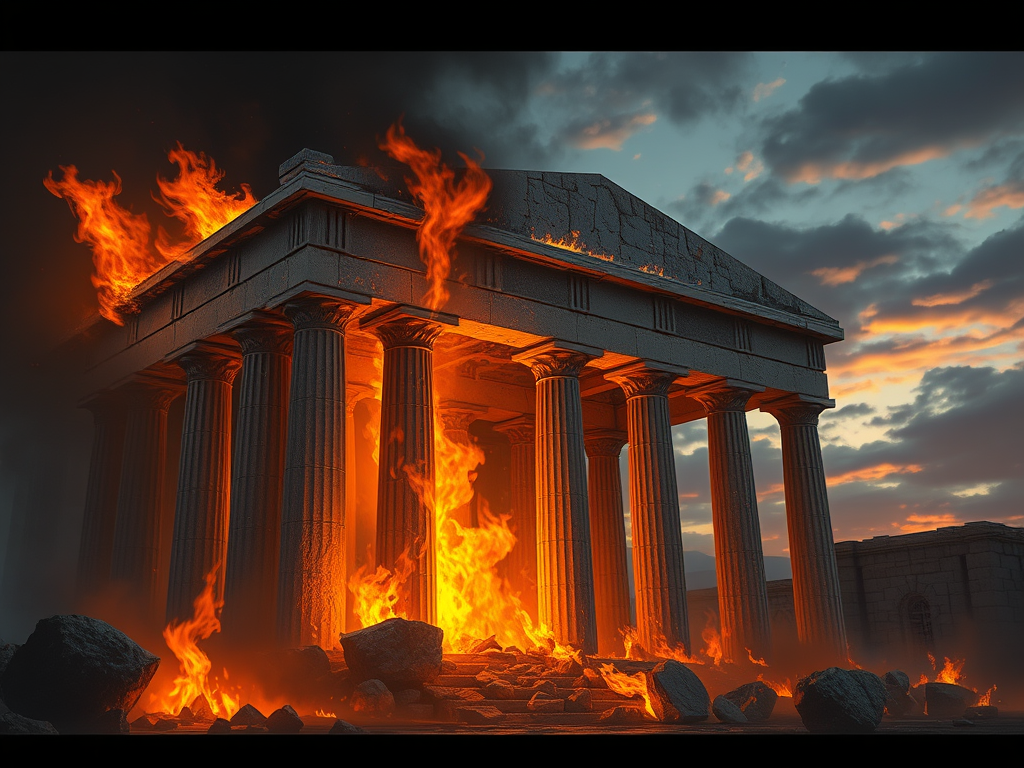
And while some were speaking of the temple, how it was adorned with noble stones and offerings, he said, “As for these things that you see, the days will come when there will not be left here one stone upon another that will not be thrown down.” And they asked him, “Teacher, when will these things be, and what will be the sign when these things are about to take place?” And he said, “See that you are not led astray. For many will come in my name, saying, ‘I am he!’ and, ‘The time is at hand!’ Do not go after them. And when you hear of wars and tumults, do not be terrified, for these things must first take place, but the end will not be at once.”

Jesus Foretells Wars and Persecution

10 Then he said to them, “Nation will rise against nation, and kingdom against kingdom. 11 There will be great earthquakes, and in various places famines and pestilences. And there will be terrors and great signs from heaven. 12 But before all this they will lay their hands on you and persecute you, delivering you up to the synagogues and prisons, and you will be brought before kings and governors for my name’s sake. 13 This will be your opportunity to bear witness. 14 Settle it therefore in your minds not to meditate beforehand how to answer, 15 for I will give you a mouth and wisdom, which none of your adversaries will be able to withstand or contradict. 16 You will be delivered up even by parents and brothers and relatives and friends, and some of you they will put to death. 17 You will be hated by all for my name’s sake. 18 But not a hair of your head will perish. 19 By your endurance you will gain your lives.

Jesus Foretells Destruction of Jerusalem

20 “But when you see Jerusalem surrounded by armies, then know that its desolation has come near. 21 Then let those who are in Judea flee to the mountains, and let those who are inside the city depart, and let not those who are out in the country enter it, 22 for these are days of vengeance, to fulfill all that is written. 23 Alas for women who are pregnant and for those who are nursing infants in those days! For there will be great distress upon the earth and wrath against this people. 24 They will fall by the edge of the sword and be led captive among all nations, and Jerusalem will be trampled underfoot by the Gentiles, until the times of the Gentiles are fulfilled.

The Coming of the Son of Man

25 “And there will be signs in sun and moon and stars, and on the earth distress of nations in perplexity because of the roaring of the sea and the waves, 26 people fainting with fear and with foreboding of what is coming on the world. For the powers of the heavens will be shaken. 27 And then they will see the Son of Man coming in a cloud with power and great glory. 28 Now when these things begin to take place, straighten up and raise your heads, because your redemption is drawing near.”

The Lesson of the Fig Tree

29 And he told them a parable: “Look at the fig tree, and all the trees. 30 As soon as they come out in leaf, you see for yourselves and know that the summer is already near. 31 So also, when you see these things taking place, you know that the kingdom of God is near. 32 Truly, I say to you, this generation will not pass away until all has taken place. 33 Heaven and earth will pass away, but my words will not pass away.

Watch Yourselves

34 “But watch yourselves lest your hearts be weighed down with dissipation and drunkenness and cares of this life, and that day come upon you suddenly like a trap. 35 For it will come upon all who dwell on the face of the whole earth. 36 But stay awake at all times, praying that you may have strength to escape all these things that are going to take place, and to stand before the Son of Man.”

37 And every day he was teaching in the temple, but at night he went out and lodged on the mount called Olivet. 38 And early in the morning all the people came to him in the temple to hear him.

Soli Deo Gloria!

Jubilee Bells: A Christmas Meditation on God’s Redemption in Christ

gold colored and black hanging bells near wall

  Blessed be the Lord God of Israel, for he has visited and redeemed his people.
Luke 1:68 

And coming up at that very hour she began to give thanks to God and to speak of him to all who were waiting for the redemption of Jerusalem.
Luke 2:32

27 And then they will see the Son of Man coming in a cloud with power and great glory.
28 Now when these things begin to take place, straighten up and raise your heads,
because your redemption is drawing near.”
Luke 21:27–28 

But [the two disciples] had hoped that he was the one to redeem Israel . . .
And beginning with Moses and all the Prophets, [Jesus] interpreted to them
in all the Scriptures the things concerning himself.
Luke 24:21, 27

Since I was a child I have heard and sung Jingle Bells too many times to count. At Christmas, that song is a staple. Yet, until this year I had never considered the place that Jubilee Bells, or rather a Jubilee trumpet might play at Christmas. And as we prepare to celebrate the birth of Christ I want to share a few reflections on Christ’s birth that relate to the Jubilee told in Leviticus 25, retold in Isaiah 61, and folded into the swaddling cloths that held Jesus.

Indeed, Jubilee is not just a part of the Levitical law, nor a planned redemption of Israel’s land and people. Jubilee is a part of God’s revelation that prepared the way for Christ. In Luke 4, Jesus announced his ministry with the words of Isaiah 61, which tell of the redemption God was planning for his people. Clearly, Jesus had an understanding of his role in redemption, as one who was fulfilling the prophetic word. Yet, Isaiah 61 goes back to Leviticus 25, and the redemption of redemptions promised in the Jubilee.

Even more, as we read Luke’s account of Christ’s birth with the light of Leviticus 25, we can see how the Evangelist portrayed the birth of Christ as indicating the coming of Jubilee and the restoration of all things. While this biblical theological meditation would require a full consideration of Leviticus 25, Isaiah 61; Daniel 9, as well as Luke and Hebrews, in the spirit of Christmas, I will focus on what we see in Luke’s Gospel. For in itself, Luke shows in at least four ways how Christ, from his birth to his death and resurrection, fulfills the ancient promise of Jubilee.

With that in mind, let’s consider how Christmas requires us to sing not Jingle Bells, but a carol of the bells celebrating Israel’s long-awaited redemption. Continue reading

Marveling at the Lord’s Teaching: A Meditation for Bible Teachers

ben-white-128604Marveled.

Astonished.

Amazed.

In Luke 4, these three words are used to describe the effect Jesus’ teaching had on people. First, in response to Jesus’ reading of Isaiah 61, coupled with his announcement that “this Scripture has been fulfilled in your hearing” (v. 21), Luke record, “all spoke well of him and marveled at the gracious words that were coming from his mouth” (v. 22). Second, verse 32 says of Jesus teaching on the Sabbath (v. 31), “and they were astonished at his teaching, for his word possessed authority.” And third, verse 36 reports “they were all amazed” because with his words “he commands the unclean spirits, and they come out.”

In these reports, Luke uses three words to express the effect Jesus had on people. And more specifically, the effect Jesus’ words had on people. First, Jesus words amazed (θαυμάζω) people. That is, people were “extraordinarily impressed or disturbed” (BDAG) by his speech. This word is often used to speak of supernatural miracles (Luke 8:25), healings (Luke 11:4), and eventually the resurrection (Luke 24:41). But in this case, they were amazed at the graciousness of his words. Continue reading

Straight Talk about the Church: A Biblical Meditation on Church Membership

natalia-y-340640For a whole year they met with the church and taught a great many people.
And in Antioch the disciples were first called Christians.
— Acts 11:26 —

For the last year I have spent a lot of time thinking about the church. Consequently, when I read books like Acts I am primed to observe ecclesial nuances (read: churchy stuff). That happened today in reading Acts 11:26, where in one verse four different words are used to speak of different (or the same) groups of people. It’s worth noting the language, because it may reveal a thing or two about how we conceive of the church.

In Acts 11 we discover the effects of the gospel spreading into places like Antioch. As verses 19–22 tell, a report of Gentiles coming to faith reached Jerusalem (v. 22). Pre-Jerusalem Council (Acts 15), the church in Jerusalem is still young in their understanding of how the Gentiles might experience salvation. So, verse 22 says, they sent Barnabas to Antioch, where he observes the grace of God in their midst (v. 23).

Upon seeing this newborn church, he goes and collects Saul from Tarsus, and returns to Antioch. This is where our verse picks up: “For a whole year they met with the church and taught a great many people. And in Antioch the disciples were first called Christians.” In that one verse, set in the context of a newly formed church in Antioch, we find four words related to the people of Antioch and their relationship to the gospel. These words are (1) church, (2) people, or many people, (3) disciples, and (4) Christians.

Let’s consider each and what they say to us about the church. Continue reading

Apostolic Exposition: How Did the New Testament ‘Preachers’ Handle the Text?

paulJust how dependent were the apostles on the Old Testament?

This is a question that interests all types. Biblical scholars, theologians, preachers, seminary students, and devoted Sunday School teachers all take interest in how the Old Testament foreshadows the New and the New Testament quotes the Old. Anyone familiar with my blog, or at least its title (see the Emmaus Road dialogue in Luke 24) will know that this has been an interest of mine for years. After all, what could be more exciting than understanding the unity of Scripture and how God’s inspired Word finds its telos in Jesus Christ.

But with such a consideration, it is important that we take our cues from Scripture and not use Scripture for our own (theological) ends. Thus, to return to the question of how the apostles made use of the Old Testament, it is worth observing how frequently the New Testament apostles took their cues from the Old Testament.

Answering the opening question with in an unreserved affirmative, I will trace the way three “apostles” (Peter, Stephen, and Paul) preached the new covenant gospel from the Hebrew Scriptures. My aim is to show how Acts gives us a model for preaching the gospel which necessarily unites the Old Testament promises in the person and work of Jesus Christ.

In my estimation, this kind of reading is necessary for understanding the Bible, knowing Jesus the Christ, and walking in obedience to the gospel. Let’s dive in and see what Acts has for us.
Continue reading

Expositional Preaching is ‘Empowered Preaching’

empoweredLast month I attended a Charles Simeon Trust workshop with about 40–50 pastors in Indianapolis, Indiana. As a preacher unapologetically-committed to expositional preaching, I was deeply encouraged to join such large number of other ‘expositors.’

In the three-day seminar, we walked through the whole book of 2 Timothy and ‘worked out’ with a number of hermeneutic tools (i.e., reading strategies) for understanding and preaching epistles. Space doesn’t permit me to share all the highlights of seminar, but one thing is worth mentioning: In defining expositional preaching, David Helm reshaped my thinking about exposition with his emphasis on “empowered preaching.” He defined expositional preaching as “empowered preaching that rightfully submits the shape and emphasis of the sermon to the shape and emphasis of a biblical text.”

Helm’s point is that “expositional preaching” is not just limpidly restating the truths of Scripture. Empowered preaching is Spirit-filled preaching that reveals the living Christ through the faithful exposition of God’s Word. And this kind of preaching comes not just from solid hermeneutics; it comes from the Spirit of God and prayer—a point he well explains in his compact book on preaching, Expositional Preaching Continue reading

Sermon Notes: How to Avoid Getting Lost on the Way from Leviticus 15 to Luke 15

On Monday, I suggested a five-fold system, a Gospel-Positioning System (GPS), to get you from obscure passages in the Law through the Prophets to Christ and the Gospel.  These five-steps are listed again.

1. Law
2A. Prophets: Judgment
2B: Prophets: Salvation
3: Christ
4: Gospel Response
5: Spirit-Empowered Action 

Today, I want to suggest four common errors that plague evangelicals today. Four ways we misread the Scriptures.

1. We skip from 1 to 5.  In pursuit of application and life-change, we read a command, a law, even a story, and we immediately move to application. Instead, of asking how the said pericope fits into the flow the Bible (i.e. textual, epochal, and canonical horizons), many of us move straight to activity.  This is wrong.  It misses the power of the law, the promise of the gospel, and the person of Jesus.  In effect, it makes the Bible about us, and no longer about Jesus.  The solution?  We must move from law through the prophets to Jesus Christ and then to us.  Personal application is vitally important but only after we encounter Christ.

2. We are afraid of 2A & 2B.  The prophets frighten us.  They are strange.  They don’t talk normal. They are hard to understand.  I get this!  I remember reading Isaiah 13-20 one time.  As I read the pronouncements against Babylon, Damascus, and Moab, I got upset.  Not because God was punishing these sinning nations, but because, “I needed a word from God, and this was not it”–so I thought.  I closed the Bible (for that day) upset, because I hadn’t seen how those words related to the rest of the Bible or my life.

If you have had an experience like that with the Prophets, it makes it hard to be a regular reader of that challenging genre.  Yet, to neglect the prophets is to neglect the greatest section of the Bible for fueling Christ-centered hope.

Maybe this will help: The prophets get a lot easier if we remember two things. First, they are speaking a word of judgment, based on the law against sinners like us.  Their words condemn covenant-breakers, social injustice, and unfaithful worship.  They speak to us about our sin.

Second, they are speaking a word of Messianic hope, based on the gospel. They give us glorious images of the Christ who is to come.  They offer salvation to sinful people, and the reality that God is going to bring recreate the world.  If we remember these two things and tie a rope from the law to the gospel, we can learn to walk thru these strange books.

3. We minimize 3.  This may sound strange, to minimize Jesus, but I have heard countless evangelical, Baptist preachers (and you have too) who preach and never mention Him.  Instead they list moral instructions from the life of Joseph or Caleb, and at the end say, “Unless you are Christian you cannot do what I just said.  So become a Christian.”

Friends, this is Christ-less preaching.  It has no power and I can hardly believe that a message without the content of Christ, will bring anyone nearer to our Lord and Savior.  In fact, it is disingenuous, to tell anyone to become a Christian after you have spent 40 minutes preaching moral lessons and not telling them about Christ.  Yet, this happens all too often.

4. We divorce 1-4 from 5.  If we are tempted to skip Jesus, we are more culpable of divorcing the gospel from application. In other words, we read the Bible for application, and we find all kinds of commands that say—Make disciples.  Love one another.  Be unified.  Forgive your enemies.  Turn the other cheek.

Yet, those commands have ZERO POWER, in and of themselves. These biblical commands are good, but in Scripture they are always set in relation to gospel promises.  To say it another way, imperatives are always grounded in gospel infinitives.  Why?  Because laws never produce godliness!  Grace produces godliness (Titus 2:11-13).

Jesus commands his disciples to be witnesses to all the nations, but he commands them to stay in Jerusalem until the Spirit comes so they will have power to do what he commands.  Paul tells us to forgive one another as Christ has forgiven you.  The power is in the gospel.  Failure to couple commands with Christ’s antecedent work, will lead earnest Christians to live the Christian life in the power of their own strength.

Instead, we must move to application and action, but as we do so, we must continue to walk in faith, loving others out of the love that has been poured into our hearts.

This is my prayer and hope!  That as we read Scripture, our minds are not just informed.  Rather, our eyes are opened to behold Christ and to become like him. Indeed, Jesus prayed that we would be sanctified by his word (John 17:17), and that comes to fruition when in his word, we see Jesus (2 Cor 3:18).

Open our eyes, Lord to see the wonder of Christ in the pages of Scripture, dss

Gathercole’s The Preexistent Son: Excellent Exegesis, Transcendent Theology, and a Methodological Model

Gathercole, Simon. The Pre-Existent Son: Recovering the Christologies of Matthew, Mark, and Luke. Grand Rapids: Eerdmans, 2006.

In The Pre-Existent Son, British New Testament scholar, Simon Gathercole, makes a convincing exegetical argument for Christ’s pre-existence as the eternal Son of God in the synoptic gospels. As he puts it, “The really controversial point to be made in this book is that the preexistence of Christ—which he defines as ‘the life of the Son prior to his birth’—can be found in the Synoptic Gospels” (1, emphasis his). The significance of his research is that Matthew, Mark, and Luke have been regarded by scholars as possessing a lower Christology than John, Hebrews, or Revelation. His aim is to argue against this notion and prove exegetically that the Synoptics possess a high Christology. His method is four-fold: 1) historically, he argues that Paul’s influence promoted pre-existence; 2) textually, the “I have come” + purpose statements indicate a heavenly preexistence; 3) theologically, he surveys the terrain of wisdom Christology; and 4) lexically, he examines four Christological titles (messiah, Lord, Son of man, Son of God) searching for evidence for pre-existence.

In Chapter 1, Gathercole aims to prove that preexistence was commonplace in early Christianity and should be “expected” in the writings of Matthew, Mark, and Luke. He appeals to Paul, the letter to the Hebrews, and Jude to make a simple background argument that the notion of preexistence was already extant. Continuing his background work in chapter 2, Gathercole “[offers] evidence that the Synoptic Gospels present Jesus as a transcendent, heavenly divine figure” (46). Appealing to the heaven-earth and Creator-creation distinctions found in these three books (47), Gathercole overwhelms the reader with evidence for Jesus transcendence and primes the pump for his next section.

Chapters 3-7 unfold the centerpiece of Gathercole’s argument. Chapter 3 introduces his thesis that the “I have come” + purpose statements are the primary evidence for pre-existence in the synoptic gospels. In chapters 4-6, Gathercole defends his thesis against potential defeaters. He summarizes on page 87:

  • None of the other scholarly options [i.e. the idiom of a prophet; merely an aramaic idiom, locative reference to Nazareth; simply the words of a leader] can be considered plausible (chapter 4).
  • The ‘I have come’ + purpose formula of the Gospels is most clearly, and most abundantly, paralleled in the announcement of angels of their comings from heaven (chapter 5)
  • The preexistence interpretation is confirmed by the content and literary context—in particular, the heavenly and dynamic features (chapter 6)

Gathercole denotes the similarities and differences between angelic visitations and Christ’s coming to earth in chapter 5.[1] Then in chapter 6, he posits a “new reading” of the “I have come” + purpose formula, basically asserting that the ‘cosmic scope’ (i.e. heaven to earth) and the ‘dynamic movement’ (i.e. the salvific intention to save, to ransom, to preach, etc) find their best understanding in the pre-existence of the Son (149ff). Gathercole adds support to his findings in Chapter 7 as he surveys those references which speak of Divine ‘sending.’ On their own, Gathercole does not think they constitute a belief in pre-existence, but taken together with the “I have come” + purpose statements, they add weight to the claim.

In section three (chapters 8-9), Gathercole critiques the prevalent notion today of wisdom Christology and argues from Matthew 23:37, a text with allusions to wisdom literature, that the Son of God is preexistent. Against wisdom Christology, he explains that the feminine, created, and anti-personal attributions of wisdom do not comport with the eternal, person of Jesus Christ. Therefore, wisdom cannot advocate pre-existence on its own, while doing justice to the New Testament vision of Jesus. Instead, Gathercole quotes Jesus words in Matthew, “Jerusalem, Jerusalem…how long I have desired to gather your children” (23:37), and shows how this quotation with its wisdom parallels attests to Jesus as “a trans-historical figure” (211-14).

Finally, in chapters 10-13, Gathercole considers whether the four titles—Messiah, Lord, Son of Man, Son of God—connote preexistence. Drawing particular attention to Luke 1:78, he asserts that “Messiah” in the Synoptics is more than simply royal, Davidic language; rather, like Melchizedek, the anointed one does not find his origin on earth—Jesus comes from heaven. Similarly, like YHWH in the OT, Jesus comes down to visit the earth.

Concerning the language of “Lordship,” he shows convincingly that OT references to YHWH are applied to Jesus and that instances of Father-Son conversation are heavenly court conversation. He concludes by asking if these evidences do not point to preexistence. From each gospel, Gathercole shows how the “Son of Man” is linked into the eternal purposes of redemption (Mark 10:45; Matt. 20:28; Luke 19:10). Moreover, in Matthew the predominate kingdom motif shows the son of man as an eternal king in conjunction with an eternal kingdom (6:10; 25:34). Finally, concerning “Son of God,” Gathercole shows how the age-old spiritual beings, Satan and his demons, and God himself address Jesus with knowledge that extends to the heavenly places. The former do this at the temptation and in direct confrontation; the latter does this at Jesus’ baptism and the transfiguration.

Overall, The Pre-existent Son presents the historic Christian position that Jesus of Nazareth existed eternally before he was born of the flesh. In this, it will find a sympathetic reading from Bible-believing Christians and will hopefully give academic skeptics something to chew on. The lasting value Gathercole’s work is not in anything novel or innovative, but in its painstaking and precise exegetical detail. It bolsters confidence in God’s word and shows attention to nuanced details of Scripture result in powerful presentations of doctrine. Likewise, his attention to the early Synoptics helps convince readers that the Christological doctrine of preexistence did not materialize later; it was always a part of the faith. In this way, Gathercole destroys any notion that preexistence is reserved for John and his gospel, while at the same time, he illustrates how high Matthew, Mark, and Luke’s Christology really is. Moreover, Gathercole’s method of argumentation is exemplary. In his thorough treatment of the subject, our trans-Atlantic brother has shown us how to craft an argument and how exegetical-theological research ought to be done.

Selah.

After writing the book review, it hit me that as important as it is to consider arguments about pre-existence, it is more edifying and soul-enriching to consider the Pre-Existent One Himself. 

Dwelling on the One in whom the fullness of God dwelled bodily (Col. 2:9) enlarges the mind and quickens the heart.  It is far more spiritually salubrious that simply assessing theological polemics and regurgitating the thoughts of others.  For Christ’s Pre-existence means is truly unfathomable.  It is a truth that we can believe, but one we will never fully grasp.  He had no beginning.  God the Son is autotheos.  Thus, his incarnation is all the more majestic. 

So, as much as I am thankful for Gathercole’s treatment of the subject of Pre-Existence of the Incarnate Word, I am even more thankful for the almighty, omnipotent, indomitable truth that Jesus Christ (God in the flesh) existed from all eternity and coming into time, he has promised to be our eternal mediator to approach God the Father.  We can trust that because, he is eternally God, full of grace and truth, eternally powerful and able to save.

Sola Deo Gloria, dss


[1] For the record, Gathercole does not promote an angel-Christology. Rather, he cites their origin and their sender to demonstrate that like angels, Jesus Christ the Pre-existent Son of God is coming from heaven at the sending of the Father.