Seeing John 9 with New Eyes: A Few Notes on Literary Structure

close up shot of bible text

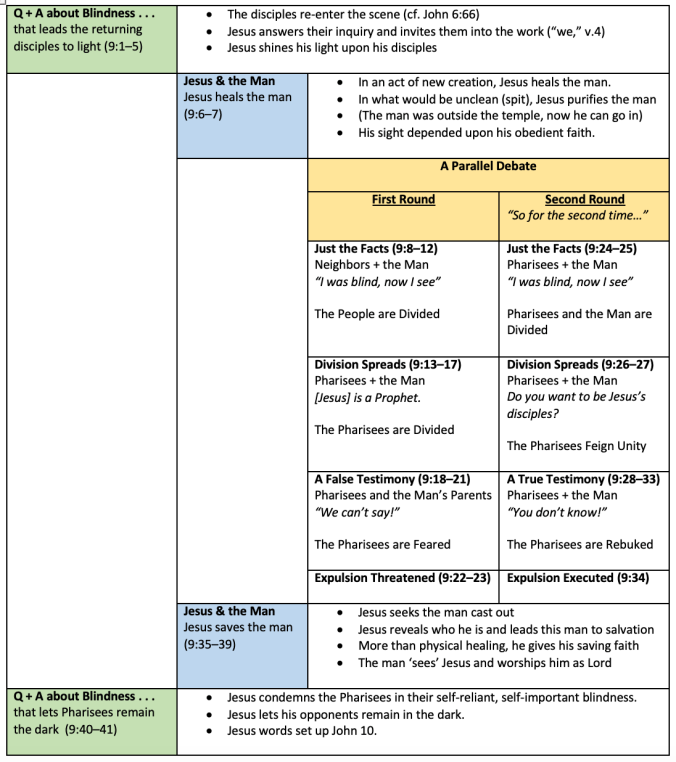
As I continue to study John’s Gospel, I grow increasingly amazed at the beloved disciple’s use of literary structure. Here’s a sampling of things to see in John 1–9.

For sake of time, I’m just going to leave this outline here. You can begin to make some biblical and theological connections as you read the chapter for yourself. Or check back in a week or so, and Lord willing, my sermon on John 9 will be up.

Screen Shot 2022-07-07 at 10.39.37 AM

Soli Deo Gloria, ds

Photo by Joshua Hurricks on Pexels.com
Truth on Trial: Seeing Who You Are By Hearing the ‘I AM’ (John 8:48–59)

john03Here is a life principle: Trials tell you who you are.

How many of us have thought we were strong, smart, and self-sufficient, until the trial came. Likewise, how many continue to believe they are calm, cool, and collected, until the trial.

Trials in life can have names like Alice or Anthony, COVID or cancer, divorce or depression. But whatever the trial is, it is the God-given means by which he reveals who we are.

Such trial are all the more more pronounced, if they take off their metaphorical garb and put on the legal robes of a judge. Maybe you have seen some of the fall out since Roe was overturned by the Dobbs decision.

Resident Biden announced by Twitter that abortion needs to be ratified as law. Senator Elizabeth Warren said that we need to crack down on anti-abortion pregnancy centers. And as I was typing this very sentence, an email came in with an update on David Dalaiden and his 9 felony counts that exposed Planned Parenthood for selling the body parts of babies.

Here’s the point: Currently and in the near future, more Christians will face real and legal trials. Just ask Barronelle Stutzman Stutzman and Jack Phillips, two faithful disciples of Christ, whose public faith required legal defense. So too with the Dobbs decision their will come Christians whose faith leads them to various trials and law courts.

So I say again, trials tell you who you are. And lest we think that Christians should avoid courts at all cost, we should get used to the fact, that faithfulness in twenty-first century America will include legal battles. And these battles—for those on the witness stand and those praying and watching and waiting—will reveal the character of all parties in involved. Continue reading

On Dobbs and the Growing Rift in America: Why Only a Spiritual Answer Explains the Division 

abortion[Photo Credit: Not The Bee]

June 24 is a date that all Christians should now mark on their calendar.

For nearly half a century, January 22 was the day that remembered the decision to make abortion available throughout America. And since the decision of Roe v. Wade in 1973, January 22 has been a day of prayer, petition, and planning for the end of Roe. And now, that prayer has been answered. Glory be to God!

On Friday, when the Supreme Court decided that Roe was not constitutional, they gave us a new day on the calendar to remember the sanctity of life and to give thanks to God for his mercy. June, a month co-opted for gay pride, has returned the rainbow, if for a moment, to its rightful owner—the God of mercy who does not give us what we deserve (see Genesis 9). More on the rainbow another day.

For now, it is worth remembering how the removal of Roe has been a rallying point for Pro-Life Christians for decades. And now that Roe has been overturned, we should give thanks to God for answering our prayers, and we should honor all those who sacrificed in order to make it happen.

Simultaneously, we should acknowledge the ways that elections have tangible consequences. In the election of Donald Trump, evangelicals supported this polarizing figure not because of his skin color, personal faith, or Twitter personality (definitely not his Twitter), but because of promises like this:

Incredibly, he fulfilled those promises. And Roe is now history.

At the same time, Roe’s end should bring incrementalists and abolitionists closer together, as they work to implement laws which protect life. Abolitionists should give thanks for the work incrementalists have done to end Roe, and incrementalists should take up the challenge set out by abolitionists to legislate equal protection under the law. Far more could be accomplished if these two approaches to abortion would work together.

Still, this post and the sermon that follows are less about abortion qua abortion. Rather, they are a biblical reflection on the spiritual warfare that fuels the battle over abortion. Indeed, as already evidenced by 41 cases of vandalism against pro-life groups, Christians should be ready for the increasing hostility that will come with the Dobbs decision. This is the point I want to make here.

Continue reading

Three Literary Mountains: Seeing the Chiastic Structures of John 7

adventure alpine background black and white

When I preached through the Five Books of the Psalms a few years ago, I began to see chiasms as “literary mountains” (see below). Which is to say, just as mountains in the Bible serve as meeting places with God, so chiastic structures (literary mountains) do the same. Because chiasms put stress on the high point of the passage, we should seek to understand how the author builds his argument and his artistry around that centerpiece. And what results is a staircase that moves up the literary mountain and back down again.Book 1

In John’s Gospel, there are more than a few chiastic structures. John 1:1–18 is carefully constructed as a chiasm. So is John 2–4 and John 5–11. And because the Gospel shows multiple chiasms, it validates our search to see further literary structures as chiastic (A-B-A). In fact, John 7 has three of these literary mountains—one small (John 7:1–9), one large (John 7:10–36), and one medium in size (John 7:37–52).

Without getting into all the interpretive details of all that follows, I offer the following literary structure. Each begin with the “feast of booths” as the gateway to each “mountain.” Then each put in the center of the chiasm, i.e., the high point of the mountain, the divide that stands in the crowd because of Jesus.

By looking at these these three chiasms together, it helps us get a sense for how to read the whole chapter, and to understand what the main point is—namely, that Jesus has come to fulfill the Feast of Booths, which will cause a divide between those who are enslaved to the shadow (i.e., the Law) and those who will believe in the substance (Christ, to which the Law points).

Tell me what you think? Does this reading match the text, as you see it? Or would you make adjustments? Continue reading

Blessed are the Un-Offended: For They are the Elect of God (John 6:60–71)

john03

Blessed are the Un-Offended: For They are the Elect of God (John 6:60–71)

Blessed is he who is not offended by me.
— Matthew 11:6 —

These are the words Jesus spoke to John the Baptist, when John sent his disciples to Jesus asking this question: Are you the one who is to come, or shall we look for another?

If you have never considered the pain of John’s words, it is worth time to ponder.

In John’s Gospel, John the Baptist is introduced as a faithful witness to Christ—a witness who so longed for the kingdom of God that he is willing to lose his kingdom. In John 3:30 he says, “He must increase, but I must decrease.” These are the words John declared, when his disciples came asking him about Jesus and the fact that more people were following him.

With humble faith, John accepted his role as a friend of the bridegroom and thus when the groom arrived, John rightly and righteously slipped out of the way. In fact, after John 3 the Baptist is not heard from again in John’s Gospel.

Nevertheless, this does not mean we do not know the rest of the story. Because we do! In Matthew 14, Mark 6, and Luke 9, we have the report that John was beheaded by Herod the tetrarch after his wife’s daughter requested decapitation as a party trick.

Yet, before his execution, Matthew 11 records the words that John sent to Jesus, as the forerunner to the Lord lay imprisoned, awaiting his deliverance or his death. And why does John ask his question about who he is? Is it because John doesn’t know Jesus, or believe him to be the Son of God? No, it is because things are not going as John anticipated! Continue reading

The Doctrine of Illumination in John’s Gospel

sunray through trees

It is the Spirit who gives life; the flesh is no help at all. The words that I have spoken to you are spirit and life. 64 But there are some of you who do not believe.” (For Jesus knew from the beginning who those were who did not believe, and who it was who would betray him.)
— John 6:63–64 —

The doctrine of illumination explains how spiritual insight is given to God’s children by the Holy Spirit. The locus classicus for this doctrine is 1 Corinthians 2:10–16, where the Apostle Paul explains the difference between those with the Spirit and those without. Describing this difference, he identifies two kinds of people—the natural man (i.e., the man without the Spirit) and the spiritual man (i.e., the man with the gift of the Spirit). In Paul’s thinking, there is no third category. The only way a man can rightly understand the mind of God is to have God himself reveal himself to the man. This occurs first in conversion, but then progressively in sanctification as the Spirit continues to instruct the saints through God’s Word (cf. John 17:17).

Going further, doctrine of illumination is the personal and subjective complement to the doctrine of inspiration. Whereas the Spirit inspired the words of the biblical authors (2 Pet. 1:19–21), the same Spirit must give light to the Scripture, in order for the child of God to understand God, his world, and his salvation. Without this illumination, the sinner remains in the dark—totally lost and wholly unable to find God (cf. Acts 17:27). Continue reading

Soul Food: When, Who, What, and Why Jesus is the Bread of Life (John 6:22–40)

john03

Soul Food: When, Who, What, and Why Jesus is the Bread of Life (John 6:22–40)

Hunger is a universal experience. So is thirst. And so is seeking to find food and drink in times of need.

Importantly, God made us creatures who need food and drink. And he did this not only because that is how organisms live, but that’s how God works. In other words, by giving us thirst, hunger, and the experience of seeking physical satisfaction, God is teaching us something about himself.

God is our spiritual food!

In John 6, this comes to the forefront as seekers cross the Sea of Galilee to find Jesus and fill their stomachs. Only in this case, Jesus exposes their errant seeking and he in turn leads them to seek food that will not perish.

Indeed, so many of our sins, follies, frustrations, and setbacks are caused by not knowing how to live on Christ, to feed on Christ, and to delight ourselves in Christ. But when we come to Christ and seek life in him, he teaches us that he is the bread of eternal life. And all who feed on him will be saved.

On Sunday, I considered what this means in John 6:22–40. You can find the sermon here. You can also find last weeks sermon too. Next week, Lord willing, I’ll pick up the sacramental language of Jesus calling us to eat his body and drink his blood. Stay tuned.

Soli Deo Gloria, ds

“I Thirst”: A Good Friday Meditation on the Meticulous Detail of Christ’s Cross

thirstAfter this, Jesus, knowing that all was now finished,
said (to fulfill the Scripture), “I thirst.” 
— John 19:28 —

Nothing was done by Christ which was not foretold;
nothing was ever foretold by the Prophets concerning Christ, which was not done.
— Alexander Watson —

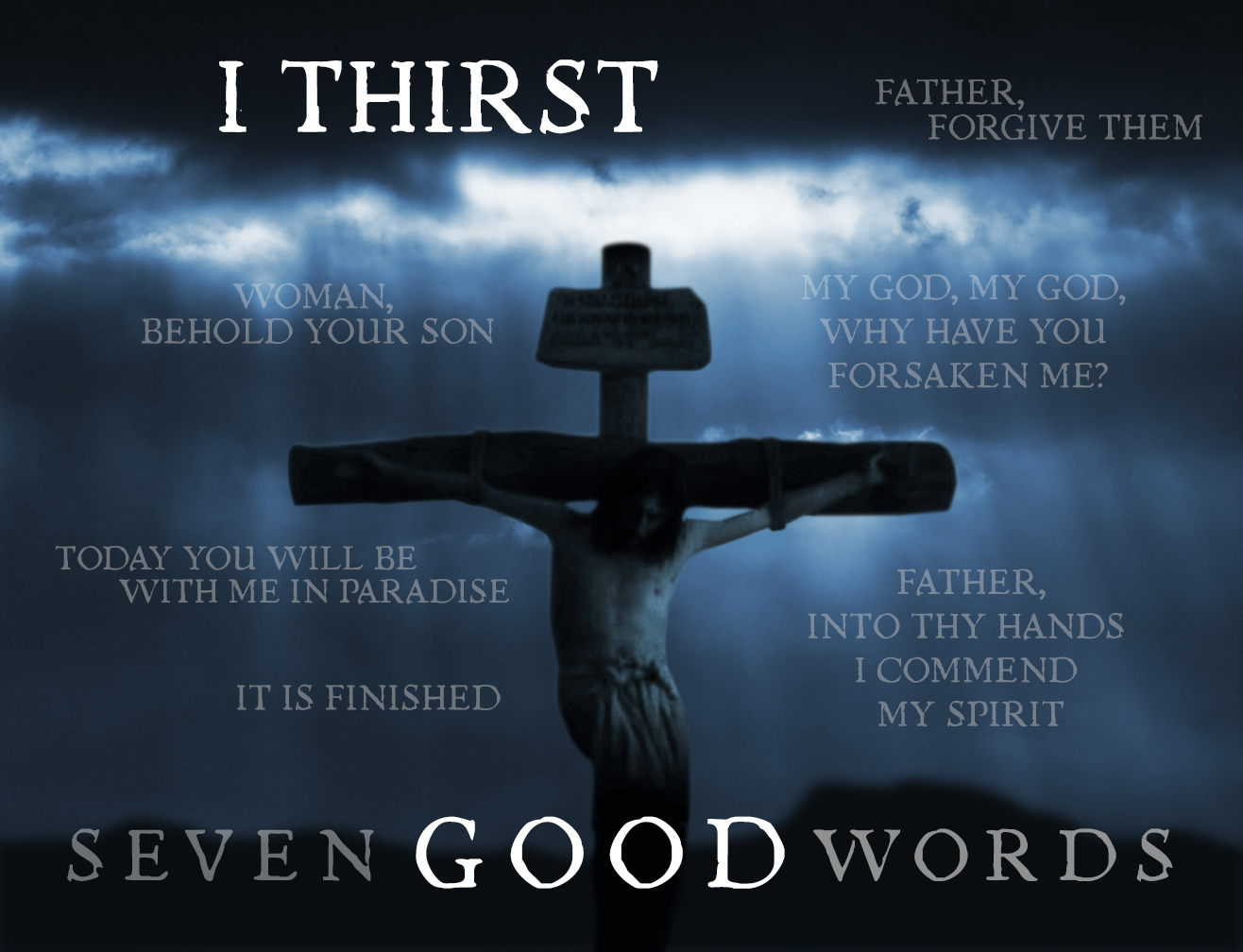
Tomorrow I will preach a Good Friday message focusing on the single word: dipsō (“I thirst”). For the last four years, our church has considered on Good Friday one of the seven words spoken on the cross. This year, we come to the fifth word, “I thirst,” a word that highlights the humanity of Jesus and the hostility of his enemies (see the context of Psalm 69). But it also shows how meticulous our Lord was in fulfilling Scripture.

In John 19:28, the Apostle notes the sharpness of Jesus’s mind, even as he bears the pain of crucifixion. And what is on Jesus’s mind as hangs on the cross? The Word of God that he must fulfill. To that point, he says, “I thirst,” a statement that may refer to Psalm 22:15, but more probably cites Psalm 69:21, which speaks of drinking sour wine, which Jesus does in John 19:29.

Tomorrow, I will consider the meaning of this fifth word, but today, I want to focus on the way Jesus perfectly fulfilled all the Old Testament, including this final statement of thirst. To help with this, I turn to Alexander Watson, a nineteenth century Anglican curate, who in 1847 preached a series of sermons called “The Seven Saying on the Cross; Or, The Dying Christ Our Prophet, Priest, and King.”  For the last few years, I have read these sermons—one per year—and have profited greatly. (For those in the know, I have not preached Watson’s sermons).

Continue reading

What Does Jesus Say About You? Four Witnesses, Four Warnings, Four Marks of Faith (John 5:30-47)

john03

What Does Jesus Say About You? Four Witnesses, Four Warnings, Four Marks of Faith (John 5:30-47)

Who do you listen to? And how well do you listen? An honest answer to those questions will tell you a lot about who you are and who you will be in five, ten, or fifty (thousand) years.

Few things are more important than the voices that we will listen to. And few gifts are more precious than men and women who testify to the grace of God in the gospel. If you are listening to others who speak of Christ, point to Christ, and help you follow Christ, you can know these are not just good friends, they are gifts from God.

On Sunday, we considered a similar line of thought as we heard the testimony of four “witnesses” who all tell us something about Christ. At a time when Jesus’ identity was in question and his actions were inviting opposition and the threat of death, Jesus turns to John the Baptist, his works, his Father, and the Scriptures to declare that he is the true Son of God.

Just the same, we need to hear these voices today, as they tell us who Jesus. Moreover, with these witnesses, Jesus warns us of many deadly symptoms of unbelief. Therefore, if you are looking to see who Jesus is or if your faith is genuine, this sermon may help. You can listen to exposition of John 5:30–47 here.

Soli Deo Gloria, ds

The True Sabbath-Giver: Finding Eternal Rest in Our Superstitious, Secular Age (John 5:1–18)

close up shot of bible text

The True Sabbath-Giver: Finding Eternal Rest in Our Superstitious, Secular Age

In his book, A Secular Age, Charles Taylor takes a long time to make a simple argument: Five hundred years ago it was impossible not to believe in God. Whether it was Christianity or some other religion, the world was filled with the divine. Today, however, the influences of science, technology, modern life and postmodern thought, have made belief in God nearly impossible. Or at least, it has become impossible to submit to a view of God and the world that is transcendent over places and true for all people.

Recently, we have seen this denial of God and his world in national news.  When a highly educated supreme court appointee doesn’t know what a woman is she – a woman – is feigning ignorance of biology in order to not offend the masses. Clearly, our civilization is not the same as it was when the light of Christ was brighter. Yet, darkness of the world does not diminish the spiritual need that humans have. Indeed, our secular age is not less religious. Instead, people just worship things that don’t deserve worship.

To say it differently, where the worship of a true and living God is lost superstitions abound. This is true for individuals, families, nations, and churches. Nature abhors a vacuum and so does the human heart. And if this is true today, it was equally true in Jesus day.

In John 5, we find something odd. Sitting just outside the temple was a group of invalids waiting for the waters to be stirred up in the pool of Bethesda. According to verse 7, and later clarified by the addition of verse 4, we find that many in Jerusalem sought healing not through prayer but through practices associated with other pagan mysterious religions. Clearly, something is wrong!

Indeed, entering a new part of John’s Gospel, the reader is brought back to Jerusalem, but instead of finding people in God’s city awaiting Israel’s restoration, like we see in Luke’s Gospel. We find a multitude of invalids waiting for a miracle that will never come. As Edward Klink notes,

With the abundance of evidence [around the Mediterranean] that pagan religion regularly used healing shrines with water as a regular component, it is not unlikely that [the tradition reported by John] is rooted in folk legend, possibly even a popular Jewish tradition.  (John, 269–70)

Wherever these pagan ideas came from, superstition has gripped a large number in Jerusalem. Even worse, the Jews – i.e., Jewish leaders – have done nothing about it. Rather like the priests condemned in the Old Testament, these guardians of the temple have permitted false worship and errant superstition. Even more, as they patrol the city watching for Jews who might be violating Sabbath, they have no care or compassion for those who are truly suffering.

So that’s the situation we find in John 5, and it will continue until John 11. For seven chapters, Jesus will be confronted by Jewish leaders even as he exposes their hypocrisy. In John 5:1 we read “After this [i.e.. the second sign in Galilee] there was a feast in Jerusalem.” The feast is not named, presumably because John wants to focus on the Sabbath, which is named in verse 9.

So in John 5, Jesus enters the scene on an unmarked Sabbath day. And in all that follows he is going to expose the weakness of the Sabbath under the old covenant, and he is going to give Sabbath rest to the man in ways anticipating the new covenant. That is to say, he is going to heal this man and send him to the temple, so that he can truly come to know the God of Israel (see John 5:14). And for us reading John 5, we come to learn something about superstitions, our Savior, and the Sabbath.

On Sunday, I preached on John 5 and you can find that sermon here. And in that message you will find the good news of Jesus Christ who is our true and better Sabbath-giver. Check back tomorrow too, where I will try to show why John 5, among other passages, does not permit me to be a Sabbatarian. Until then you can read this and leave comments below.

For now, may we give praise to God that the Son invites us to find rest in him and that such rest is not contingent upon our works but his.

Soli Deo Gloria, ds

Photo by Joshua Hurricks on Pexels.com