True Confession: When “I’m Sorry, I Messed Up” Isn’t Enough

How often have you heard or said, “Yeah, I know I messed up. I’m sorry.  I don’t know how it happened. I’ve got issues.”

This language is typical in our day, when as a culture we have abdicated responsibility, absorbed psychology as a means of explaining sin issues, and abandoned God’s perspective on guilt and forgiveness. Sadly, this kind of thinking is just as rampant in the church as in the world.

Confession, which is an integral part of the Christian life, has become less of a transaction of offense confessed and offense forgiven.  It has instead become, or it at least it appears often, as an excuse-laiden, cross-less, appeal for acceptance.  But is this new?  Not really.  In Exodus 32, we find in Aaron the age old problem of a false confession.

Exodus 32:22-24

After the golden calf is destroyed, Moses turns his attention to Aaron and the people. Like a lawyer before the judge, Moses questions the accused. In v. 21, “What did this people do to you that you have brought such a great sin upon them?” Aaron’s answer echoes that of Adam and Eve in the Garden.

Verse 22.  Aaron blames Israel for their evil. Which is true.  But it seems that he uses their wickedness as a shield from his own law-breaking.

Verse 23.  Then he recites the demands of the Israelites.  Further adding to their guilt.  Now, notice for a moment who is saying this—it isn’t a commoner in Israel; it is the priest.  The one who is supposed to remove guilt, not add to it.  Moreover, one wonders if Aaron uses the people’s words about Moses absence from camp to insinuate his own guilt in the episode.  For, if Moses had been there, none of this would happened.

Verse 24. Then finally he gets to his part. Instead of admitting the active role he had in “making” the calf, he shows surprise in how this beast was fashioned.  Paraphrased, it sounds like this “I threw the gold into the fire, and out popped this calf.”

It is easy to point at Aaron, or even to laugh at the ridiculousness of his excuse, but we should be quick to notice how similar we are to Aaron.  Paul says we are to learn from the counter-example of Israel (1 Cor 10:1-11), and thus God uses Aaron’s ridiculous confession to show us what confession is not.

Five Attributes of False Confession and True Confession

(1) Confession does not name others first; it takes the first step to admit wrong. There is no place in confession for pointing to the faults of others as contributing factors.  It is satisfied to single our self, and to deal with the Lord and others, without pulling others into the mix.  Though Scripture models corporate confessions–one thinks of Nehemiah or Daniel–personal confession has no business finding comfort in the sins of others.

(2) Confession does not blame-shift; pointing out the sins of others.  It points to self. It is not looking for a scape-goat or an external reason for the moral failure or relational offense.  There is no need to load our sins on anyone else, because for Christians, Christ has already taken that sin on the cross.  Thus confession gives us another reason to rejoice in sin pardoned.

(3) Confession does not simply claim that wrong was done; it is admitting your part. Unlike Aaron, who passively recounts the events of the golden calf, true confession steps up and says, “I am the man. Forgive me.”

(4) Confession does not aim to save face; it is looking to see the face of Christ again. With Christ and his cross in view, it always sees the penalty of sin as a bloody cross; but it also remembers that the greatest sin has been covered by the greater grace of God in Christ (Rom 5:20).  Thus, it frees us to confess even the most miserable and atrocious sins, because in Christ they have been fully forgiven.

(5) Confession is not a lame ‘yeah, I’m sorry,’ It demands a spirit of contrition & brokenness, and willingness to do anything to bring about reconciliation. It abandons personal rights, and is willing to suffer hardship to make-peace.

(6) Confession does not simply retell the shame, it agrees with God that the act, thought, speech, motive, pattern, etc was a sin, and then it boldly claims the blood of Christ as the once for all atonement for that hell-deserving sin.  

Confession that is true reiterates our belief that we are more sinful than we ever knew, and that Christ as our mediating high priest is more sufficient than we ever imagined. It is prompted by the Spirit and leads to forgiveness and cleansing (1 John 1:9).  It comes from a heart that has seen sin the way God sees sin; it cannot be manufactured, it is a gift from God.

In short, it is part and parcel of the Christian life, one that is illumined by God’s word and directed by the convicting work of the Holy Spirit.  For truly born again Christians, it should not be an irregular activity or something initiated by a pastoral reminder.  It should be a daily, even moment-by-moment offering to the Lord.

Still, with all that said, I wonder how many Christians do confession much like Aaron. I am concerned that many “Christians” play church–that confession, repentance, and reconciliation are not part of their daily lives.  And thus, their professed Christianity is nothing like the real thing.  Instead of a genuine relationship with Jesus, programs and platitudes have sufficed.

Ask yourself: How often do I make confession to the Lord, and to others?  Is it a regular practice of my life, one stimulated by the Spirit?

Jesus is clear. Those who are forgiven will forgive; and those who are convicted will confess. This is not optional; this is the normal Christian life.  God’s love confronts us and calls us to regularly confess sin and seek restoration with God and others, and Aaron’s errant confession teaches us that “I’m sorry, I’ve got issues,” just doesn’t cut it.

Lord pour out a Spirit of grace and pleas for mercy on your church and on me.

Soli Deo Gloria, dss
 

Sermon Notes: Exodus 34:6-7 In Biblical-Theological Context

The Context of Exodus 32-34

Exodus 32-34 are at the center of the tabernacle section (Exodus 25-40).  They function as a break between the instructions (25-31) and the construction (35-40). But the break is not just literary, it’s relational.

After all that God has done for Israel—remembering them in Egypt, redeeming them from slavery, making his covenant with them—Israel returns the favor by committing spiritual adultery.  In Exodus 32, God’s people make a graven image, and bow before it.  This invokes God’s wrath, but it also sets the stage to display YHWH’s mercy and grace.

Exodus 34:6-7 is the capstone of this passage, and in these two electric verses, we find the center of Old Testament Theology in God’s revelation to Moses (see Jim Hamilton, God’s Glory in Salvation Through Judgment for a full development of this idea).  These verses are programmatic for the rest of the Bible and they read,

The LORD passed before [Moses] and proclaimed, “The LORD, the LORD, a God merciful and gracious, slow to anger, and abounding in steadfast love and faithfulness, keeping steadfast love for thousands, forgiving iniquity and transgression and sin, but who will by no means clear the guilty, visiting the iniquity of the fathers on the children and the children’s children, to the third and the fourth generation.”

To know our God, it is vital to understand these passages in context and content. To better acquaint ourselves with this passage, notice three ways that God’s revelation on Sinai functions much like the cross in the New Testament.

1. Like the cross of Christ, these chapters show God’s mercy and his justice. Like a perfect kaleidoscope, they radiate the colors of God’s severity and kindness (cf. Rom 11:22).  In the New Testament, wrath and mercy meet at the cross; in the Old Testament they meet here.

2. Like the cross of Christ, the role of Moses is that of God-given Mediator.  In other words, he stands between God’s holy wrath and Israel’s rebellious sin.  In this way, as he pleads for mercy, he foreshadows Christ.  But lets not make the mistake that Moses or Christ change God’s mind; in both cases, the God who metes out perfect justice, also sends his a mediator to plead for pardon.  In this, there is the beautiful mystery that God who seeks to destroy Israel, is first the God works to save them.  He listens to Moses’ prayer, because he sent Moses to pray.

3. Like the cross of Christ, this episode shapes the rest of the OT (and NT). Exodus 34:6-7 is quoted throughout the rest of the Bible, and gives shape to all that follows.

This verse is picked up in places like Num 14:18. When Israel rebels against Moses, Moses quotes Exodus 34:6-7 in full as he pleads for Israel’s pardon. In the Psalms, it is often cited to remind Israel of God’s gracious character (cf. 86:15; 103:7).  But in the prophets, Nahum stresses God’s wrath: “The LORD is a jealous and avenging God; the LORD is avenging and wrathful; the LORD takes vengeance on his adversaries and keeps wrath for his enemies. The LORD is slow to anger and great in power, and the LORD will by no means clear the guilty. His way is in whirlwind and storm, and the clouds are the dust of his feet” (1:2-3). Even Jonah quotes the verse, saying it was this reason that he did not go to Nineveh, because the reluctant prophet knew God would forgive them if they repented.

Exodus 34:6-7 is so programmatic because of the way it expresses God’s relationship with the world.  YHWH is unchanging (Mal 3:6), yet people are not.  Thus, God has made a world in covenant with him.  Which means: Those who keep covenant will receive grace, mercy, and forgiveness (thru atonement).  However, for those who reject or ignore him, he loathes. His anger burns red-hot. His patience is slow, but not infinite.

Finally, Exodus 34:6-7 is fulfilled in Christ himself. In John 1:14, the beloved disciple introduces Christ saying, “And the Word became flesh and dwelt among us, and we have seen his glory, glory as of the only Son from the Father, full of grace and truth.”  The connection with Exodus 34:6-7 is in the last phrase.  The God who is abounding in steadfast love (hesed) and faithfulness (emeth) is fully revealed in Christ who is full of grace (charis) and truth (aletheia).

This is our God.  Though, Scripture reveals him progressively over time, he is the same yesterday, today, and forever.  The Old Testament God and the New Testament God are not juxtaposed, rather, as I recently heard D. A. Carson say, the New Testament vision of God is simply more clear and precise–this is true with God’s love and his justice.

May we this week, worship the God of Sinai and Calvary, and learn to know him in his faithfulness to forgiveness and judge.

Soli Deo Gloria, dss

A Temple Story: Tracing God’s Presence Through Scripture

A Temple Story

What is the best way to describe the Bible?  Is it a collection of verses that supply promises and warnings for the Christian life?  Is it a collection of books that each point to Jesus Christ?  Or is it an epic story of Paradise Created, Paradise Lost, Paradise Promised, and Paradise Made New in Christ?

Perhaps, the best answer is all the above.  While each of these three answers are correct, I think the last is the most difficult to see in Scripture.  In the last month at our church, we have given attention on Sunday mornings to the tabernacle in Exodus and how it fits into God’s plan of redemption.  Because of that, I want to give you a biblical roadmap that traces God’s “tabernacles.”  I think by seeing this line of dwelling places, it will give you and I a greater ground for hope in God.  Call it a temple story.

Garden of Eden.  This is God’s first dwelling place on earth. In Genesis 3, it describes God walking in the Garden in the cool of the day.  This garden has many features of the later sanctuaries of God—gold, bountiful trees, flowing rivers, priestly guardians, and more.  Thus, from the beginning, God sets a pattern for the kind of place he will inhabit with his people.

Exodus 25-40. On Mount Sinai God gives Moses a vision of his throne room, which becomes the pattern for the tabernacle and all future sanctuaries.  Interestingly, as we have seen this tabernacle points back to Eden and ahead to a New Eden.  The tabernacle given in Exodus is a portable Sinai where God’s people—through the priest—can climb the rungs of Jacob’s ladder and come into God’s presence.

1 Kings 8.  After Israel is settled and resting in the land, 1 Kings records how God gives Solomon wisdom to build a temple in Jerusalem.  This temple replaced God’s nomadic tent and became a permanent fixture in Israel.  It’s size and beauty surpassed that of the first tabernacle, showing that as time goes by, God’s temple increases in glory and beauty.

Ezekiel 40-47.  During the Exile, after God’s spirit had abandoned the temple, Ezekiel describes a future temple that overflows with streams of living water.  This water will cleanse the earth, and God’s presence will once again dwell with his people.  Significantly, when Jesus comes, John uses imagery from Ezekiel to describe Christ’s cleansing ministry (see John 7:37-39).

Jesus.  Perhaps most amazing of all, Jesus Christ is described as God’s dwelling place.  He is God with us, Immanuel.  John 1:14 says that the Word became flesh and “tabernacled” among us.  In truth, Christ is the meeting place between God and man.  In him the fullness of God dwelt bodily (Col 2:9), and in him we have access into the very throne room of God (Heb 10:19-25).  Therefore, we ought to come regularly into his presence with thanksgiving and supplication.

The Church.  Today, God dwells in heaven, but by his Spirit, he also dwells in his church. Paul says, “We are the temple of living God” (2 Cor 6:16), and that our bodies are the “temple of the Holy Spirit” (1 Cor 6:19).  Likewise, 1 Peter 2:5 describes believers as living stones “being built up as a spiritual house.”  In this way, the church is the spiritual house of God (Eph 2:19-22).

Revelation.  Finally, there is the promise at the end of the age that God will dwell with his people on earth.  In fact, Revelation 21 speaks of a New Jerusalem that will come down out of heaven adorned as a bride. It says there won’t be a temple, for the lamb will be the temple of God.  This is our hope. At the end of the age, all the cosmos will experience the glory of God’s holiness, and will be as sacred as innermost chamber of the temple.

This temple theme is a source of great wonder and hope.  When the world around us seems to be crumbling, the ever-steady rise of God’s dwelling place in our world is a gospel reminder that even if our flesh and funds may fail, God is bringing us into his dwelling place.

Remember what Jesus promised.  He said, “In this world, we would have tribulation, but take heart, I have overcome the world” (John 16:33).  Such a promise is good news, but its goodness grounded in another promise: “Let not your hearts not be troubled.  Believe in God; believe also in me.  In my father’s house are many rooms.  If it were not so, would I have told you that I go to prepare a place for you?  And if I go and prepare a place for you, I will come again and will take you to myself, that where I am you may be also” (John 14:1-3).

I am praying that this month God will give you and me a greater vision of his heavenly tabernacle, and that such a vision will purify our daily desires, and motivate us to live more radically for Christ.  God’s temple story gives us hope for tomorrow, no matter what is transpiring today.

Soli Deo Gloria, dss

Sermon Notes: The Sweet-Smelling Aroma of Prayer (NT)

Not only does the New Testament develop general themes of Christ’s fulfillment of the tabernacle.  It also picks up more specific details, like that of the golden altar of incense.  Yesterday, we considered the law and the prophets on this theme.  Today, we venture into the New Testament.

4. Christ’s offering is fragrant and acceptable to God.  We see this in at least two places in the New Testament.

Ephesians 5:2.  Walk in love, as Christ loved us and gave himself for us, a fragrant offering and sacrifice to God.  In Exodus, “fragrant” always described the incense.  Here, we have evidence of Christ’s offering on the golden altar and the sacrifice on the bronze altar.

Hebrews 5:7.  In the days of his flesh, Jesus offered up prayers and supplications, with loud cries and tears, to him who was able to save him from death, and he was heard because of his reverence.

5. The Gospel: We have a God who hears us.  In Christ, our prayers get behind the veil. In the nostrils of God our prayers are a fragrant offering because they have the scent of his son.  This is seen most convincingly in Revelation.

Rev 5:8. And when he had taken the scroll, the four living creatures and the twenty-four elders fell down before the Lamb, each holding a harp, and golden bowls full of incense, which are the prayers of the saints.

 Rev 8:3-4. Another angel came and stood at the altar with a golden censer, and he was given much incense to offer with the prayers of all the saints on the golden altar before the throne, and the smoke of the incense, w the prayers of the saints, rose before God from the hand of the angel.

In both of these texts, the prayers of the saints, are received in the presence of God, because they emit the fragrance of Christ’s sacrifice, as they are always lifted in the name and power and intercession of Jesus Christ.  This then leads to our application.

6. Christian Application: Pray. Pray confidently (Heb 4:16). Pray often (1 Thess 5:17). Pray in Christ’s name.  More specifically, let me list three points of application.

We do not come before God in our own name.  On our own, our works are an aroma of death and dung before God.  But in Christ, our prayers are a pleasing scent to God.  He delights for you and I to come and speak with him, because he “smells” his Son on us.  Thus in Christ, Proverbs 15:8 applies to us.

Proverbs 15:8. The sacrifice of the wicked is an abomination to the LORD, but the prayer of the upright is acceptable to him.

Now, you and I are not upright.  The law condemns our sin and unrighteousness.  But with Christ as our altar of incense, his righteousness covers us, and our unrighteous prayers are covered by his blood.  So that, they are pleasing to the Father!

The prayers that the enter heaven are prayers that are effective.  The good news of prayers by New Covenant believers is that they are not only empowered and directed by the Spirit, but they are guaranteed to have effect as we pray according to God’s will.

By extension, this means that God does not listen to the prayers of unbelievers. Psalm 66:18 says, “If I cherished iniquity in my heart, the Lord would not have listened.”  That is the perpetual state for those who don’t know Christ.

Because Christ is our fragrant offering to God, when we come in his name before the Father, we will never be turned away.  This is a great word that calls us to pray with greater intensity.

Soli Deo Gloria, dss

Sermon Notes: Christ’s Consecration is Our Confidence (OT)

TEST CASE # 1 :: Exodus 29: Consecration of the Priests

Following the five-fold model (Law, Prophets 1 &2, Christ, Gospel, Christian Application) presented in the last few days, I will today try to give a “test case” for getting from the consecration of the high priest in Exodus 29 to Christ to Christians today.

1. Exodus 29 gives explicit laws for consecrating the priest. 

Exodus 29 is an exposition of Exodus 28:41, “And your shall put them”—that is the priestly garments— “on Aaron your brother, and on his sons with him, and shall anoint them and ordain them and consecrate them, that they may serve me as priests.”  The point of the chapter is to explain how the high priest might be received into the presence of the Lord.  And it is an incredible process. To begin with, verses 4-9 give a point by point process for cleansing the priest.

Verses 4-9: Five Steps for Consecration

Verse 4. The priests are washed.  In a hot, dusty desert, these men needed a bath. This would not be sufficient, but it was a necessary beginning.

Verse 5. The priest is clothed.  All the garments made for “dignity and honor,” or “beauty and glory” were put on the priest.

Verse 6. The priest is crowned. The most significant element of the apparel was the turban.  It was put on last, and it essentially crowned the priest (Zech 6).

Verse 7. The priest is anointed.  With the anointing oil, the priest is ordained, as God’s chosen vessel to represent the people before him.  This anointing is defined with greater detail in Hebrews 5, where it says that the priest did not appoint and anoint himself.  As one commentator has said, this anointing basically stamped the priest with heavenly approval.

Verse 8-9. The priest is supported. Each of the priests are dressed and ready to serve him, in the service of the temple.

Verses 10-28: Six Atoning Sacrifices

Now everything was ready for the offerings.  In verses 10-28, Moses lists six different kinds of offerings that were involved in the priests ordination.  Most of these would be further explained in Leviticus 1-7, but let’s take a short survey here to simply mention the complexity of all the sacrifices involved.

Sin offering.  Unclean sections of the animal are taken outside the camp and burned.

Burnt Offering. First ram is completely consumed, symbolizing the priest’s total devotion

Ram of Ordination.  Only for the priests, this lamb was slaughtered and the blood applied to their ear lobes, thumbs, and big toes.  All the exposed parts of the priest are cleansed by the blood.

Wave Offering.  Taking the cooked meat and bread, the offering was waved before the Lord. Walter Kaiser describe them like this: “The waving was not from side to side but toward the altar and back, showing that the sacrifice was given to God and then received back by the priest for his use” (Exodus, 470). This food is then burned up on the altar as a Food Offering.

Peace Offerings.  Included in the consecration was the eating of the food before the Lord.  This ‘portion’ to eat represented the kind of peace the priests (and Israel) had with God through the atoning sacrifices.

Verses 29-42: Further Priestly Instructions

After the offerings came another round of detailed instructions.  Everything from how to boil the food that the priest would eat with God to directions on the daily offerings.

Verse 29-30.  God gives instructions concerning the garments, and how they are to be passed down from one generation to the next.

Verse 31-35.  The priests have instructions for boiling the meat and eating it.

Verse 35-37.  This ordination takes 7 days, again showing how weak the sacrifices were and how great was the need for cleansing.

Verse 38-42. On top of the ordination service, there is the morning and evening sacrifice, which twice a day provided atonement for the holy place.

This elaborate system, along with everything else in Exodus 25-40, was put in place to teach Israel about the holiness of God, the sinfulness of man, and what it takes to get into God’s presence.  In one sentence, the message was this: You need a priest who will represent you before God, and that priest needs the highest degree of cleansing.  Now the question becomes, “How did Israel do with this?”  Let’s see.

2. Malachi 2:1-9 shows how the priests failed to keep covenant with God. Reciting the covenant God had with Levi, Malachi indicts the sons of Levi for their corrupted service.

 And now, O priests, this command is for you. If you will not listen, if you will not take it to heart to give honor to my name, says the LORD of hosts, then I will send the curse upon you and I will curse your blessings. Indeed, I have already cursed them, because you do not lay it to heart. Behold, I will rebuke your offspring, and spread dung on your faces, the dung of your offerings, and you shall be taken away with it. So shall you know that I have sent this command to you, that my covenant with Levi may stand, says the LORD of hosts. My covenant with him was one of life and peace, and I gave them to him. It was a covenant of fear, and he feared me. He stood in awe of my name. True instruction was in his mouth, and no wrong was found on his lips. He walked with me in peace and uprightness, and he turned many from iniquity. For the lips of a priest should guard knowledge, and people should seek instruction from his mouth, for he is the messenger of the LORD of hosts. But you have turned aside from the way. You have caused many to stumble by your instruction. You have corrupted the covenant of Levi, says the LORD of hosts, and so I make you despised and abased before all the people, inasmuch as you do not keep my ways but show partiality in your instruction.

3. Zechariah 3 promises a new priest who will be pure and devoted to God. In a book full of Messianic promises, the hope of a royal priest who will cleanse the people is especially prominent, because God’s dwelling with his people depended on the people’s purity.  Verses 6-10 read,

Thus says the LORD of hosts: If you will walk in my ways and keep my charge, then you shall rule my house and have charge of my courts, and I will give you the right of access among those who are standing here. Hear now, O Joshua the high priest, you and your friends who sit before you, for they are men who are a sign: behold, I will bring my servant the Branch. For behold, on the stone that I have set before Joshua, on a single stone with seven eyes, I will engrave its inscription, declares the LORD of hosts, and I will remove the iniquity of this land in a single day. In that day, declares the LORD of hosts, every one of you will invite his neighbor to come under his vine and under his fig tree.

At this point in redemptive-history, the people of God wait for a pure priest.  God’s promise is sure, but the fulfillment is still future.  The flow of the narrative builds anticipation for the arrival of the Messiah.

Following the lead of the inter-testamental period, we will pause here too, and come back in our next post.

dss

Sermon Notes: How to Avoid Getting Lost on the Way from Leviticus 15 to Luke 15

On Monday, I suggested a five-fold system, a Gospel-Positioning System (GPS), to get you from obscure passages in the Law through the Prophets to Christ and the Gospel.  These five-steps are listed again.

1. Law
2A. Prophets: Judgment
2B: Prophets: Salvation
3: Christ
4: Gospel Response
5: Spirit-Empowered Action 

Today, I want to suggest four common errors that plague evangelicals today. Four ways we misread the Scriptures.

1. We skip from 1 to 5.  In pursuit of application and life-change, we read a command, a law, even a story, and we immediately move to application. Instead, of asking how the said pericope fits into the flow the Bible (i.e. textual, epochal, and canonical horizons), many of us move straight to activity.  This is wrong.  It misses the power of the law, the promise of the gospel, and the person of Jesus.  In effect, it makes the Bible about us, and no longer about Jesus.  The solution?  We must move from law through the prophets to Jesus Christ and then to us.  Personal application is vitally important but only after we encounter Christ.

2. We are afraid of 2A & 2B.  The prophets frighten us.  They are strange.  They don’t talk normal. They are hard to understand.  I get this!  I remember reading Isaiah 13-20 one time.  As I read the pronouncements against Babylon, Damascus, and Moab, I got upset.  Not because God was punishing these sinning nations, but because, “I needed a word from God, and this was not it”–so I thought.  I closed the Bible (for that day) upset, because I hadn’t seen how those words related to the rest of the Bible or my life.

If you have had an experience like that with the Prophets, it makes it hard to be a regular reader of that challenging genre.  Yet, to neglect the prophets is to neglect the greatest section of the Bible for fueling Christ-centered hope.

Maybe this will help: The prophets get a lot easier if we remember two things. First, they are speaking a word of judgment, based on the law against sinners like us.  Their words condemn covenant-breakers, social injustice, and unfaithful worship.  They speak to us about our sin.

Second, they are speaking a word of Messianic hope, based on the gospel. They give us glorious images of the Christ who is to come.  They offer salvation to sinful people, and the reality that God is going to bring recreate the world.  If we remember these two things and tie a rope from the law to the gospel, we can learn to walk thru these strange books.

3. We minimize 3.  This may sound strange, to minimize Jesus, but I have heard countless evangelical, Baptist preachers (and you have too) who preach and never mention Him.  Instead they list moral instructions from the life of Joseph or Caleb, and at the end say, “Unless you are Christian you cannot do what I just said.  So become a Christian.”

Friends, this is Christ-less preaching.  It has no power and I can hardly believe that a message without the content of Christ, will bring anyone nearer to our Lord and Savior.  In fact, it is disingenuous, to tell anyone to become a Christian after you have spent 40 minutes preaching moral lessons and not telling them about Christ.  Yet, this happens all too often.

4. We divorce 1-4 from 5.  If we are tempted to skip Jesus, we are more culpable of divorcing the gospel from application. In other words, we read the Bible for application, and we find all kinds of commands that say—Make disciples.  Love one another.  Be unified.  Forgive your enemies.  Turn the other cheek.

Yet, those commands have ZERO POWER, in and of themselves. These biblical commands are good, but in Scripture they are always set in relation to gospel promises.  To say it another way, imperatives are always grounded in gospel infinitives.  Why?  Because laws never produce godliness!  Grace produces godliness (Titus 2:11-13).

Jesus commands his disciples to be witnesses to all the nations, but he commands them to stay in Jerusalem until the Spirit comes so they will have power to do what he commands.  Paul tells us to forgive one another as Christ has forgiven you.  The power is in the gospel.  Failure to couple commands with Christ’s antecedent work, will lead earnest Christians to live the Christian life in the power of their own strength.

Instead, we must move to application and action, but as we do so, we must continue to walk in faith, loving others out of the love that has been poured into our hearts.

This is my prayer and hope!  That as we read Scripture, our minds are not just informed.  Rather, our eyes are opened to behold Christ and to become like him. Indeed, Jesus prayed that we would be sanctified by his word (John 17:17), and that comes to fruition when in his word, we see Jesus (2 Cor 3:18).

Open our eyes, Lord to see the wonder of Christ in the pages of Scripture, dss

What Does the Tabernacle Symbolize?

Justin Taylor has a helpful post on the meaning of the tabernacle on his blog today.  As we have seen in our study of Exodus, the tabernacle is filled with imagery that helps us better understand our own relationship with God.

Here is the ESV Study Bible note that he begins with on Exodus 25:1-31:17:

First, the tabernacle is seen as a tented palace for Israel’s divine king. He is enthroned on the ark of the covenant in the innermost Holy of Holies (the Most Holy Place). His royalty is symbolized by the purple of the curtains and his divinity by the blue. The closer items are to the Holy of Holies, the more valuable are the metals (bronze→silver→gold) of which they are made.

The other symbolic dimension is Eden. The tabernacle, like the garden of Eden, is where God dwells, and various details of the tabernacle suggest it is a mini-Eden. These parallels include the east-facing entrance guarded by cherubim, the gold, the tree of life (lampstand), and the tree of knowledge (the law). Thus God’s dwelling in the tabernacle was a step toward the restoration of paradise, which is to be completed in the new heaven and earth (Revelation 21-22).

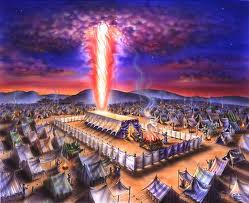
The explanation continues here with a full-color picture of the tabernacle.

For further reflections on the tabernacle see:

The Tabernacle as Typological Model

The Tabernacle as Holy Abode

The Tabernacle as God’s Meeting Place

The Tabernacle as a Royal Victory Palace

Soli Deo Gloria, dss

Sermon Notes: Holy to the Lord

Aaron’s priestly work brings holiness Israel

In our last reflection on Exodus 28, we see that verses 36-39 describe the priest’s turban. Front and center in this brief description, and on the priest’s head, is a the mention of a golden plate.  Engraved in this golden crown is the inscription, “Holy is the Lord.”

From this statement, it seems that Aaron and his sons’ ability to enter the holy of holies and not die, indicates that he was given the status of holy and pure. Does this anticipate imputed righteousness? Perhaps, but clearly from the surrounding context (esp. Exod 29), he is not intrinsically holy, but covered in the blood of sacrificial bulls and goats, and wearing his priestly apparel, he is “holy to the Lord.”

More importantly though, he is not just representing himself.  He is approaching the throne of God on behalf of Israel’s twelve tribes.  Their names are on his heart. Thus, his status of holy is representatively communicated to the people of God as well.  As the mediating priest for this people, he maintains or establishes the ongoing holiness of God’s treasured possession (cf. Exod 19:5-6).

Christ’s priestly work does not depend upon bulls and goats

Again in Exodus, we are working in types and shadows.  So, it must be asserted that at the same time that the priestly work effectively preserves the people of Israel–God really does dwell in their midst–the sacrificial system given to Moses on Sinai cannot really make Israel holy.  The blood of bulls and goats cannot cleanse from sin (Heb 10:4).  But as they point forward to Christ, God accepts these offerings for his people, until the fulness of time, when his own Son would come and fulfill the law.

In fact Hebrews 10:1-10 explains how Christ’s priestly service depends not on animal sacrifice, but rather his own holy life.

For since the law has but a shadow of the good things to come instead of the true form of these realities, it can never, by the same sacrifices that are continually offered every year, make perfect those who draw near. Otherwise, would they not have ceased to be offered, since the worshipers, having once been cleansed, would no longer have any consciousness of sins? But in these sacrifices there is a reminder of sins every year. For it is impossible for the blood of bulls and goats to take away sins. Consequently, when Christ came into the world, he said, “Sacrifices and offerings you have not desired, but a body have you prepared for me; in burnt offerings and sin offerings you have taken no pleasure. Then I said, ‘Behold, I have come to do your will, O God, as it is written of me in the scroll of the book.'” When he said above, “You have neither desired nor taken pleasure in sacrifices and offerings and burnt offerings and sin offerings” (these are offered according to the law), then he added, “Behold, I have come to do your will.” He does away with the first in order to establish the second. And by that will we have been sanctified through the offering of the body of Jesus Christ once for all.

With Christ as our perfect high priest, his holiness extends to all those for whom he represents.  As Hebrews 10:14 declares, “For by a single offering he has perfected for all time those who are being sanctified.”  To say it another way, the priestly work of Christ is particularly for those designated by God to receive the benefits of his atonement, not his enemies (v. 13).   Still, the effect of his purification goes even farther.

Christ’s priestly work purifies all of heaven and earth

There is only one other place in the Bible where an inscription reads, “Holy is the Lord.” It is in Zechariah.  Consider the what the prophet sees,

And on that day there shall be inscribed on the bells of the horses, “Holy to the LORD.” And the pots in the house of the LORD shall be as the bowls before the altar. And every pot in Jerusalem and Judah shall be holy to the LORD of hosts, so that all who sacrifice may come and take of them and boil the meat of the sacrifice in them. And there shall no longer be a trader in the house of the LORD of hosts on that day (14:20-21).

The question is what does it mean that “Holy is the Lord” is inscribed on the bells of horses?  What is Zechariah, the prophet, telling us about the age to come?

Consider a couple things. First, the bells are on a horse, not a human.  Though, I have had little experience with horses, the smell of Mackinaw Island stands out.  There on that little island, cars are not permitted, and thus the island has a certain “horsey” smell.  In other words, horses are not clean, and the bells on their bodies would certainly not, of themselves, have the kind of cleanness needed to enter the courtyard, let alone the holy of holies.

More biblically, the mention of horses in the Bible, though variegated, is often not holy.  In the law, kings were not meant to collect horses as a means of strength (Deut 17:16).  In the Psalms, there is exists a contrast between trusting in horses, or trusting in the LORD (20:7).  In the prophets, this sort of distinction, plays itself out with regularity (cf. Isa 31:1).  While not attempting to draw out a “theology of horses,” there is a certain kind of tension in the text, that the inscription of the priest is now engraved on the bells of horses.

Moreover, as verse 21 continues, this holiness is not limited to horses.  Rather, it is an example of how far-reaching this holiness is.  What does this mean?

Here is my proposal: This prophecy magnifies Christ’s priestly work!  So great is Christ’s priestly work that not only will his people be eternally redeemed by his blood, but all heaven and earth will be cleansed as well. His blood perfectly atones for the New Israel (Gal 6:16), but it also makes a way for all the earth to be purified.

Has this happened yet?  No, but the text in Zechariah is eschatological.  It is looking forward to “that day.’  The cleansing of the universe has not taken place yet.  New Creation is still forthcoming; and yet Christ’s new creation work has begun in the individuals who have been made priests by the blood of his atonement (1 Pet 1:18-19; 2:5, 9).  Thus, while we have not seen Zechariah 14 yet, we have every reason to expect that it will come to fruition “on that day.”

In the meantime, we have confidence that if Christ’s blood has the power to make horses clean, his blood has the power to make the worst sinner clean.  In other words, if the atonement is so extensive as to clean all the universe, than it must be have such an intensive power, that there is not one sin that God cannot forgive in Christ.

Indeed, that is the promise: For anyone who confesses there sins to God, he is faithful and just to forgive their sins and cleanse them of all unrighteousness (1 John 1:9).  This is the good news, and it seen in the tabernacle of Exodus 28, on the bells of horses in Zechariah 14, and throughout the rest of the Bible.

What could be better knews than that?

Soli Deo Gloria, dss


Ten Cultural Christs

Jesus asked Peter in Matthew 16:13 the most important question in the Bible when he queried, “Who do people say that the Son of Man is?”  How we answer that question is of eternal importance.  Sadly, many “Christians” today would have trouble defining who Jesus is because Jesus has been co-opted to promote so many different agendas.

Indeed as Stephen Nichols shows in his fascinating cultural study, Jesus Made in America, Jesus has become a commodity in the United States where he helps candidates gain voters and Hollywood sell movies.

Accordingly, in addition to presenting a positive view of Jesus when we teach the doctrine of Christ–as I begin to do tonight–it is just as important to show false Christs that have garnished favor in our Christian sub-culture.

What follows are ten “Cultural Christs” that are intentionally caricatured to highlight the false ways Christ has been portrayed.  There are surely others.  I would love to hear if you think these could be improved or added to.

Here we go…

  1.  The Therapeutic Jesussoft & soothing, helps you improve your self-esteem thru positive-thinking
    Followers of this view minimize sin and treat religion as a pick-me-up to get through the week.
    Motto: You can have your best life. (Big Smile)
  2. The Life Coach Jesuswill give you the tips and tools to succeed in whatever you do.
    Followers go to Jesus for personal interest—CEO Jesus, Touchdown Jesus, Matchmaker Jesus
    Motto: I can do all things through Christ who strengthens me (Phil 4:13)
  3. The Mr. Rogers Jesus… loves kids, morality, and helping you do the right thing.
    Followers go to church, do good, vote values, and help their neighbors.
    Motto: Won’t You Be My Neighbor?
  4. The Warrior Jesusis uber-macho and can be confused with William Wallace or Jack Bauer.
    Followers (male) rage against feminized pictures of Jesus, mistake ‘manliness’ with godliness.
    Motto: My Jesus Can Kick Your Jesus Butt.
  5. The Social Gospel Jesusimproves society through increasing social justice and meeting needs.
    Muting the gospel, these followers build houses, feed the poor, and fight AIDS for Jesus.
    Motto: Preach the Gospel and if necessary use words.
  6. The Politico Jesuspromotes idealistic activism, and it comes in two varieties.
    Riding an elephant, he fights against tax hikes, abortion clinics, and for prayer in schools.
    Riding a donkey, he promotes care for the environment and equal rights.
    Motto: God Bless the United States of America.
  7. The Wristband Jesusbecomes a Christian talisman. The presence of Jesus junk fights sin.
    Followers adorn themselves with Christian paraphernalia and focus on living life for Jesus.
    Motto: What Would Jesus Do?
  8. The Rock Band Jesusbuilds his church with fun activities and cool music.Followers live for Christian concerts, camps, and other lively events.
    Motto: Jesus rocks!
  9. The WordPress Jesusis hyper-orthodox and fights against theological error.
    Followers love reading books, debating theology, and publishing rants online.
    Motto: Love the Lord your God with all your MIND.
  10. The Love Wins Jesusrejects intolerant religionists and just loves everybody for who they are.
    Followers question authority, objective truth, judgment, and institutional religion, but love open-mindedness.
    Motto: God is love; everything is Spiritual.
In each of these caricatures there are elements of truth, but often truth out of proportion or in need of other qualifying biblical dimensions.  Most importantly though, each of these false christs fails to keep Jesus in the biblical storyline.  It highjacks Jesus for the needs of some other cause and puts him in a story that is not God’s story.  Thus, in order to rightly understand who Jesus is as the Christ, the Son of the Living God, we are again pressed to return to the Scriptures and mine out who he is from Genesis to Revelation. This is the task of the pastor, the Bible teacher, and every Bible-believing Christian.
May God give us illumination as we see Christ in Scripture and may he show us how our culture has shaped our views of Jesus, so that we might have a more clear view of who he is, because as we see him, so we become like him (1 John 3:2).
Soli Deo Gloria, dss

From Jubal to the Jukebox to Jesus: You Were Made to Sing

[This article was originally featured in our hometown newspaper, The Seymour Tribune]

You were created to sing. But you already knew that because you are likely already listening to something, if only the jingle that is stuck in your head. Whatever your preference, music is a defining element in our lives. It’s always been this way. Before the invasion of rock, the invention of rap or the instrumentation of classical, people were making instruments and song.

In Genesis 4, when Adam’s children began to multiply, Moses says that Jubal “was the father of all those who play the lyre and pipe.” Within two verses, Scripture records its first song, the “Song of the Sword.” Six millennia before Carrie Underwood took a Louisville Slugger to both headlights, songs about sex and violence were already on the jukebox.

However, Scripture does not simply recount the lustful lyrics of Lamech. It redeems the whole enterprise of song. While mankind, made in God’s image, sings, only those who know God’s redeeming love can sing the eternal song (Revelation 5:9-10).

Indeed, one of God’s greatest gifts is music, and the whole world enjoys it. However, God gives us more than music. For those who have ears to hear, God himself sings a song of redemption. Zephaniah 3:17 says, “The Lord your God is in your midst, a mighty one who will save; he will rejoice over you with gladness; he will quiet you with love; he will exult over you with loud singing.”

What a song that must be! God serenading those who have believed in the saving love of Jesus Christ (John 3:16). Of all songs, his is the Song of Songs. It fills the heart with joy, satisfying us with God’s eternal pleasures (Psalm 16:11). Better than sex, drugs and rock and roll, God’s song promises freedom, love and life in Jesus. And better still — God’s song doesn’t wear out and he will sing it to anyone who asks.