
Wide are God’s Mercies: Giving Public Praise to Our Lord for His Ongoing Work at Our Church

nathan-dumlao-KYiGu8qqEcM-unsplashMy companion stretched out his hand against his friends; he violated his covenant. 21 His speech was smooth as butter, yet war was in his heart; his words were softer than oil, yet they were drawn swords. 22 Cast your burden on the Lord, and he will sustain you; he will never permit the righteous to be moved.

– Psalm 55:20–22 –

Recently, I received an email that brought to mind a dozen or so events from the last ten years. The email was intended to lay charges against our church, myself, and my fellow elders. And, in a world that offers multiple perspectives, those accusations are certainly one interpretation. However, as we learn from Proverbs 18:17, “The one who states his case first seems right, until the other comes and examines him.”

Today, I have no interest in examining the charges made. They have been examined often over the last six months and before, but I do have an interest in giving thanks to God for the charges that have been made and for the events they recall. For in fact, all of things that were brought to light are, from another angle, testimonies of God’s grace. And thus, I want to give public praise to God for all the ways that his mercies have been made new over the last decade.

When Paul defended himself in 2 Corinthians against the charges of the super-apostles, he boasted in his weaknesses. In what follows, I will do much of the same. But more, I will boast in the kind and loving work of God in a local church that was once featured negatively in a book by Nancy Pearcey.

As with all local churches, ours is made up of members who have feet of clay. And yet, with clay feet we are learning to walk with our Lord, and looking back on the last three decades, God has demonstrated his mercy and grace again and again. And for that reality, I am profoundly grateful. And I share these ten reflections as a testimony to the wideness of God’s of God’s past mercies, which funds the promise of future grace.

Continue reading

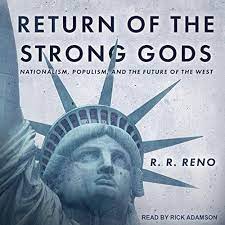
Tolle Lege: The Return of the Strong Gods by R. R. Reno

an aerial shot of the apple park in california

Apple Park in Cupertino, California

From Brexit to the rise and fall of Donald Trump, we have heard a lot about the dangers of globalism and return of populism. Many charged Trump with a kind of nationalism that led to all kinds of racism, fascism, and other political maladies. But many others, would share a concern for commercial giants like Apple, Amazon, and Alphabet Inc. (that’s Google’s parent company) who are assuming powers that transcend geopolitical nations.

In short, debates range today over what is most dangerous: Is it the tyrannical rise of globalism which calls for diversity, antiracism, and economic justice? Or is the greater concern a view of the world that affirms boundaries, borders, and limited budgets?

Those are big questions which touch on every area inch of public life, but connecting them all is a shared history of how to make sure that the fascism of Nazi Germany and the race-based slavery of America don’t happen again. Indeed, the push towards diversity and the denial of strong authorities is strongly associated with a push against the world events that ran from 1917 to 1945. Throw in the boom of technology and the ideologies of the 1960s (chronicled in Carl Trueman’s The Rise and Triumph of the Modern Self ) and you have a starting place for understanding our age.

The Return of the Strong Gods

renoAdding to this understanding in R. R. Reno’s book The Return of the Strong Gods: Nationalism, Populism, and the Future of the West. In this work of history and cultural commentary, Reno begins with the idea of the Open Society put forward by Karl Popper. He argues that Popper, along with many others, pushed hard against the militant authorities of the two world wars and called for a society that had no such “strong gods.” Reno explains how this worked out in the liberal policies of the 1960s and following, and how our world today is suffering under the weight of a world without any strong ideas. In other words, by evacuating strong leaders, strong ideas, strong gods from the world, it created a nice, safe, open space for individuals to express themselves without destroying others. Continue reading

A Little Help With Daniel 11:1–12:4: Three Aids for Reading This Challenging Chapter

bible 2Daniel 11 is a challenging passage of Scripture. Primarily, its difficulty rests in the fact that modern, Western readers do not know the history that stands between Daniel and Jesus. Such historical ignorance of about 550 years makes a crucial difference in knowing how to understand this long and complex passage. This is especially true with respect to Antiochus IV, who defiled the Jerusalem in 167 BC by offering unclean sacrifices on the altar, producing what Daniel calls the abomination of desolation. Both Daniel and Jesus speak of this event, and only when we understand how Daniel 11 points to this historical event, based upon God’s heavenly decrees (i.e., the book of truth in Dan. 10:21) can we rightly interpret this passage.

Indeed, Daniel’s prophecies are so precise, many scholars believe that Daniel must have been written after the fact.[1] Such a reading stands, however, on a commitment to explain away elements of predictive prophecy. By contrast, those who believe God inspired the Word of God have no little trouble letting the text speak. Scripture teaches us that God has declared the end from the beginning (Isa. 46:10) and that nothing occurs by accident. Rather, God has decreed in eternity what will take place in time. In fact, Daniel 10:21 speaks to this very thing, when the angel of the Lord states, “But I will tell you what is inscribed in the book of truth . . .”

As stated, Daniel 11 is a small portion or reflection of God’s eternal and immutable decree. In answer to Daniel’s prayers and his longing to see the temple of God rebuilt, God sends a fourth and final vision in Daniel to strengthen him and show him what will come next. Daniel 11, therefore, is a history that begins in the days of Daniel (535 BC) and runs until the days of Christ and his resurrection. In fact, as I preached two Sundays ago, I believe that Daniel 12:1–3 is fulfilled (better: has begun to be fulfilled) in the resurrection of Christ. And thus, Daniel 11 gives us a vision of history that runs for more than 500 years and that has implications even to our own day, as the resurrected Christ continues to raise people from the dead.

Still, to understand Daniel 11 in context, we might need a little help. In what follows, I offer three such ‘helps.’ First, I offer a link to the sermon I preached on Daniel 11. Second, I share below an account of a make-believe prophet of America that might provide insight into how we should read Daniell 11. Third and last, I’ve included a PDF of the notes I gave to our church when I preached on Daniel 11. They give a play-by-play of the historical turns in Daniel 11:2–35. Then, drawing on the work of Mitchell Chase, they offer an attempt to read Daniel 11:21–35 as parallel to Daniel 11:36–12:3. I believe Mitch has found a number of key connections in the text which confirms this approach to the chapter. I outline these in the PDF as well. May these resources be a help to you. Continue reading

Putting the Prophets in Their Place: An Introduction to the Historical Background of the Minor Prophets

mick-haupt-eQ2Z9ay9Wws-unsplashThere are four “major prophets” in the Old Testament—Isaiah, Jeremiah, Ezekiel, and the Twelve. While the first three major prophets are each associated with one prophet, the Minor Prophets (i.e., the Twelve) is a collection of twelve different prophets. Together, the twelve Minor Prophets compose a book of prophecy approximately the same size as the other Major Prophets.

Focusing our attention on the Minor Prophets, we can see that these twelve books originated over the course of four centuries (approx. 770 BC to 430 BC). Through this chronology, the Minor Prophets provide a unique perspective on the spiritual welfare of God’s people over time. While there are challenges to discerning the unity of the twelve, their chronology is especially important for understand God’s message.

Because the prophets are forth-tellers of God’s law, more than fore-tellers of God’s future, the prophets addressed the sinfulness of Israel/Judah, called for repentance, and promised mercy in a time to come. To rightly perceive their message, we must know the historical setting. Indeed, because prophets are given to Israel throughout their history (Jer. 7:25), it is vital to learn some basic events in Israel’s history if we are to learn the message of the prophets. Continue reading

Four Ideas That Led Margaret Sanger and Others to Deadly Consequences

sangerBecause ideas have consequences, it matters what a leader believes. This is true in general, but it is also true with the mother of abortion in America, Margaret Sanger.

Over the last week, I read the book Killer Angel: A Biography of Planned Parenthood’s Margaret Sanger by Presbyterian pastor George Grant. The book, commended by R.C. Sproul and Michael Milton, uncovers the dark life of Margaret Sanger. In Grant’s book, he exposes many of the underlying ideologies which fueled Sanger. To understand what drove her and what still drives her disciples, its vital to know her story, and Grant’s book is excellent. (Here’s my summary of it).

In what follows, I want to make four summary observations from Sanger’s life and legacy that show how her views of sex, culture, eugenics, and money led her to start an organization that continues to prey upon the most vulnerable in our country. My prayer is that by knowing more of her story it will help us to be better equipped to expose Planned Parenthood’s lies and bring hope to those who women targeted by their organization. Continue reading

What Does Revival Look Like?

fireWhen the First Great Awakening occurred in the 1730s and 1740s, Americans experienced a great outpouring of the Spirit of God. Many cried out in terror from a deep awareness of their sins. Many more wept for joy as they experienced genuine forgiveness and the power of the Spirit giving them new life.

Concurrent with these works of God, many false professions were also reported. While the Spirit “awoke” many from their spiritual tombs, Satan also manifested himself as an angel of light by deceiving many into believing they had experienced God when, in fact, they had not (cf. 2 Cor 11:14). As pastors of the era observed, many reported having heavenly visions while others heard God speak sweet words to them. Yet, what made these experiences prove false was the way that such people showed no corresponding change in behavior (i.e., holiness towards God and love towards others), nor was there explicit trust in Christ’s death and resurrection.

What does revival look like?

This was the question being asked in that era. And today, we ask it from another angle: How would we know revival if it came? Would it merely increase religiosity in our culture? Would it mean less crime, better families, or improved race relations? Or is there something more Christ-centered, even cross-centered, that must be seen? These are vital questions when considering revival and perhaps the best answer can be found from the Great Awakening itself. Continue reading

Why Should You Study Church History?

chIn the introduction of his book, Christian History Made Easy, Timothy Paul Jones gives a compelling answer to that question. Let me quote him at length.

In a classic Peanuts comic strip, Sally carefully labels her paper, “Church History.” As Charlie Brown glances over her shoulder, Sally considers her subject.

“When writing about church history,” Sally scrawls, “we have to go back to the very beginning. Our pastor was born in 1930.

Charles Schulz’s comic strip may be amusing, but it isn’t too far from the truth. In sermons and devotional books, Christians encounter names like Augustine and Calvin, Spurgeon and Moody. Their stories are interesting. Truth be told, though, most church members have a tough time fitting these stories together. The typical individual’s knowledge of church history ends with the apostles and doesn’t find its footings again until sometime in the twentieth century.

Still, the story of Christianity deeply affects every believer in Jesus Christ. The history of the Christian faith affects how we read the Bible. It affects how we view our government. It affects how we worship. Simply put, the church’s history is our family history. Past Christians are our mothers and fathers in the faith, our aunts and uncles, our in-laws and –in a few cases—our outlaws!

When a child in Sunday School asks, “How could Jesus be God and still be like me?” she’s not asking a new question. She is grappling with an issue that, in AD 325, three hundred church leaders discussed in a little village named Nicaea [ni-SEE-ah], now the city of Iznik in the nation of Turkey. Even if you’ve never heard of Iznik or Nicaea, what those leaders decided will influence the way that you frame your response to the child’s question.

If you’ve ever wondered, “Why are there so many different churches?” the answer is woven somewhere within two millennia of political struggles and personal skirmishes. When you read words like “predestined” or “justified” in the apostle Paul’s letter to the Romans, it isn’t only Paul and your pastor who affect how you respond. Even if you don’t realize it, Christian thinkers such as Augustine and John Calvin and Jonathan Edwards also influence how you understand these words.

So, if the history of Christianity affects so much of what we do, what’s the problem? Why isn’t everyone excited about this story? Simply this: A few pages into many history books, and the story of Christianity can suddenly seem like a vast and dreary landscape, littered with a few interesting anecdotes and a lot of dull dates.

Despite history’s profound effect on our daily lives, most church members will never read Justo Gonzalez’s thousand-page The Story of Christianity. Only the most committed students will wade through all 1,552 pages of Ken Latourette’s A History of Christianity. Fewer still will learn to apply church history to their lives. And so, when trendy novels and over-hyped television documentaries attempt to reconstruct the history of Christianity, thousands of believers find themselves unable to offer intelligent answers to friends and family members.

What we don’t seem to recognize is that church history is a story. It’s an exciting story about ordinary people that God has used in extraordinary ways. What’s more, it’s a story that every Christian ought to know. (Christian History Made Easy by Timothy Paul Jones, pp. 6–7: Book and DVD)

Do you believe that? I hope you do. Continue reading

Saint Patrick: Separating Missionary Fact from Fictitious Malarkey

What comes to mind when you think of St. Patrick’s Day? 

Leprechauns.  Ireland.  Wearing green.  Or drinking green beer.  If that is it, you may want to re-read the record books.  

A few years back, Russell Moore gave a brief history lesson on the real Patrick that should make every missionally-minded Christian sit up and take notice.  Drawing on the Philip Freeman’s 2007 book, St. Patrick of Ireland: A Biography, Moore summarizes Freeman’s work:

Freeman helpfully retells Patrick’s conversion story, one of a mocking young hedonist to a repentant evangelist. The story sounds remarkably similar to that of Augustine—and, in the most significant of ways, both mirror the first-century conversion of Saul of Tarsus. Freeman helpfully reconstructs the context of local religion as a “business relationship” in which sacrifice to pagan gods was seen as a transaction for the material prosperity of the worshippers. Against this, Patrick’s conversion to Christianity was noticed quickly, when his prayers of devotion—then almost always articulated out loud—were overheard by his neighbors.

The rest of the narrative demonstrates the ways in which Patrick carried the Christian mission into the frontiers of the British Isles—confronting a hostile culture and institutionalized heresy along the way. With this the case, the life of Patrick is a testimony to Great Commission fervor, not to the Irish nationalism most often associated with the saint. As a matter of fact, Freeman points out that Patrick’s love for the Irish was an act of obedience to Jesus’ command to love enemies and to pray for persecutors.

Likewise, Kevin DeYoung, also from the archives (ca. 2011), provides a brief missionary biography of Patrick.  He says,

Here’s what most scholars agree on: Patrick–whose adult life falls in the fifth century–was actually British, not Irish. He was born into a Christian family with priests and deacons for relatives, but by his own admission, he was not a good Christian growing up. As a teenager he was carried by Irish raiders into slavery in Ireland. His faith deepened during this six year ordeal. Upon escaping Ireland he went back home to Britain. While with his family he received a dream in which God called him to go back to Ireland to convert the Irish pagans to Christianity.

In his Confessio Patrick writes movingly about his burden to evangelize the Irish. He explicitly links his vocation to the commands of Scripture. Biblical allusions like “the nations will come to you from the ends of the earth” and “I have put you as a light among the nations” and “I shall make you fishers of men” flow from his pen. Seeing his life’s work through the lens of Matthew 28 and Acts 1, Patrick prayed that God would “never allow me to be separated from His people whom He has won in the end of the earth.”  For Patrick, the ends of the earth was Ireland.

According to one historian (again I am citing DeYoung’s research) “[Patrick] was the first person in Christian history to take the scriptural injunctions literally” (Richard Fletcher, The Barbarian Conversion: From Paganism to Christianity86)  meaning that he was the first person to take the Great Commission as a command.  Rightly, Patrick read Matthew 28:19 as a calling for him, and so he left home to take the gospel to pagans of Ireland. 

This literal and personal reading of disciple-making needs to be reissued today, because some still think Jesus’ words are for someone else. Tragically, they relegate Jesus’ missionary imperative to a bygone era or for some special class of people.  Yet, as Patrick’s life and labors show, when men take seriously the call to be a disciple-making disciple, God will bring great blessings.  Fifteen centuries later we have much to learn from Patrick.

I encourage you to read the rest of Moore’s blogpost (What evangelicals can learn from Saint Patrick) and DeYoung’s foray into history (Who was Saint Patrick?).  Together these two brief posts will help you determine fact from fiction.  They will give you many reasons to thank God for the missions-minded Brit who brought the light of the gospel to the whole nation of Ireland.

May Patrick’s brave example spur us on to share the gospel with our own pagan nation and hostile neighbors. 

Sola Deo Gloria, dss

The Beauty of the Incarnation

When God created the world, he filled it with splendor and beauty.  The sky above flashes a myriad of colors, and the world below is covered with majestic mountains, lush valleys, winding rivers, hidden lakes, and fields filled abundant wildlife.  All of which highlight the wise creativity of our God.

The beauty of our planet is so pervasive, that many give their lives for the preservation of the environment or the thrill of filming the most exotic locales.  Yet, God’s beauty is not just seen in creation.  The pages of history, while smeared with darkness and death, display a redemptive beauty that in the end will swallow death.  Aside from the death-defeating resurrection itself, nowhere is the jaw-dropping beauty of God’s sovereign story-telling more evident than in the incarnation of Jesus Christ.

Thus, as we think about aesthetics and the beauty of God in creation, history, and redemption, we must behold Christ’s humble beginnings.

Continue reading

Getting to Know Friedrich Schleiermacher (4): The Church, Eschatology, and the Trinity

Yesterday, we looked at Schleiermacher’s theology of God, Sin, Redemption, and the person of Christ. Today, we will examine his views on the church, eschatology, and the Trinity.

The Church

The last section of his systematic theology is on the church.  This breaks down into three sections—the origin, existence, and perfection of the church.  On the churches origin, he speaks of election and the Holy Spirit.  Concerning election, Schleiermacher vacillates.  On one hand, from the vantage point of the decree (which he speaks about but doesn’t really fit his system) God is the causal agent of all things in the world and thus he causes the election of those in the church, but on the other, as the one who knows all things, he elects based on future knowledge. Schleiermacher seems confused on this matter, and this is one the stress points of his system.  Concerning the Holy Spirit, Schleiermacher denies any deity to the Holy Spirit; instead, the spirit is the common spirit of the church.  The shared experience and feeling of Christ unites the church, and thus there is this universal spirit.

On the existence and practice of the church, Schleiermacher lays out six aspects of practice that are organized with the three offices of Christ.  So the church focuses on the Word of God and preaching as a means of the prophetic office; the church performs baptism and the Lord’s Supper in conjunction with Christ’s priestly office; and the church is invited to pray in the Lord’s name and exercise the keys of the kingdom in conjunction with Christ’s royal office.  In all of these, Schleiermacher reformulates doctrine.  So for instance, communion is not an ordinance laid down by Jesus, it is man’s demonstration of need for grace and the expression of his Godward dependence.  Likewise, prayer for Schleiermacher is not to a God who is outside of space and time; rather, prayer is the inward longing for God and his kingdom to be exercised in the world.

Eschatology

Finally, on the perfection of the church, there is no true doctrine.  It is only an idea.  Since doctrines are those things which church communities experience and record, there has not yet been an experience of a perfect church, and thus what the historical theologians have described as eschatology are merely conjectures.  He renames these doctrines “articles” and offers very scant evidence for them.  Instead, with great agnosticism, he states that we cannot know for sure what the resurrection, intermediate state, and the final judgment will be like.  In the end, he qualifies the doctrine of heaven and hell, to insist that in some way, all men will be reconciled and perfected.  In this, his view of election and universalism are similar to Karl Barth, who is one of Schleiermacher’s greatest critics.

The Trinity: An Appendix

Finally, in an appendix, Schleiermacher relegates the doctrine of the Trinity.   Its position there shows Schleiermacher’s connection with church history—it would be impossible to be a Christian theologian and not talk about this central doctrine.  And yet, because of his Kantian presupposition, he decides that the Trinity is neither practical, nor knowable.  And thus should be mentioned but not greatly used.

While, all these features of Schleiermacher’s theology mentioned above and over the last few days require a great deal more consideration, it is a start.  Tomorrow, we will look at how we should evaluate this theological giant whose shadow still looms until today.

Soli Deo Gloria, dss