Hermeneutics as Disciple-Formation

Christ in OTThe one who follows Jesus to the cross (but no further) is an admirer; the one who takes up the cross is a disciple. The admirer, unlike the disciple, follows Jesus only up to a point. . . . The Emmaus road admirers did not recognize Jesus; he was a stranger to them. They were incapable of reading the Scripture or the situation rightly. . . . Admirers [users and critics] of Jesus are able to follow the biblical testimony up to a point; they are able neither to recognize what it means for them nor to appropriate its perlocutionary effect [i.e., the way the word ‘works’]. Similarly, for many readers, the text is a ‘stranger,’ to be admired or followed only ‘up to a point.’ Like the Emmaus travelers, the itinerant reader may be familiar with the text without ever having a moment of recognition, without ever coming to a personal knowledge of the ‘strange new world of the Bible,’ without ever deciding whether the stranger [i.e., the triune God] is friend or foe.
 Kevin Vanhoozer, Is There a Meaning in This Text? —

Hermeneutics, technically defined, is “the science that teaches us the principles, laws, and methods of interpretation” (Louis Berkhof). Since college, this subject has been a passion and a pursuit. And so it is with great joy that I continue to consider this topic with the men of Occoquan Bible Church today.

Because the ‘science . . . of interpretation’ is actually part of God’s wise and gracious process of making disciples, it is vital we learn more than interpretive skills and techniques when we study hermeneutics. We must begin with the right posture of heart, which is to say the Holy Spirit must grant new eyes and new affections, so that as born again disciples of Christ our biblical studies bring us into greater communion with the triune God.

Keeping this personal knowledge of God at the center, I have tried to frame our study around the Father who Speaks, the Son who is that Spoken Word, and the Spirit who empowers us to believe and receive the Word of God. Most, if not all, of these thoughts are unoriginal, but novelty for novelty sake is never the goal of interpretation. Rather, the goal of Bible reading, I believe, is beholding Christ in all Scripture. With in mind, I share the notes here on three presuppositions (read: postures of the heart) disciples need to rightly understand the Word of God.

  1. Author — The God Who Speaks
  2. Text — The Word God Writes
  3. Audience– The Spirit Who Empowers Understanding (today’s lesson)

In these, my hope is to consider how faithful interpretation enhances doxology and discipleship. For any other aim misses the point of Scripture.  As Kevin Vanhoozer has wisely written, we must be disciples who receive the Word of God not mere admirers, dubious critics, or pragmatic users of God’s Word. To that end we pray and study.

Soli Deo Gloria, ds

The Covenantal Cast of the Biblical Canon

otThe covenantal character of Scripture challenges the idea of the Bible as a textbook. ‘For the Christian conception of God the Bible is our only textbook. In its pages we have the self-revelation of God.’ Without doubt, the Bible teaches us about God. It has a key didactic function: if we are to respond to God in the area of truth, we need to be instructed in the truth. But we also need to do justice to its covenantal nature, its function of finding us and holding us for God through its promises. The promissory nature of Scripture means that it gives us information about the plans and purposes of God. The Bible is God’s many-sided provision for his covenant people.[1]
– Peter Jensen –

In his book The Structure of Biblical Authority, Meredith G. Kline makes the case a canon is not a product of the church, but the product of God’s people in an ancient Near Eastern context. In other words, the biblical canon (i.e., what books are included as authorized Scripture) did not come after the Apostles, or for that matter, after the Old Testament Prophets. Rather, from the beginning, the canon has been a “closed” covenant document between God and his people.

In the first chapter of The Structure of Biblical Authority, Kline shows how ANE covenants had “canons.”

To sum up thus far, canonical document [sic] was the customary instrument of international covenant administration in the world in which the Bible was produced. . . . While it has been acknowledged [by critical scholars] that the Israelites at a relatively early time recognized certain written laws as divine revelation, the meaning of this for the history of the canon concept in Israel has been obfuscated. (37, 39)

He argues that a better understanding of “covenant” will correct our doctrine of canon:

The origin of the Old Testament canon coincided with the founding of the kingdom of Israel by covenant at Sinai. The very treaty that formally established the Israelite theocracy was itself the beginning and the nucleus of the total covenantal cluster of writings which constitutes the Old Testament canon. (43)

From this covenantal origin, the canon grew as the covenants of God with his people developed over time.

“Our conclusion in a word, then, is that canon is inherent in covenant, covenant of the kind attested in ancient international relations and the Mosaic covenants of the Bible. Hence it is to this covenant structure that theology should turn for its perspective and model in order to articulate its doctrine of canon in terms historically concrete and authentic” (43–44).

According to Kline, God’s people have always had a canon to document their covenant with God. In truth, this canon was not codified until Sinai, when Moses wrote down God’s Words (after God himself etched his law in stone). But from the beginning, God’s people had a clear and sufficient word that established his covenant rule. From this beginning, we shouldn’t be surprised to see that the Bible is and has always been cast in the mold of covenant. Continue reading

On Typology: Ten Axioms from God’s Kingdom through God’s Covenants

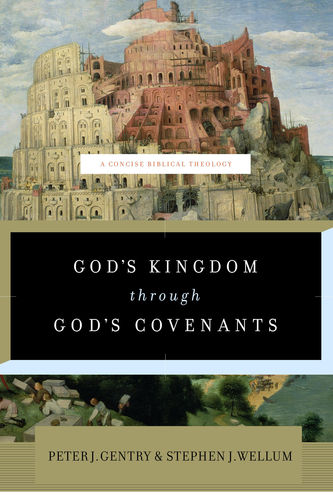
ktcIn the opening pages of their “concise biblical theology,” God’s Kingdom through God’s Covenants (GKTGC), Stephen Wellum and Peter Gentry lay out a description of typology that is worth considering. In what follows, I’ve synthesized their discussion into ten axioms. All of the quotations are from GKTGC; the references to other authors are found in their discussion (pp. 38–43). I’ve also taken the liberty comment and expand their thoughts in a few places.

1. Typology is not allegory.

This is an important distinction, one that is often confused. Wellum and Gentry write, “The major difference is that typology is grounded in history, the text, and intertextual development, where various ‘persons, events, and institutions’ are intended by God to correspond to each other, while allegory assumes none of these things.” Moreover, “‘allegorical interpretation’ depends on some kind of extratextual grid to warrant its explanation.” (38)

2. Typology is textual-historical.

Citing Richard Davidson,  Wellum and Gentry explain, “Typology is symbolism rooted in historical and textual realities.” But more than isolated (synchronic) symbols scattered in Scripture, biblical types (i.e., redemptive events explained by inspired Scripture) fit into a larger system of revelation. Richard Lints defines this when he says, “The typological relationship is a central means by which particular epochal and textual horizons are linked to later horizons in redemptive revelation.” (39) Continue reading

Let the Reader Understand: Interpretation That Sanctifies (1 Corinthians 10:1–13)

sermon photoTypology. Intertexuality. Biblical interpretation. Sanctification.

Those are esoteric subjects for a nerdy few, right? Well, I don’t think so. At least, according to 1 Corinthians 10, we see how the Apostle Paul cites ten different events in Israel’s history, which he says were written down for the church, as a means of instruction and sanctification.

In a section of 1 Corinthians where Paul continues to confront idolatry, Paul teaches us how to read the Bible and what ongoing purpose the Old Testament Scripture has for New Testament churches. You can listen to or read this week’s sermon. Below are discussion questions and resources for further study.  Continue reading

Israel and the Church: Continuity, Discontinuity, or Something of the Two?

haysIn his influential study on intertextuality, Echoes of Scripture in the Letters of PaulRichard Hays argues the apostle Paul’s hermeneutic is “functionally ecclesiocentric rather than christocentric” (xiii). In a series of essays, he shows how the apostle applies Old Testament texts to the New Testament church, and in so doing he questions the commonly held assumption that Paul wrote with a Christocentric approach to the Old Testament.

In comparison to the Gospels, especially Matthew and John, Hays shows that Paul is much more reticent to cite messianic prooftexts. Rather, writing to local churches who are comprised of the eschatological people of God (cf. 1 Corinthians 10:11), he applies the Old Testament scriptures semi-directly to the church. I say semi-directly, because the old covenant scriptures only apply through the mediation of Jesus Christ, a point Hays goes on to affirm: “christology is the foundation on which [Paul’s] ecclesiocentric counterreadings are constructed” (120).

For Hays, his aim is to observe the hermeneutical principles at work in Paul’s letters. My question is more systematic. What does Paul’s method of interpretation say to us about the relationship between Israel and the Church? Debates rage between Dispensationalists who make a clear division between Israel and the Church and Covenant Theologians who have ostensibly replaced Israel with the Church. Thankfully, these hard divisions have been revised in recent years—Progressive Dispensationalists see more continuity between Israel and the Church (even as they retain a unique place for Israel), and Covenant Theologians like Richard Gaffin and Anthony Hoekema have centered Old Testament promises in Jesus Christ and his new covenant people. Still, the debate continues: how should we relate the testaments? Continue reading

Hearing the Voice of God: Ten Axioms About God’s Authorship of Scripture

bible“The fear of the Lord is the beginning of wisdom.”
– Proverbs 1:7 –

“The fear of the Author is the beginning of literary understanding”
– Kevin Vanhoozer[1]

This morning, I have the privilege of beginning a series of “studies” on hermeneutics and biblical interpretation among the men at my church. The title I’ve chosen is “Toward Doxology and Discipleship: Presuppositions and Principles for a Trinitarian Reading of Scripture.”

Influenced by the work of Kevin Vanhoozer, my aim is to lay out three presuppositions in the next three months concerning the three horizons of communications—author, text, and recipient(s). By taking a trinitarian approach—where we see the Father as speaker, the Son as the content of Scripture, and the Spirit as the One who enables people  to rightly receive understand God’s speech—can are ready to rightly read Scripture.

Only after this triad of communicative presuppositions, can we employ biblical principles that cohere with God’s inspired Word.  That’s the goal of the next three studies, where I hope to outline the three horizons of the biblical text to show how every interpreter of of the Bible must do justice to the textual, covenantal, and canonical horizons (so Edmund Clowney, Richard Lints, etc.). Only by reading texts with respect to grammar and history, covenantal or epochal placement in the Bible, and the final revelation of Christ in God’s canon can we fully appreciated all Scripture has to say to us, indeed what God is speaking to us even today (see Hebrews 3:7).

If you are interested, I’ve included my notes for this week and listed below my ten concluding “axioms” that show the cash value of starting with the doctrine of God, and more specifically why bringing his Authorship to the forefront is imperative for good hermeneutics. If hermeneutics is “your thing,” or if it is not, I’d love your feedback. Continue reading

Spiritual Leadership: Gospel Rights and Responsibilities (1 Corinthians 9:1–12)

sermon photo

Spiritual Leadership: Gospel Rights and Responsibilities 
(1 Corinthians 9:1–12)

In May I preached three messages on church leadership

Now this month, we come back to the theme of leadership in the church, as 1 Corinthians 9 picks up some of these crucial themes. However, Paul is not merely digressing to complete what he left unsaid in 1 Corinthians 4. Rather, he is using his ministry as an example of self-denial for the good of others. At the same time, he is defending his apostleship against the examiners in Corinth.

In this way, 1 Corinthians 9 reveals how gospel-centered ministers and gospel-centered churches work together to announce the good news of Jesus Christ. This week’s sermon focuses on the rights of gospel minister; next week we will (Lord willing) consider the second half of Paul’s argument, the rights he refused for the sake of the gospel.

You can listen to the sermon here, read the sermon notes here, or discuss the questions and resources below. Continue reading

‘Do Not Muzzle the Ox’: A Logical, Intra-biblical, and Eschatological (but not Allegorical) Reading of Deuteronomy 25:4 in 1 Corinthians 9:9


paulDo I say these things on human authority? Does not the Law say the same? For it is written in the Law of Moses, “You shall not muzzle an ox when it treads out the grain.” Is it for oxen that God is concerned? Does he not certainly speak for our sake? It was written for our sake, because the plowman should plow in hope and the thresher thresh in hope of sharing in the crop,
– 1 Corinthians 9:8–10 –

When Jesus describes the value of the sparrow in Luke 12 and says, “Fear not; you are of more value than many sparrows” (v. 7) is he speaking allegorically? What about when he tells the elaborate parable about the four soils (Matthew 13:1–9, 18–23) or the wheat and the tares (Matthew 13:24–30, 36–43)? The answer will depend on how you define ‘allegory,’ but most will not see Jesus’ comparison with the sparrows as an allegory, even as many do see Jesus parable as incorporating allegorical elements.[1] What makes the difference? And do we rightly read allegory, without allegorizing?

Allegorical Literature vs. Allegorical Interpretation

In truth, there are in Scripture elements of allegory. When Jesus explains some of his parables by saying, “The field is the world, and the good seed is the sons of the kingdom. The weeds are the sons of the evil one, 39 and the enemy who sowed them is the devil” (Matthew 13:38–39), he is speaking in allegory. Allegory by definition is

A work of literature in which many of the details have a corresponding “other” meaning. The basic technique is symbolism in the sense that a detail in the text stands for something else. Interpreting an allegorical text must not be confused with allegorizing the text. To interpret an allegorical text is to follow the intentions of the author. Allegorizing a text  implies attaching symbolic meanings to a text  that was not intended by the author to be allegorical.[2]

This distinction between between allegorical literature (e.g., The Pilgrim’s Progress) and allegorical methods of interpretation (e.g., Origen’s approach to the Bible) is one of the most confused and confusing aspects of modern evangelical hermeneutics. To be sure, Scripture includes multiple instances of allegory.

  • When Jotham told his story of the bramble who would be king, he used allegory (Judges 9).
  • When Nathan confronted David in his sin with Bathsheba, he employed allegory (2 Samuel 7).
  • When Jesus told his parables he often intended for one element (“the field”) to stand for another (“the world”). This is allegory.
  • Paul even understands the story of Sarah and Hagar (Genesis 16ff) to be written “allegorically” (Galatians 4).[3]

In each of these instances, the author’s intent is allegorical. (Except the last example, Galatians 4, is best understood as typological writing in Genesis). Therefore, the extant literature is allegorical, which requires any literal method of interpretation (i.e., one that aims to understand and reproduce the authorial intent) to read the passage “allegorically.” But—and this is where the confusion comes in—in reading the biblical allegory, we must not allegorize the text. And even more, we must not adopt an allegorical method because we find some allegories in Scripture.

But this brings us to the text in question (1 Corinthians 9:8–10): Did Paul use an allegorical method in his quotation of Deuteronomy 25:4? And if he is allegorized a passage from the law—a genre not given to allegory—can we do the same? Or did he, like Jesus with the sparrows, make a simple comparison between oxen and men? Or did he do something else entirely?

Logical, Intra-biblical, Eschatological: Tracing Paul’s Argument

Following the lead of John Calvin, Richard Hays, and others, I will argue that Paul’s use of Deuteronomy 25:4 is (1) logical in its structure (not fanciful), (2) textual (not twisting the original context of Deuteronomy), and (3) theological (specifically, eschatological). But in no way is it allegorical. Continue reading

Will the Real Elijah Please Stand Up? Learning from Jesus How to Read the Bible Literally

elijah“Behold, I will send you Elijah the prophet before the great and awesome day of the Lord comes. And he will turn the hearts of fathers to their children and the hearts of children to their fathers, lest I come and strike the land with a decree of utter destruction.” (Malachi 4:5–6)

And the disciples asked him, “Then why do the scribes say that first Elijah must come?” 11 He answered, “Elijah does come, and he will restore all things. 12 But I tell you that Elijah has already come, and they did not recognize him, but did to him whatever they pleased. So also the Son of Man will certainly suffer at their hands.” 13 Then the disciples understood that he was speaking to them of John the Baptist. (Matthew 17:10–13)

Every self-respecting, Bible-believing evangelical wants to read the Bible “literally.” No one wants to be called a “spiritualizer” or accused of (un)intentionally “allegorizing” the “plain meaning of Scripture.” But what does it mean to read the Bible “literally”?

On one hand, it is mistaken to read a passage text differently than the author intended. A well-formed grammatical-historical  approach to interpretation affirms authorial intent and the possibility of discerning meaning in a text. On the other hand, it is mistaken to read the biblical text so rigidly (read: literalistically) that in the name of seeking the literal meaning of the text we miss the meaning of the Bible’s divine author. But how do we discern the difference?

The best way I know is to watch and learn from Jesus himself. Continue reading

Books on Biblical Theology: A Brief Annotated Bibliography

biblical theologyYesterday evening I taught on ‘Seeing Christ in All the Scripture‘ in our Sunday evening service. As we emphasize the discipline of biblical theology this summer at our church, I put together a handout showing how the New Testament teaches us to read the Old Testament and how the Old Testament demonstrates a series of pattern which culminate in Christ. You can see the front of that handout here. Below is the back side, which lists and introduces books on biblical theology for children, beginners, and beyond.

Children

  1. The Big Picture Story Bible by David Helm – Perfect for ages 3–103, David Helm traces the idea of God’s People in God’s Place under God’s Rule. He teaches young children how to read the Bible with Christ at the center.
  2. Jesus Story Book Bible by Sally Lloyd-Jones – Suitable for ages 5–105, Lloyd-Jones, who I’ve recently learned is *not* related to the famous Dr. Martyn Lloyd-Jones (thanks Gilbert!), goes into greater depths than Helm. She too shows how the types, shadows, and patterns in the Old Testament find their fulfillment in Christ. At points, her story Bible is quite funny as it considers the stories of Scripture.
  3. The Gospel Story Bible by Marty Machowski – Ideal for ages 7–107, Machowski’s book takes the story of Christ even further. It includes a couple questions about the story on each page, as well.

Together, each of these illustrated children’s Bibles contain slightly more content as they teach young ones (and older ones) how Christ is the pinnacle and linchpin of the whole Bible.

Beginner

  1. According to Plan: An Introduction to Biblical Theology by Graeme Goldsworthy – In my estimation, this is the introduction to biblical theology. It gives a short ‘how-to’ and a readable overview of the whole Bible through the gospel of the kingdom. He has also written a more comprehensive biblical thelogy: Christ-centered Biblical Theology that gives even more explanation of his method and approach.
  2. God’s Big Picture by Vaughn Roberts – A short, eight-fold explanation of redemptive history centered on the kingdom of God.
  3. Reading the Bible Through the Jesus Lens by Michael William – It gives a short, Christ-centered interpretation of every book in the Bible. Any teacher doing a BT overview should have this book.
  4. The Drama of Scripture: Finding Our Place in the Biblical Storyline by Craig Bartholomew and Michael Goheen – Speaks of the Bible as a five act drama, where the analogy of drama is effectively used to explain redemptive history.
  5. The Unfolding Mystery: Discovering Christ in the Old Testament by Edmund Clowney – Any student of Biblical Theology should know Clowney, and this worship-inducing book is the best introduction. Preachers should also commit to reading his short book Preaching and Biblical Theology.

Intermediate

  1. The Goldsworthy Trilogy by Graeme Goldsworthy – Three-Books-in-One: Goldsworthy applies his ‘gospel-centered’ approach to the whole Bible, Wisdom literature, and the book of Revelation. For those tired of reading Revelation in light of shifting current events, Goldsworthy shows how Revelation is a book about Jesus.
  2. Dominion and Dynasty: A Biblical Theology of the Hebrew Bible by Stephen Dempster – Picking up the royal themes of people and place, Dempster beautifully shows the unity of the Old Testament.
  3. Magnifying God in Christ: A Summary of New Testament Theology by Thomas Schreiner – This abbreviation of his outstanding New Testament Theology gives a rich overview of NT Theology. He also has a large, but very readable Biblical Theology, The King in his Beauty.
  4. From Eden to the New Jerusalem by T. D. Alexander – Tracing six crucial themes (e.g., temple, sacrifice, sovereignty, etc.), this book shows how to move from Genesis to Revelation.
  5. New Dictionary of Biblical Theology – Although large, this is the one-stop shop for biblical theology. In three sections, a bevy of evangelical scholars (1) give instruction on how to approach biblical theology, (2) introduce every book of the Bible, and (3) summarize many important Biblical Theological themes. Every serious Bible teacher should have this reference work.

Advanced

  1. Biblical Theology by Geerhardus Vos – The classic work on Biblical Theology. This book is hard-going at times, because it contains a great deal of interaction with higher-criticism (the academic viewpoint that takes the Bible as as compilation of man-made books, not a unified revelation, inspired by God). However, if you can wade through the chaff, you’ll benefit immensely from this Princeton Giant—not to mention, you will gain an appreciation for what it took for the modern genesis of evangelical biblical theology to emerge.
  2. God’s Kingdom Through God’s Covenants by Stephen Wellum and Peter Gentry – Contrasting Covenant Theology and Dispensationalism, these two Baptist scholars argue for a series of covenants (progressive covenantalism) as the “backbone” of the Bible. This book abbreviates and gives some response to objection to their earlier book, Kingdom through Covenant.
  3. Progressive Dispensationalism by Craig Blaising and Darrell Bock – A well-researched and irenic book which updates older models of Dispensationalism. Dispensationalist and non-dispensationalists alike would benefit from this well-argued book.
  4. The Temple and the Church’s Mission by G.K. Beale – Long, but worth the read. If you ever want to see how exegesis flows into Biblical Theology for the sake of the church, this is your book. At the same time, this book makes a whole-Bible argument for why Christians should not expect a future reconstruction of the temple.
  5. God’s Glory in Salvation through Judgment by Jim Hamilton – Hamilton shows how salvation and judgment redound the praise of God in every book of the Bible. Hamilton’s forte is showing the literary structure of each book and how each book contributes to theme of God’s glory.

There are countless other books that could be added to this list, and thankfully more continue to be published each year. If there are others that should be mentioned, feel free to suggest them in the comments. For now, I will commend these books to you, with one additional series: New Studies in Biblical Theology. Recognizable by its silver covers, this series edited by D.A. Carson holds nearly 40 individual studies on Biblical Theology from a wide array of evangelical scholars. These studies are fantastic for tracing themes throughout both testaments. (And to make these books even more accessible for pastors and teachers, Andy Naselli has served the church well by writing up a Scripture index for these volumes).

In sum, few areas of study have been more encouraging to my soul than biblical theology. Gaining an understanding of the Bible as a whole is something Jesus taught his disciples (Luke 24:27, 44–49) and it is something we should give great attention.

May the Spirit of truth illumine our eyes to behold Christ in all of Scripture, and may these resources serve in that study.

Soli Deo Gloria, ds