Via Emmaus on the Road: Revelation 7

Further Resources


Revelation 7 (ESV)

The 144,000 of Israel Sealed

After this I saw four angels standing at the four corners of the earth, holding back the four winds of the earth, that no wind might blow on earth or sea or against any tree. Then I saw another angel ascending from the rising of the sun, with the seal of the living God, and he called with a loud voice to the four angels who had been given power to harm earth and sea, saying, “Do not harm the earth or the sea or the trees, until we have sealed the servants of our God on their foreheads.” And I heard the number of the sealed, 144,000, sealed from every tribe of the sons of Israel:

12,000 from the tribe of Judah were sealed,

12,000 from the tribe of Reuben,

12,000 from the tribe of Gad,

12,000 from the tribe of Asher,

12,000 from the tribe of Naphtali,

12,000 from the tribe of Manasseh,

12,000 from the tribe of Simeon,

12,000 from the tribe of Levi,

12,000 from the tribe of Issachar,

12,000 from the tribe of Zebulun,

12,000 from the tribe of Joseph,

12,000 from the tribe of Benjamin were sealed.

A Great Multitude from Every Nation

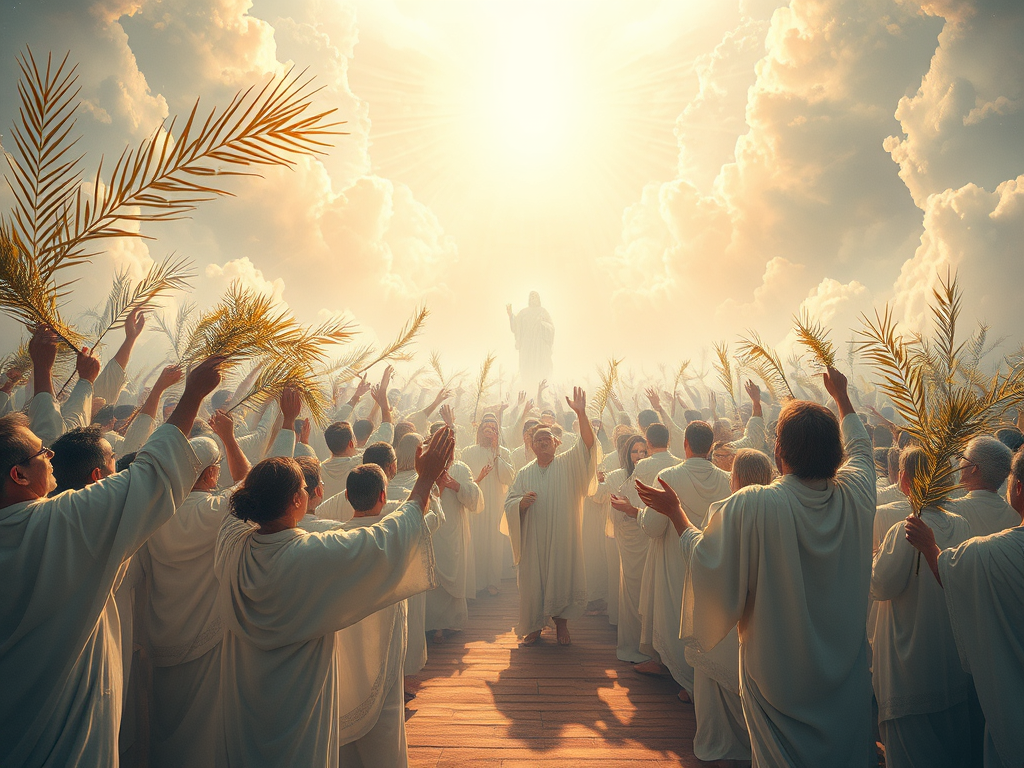
After this I looked, and behold, a great multitude that no one could number, from every nation, from all tribes and peoples and languages, standing before the throne and before the Lamb, clothed in white robes, with palm branches in their hands, 10 and crying out with a loud voice, “Salvation belongs to our God who sits on the throne, and to the Lamb!” 11 And all the angels were standing around the throne and around the elders and the four living creatures, and they fell on their faces before the throne and worshiped God, 12 saying, “Amen! Blessing and glory and wisdom and thanksgiving and honor and power and might be to our God forever and ever! Amen.”

13 Then one of the elders addressed me, saying, “Who are these, clothed in white robes, and from where have they come?” 14 I said to him, “Sir, you know.” And he said to me, “These are the ones coming out of the great tribulation. They have washed their robes and made them white in the blood of the Lamb.

15  “Therefore they are before the throne of God,

and serve him day and night in his temple;

and he who sits on the throne will shelter them with his presence.

16  They shall hunger no more, neither thirst anymore;

the sun shall not strike them,

nor any scorching heat.

17  For the Lamb in the midst of the throne will be their shepherd,

and he will guide them to springs of living water,

and God will wipe away every tear from their eyes.”

Soli Deo Gloria!

Via Emmaus on the Road: Revelation 6

Further Resources


Revelation 6 (ESV)

The Seven Seals

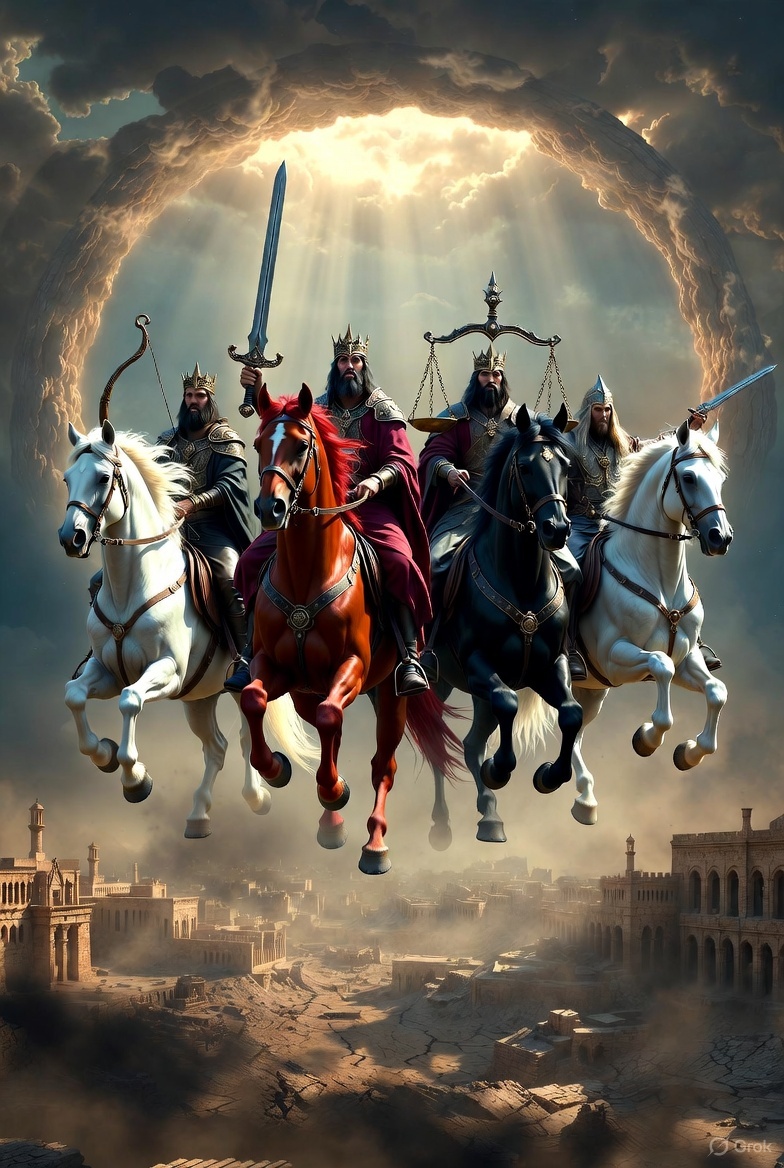
Now I watched when the Lamb opened one of the seven seals, and I heard one of the four living creatures say with a voice like thunder, “Come!” And I looked, and behold, a white horse! And its rider had a bow, and a crown was given to him, and he came out conquering, and to conquer.

When he opened the second seal, I heard the second living creature say, “Come!” And out came another horse, bright red. Its rider was permitted to take peace from the earth, so that people should slay one another, and he was given a great sword.

When he opened the third seal, I heard the third living creature say, “Come!” And I looked, and behold, a black horse! And its rider had a pair of scales in his hand. And I heard what seemed to be a voice in the midst of the four living creatures, saying, “A quart of wheat for a denarius, and three quarts of barley for a denarius, and do not harm the oil and wine!”

When he opened the fourth seal, I heard the voice of the fourth living creature say, “Come!” And I looked, and behold, a pale horse! And its rider’s name was Death, and Hades followed him. And they were given authority over a fourth of the earth, to kill with sword and with famine and with pestilence and by wild beasts of the earth.

When he opened the fifth seal, I saw under the altar the souls of those who had been slain for the word of God and for the witness they had borne. 10 They cried out with a loud voice, “O Sovereign Lord, holy and true, how long before you will judge and avenge our blood on those who dwell on the earth?” 11 Then they were each given a white robe and told to rest a little longer, until the number of their fellow servants and their brothers should be complete, who were to be killed as they themselves had been.

12 When he opened the sixth seal, I looked, and behold, there was a great earthquake, and the sun became black as sackcloth, the full moon became like blood, 13 and the stars of the sky fell to the earth as the fig tree sheds its winter fruit when shaken by a gale. 14 The sky vanished like a scroll that is being rolled up, and every mountain and island was removed from its place. 15 Then the kings of the earth and the great ones and the generals and the rich and the powerful, and everyone, slave and free, hid themselves in the caves and among the rocks of the mountains, 16 calling to the mountains and rocks, “Fall on us and hide us from the face of him who is seated on the throne, and from the wrath of the Lamb, 17 for the great day of their wrath has come, and who can stand?”

Soli Deo Gloria!

Via Emmaus on the Road: Revelation 5

Further Resources


Revelation 5 (ESV)

The Scroll and the Lamb

Then I saw in the right hand of him who was seated on the throne a scroll written within and on the back, sealed with seven seals. And I saw a mighty angel proclaiming with a loud voice, “Who is worthy to open the scroll and break its seals?” And no one in heaven or on earth or under the earth was able to open the scroll or to look into it, and I began to weep loudly because no one was found worthy to open the scroll or to look into it. And one of the elders said to me, “Weep no more; behold, the Lion of the tribe of Judah, the Root of David, has conquered, so that he can open the scroll and its seven seals.”

And between the throne and the four living creatures and among the elders I saw a Lamb standing, as though it had been slain, with seven horns and with seven eyes, which are the seven spirits of God sent out into all the earth. And he went and took the scroll from the right hand of him who was seated on the throne. And when he had taken the scroll, the four living creatures and the twenty-four elders fell down before the Lamb, each holding a harp, and golden bowls full of incense, which are the prayers of the saints. And they sang a new song, saying,

“Worthy are you to take the scroll

and to open its seals,

for you were slain, and by your blood you ransomed people for God

from every tribe and language and people and nation,

10  and you have made them a kingdom and priests to our God,

and they shall reign on the earth.”

11 Then I looked, and I heard around the throne and the living creatures and the elders the voice of many angels, numbering myriads of myriads and thousands of thousands, 12 saying with a loud voice,

“Worthy is the Lamb who was slain,

to receive power and wealth and wisdom and might

and honor and glory and blessing!”

13 And I heard every creature in heaven and on earth and under the earth and in the sea, and all that is in them, saying,

“To him who sits on the throne and to the Lamb

be blessing and honor and glory and might forever and ever!”

14 And the four living creatures said, “Amen!” and the elders fell down and worshiped.

Soli Deo Gloria!

Via Emmaus on the Road: Revelation 4

Further Resources


Revelation 4 (ESV)

The Throne in Heaven

After this I looked, and behold, a door standing open in heaven! And the first voice, which I had heard speaking to me like a trumpet, said, “Come up here, and I will show you what must take place after this.” At once I was in the Spirit, and behold, a throne stood in heaven, with one seated on the throne. And he who sat there had the appearance of jasper and carnelian, and around the throne was a rainbow that had the appearance of an emerald. Around the throne were twenty-four thrones, and seated on the thrones were twenty-four elders, clothed in white garments, with golden crowns on their heads. From the throne came flashes of lightning, and rumblings and peals of thunder, and before the throne were burning seven torches of fire, which are the seven spirits of God, and before the throne there was as it were a sea of glass, like crystal.

And around the throne, on each side of the throne, are four living creatures, full of eyes in front and behind: the first living creature like a lion, the second living creature like an ox, the third living creature with the face of a man, and the fourth living creature like an eagle in flight. And the four living creatures, each of them with six wings, are full of eyes all around and within, and day and night they never cease to say,

“Holy, holy, holy, is the Lord God Almighty,

who was and is and is to come!”

And whenever the living creatures give glory and honor and thanks to him who is seated on the throne, who lives forever and ever, 10 the twenty-four elders fall down before him who is seated on the throne and worship him who lives forever and ever. They cast their crowns before the throne, saying,

11  “Worthy are you, our Lord and God,

to receive glory and honor and power,

for you created all things,

and by your will they existed and were created.”

Soli Deo Gloria!

On Earth as It Is in Heaven: Seeking a Biblical Pattern for Worship

worship.jpegIf Scripture stands against our natural and cultural bent towards innovative worship, it also provides a biblical pattern for the kind of worship God requires. Last week I considered the first problem—namely, the problem(s) with man-made worship. This week, I want to show how a pattern of worship repeats throughout the Bible.

Actually, Jonathan Gibson has provided this biblical-theological survey already. In his chapter “Worship On Earth as It Is in Heaven,” in Reformation Worshiphe traces a basic pattern of worship from Genesis to Revelation. In what follows, I’ll employ some of his findings to help us see what “biblical” worship looks like.

Worship in Eden: The Basic Pattern

The basic pattern of worship begins even before the Fall. In Genesis 2:15–17 Adam is commanded to “serve” and “guard” in the garden-temple of Eden. These verbs are used later to speak of the priestly service of Levites. From the light of later revelation, we can see worship is not something that emerged after redemption. It was the reason why God made humanity in the first place.

And thus, Jonathan Gibson lists the basic elements of worship like this:

  • Call to Worship (through God’s Word)
  • Response (by faith and obedience, love and devotion)
  • Fellowship meal (union and communion with God)

Reflecting on this prelapsarian (i.e., before the Fall) worship, he states,

Adam was commanded to fast from one tree in order that he might feast at another three, and thus enjoy consummate union and communion with God—everlasting life. And so, for Adam and all his descendants, a liturgy was fixed, stitched into the very order and fabric of human life on earth: call–response–meal. (4) Continue reading

The Lord’s Reign: Herman Bavinck on the Scriptural Sense of God’s Transcendence

paige-weber-974172-unsplash.jpgThe Lord has established his throne in the heavens, and his kingdom rules over all.
— Psalm 103:19 —

For thus says the One who is high and lifted up, who inhabits eternity, whose name is Holy: “I dwell in the high and holy place, and also with him who is of a contrite and lowly spirit, to revive the spirit of the lowly, and to revive the heart of the contrite.
— Isaiah 57:15 —

Where is God?

In one sense, God is everywhere (Ps. 139:7–12). In another, God is outside of space and time (1 Kings 8:27). Still, in a third way, Scripture speaks of God as dwelling in heaven, high above his creation (Isa 57:15; cf. Ps. 135:6). Yet, it is important to remember God’s place in heaven is not outside of creation. Rather, it is the created place for the glorious and uncreated God to dwell within creation.

From that divine throne, God rules all creation. And in creation, God reveals himself to us in his world and in his word. Bringing these big and beautiful realities together, Herman Bavinck describes what it means for God to be over and in creation. Doctrinally, these realities are expressed by the terms transcendence and immanence. And in the newly released volume Philosophy of RevelationBavinck has this to say about a scriptural sense of God’s transcendence: Continue reading

Getting A Vision of Heaven on Earth: Heaven, Earth, and the Bible Project

22But you have come to Mount Zion and to the city of the living God, the heavenly Jerusalem, and to innumerable angels in festal gathering,23and to the assembly of the firstborn who are enrolled in heaven, and to God, the judge of all, and to the spirits of the righteous made perfect,24and to Jesus, the mediator of a new covenant, and to the sprinkled blood that speaks a better word than the blood of Abel.25See that you do not refuse him who is speaking. For if they did not escape when they refused him who warned them on earth, much less will we escape if we reject him who warns from heaven.
— Hebrews 12:22–25 —

Yesterday, I argued in my sermon that the local church is an earthly display of a heavenly reality. From Hebrews 12, we learn that when we gather in the name of Jesus, we are (imperfectly) revealing the glories of heaven—a myriad of saints and angels gathered around the throne of God. Or better, we are foreshadowing the final assembly of the nations who will worship around the throne of God.

In making that argument, I assumed a certain amount of background information about how heaven and earth relate. I want to fill in some of the gaps here. (This brief temple story may help too). Continue reading

Honoring a Father in the Faith

gloryjpegPay to all what is owed to them: . . .
respect to whom respect is owed,
honor to whom honor is owed.

— Romans 13:8 —

In God’s kind providence he has given me many fathers in the faith. Some have taught me how to read the Bible, others have showed me how to love my family and do the work of the ministry, and others have even helped me know where to stand. It is this last category that I am reminded of today.

More than five years ago, when I was newly called as pastor, Jim Downey told me where to stand and how to lead my first funeral service. To someone fresh out of seminary and nervous to conduct his first funeral, such simple instructions were truly invaluable. His fatherly advice was most welcome and would be the first of many funeral services he and I conducted together. But with sadness in my heart, we will not share that ministry again.

On Monday, July 6, Jim went to receive his reward in heaven. Yesterday, I stood next to the man who told me where to stand at a funeral. And today, I want to honor him for his service to the Lord. Continue reading

Food for Thought: Competing Visions of Heaven

heaven2What would a trip to heaven look like?

In 2004, Baker Books decided to test-run a book about one man’s trip to heaven. The book was Don Piper’s Ninety Minutes in Heaven. In ten years, his book has sold over 6 million copies, been translated 46 times, and prompted a whole new genre of “Christian “ book—heavenly tourism.

I put “Christian” in quotes because even as visions of heaven are known in Scripture, the descriptions are nothing like the visions described in newfangled spiritual journeys. In fact, it is worth asking: What should we think about  Heaven is for Real, Ninety Minutes in Heaven, Twenty-three minutes in Hell, etc.? Let me offer five thoughts.

First, descriptions of heaven are superfluous to and compete with the Bible.

There are a number of times in Scripture when God’s word speaks of prophets and apostles entering God’s heavenly court. However, in the case of Isaiah (Isa 6), Paul (2 Cor 12), and John (Revelation), their vision became recorded Scripture. This is categorically different from the accounts offered by Piper, Burpo, and others. In a world of competing sound bytes, these books add to Scripture’s testimony of what to know and believe about God, heaven, and how we get there.

Likewise, for those raised back to life, Scripture has no record of their experience. Apparently, God’s sufficient word did not (and does not) need such testimony. In fact, in Jesus’ parable with the rich man and Lazarus (Luke 16:19–31), Jesus makes it clear that if earth-dwellers “do not hear Moses and the Prophets, neither will they be convinced if someone should rise from the dead.” In context, this has direct application to Jesus death and resurrection, but it also relates to near death experiences today. If Heaven is for Real is considered a way to engender faith in those who won’t read the Bible, such thinking is a vain invention of man, not the ways of God. The Spirit (who inspired the Word) will do nothing to undermine the authority of the Scripture.

Second, in Scripture heavenly visions were accompanied by great afflictions.

John was not brought into heaven until his tortured exile on Patmos; when Isaiah left God’s throne room, he was tasked with proclaiming the ‘gospel’ to a nation who wouldn’t believe (Isa 6:9–11). And in Paul’s case, the apostle declared that a messenger from Satan accompanied his visions, so as to keep him from becoming conceited (2 Cor 12:7). By contrast, the recent heavenly accounts have brought acclaim, book contracts, and movie deals. There might be some slight discomforts that followed, but thorns sent from Satan himself? I’m doubtful. When we reconsider the places in Scripture where Paul, John, and Isaiah encounter God, it is apparent that the comparison is apples and oranges.

Third, God’s revelation always exalts Scripture and Jesus Christ.

In 2 Peter 1, Peter speaks of the origin of Scripture as arising from the Spirit and not man (vv. 19–21). Strikingly, he contrasts his own vision of glory with that of the OT. He says that the inspired word is more reliable than his own experience with the divine. Such apostolic humility gives us pause when we hear others speaking (and getting paid to speak) of their experience, especially when their message is more about heaven than Jesus. While Scripture is a radically, Christ-centered book (Luke 24:27; John 5:39), these new bestsellers focus more on heaven, than Jesus. And yet, what would heaven be like without Jesus? In a word, it would be hell! Indeed, for Christians, Christ is our heavenly hope. Or more put more starkly: Heaven is Christ.

Fourth, why are we convinced that uninspired heavenly visions are from God?

Since we know Satan masquerades as an angel of light (2 Cor 10:4), why would be surprised that in these days, the father of lies would seek to lead astray the elect of God, as Jesus says in Matthew 24:22, 24, 31? Would it not be a stratagem of Satan to concoct a series of visions that feign heaven, but without mentioning the gospel? Satan is very happy for people to believe in heaven and the afterlife, especially if takes them away from God’s Word or it increases the likelihood that they would begin looking for the sensational in life, instead of life in Scripture (cf. Deut 32:47). In other words, if Satan’s goal is to distance Christians from the truth God’s Word, why wouldn’t he use heavenly tourism as a way creating a taste for something less than Christ himself?

Fifth, and most importantly, heavenly visitations are superfluous for the believer who worships every Sunday.

Though we don’t often speak this way, when Christians assemble for worship, they visit heaven every Lord’s Day. Or better, heaven visits them. According to Hebrews 12, when believers gather in the name of Jesus, they are Spiritually and literally (if not bodily), gathering around the throne of Christ. Read Hebrews 12:22–24.

But you have come to Mount Zion and to the city of the living God, the heavenly Jerusalem, and to innumerable angels in festal gathering, and to the assembly of the firstborn who are enrolled in heaven, and to God, the judge of all, and to the spirits of the righteous made perfect, and to Jesus, the mediator of a new covenant, and to the sprinkled blood that speaks a better word than the blood of Abel. 

It doesn’t say, “And you will come to Mount Zion” in the future; it speaks in the present tense: “You have come . . .”

When believers gather to worship, the Spirit of Jesus is present. When the Scriptures are read and preached rightly, Jesus, who sits in heaven, speaks on the earth. When the congregation sings a new song (i.e., a song of salvation), they are joining with the angels. And when we lift our hears in prayer, we are entering the very throne room of God. Sadly, too many Christians forget that they “travel” to heaven every week. As a result, they are vulnerable to the exotic testimonies of others.

In the end, heavenly tourism, as sold at the local Wal-Mart, is deficient, dangerous, and possibly even demonic. It competes with the way in which God has spoken, and it leads believers and unbelievers alike to put confidence in the words of men and experiences that stand outside of Scripture. All in all, it is a kind of literature that is not needed and should be avoided. God has given us everything we need for life and godliness in God’s word (2 Pet 1:3). The question for each of us is, “Do we have an appetite for the things of God, or are we content to settle for visions of heaven that speak little of the gospel?”

For more on visits to heaven, read David Jones four-page outline on ‘Near Death Experiences.’ It will give you more than a few things to think about and help you formulate a better understanding of what Scripture says about heaven, seeing God, and near death experiences.

Soli Deo Gloria, dss


Thinking About ‘Near Death Experiences’

heavenDavid Jones, professor of Christian Ethics at Southeastern Baptist Theological Seminary, has provided an excellent resource on how to think about “Near Death Experiences” (NDE). In four pages, he gives thoughtful Christians a historical, cultural, biblical, and practical look into a discussion prompted by the recent movie Heaven is for Real.

Here’s a brief outline:

  • He begins with the way that all religions have NDE tales, and he chronicles the rise in recent Christian interest in the subject.
  • He points to the ten NDE in the Bible (e.g., the widows son, 1 Kgs 17:17–24; the Shunammite’s child, 2 Kgs 4:32–37;  the dead man who touched Elisha’s bones, 2 Kgs 13:21; Jairus’s daughter, Matt 9:18–26 [par. Mark 5:21–43; Luke 8:40–56]; the widow’s son, Luke 7:11–16; unnamed saints, Matt 27:52–53; Jesus, Matt 28 [par. Mark 16; Luke 24; John 20–21]; Lazarus, John 11:1–4; Dorcas, Acts 9:36–41; and Eutychus Acts 20:9–12) and observes that no one (including Jesus) returned to earth touting the glories of heaven.
  • He considers a number of other heavenly experiences in Scripture and concludes with cautionary counsel from Scripture about the recent book/movie Heaven is for Real and its predecessor 90 Minutes in Heaven—the book which Tim Challies notes as creating a new genre of Christian non/fiction (namely, Heaven Tourism).

If you have read the book, seen the movie, or are in conversation with those who have, let me encourage you to read Dr. Jones four-page outline. It will give you more than a few things to think about and help you formulate a better understanding of what Scripture says about heaven, seeing God, and near death experiences.

Soli Deo Gloria, dss