Martin Luther: Rediscovering the Gospel and Reforming the Church (A Biographical Sermon)

reformation

Martin Luther: Rediscovering the Gospel and Reforming the Church

As we gathered at church this Reformation Sunday, we did so with the fruits of the Reformation still impacting our lives. From the Bibles in our laps (or on our phones) to the message justification by faith alone in Christ alone, we who know the true gospel of grace are, in so many ways indebted to the men and women of the Reformation. Through their suffering, couple with the faithful who have gone before and after them, we have received an incredible heritage.

Accordingly, it is appropriate to spend time learning from their example. Indeed, it is even biblical. Hebrews 13:7 says, “Remember those who taught you the word of God, consider the outcome of their lives, and imitate their faith.” This morning, that is what our church did, setting our series of Ephesians aside for one week, in order to remember the life of Martin Luther and to learn from his faith.

Indeed, any study of Martin Luther requires a specific topic. His writing is so voluminous and his impact, not to mention his personality, is so vast, it requires any biographer to hone in on some aspect of his life. When John Piper preached a biographical sermon on Luther, he chose his relationship with God’s Word. For me, I chose to focus the church he aimed to reform with the gospel he reclaimed.

In this biographical sermon, I considered how Luther’s rediscovery of the gospel led him to fight for the purification and replanting, if you will, of the church. In truth, he never abandoned the church, but with the key of the gospel, he sought to unlock the church from its captivity to Rome. Therefore, there is much to learn from Luther about the gospel and the church, and how we can and ought to be gospel-centered churches.

To find out what we can learn from the life and legacy of Martin Luther, you can listen to the sermon online, or you can read the sermon notes. Discussion questions and additional resources are included below. Continue reading

Paul, Timothy (Keller), and the Making of Good Arguments

grant-lemons-82179In 1 Corinthians 15 Paul engages the skeptic about questions concerning resurrection of the body. In verse 35 he writes, “But someone will ask, ‘How are the dead raised? With what kind of body do they come?'”

To this he turns to nature to make his argument. Instead of simply rejecting the error of “the fool” (v. 36), he argues for the plausibility of the resurrection from a commonly held belief—that plants rise from the ‘dead’ when the seed is planted in the ground.

Here’s how he argues. First, Paul uses the farmer’s field to explain the resurrection in terms of seed and plant (vv. 36–38). Then he points to the various kinds of flesh on earth and the various kinds of glory in the heavens (vv. 39–41). In order to begin taking steps to show how the dust of earth might be raised up and transformed into glory (see vv. 42–49), he appeals to nature to explain their plausibility. In these two analogies, therefore, Paul moves from shared belief in nature, to greater truth revealed in the gospel of Jesus Christ.

Materially, Paul’s words makes a strong argument for how the resurrection will happen. But formally, Paul’s approach to the skeptics is a vital lesson in how to communicate truth to a doubting world. In this approach to skeptics, we can learn much. Continue reading

God’s War Memorial: The Church of Jesus Christ (Ephesians 2:11–22)

more-than-we-can-imagine_

God’s War Memorial: The Church of Jesus Christ (pt 1)

This Sunday marks our fifth sermon in Ephesians and with it the consideration of the fifth sola. As our church remembers the Protestant Reformation this fall, we have sought to highlight the five solas from the text of Ephesians. After considering the material principles of the gospel in Ephesians 1–2 (e.g., Sola Gratis, Sola Fide, Solus Christus, Soli Deo Gloria), we considered the material principle of the Reformation from Ephesians 2:11–22 (i.e., Sola Scriptura). 

More central to the text, however, this week’s message focused on the argument of Ephesians 1–3 and Paul’s repeated emphasis on the temple of God, which is the church of Jesus Christ. Taking a page from the Reformers (ad fontes), we stepped back to understand the symbolism of this temple and how temples operated in the warfare worldview of Ephesus and the Old Testament. Accordingly, this sermon paid keen attention to the temple theme in the Bible and it aimed to prepare us for understanding how the church as temple shapes our identity, community, and mission—three themes that we will, Lord willing, develop from verses 11–22 next week.

You can listen to the sermon online or read the sermon notes (there may also be an alternative ending to the sermon notes, too). Discussion questions and further resources can be found below. Continue reading

Our Mission Trip to Iceland: A Sunday Morning, Coffee House Update

IMG_0514On Facebook, I’ve had a chance to share a few updates from our mission trip. Today, as we get ready to go to church (at 2pm UTC), we are stopping in a local coffee shop—the Flagship Coffee House of the North Atlantic—and stopping to give a brief update on our trip. So, here are six highlights from the trip.

Six Highlights from Iceland

The Landscape

The first thing to mention about Iceland is the stunning beauty of the Iceland. The word Reykjavik, which hosts about 80% of the population (280,000 of 340,000), means “smoky bay.” The reason: Iceland is situated on a volcanic rock jutting out of the Northern Atlantic. Accordingly, it has beautiful black beaches, rocky mountains, long bays (called fjord), and rainbow-filled skies. In short, the landscape looks like something from a C. S. Lewis or J. R. R. Tolkien novel—and that’s fitting because both were affiliated with Iceland.

The Weather

Next, the weather. When I first thought of Iceland, I (wrongly) thought of ice, snow, blizzard, and sunless winters. And to be sure, Iceland is cooler than Virginia and darker in the Christmas season. But at the same time, it has been far more pleasant than I imagined. Our weather has been wet, but the houses are more than adequately warmed. With lava-heated water pumped into every home, windows stay open most of the time. And the landscapes and people more than make up for the Seattle-like wetness. Continue reading

What is the Protestant Reformation? 4 Reasons and 9 Resources for Digging Into This Recovery of the Gospel

lutherFive-hundred years ago, on October 31, Martin Luther nailed his 95 Theses to the Wittenberg Castle Church door. This action launched a series of disputations about the Bible, the gospel, and the church—to name only a few. In time, Luther’s action would be considered the spark which ignited the Protestant Reformation.

But what is the Protestant Reformation? And why do we need to know about it? And what is there to learn?

To answer those questions and others like them, let me give four reasons why the Reformation should be highlighted and then a series of multi-media resources that might help you better understand the history and value of the Reformation.

Four Reasons to Highlight the Reformation

1. The Protestant Reformation is the largest revival in church history.

When American Christians think of revivals, they might think of big tents and saw dust trails. Or, if they are more historically inclined, the First or Second Great Awakening may come to mind. Still, in church history no genuine revival and outpouring of the Spirit (as evidenced by gospel proclamation, genuine conversions, and churches planted) outpaces the Protestant Reformation of the 16th Century.

For close to a century, two generations of Reformers preached the gospel, translated the Bible, and planted churches, such that their effects are still felt today. For instance, Martin Luther and John Calvin’s writings continue to feed the church. The churches begun in that period continue to preach the gospel—sadly, with many deviations and perversions included. But most importantly, the Reformation principles that recovered the gospel—Scripture alone, Christ alone, faith alone, grace alone, and God’s glory alone—continue to motivate and instruct the Protestant Church today.

In its day, the preaching of the gospel, with its emphasis on grace over works, justification by faith, trust in the finished work of Christ, and the sufficiency of God’s Word, led to mass conversions. Protestant churches sprung up in urban centers throughout Germany, Switzerland, the Netherlands, and the United Kingdom. In short, the Reformation recovered the gospel and with it freed thousands (and in years to come millions) of souls from the enslaving doctrines of the Catholic Church.

Thus, we should consider the Reformation because it is the largest revival in church history. Continue reading

Preaching to the Late Modern Mind: Five Cultural Narratives to Know

preachingIn his book Preaching: Communicating Faith in an Age of Skepticism, Tim Keller addresses how Christianity confronts culture. Wisely he speaks of the way we must (1) affirm truth in culture, (2) confront idols in culture, and (3) show how truth in culture is derived from and only satisfied by the Christ who reigns supreme over all cultures. Thus, instead of just being for or against culture, Keller describes a “Yes, but no, but yes” approach for preaching Christ to culture.

Approaching culture in this nuanced way means understanding the modern world in which we live. In a chapter entitled “Preaching and the (Late) Modern Mind,” he describes the difference between the pagan, pre-Christian world and the way in which Christianity brought dignity and personal value to the West. In other words, before Christianity emerged in the West, the pagan world with its philosophers conceived of the world as an impersonal universe. Belief in a tri-personal God, sovereignly directing history and seeking to redeem humanity changed all of that. And the bounty of the Western world, therefore, is a byproduct of Christianity’s influence.

In one place, Keller nicely summarizes five differences between the pre-Christian world with the Christian West. He then goes on to explain how secularism has taken Christian values to the extreme, making them idolatrous falsehoods. But in explaining how Christian values have gone rogue, he doesn’t include them in his compact table. On page 128, there is one column missing (that would help flesh out his argument on pp. 128–33).

So, I added the third column to the table below to help show the way in which the West has left Christianity behind and distorted many of the values it provided. By seeing in our culture post-Christian culture the traces of Christian thought, we can as Keller points out, begin to lead people back to the source of the values (e.g., science, individualism, personal choice) they embrace today. Indeed, if you value and enjoy science, justice, or personal choice today, it is worth noting where those cultural gifts derive. Keller’s chapter on preaching Christ to culture is an excellent place to begin thinking about that relationship.

Five Chief Narratives of Western Thought[1]

Before Christianity Emerged [in the West] After Christianity Came to the West After Christianity ‘Left’ the West
The body and material world are less important and real than the realm of ideas The body and material world are good. Improving them is important. Science is possible. Science is absolute. Materialism is absolute. Technology is sufficient to solve our problems.
History is cyclical, with no direction. History is making progress. Progress means history is unimportant. Everything novel is superior to the past.
Individuals are unimportant. Only the clan and tribe matter. All individuals are important, have dignity, and deserve our help and respect. Individuals are supremely important. Individualistic expression should never be questioned, even when detrimental to the group.
Human choices don’t matter; we are fated. Human choices matter and we are responsible for our actions. Choice is sancrosanct and must be guarded and guaranteed at all costs.
Emotions and feelings should not be explored, only overcome. Emotions and feelings are good and important. They should be understood and directed. Emotions and feelings are determinative. To feel authentic I must express my desires and never suppress them.

In sum, these “five axes,” which Keller adapts from Charles Taylor (The Secular Age), help diagnose some of the challenges in front of us. Together these five narratives can be classified as follows:

  • rationality (and an explanation of where the world came from and what we can know about it),
  • history (and the meaning of life),
  • society (and the relationship of individuals to groups),
  • morality (and who gets to determine right and wrong), and
  • identity (and where we get our sense of value and purpose).

To be sure, these realities do not drive our exegesis of the biblical text, but in communicating that text to others we must be aware of these ideas. Knowing these cultural baselines helps us affirm and deny the beliefs we find in individuals and in our surrounding culture. Preachers must be aware of these realities to wisely apply God’s Word.

Indeed, all Christians should have a growing awareness of cultural presuppositions. Why? So that we will not be ensnared by them, and so we can communicate the gospel by rightly affirming some cultural desires as finding their telos in Christ and by confronting others cultural idols as errant promises that ultimately lead to death (Prov. 14:12).

In short, Keller’s sections on preaching Christ in a post-Christian culture are worth considering. They challenge the faithful witness to love his neighbor(s) by knowing what his neighbor believes and loves. Therefore, while planting ourselves in God’s unchanging Word, we must also learn how to share Christ with others who embrace various aspects of the aforementioned narratives.

To that end, let us continue to give ourselves the Word and the world, so that we can take the good news of the former to meet the dire needs of the latter.

Soli Deo Gloria, ds

_________________

[1] Timothy Keller, Preaching: Communicating Faith in an Age of Skepticism (New York: Viking, 2015), 128. First two columns are verbatim; the last column summaries Keller’s prose.


The Horizontal and Vertical Gospel

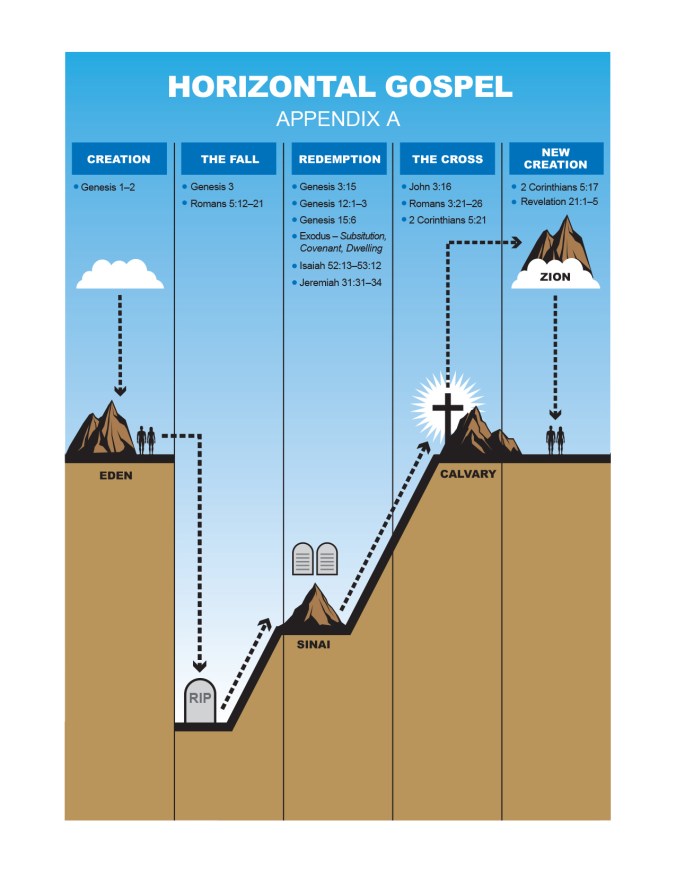
When I share the gospel at our Discover OBC Class—our new members class—I usually talk about the gospel from two angles. One follows the contours of the ‘horizontal’ storyline of Scripture (Creation — Fall — Redemption — New Creation); the other focuses on the ‘vertical’ relationship with God (Holy God — Man Dead in Sin — Christ — Response). For me, this has been a helpful way to present the gospel, as it sets the person and work of Jesus into the storyline of the Bible.

Typically, I draw these two aspects of the gospel on a whiteboard or a napkin. But this week one of our elders put those presentations into two graphic designs—far better than any napkin I’ve drawn. Here they are. I think they speak for themselves, but feel free to ask questions or suggest enhancements. But even better, go share the gospel with someone—from the whole storyline of the Bible and its centerpiece the person and work of Jesus Christ.

horizontal02vertical01

Soli Deo Gloria, ds

Playing Your Part in the Gospel (pt. 1): Planning, Giving, Going, Hosting, Helping (1 Corinthians 16:1–11)

sermon photo

Playing Your Part in the Gospel (pt. 1): Planning, Giving, Going, Hosting, and Helping (1 Corinthians 16:1–11)

When Paul finishes his doctrinal defense of the resurrection, he says, “Therefore, my beloved brothers, be steadfast, immovable, always abounding in the work of the Lord, knowing that in the Lord your labor is not in vain” (15:58). Clearly, in his mind the resurrection is not an esoteric point of doctrine; rather, it fuels ministry and missions. Indeed, in 1 Corinthians 16 we find a flurry of gospel activity that prompts us to consider how we are living in light of the resurrection.

In this Sunday’s message, I suggested that we play our part in (proclaiming) the gospel through planning, going, giving, hosting, and helping. You can listen to this call to action or read the sermon notes. Discussion questions are below, as are a cadre of resources on these actions of ministry. Continue reading

The Resurrection: Historical, Necessary, and More Than Sufficient (1 Corinthians 15:12–20)

obc-1 corinthiansThe Resurrection: Historical, Necessary, and More Than Sufficient (1 Corinthians 15:12–20)

Is the resurrection necessary? Evangelicals Christians say, “Absolutely. Undoubtedly. No question.” Other “Christians,” Protestant Liberals, are less committed. Who’s right? 

Thankfully, the Bible is not indifferent or ambiguous to the question. In 1 Corinthians 15, the Apostle Paul spends an entire chapter arguing for the centrality of the resurrection. Last week, we saw how verses 1–11 articulate the gospel of Jesus Christ crucified, buried, risen, and reigning. This week,  we examined how verses 12–19 address the question of the resurrection’s historicity, necessity, and sufficiency.  In particular, we find in the historical necessity of the resurrection a sufficient foundation for our hope and a word of life to anyone facing death.

You can listen to sermon online or read the sermon here. Below there are discussion questions and resources for further study. Continue reading

Framing the Gospel: Four Biblical Truths For Rightly Proclaiming and Protecting the Gospel

framesFor the gospel of God to remain in focus it needs a frame. That is to say, if we are going to proclaim Christ clearly and consistently, we must understand the biblical presuppositions necessary to preserve and protect the gospel. In particular, the gospel needs at least four truths to guard it from distortion. These truths do not add anything to the gospel, but they do ensure that nothing is taken away from the gospel.

What are these ‘framing’ truths?

From 1 Corinthians 15, I believe Paul explains the gospel as needing to be kept (1) central, (2), external, (3) Scriptural, and (4) historical. Without these four frames the gospel will be put in jeopardy. Therefore, to better understand the biblical presuppositions with undergird the gospel, let’s consider each of these truths briefly and then what happens when they are lost. Continue reading