Jesus is God: Four Ways to See Jesus’s Divinity in John’s Gospel

marcos-paulo-prado-xec7srO4U5c-unsplashThis month our church returns to the Gospel of John, and specifically we have started to look at the Upper Room Discourse (John 13–17), picking up in John 14. For those familiar with John 14–16, as well as the whole book of John, you know how often trinitarian themes, doctrines, and verses emerge. As John recounts the way Jesus speaks of his Father, the promise of sending the Spirit, and the relationship between Father, Son, and Spirit, we have perhaps the richest vein in Scripture for mining trinitarian gold.

To help our church, and those reading along here, I am going to begin posting some short pieces on the doctrine of the trinity and the key ideas related our God who is Father, Son, and Holy Spirit. Today, I will begin with a note from Scott Swain, author of many works on the Trinity, including Crossway’s Short Studies in Systematic Theology volume, The Trinity: An Introduction.

In his blogpost, “How John Says Jesus is ‘God’,” he offers four ways to think about Christ’s deity in John, and he concludes with this fourfold textual proof of Jesus’s divinity from John. All told, Swain actually offers seven ways to think of Jesus as God. And what I include here is the four point, with four proofs. Take time to consider each, and then as you read John, keep your eye out for the ways that John presents Jesus as God.

1. Jesus shares the divine name(s).

According to the Fourth Gospel, Jesus shares his Father’s holy “name” (Jn 17:11; cf. 12:41). Throughout the Gospel, Jesus is not only acclaimed as “God” (Jn 1:1; 20:28), he is also identified by God’s proper name YHWH, “the linguistic token of God’s uniqueness par excellence,” along with the “corona of connotation” established by various OT ways of expounding God’s proper name (Kendall Soulen). The monogenēs is called “the one who is” in John 1:18 (echoing Exod 3:14 LXX). Jesus is called “the Lord” in John 1:23 (citing the Tetragrammaton from Isa 40:3) and John 20:28 (echoing Ps 35:23 [34:23 LXX], which calls YHWH “my Elohim and my Adonai”). Perhaps most significantly, Jesus identifies himself as the one true God by means of a series of absolute (Jn 4:26; 6:20; 8:24, 28, 58; 13:19; 18:5, 6, 8) and predicate (Jn 6:35, 41, 48; 8:12; 10:7, 9, 11, 14; 11:25; 14:6; 15:1) “I am” statements, which echo YHWH’s own self-identification in the Old Testament (Deut 32:39; Isa 41:4; 43:10, 13, 25; 46:4; 48:12; 51:12; 52:6).

2. Jesus possesses divine attributes.

He shares God’s eternal and unchangeable being, in contrast to temporal and changeable creatures (Jn 1:1-3; 8:35, 58). He manifests YHWH’s unique “glory” (Jn 12:41, alluding to Isaiah 6), abounding in “grace and truth” (Jn 1:14, which alludes to Exod 34:6). He has “life in himself,” just “as the Father has life in himself” (Jn 5:26). Jesus is a divine king (Jn 18:36) who holds all divine authority in his hands (Jn 3:35; 13:3).

3. Jesus performs divine works.

As the Word who created all things (Jn 1:3-5), Jesus also proclaims the divine name to creatures (Jn 1:14, 18; 17:6, 26). Because he holds all divine authority in his hands, he executes divine judgment, raises the dead, and grants eternal life to whomever he will (Jn 5:21-22, 25, 27; 10:18; 17:2). Jesus predicts the future, revealing that “I am he” (Jn 13:19). Whatever the Father does, the Son does likewise (Jn 5:19), completing the divine work of salvation that the Father gave him to do on the cross (Jn 13:1; 19:3). For all the aforementioned reasons and others,

4. Jesus is worthy of divine honor.

The Father “has given all judgment to the Son, that all might honor the Son, just as they honor the Father” (Jn 5:22-23). Jesus is worthy of the same faith that is due God (Jn 14:1; cf. 3:14-15; 8:24; 20:31), and also the same love (Jn 14:15). As one who shares the divine name, he is “lifted up” and “glorified” as “I am” (Jn 8:28; 12:32, 41). After Jesus’ resurrection, Thomas exclaims, “my Lord and my God” (Jn 20:28), a scriptural expression of covenant devotion (Ps 35:23). Though personally distinct from the Father as his Word and monogenēs, Jesus, according to John, is “one” God with the Father in every way (Jn 10:30).

From these four points and others, we have every reason to see that the Bible is unequivocal in calling Jesus ‘God.’ And thus, we should worship him not only as a good and great man, but as our God—Creator, Redeemer, Lord, and Second Person of the Trinity. Indeed, let us come to the Father, through the Son, by the Spirit, bringing him all the praise he deserves.

Soli Deo Gloria, ds

Photo by Marcos Paulo Prado on Unsplash

Worshiping Christ at Christmas: Two Christmas Sermons (Isaiah 60 and Matthew 2)

three kings figurines

This year, Christmas Day afforded the church a double blessing. Each Lord’s Day, the saints gather to celebrate the resurrection of Christ. And on that day, the first day of the week, the day of new creation, we (God’s new creations) bear testimony to the world that Jesus Christ is Lord.  This we do every Sunday, in order to worship God and bear witness to his gospel.

This year, however, with Christmas on the Lord’s Day, we also gathered to declare that Jesus Christ, the Lord, is born. Indeed, Christmas is the holiday that reminds us of the Lord come to earth, such that those of earth might come to heaven. Wonderfully, our church gathered twice in less than 24 hours to rejoice in all that Christ is and has done.

On Christmas Eve, we gathered to meditate on what it means that the Magi came to worship Christ, the king of the Jews (Matt. 2:1-12). Then, on Christmas morning, we gathered again to see how the Magi’s gifts of gold, frankincense, and myrrh fulfilled the prophecy of Isaiah 60. Indeed, Isaiah tells us that light has come into the world (vv. 1–3) and that light will one day engulf creation (vv. 19–22)—a prophecy that Revelation 21–22 picks up and applies to the new creation. In between the first coming of the light (in Christ’s birth) and its final establishment (in the new creation), we can continue to see how the light of God is coming into all the world, as the nations come to Zion and worship the Lord.

Those were the themes of our Christmas celebration. And I share the sermons below, so you might be able to dwell on these glorious truths. You can also find a pair of theological reflections on Isaiah 60 here and here. And if you need more Christological gold, take a look at what Christ Over All has published this month—Christology at Christmas. These essays are some of the best things I’ve read on the meaning of Christ and Christmas.

Come and Worship the True King (Matthew 2:1–12)

Let Us Come to Zion and Worship Christ (Isaiah 60)

Indeed, Christmas is one day behind us, or 364 days ahead us, if you are already counting. But the realities of Christ’s Incarnation, as well as his Lordship, abide year round. Therefore, may we continue to worship the Lord who was born in Bethlehem and the Lord who now reigns in Zion.

Soli Deo Gloria, ds

Photo by Jonathan Meyer on Pexels.com

Last Things First: Four More Ways Christ’s Birth Fulfills An End Times Prophecy

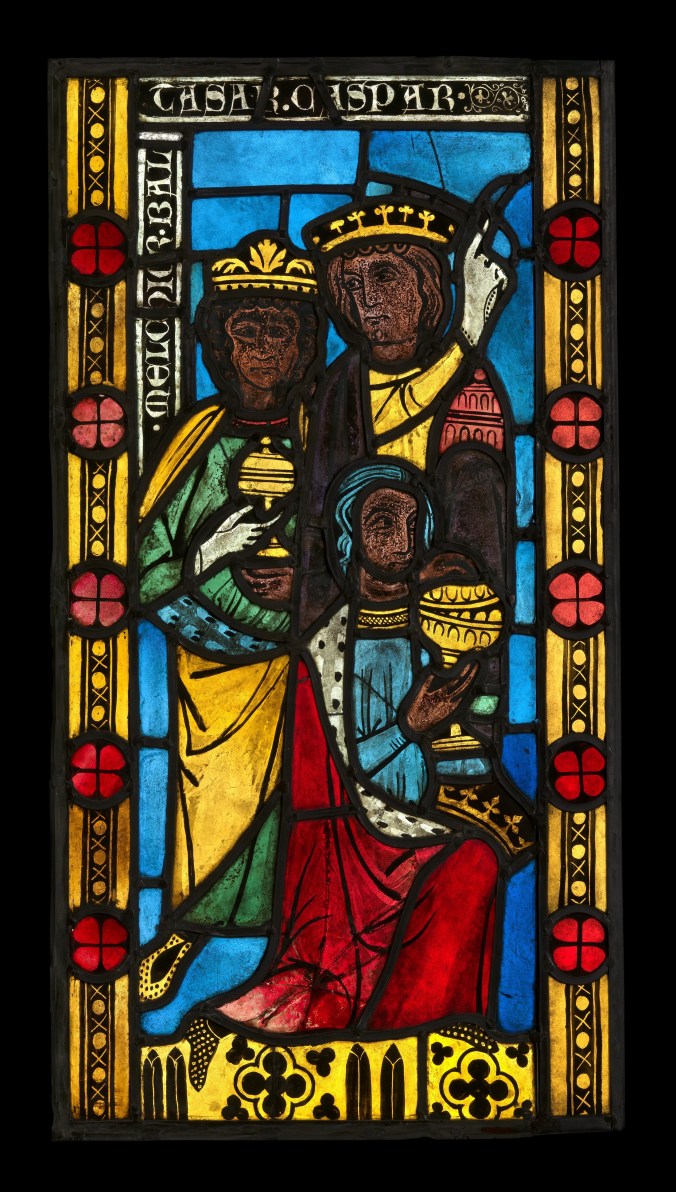
The Adoration of the MagiPicking up where I left off yesterday, I want to continue showing how the end-times prophecy of Isaiah 60 is fulfilled in the birth of Christ. From Isaiah 60:1–6, I highlighted three ways that Christ’s birth fulfilled the promises of (1) light, (2) joy, and (3) treasures brought to the temple. Today, I will pick up four more promises that are fulfilled in Christ’s birth.

4. Gentiles Have Been Received By Christ

In Isaiah 60:6 the LORD says kings will come to Zion bringing gifts. Now, in verse 7, we find the promise that those gifts “will beautify my beautiful house.” This “house” is a reference God’s holy temple, the place where God dwelt on earth. But incredibly, this house, its altar and inner sanctuary, were off limits–especially to Gentiles. And yet here, in Isaiah 60 we find the invitation for Gentile kings to “come up with acceptance on my altar.” The inclusion of “acceptance” is remarkable.

Under the old covenant, Gentiles were ritually and religiously unclean. In Ezekiel 44:6–9, Israel received the harshest condemnation because they permitted Gentiles to come near to God’s house. But now, Isaiah 60 says these foreign kings will be acceptable. How is this possible? The answer goes back to the international scope of the Servant’s work (Isa. 49:6–7).

While God chose Israel to be his covenant people in the Old Testament, the goal was always bigger. God would redeem a people from all nations, a theme that runs throughout Isaiah, and goes back to Abraham himself (see Gen. 12:1–3). In Isaiah 60, we now see the nations coming to Zion, bringing gifts (vv. 6–9), and building up the city of God. Listen to verse 10, “Foreigners shall build up your walls, and their kings shall minister to you; for in my wrath I struck you, but in my favor I have had mercy on you.”

Incredibly, when God exiled the people of Israel to Babylon and the nations, he in turn made a way for the nations to begin coming to Zion to find salvation in Israel’s king. In Zechariah 8:23, the post-exilic prophet puts it like this, “In those days ten men from the nations of every tongue shall take hold of the robe of a Jew, saying, ‘Let us go with you, for we have heard that God is with you.’” Indeed, in God’s unfathomable wisdom, he would turn Israel’s exile into a pathway of salvation for the nations. And in Isaiah 60:6–16 we find the nations coming to Israel bringing gifts and finding a place to reside near God.

In the New Testament, this emigration towards Zion is seen in the way the Magi come to Jerusalem to worship the king of the Jews. Most likely, these men of the East came to Jerusalem in response to the knowledge they received from exiled Jews. Daniel is a likely candidate for this kind of knowledge, but it could be others too. For our purposes, it is clear that Isaiah 60’s vision of the nations coming to Zion anticipates the arrival of the Magi. Or to turn it around, Matthew includes their pilgrimage to Zion (to Jesus, not just Jerusalem) to show how Isaiah 60 is being fulfilled.

On this point, we can go even further. These Gentile kings did not merely come to Bethlehem, they were welcomed into the Jewish living space Joseph, Mary, and Jesus. As Matthew 2:11 begins, “And going into the house, they saw the child with Mary his mother.” Let us not miss the significance of this moment. These unclean Gentiles are received into the presence of the Israel’s king because of their worshipful faith. This too reinforces the fact that Isaiah 60 is being fulfilled in the way Gentile kings are received the King of the Jews. Continue reading

Trust in the Lord, the Promises of God Incarnate (A Sermon on Isaiah 28–35)

Seed of the Woman 1024x1024With Thanksgiving behind us and Christmas Carols upon us, the holiday season is now here. And with the holidays comes the making of many lists.
Santa has his list. And I am sure many readers of this blog have theirs. Whether it is a list of things to get done for Christmas or a list of this to wrap up before the new year comes, lists are a part of life. And lists can be all sorts of things.

They can be harmful, if your list is filled with grudges. Or, they can be helpful, if they help you remember all that your need to do. And they can even be misunderstood, if they are intercepted and read out of context.

Recently, my daughter found a list of family names with corresponding items under each. Still learning how to read, she thought it was surely a list of Christmas presents. But actually, when examined, this list contained all the school work to be done before Christmas. Such are the ways of lists. They can help, but they can also mislead.

In fact, lists can have negative consequences when we read the Bible. If you haven’t noticed, Scripture is not written in list form. Oh, it has lists. The first eleven chapters of Genesis contain two of them; they are called genealogies. Likewise, throughout the Bible, you can find lists of names, places, treasures, and laws. In short, the Bible is not against lists; it’s just that, on the whole, the Bible is not a list.

Resultantly, when we grind the Bible into list form, as many sermon-makers are quick to do, we run the risk of missing its message. Even more, when we turn the Bible into lists, we often miss the Messiah!

That said, there are times when it is helpful to put the truths of Scripture in list form. Systematic theologies do that, as do many sermons. And though I think the listicle sermon often misses the shape of the text, there are times for it. And this Sunday was one of them.

After riding an airboat through Isaiah 1–12 and a helicopter over Isaiah 13–27, I offered a sermon with four encouraging truths from Isaiah 28–35. Without abandoning the literary structure of the text, I focused on the applications that came from these eight chapter. To find those applications of the gospel, you can listen to the sermon here. You can also find the literary structure of Isaiah 28-35 here.

So far, preaching Isaiah 1–35 has been a challenge, but it has been a happy challenge, as it has forced us to see how the whole book fits together and leads us to Christ. Truly, Isaiah is glorious book, so let’s keeping reading it. And as you do, I pray these sermons may help you as you read.

Soli Deo Gloria, ds

The Resurrection and the Life: How Jesus Raises the Dead (A Sermon on John 11:17–44)

john03

The Resurrection and the Life: How Jesus Raises the Dead (A Sermon on John 11:17–44)

John’s Gospel is written so that we might believe that Jesus is the Christ, the Son of God (John 20:31). And in John’s Gospel there are many ways eye-witnesses testify to Christ and many other ways John shows followers of Jesus coming to and growing in faith. In fact, John 11 is one of the key places where believers are pressed to believe and to believe more deeply.

For all Christians, there is a need to grow in faith. While God grants spiritual life and Christ-centered faith, living faith cannot stagnate. It must be exercised in order to grow. Even more, what faith God has given for today will not carry us into tomorrow or for the next ten years, unless it grows. Accordingly, we need daily grace for growing faith.

Wonderfully, God delights to uphold the faith of his saints. He who gives us faith in the new birth also gives us strength to keep believing. And Sunday’s sermon, I showed from John 11 how God grew the faith of Martha, Mary, and many others, as he raised Lazarus from the dead.

You can find the sermon here. You can also find last week’s sermon on John 11:1–16 here. I pray it may strengthen your faith as you continue to trust in the one who is the resurrection and the life.

Soli Deo Gloria, ds

How Sheep Get Saved: Jesus as the Door, the Good Shepherd, and the Sovereign Sacrifice (A Sermon on John 10:1–21)

john03How Sheep Get Saved: Jesus as the Door, the Good Shepherd, and the Sovereign Sacrifice (A Sermon on John 10:1–21)

In Luke 15 we come across a parable told by Jesus, directed at the Pharisees, where a shepherd leaves his ninety-nine sheep to go save the one lost sheep. In that parable Jesus says something about himself and the lost sheep he has come to save. Even more, in that parable, Jesus speaks against the Pharisees who have refused to find the lost sheep. Simultaneously, he reveals the kingdom he is bringing, a kingdom filled with lost sheep, now found by Christ.

Just in case you have not read Luke 15 in a while, here it is again.

Now the tax collectors and sinners were all drawing near to hear him. 2 And the Pharisees and the scribes grumbled, saying, “This man receives sinners and eats with them.” 3 So he told them this parable: 4 “What man of you, having a hundred sheep, if he has lost one of them, does not leave the ninety-nine in the open country, and go after the one that is lost, until he finds it? 5 And when he has found it, he lays it on his shoulders, rejoicing. 6 And when he comes home, he calls together his friends and his neighbors, saying to them, ‘Rejoice with me, for I have found my sheep that was lost.’ 7 Just so, I tell you, there will be more joy in heaven over one sinner who repents than over ninety-nine righteous persons who need no repentance.

In Luke’s Gospel everyone agrees this is parable. Jesus is using sheep to speak about the conditions in Jerusalem, which he was going to change soon.

In John 10 we have a similar parable, though the word parable (parabolē) is replaced by the word “figure of speech” (paroimian, v. 6). Ironically, many who read Jesus’s words in verses 1–6 do not recognize the parabolic nature of Jesus’s language. Instead, they see his words about the sheep as a mere illustration or metaphor. But in so doing, these commentators miss the context of Jesus’ sharp words.

So let me begin by saying that on the last day of the Feast of Booths, Jesus addresses his adversaries, the ones seeking to kill him, and he tells a parable that describes God’s coming judgment on the temple courts of Jerusalem. At the same time, his parable identifies Jesus as the only Savior who can lead his sheep away from this impending disaster.

This is the context of John 10:1–6, and in these six verses, we find at least three reasons for reading this passage in this way.

First, Jesus is not speaking to shepherd-peasants. He is speaking to the leaders of Jerusalem (9:40–41). As we read in John 8–9, Jesus is speaking to the Pharisees who were leaders in Israel. And as John has shown from the beginning, when Jesus drove out the traders from the temple (John 2:13–22), Jesus is bringing a message of judgment against such false leaders.

So, as Jesus speaks here, he is not speaking literally about sheep and pens, he is using a figure of speech to condemn the shepherds in Jerusalem. And this is the second reason I don’t see vv. 1–6 as mere illustration. In verse 6 Jesus tells us how to interpret his words: “This figure of speech Jesus used with them, but they did not understand what he was saying to them.”

So Jesus’s opponents don’t understand his words. And like all the parables Jesus told, this was the purpose. The reason Jesus spoke in parables was to reveal and conceal, to save and judge. And so here, Jesus’s sheep hear his voice, but his enemies will be confounded. And this was as it was designed by God.

So again, Jesus is speaking to the false shepherds of Jerusalem, and second he is speaking in a parable to them. But then, third, Jesus is speaking of events foretold in the Old Testament.

That is to say that when Jesus spoke of shepherds, sheep, sheepfolds, and strangers, we was digging into a rich tradition of biblical imagery and biblical prophecy. As we read in Ezekiel 34, the reason why God brought judgment on Jerusalem was largely a result of shepherds fleecing the sheep and failing to protect the flock.

So too in Jesus day, the Jewish leaders were not protecting the flock from sin but were robbing them and defiling God’s house. And accordingly Jesus came with this figure of speech aimed directly at the priests. In short, it is a word filled with warning.

At the same time, it was a word filled with hope and salvation for those sheep who have ears to hear. In fact, as John 10 continues, Jesus explains further how he will bring salvation to his sheep, even as the judgment comes. And for those today seeking to find salvation, shelter, and security from a world under threat of God’s judgment, this chapter is filled with gospel promises.

On Sunday, our church considered these promises and what it means that Jesus is the Door (John 10:7, 9), the Good Shepherd (John 10:11, 14), and the Sovereign Sacrifice—the Son who had authority to lay down his life and take it back up again (John 10:17–18). Indeed, these are just some of the truths found in John 10:1–21 and you can hear the whole sermon here.

May the Lord continue to open the ears of his sheep, so that they are led from the courts of destruction to the eternal courts of God. This is the promise of John 10 and one we need today.

Soli Deo Gloria, ds

The Great Reversal: God’s Cosmic Plan to Displace Darkness With Light (A Sermon on John 9:1-41)

john03The Great Reversal: God’s Cosmic Plan
To Displace Darkness With Light
(A Sermon on John 9:1-41)

In the Bible, we find a series of ironic reversals that move the story of salvation from the Garden of Eden to the Garden of Gethsemane to the Garden City of Zion.

For instance, when Haman was hung on his own gallows, on the very day that this enemy of God sought to destroy the Jews, God reversed the course of events and saved Israel and sentenced Haman to death (see the Book of Esther). This is but one biblical example of a last second, game-winning ironic reversal.

In Scripture, victories over giants (1 Samuel 17), plagues by night (2 Kings 19), deadly fish that become emissaries of salvation (Jonah) become common features of God’s salvation. Accordingly, God’s people begin to trust that God will bring light in moments of darkness. And more, God actually delights to make the dark darker, before bringing such moments of light-giving salvation.

So great is this pattern of salvation, that Mary could praise God for his promise to raise up the humble and knock down the proud, even as she faced a life of hardship of being the the mother of God (see Luke 1:46–56). Steeped in the Old Testament, the mother of Jesus prayed to God like Hannah (1 Samuel 2), and David (Psalm 18), and the prophets (see e.g., Isaiah 60). And not surprisingly, this pattern of ironic reversals culminates in the death and resurrection of her son, Jesus Christ. Killed at the hands of wicked men, it appeared that all  hope was lost. Holy Saturday was a dark day. But on the third day, just as God had long ago promised, Jesus rose from the grave, proving that the dark is not dark to God (Ps. 139:1–6).

Indeed, the promise of light shining in the dark is a theme that runs through the Bible and one that culminates in many ways in John 9. Following God’s pattern for ironic reversals, this chapter shows us how a man born in darkness (i.e., born blind) is brought to the light. Meanwhile, those who lit the torches in the temple and proclaimed to have the light, were, by their unbelief, consigned to darkness. And why the difference? Well, that is what John 9 reveals.

And on Sunday, John 9 is what we considered. Indeed, to those who think they have power and authority to rule by their own wisdom, Jesus teaches us that he will withdraw his light. But to those who walk in darkness crying out for light, God the Son delights to come and save. This is the great reversal that stands at the center of the world. And in this sermon, you can see what Christ’s light has to say to us, in a world seeking salvation by a Great Reset. In truth, we need a Great Reversal. And thankfully that is what Christ has given us.

Soli Deo Gloria, ds

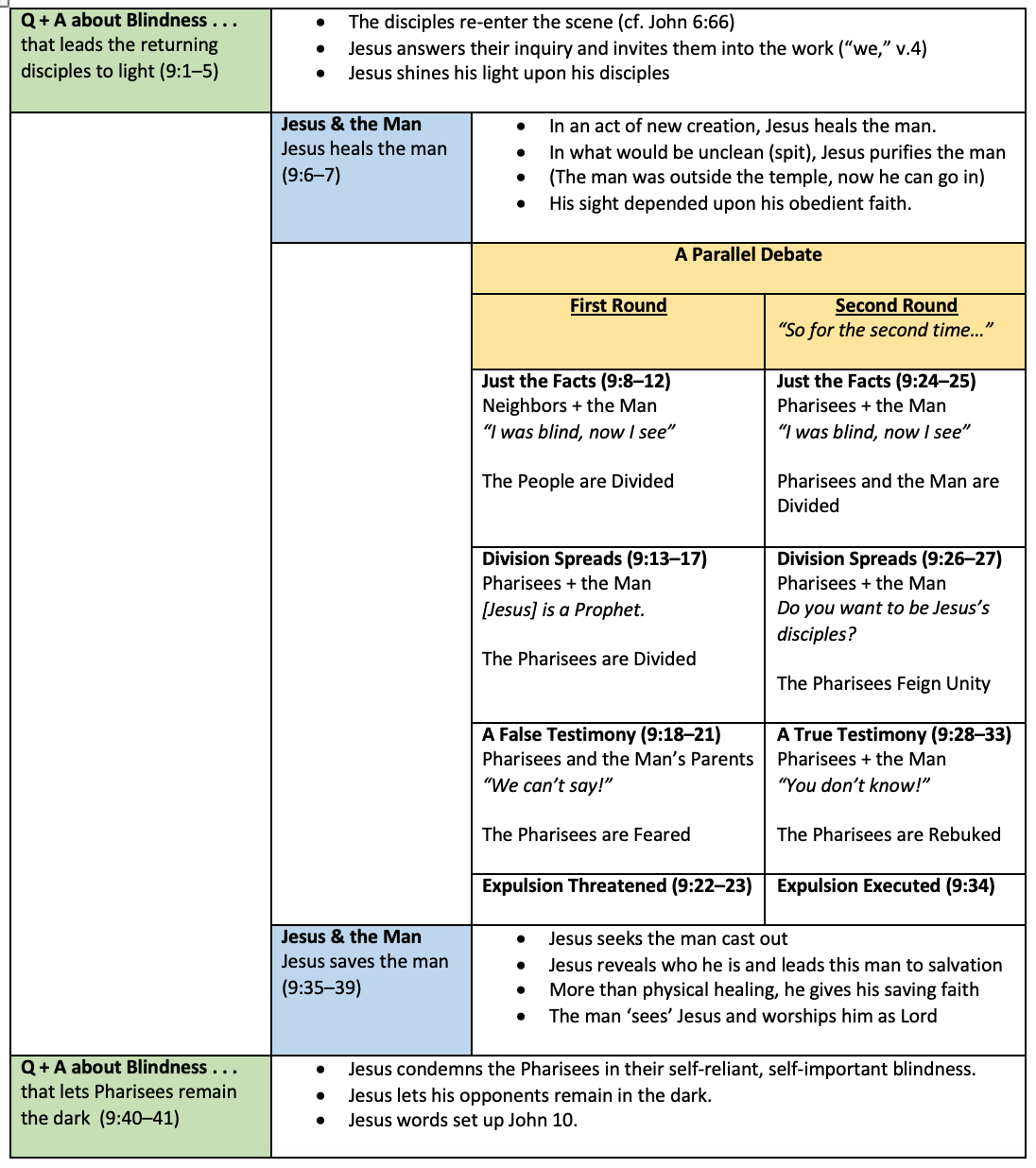
Seeing John 9 with New Eyes: A Few Notes on Literary Structure

close up shot of bible text

As I continue to study John’s Gospel, I grow increasingly amazed at the beloved disciple’s use of literary structure. Here’s a sampling of things to see in John 1–9.

For sake of time, I’m just going to leave this outline here. You can begin to make some biblical and theological connections as you read the chapter for yourself. Or check back in a week or so, and Lord willing, my sermon on John 9 will be up.

Screen Shot 2022-07-07 at 10.39.37 AM

Soli Deo Gloria, ds

Photo by Joshua Hurricks on Pexels.com

The Sharp Edges of God’s Sovereign Salvation: 9 Truths about the Doctrine of Election

black and white silhouette of christ the redeemer

A number of years ago, I preached a sermon Titus 1:1. In that passage, Paul says, he is “an apostle Jesus Christ, for the sake of the faith of God’s elect and their knowledge of the truth.” In that sermon it would be impossible and unfaithful to ignore the word “elect” (eklekton) and the way in which Paul labored for the faith of the elect.

And yet, despite the clear presence of the word in the text and its relationship to faith, truth, and Paul’s gospel ministry, my exposition initiated a cascade of events that resulted in my eventual resignation from my pastoral office. Such is the antagonism against the doctrine of election, which has often been flown under the banner of Calvinism.

In more recent days, I preached a series of messages from John 6, a passage that also touches the doctrine of election. And in these messages, preached in a church where the doctrines of grace are not eschewed but embraced, I was able to show from Scripture what Jesus says about God’s sovereignty in salvation.

In what follows, I want to bullet point some of the key truths uncovered in John 6 with respect to the doctrine of election. In many other articles, I have written how evangelism and election relate, what Scripture says about election, and what hyper-Calvinism really is. In this article, however, I want to stick to Jesus’s words in John 6—a passage where our Lord teaches about the ways God brings salvation to his elect, while passing over others.

Admittedly, this passage is a hard saying (v. 60) and election is a hard doctrine, but it is a true doctrine and one worth pondering. So, with the goal of understanding what Jesus says in John 6, let me offer nine truths about the doctrine of election.

Nine Truths about the Doctrine of Election

Before getting into the text, here is an outline of the nine points. Because what follows is rather long, you might consider picking which point is most interesting (or troubling) and starting there.

  1. Election depends on the God who selects, not mankind who seeks.
  2. Election is ordained in eternity and revealed in time.
  3. Election in time mirrors God’s election in eternity.
  4. God’s election results in faith, not the reverse.
  5. Election does not deny the universal offer of Christ; it secures a positive response.
  6. Election depends on the will of God, not the will of man.
  7. The election of God’s people ensures that he will bring the gospel to them.
  8. Election directs Jesus’s ministry, and ours.
  9. Election is for the glory of God, not the glory of man.

Continue reading