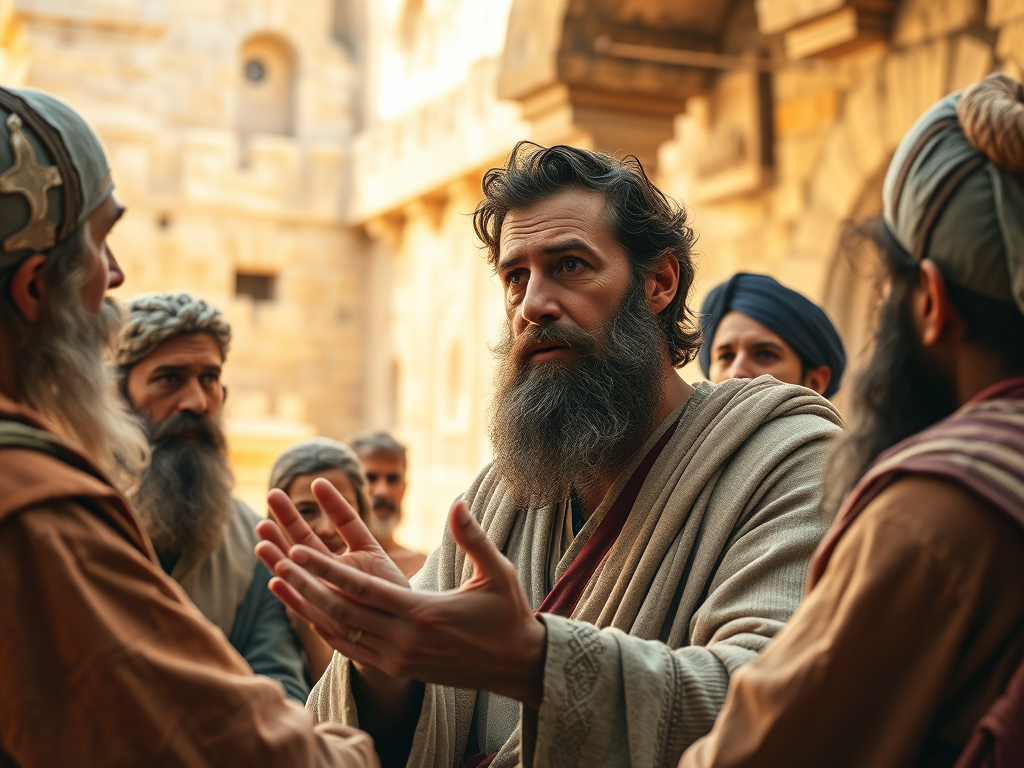
Via Emmaus on the Road: Galatians 6

Further Resources


Galatians 6 (ESV)

Bear One Another’s Burdens

Brothers, if anyone is caught in any transgression, you who are spiritual should restore him in a spirit of gentleness. Keep watch on yourself, lest you too be tempted. Bear one another’s burdens, and so fulfill the law of Christ. For if anyone thinks he is something, when he is nothing, he deceives himself. But let each one test his own work, and then his reason to boast will be in himself alone and not in his neighbor. For each will have to bear his own load.

Let the one who is taught the word share all good things with the one who teaches. Do not be deceived: God is not mocked, for whatever one sows, that will he also reap. For the one who sows to his own flesh will from the flesh reap corruption, but the one who sows to the Spirit will from the Spirit reap eternal life. And let us not grow weary of doing good, for in due season we will reap, if we do not give up. 10 So then, as we have opportunity, let us do good to everyone, and especially to those who are of the household of faith.

Final Warning and Benediction

11 See with what large letters I am writing to you with my own hand. 12 It is those who want to make a good showing in the flesh who would force you to be circumcised, and only in order that they may not be persecuted for the cross of Christ. 13 For even those who are circumcised do not themselves keep the law, but they desire to have you circumcised that they may boast in your flesh. 14 But far be it from me to boast except in the cross of our Lord Jesus Christ, by which the world has been crucified to me, and I to the world. 15 For neither circumcision counts for anything, nor uncircumcision, but a new creation. 16 And as for all who walk by this rule, peace and mercy be upon them, and upon the Israel of God.

17 From now on let no one cause me trouble, for I bear on my body the marks of Jesus.

18 The grace of our Lord Jesus Christ be with your spirit, brothers. Amen.

Soli Deo Gloria!

Via Emmaus on the Road: Galatians 4

Further Resources

Galatians 4 (ESV)

Sons and Heirs

I mean that the heir, as long as he is a child, is no different from a slave, though he is the owner of everything, but he is under guardians and managers until the date set by his father. In the same way we also, when we were children, were enslaved to the elementary principles of the world. But when the fullness of time had come, God sent forth his Son, born of woman, born under the law, to redeem those who were under the law, so that we might receive adoption as sons. And because you are sons, God has sent the Spirit of his Son into our hearts, crying, “Abba! Father!” So you are no longer a slave, but a son, and if a son, then an heir through God.

Paul’s Concern for the Galatians

Formerly, when you did not know God, you were enslaved to those that by nature are not gods. But now that you have come to know God, or rather to be known by God, how can you turn back again to the weak and worthless elementary principles of the world, whose slaves you want to be once more? 10 You observe days and months and seasons and years! 11 I am afraid I may have labored over you in vain.

12 Brothers, I entreat you, become as I am, for I also have become as you are. You did me no wrong. 13 You know it was because of a bodily ailment that I preached the gospel to you at first, 14 and though my condition was a trial to you, you did not scorn or despise me, but received me as an angel of God, as Christ Jesus. 15 What then has become of your blessedness? For I testify to you that, if possible, you would have gouged out your eyes and given them to me. 16 Have I then become your enemy by telling you the truth? 17 They make much of you, but for no good purpose. They want to shut you out, that you may make much of them. 18 It is always good to be made much of for a good purpose, and not only when I am present with you, 19 my little children, for whom I am again in the anguish of childbirth until Christ is formed in you! 20 I wish I could be present with you now and change my tone, for I am perplexed about you.

Example of Hagar and Sarah

21 Tell me, you who desire to be under the law, do you not listen to the law? 22 For it is written that Abraham had two sons, one by a slave woman and one by a free woman. 23 But the son of the slave was born according to the flesh, while the son of the free woman was born through promise. 24 Now this may be interpreted allegorically: these women are two covenants. One is from Mount Sinai, bearing children for slavery; she is Hagar. 25 Now Hagar is Mount Sinai in Arabia; she corresponds to the present Jerusalem, for she is in slavery with her children. 26 But the Jerusalem above is free, and she is our mother. 27 For it is written,

“Rejoice, O barren one who does not bear;

break forth and cry aloud, you who are not in labor!

For the children of the desolate one will be more

than those of the one who has a husband.”

28 Now you, brothers, like Isaac, are children of promise. 29 But just as at that time he who was born according to the flesh persecuted him who was born according to the Spirit, so also it is now. 30 But what does the Scripture say? “Cast out the slave woman and her son, for the son of the slave woman shall not inherit with the son of the free woman.” 31 So, brothers, we are not children of the slave but of the free woman.

Soli Deo Gloria!

Via Emmaus on the Road: Galatians 3

Further Resources


Galatians 3 (ESV)

By Faith, or by Works of the Law?

O foolish Galatians! Who has bewitched you? It was before your eyes that Jesus Christ was publicly portrayed as crucified. Let me ask you only this: Did you receive the Spirit by works of the law or by hearing with faith? Are you so foolish? Having begun by the Spirit, are you now being perfected by the flesh? Did you suffer so many things in vain—if indeed it was in vain? Does he who supplies the Spirit to you and works miracles among you do so by works of the law, or by hearing with faith— just as Abraham “believed God, and it was counted to him as righteousness”?

Know then that it is those of faith who are the sons of Abraham. And the Scripture, foreseeing that God would justify the Gentiles by faith, preached the gospel beforehand to Abraham, saying, “In you shall all the nations be blessed.” So then, those who are of faith are blessed along with Abraham, the man of faith.

The Righteous Shall Live by Faith

10 For all who rely on works of the law are under a curse; for it is written, “Cursed be everyone who does not abide by all things written in the Book of the Law, and do them.” 11 Now it is evident that no one is justified before God by the law, for “The righteous shall live by faith.” 12 But the law is not of faith, rather “The one who does them shall live by them.” 13 Christ redeemed us from the curse of the law by becoming a curse for us—for it is written, “Cursed is everyone who is hanged on a tree”— 14 so that in Christ Jesus the blessing of Abraham might come to the Gentiles, so that we might receive the promised Spirit through faith.

The Law and the Promise

15 To give a human example, brothers: even with a man-made covenant, no one annuls it or adds to it once it has been ratified. 16 Now the promises were made to Abraham and to his offspring. It does not say, “And to offsprings,” referring to many, but referring to one, “And to your offspring,” who is Christ. 17 This is what I mean: the law, which came 430 years afterward, does not annul a covenant previously ratified by God, so as to make the promise void. 18 For if the inheritance comes by the law, it no longer comes by promise; but God gave it to Abraham by a promise.

19 Why then the law? It was added because of transgressions, until the offspring should come to whom the promise had been made, and it was put in place through angels by an intermediary. 20 Now an intermediary implies more than one, but God is one.

21 Is the law then contrary to the promises of God? Certainly not! For if a law had been given that could give life, then righteousness would indeed be by the law. 22 But the Scripture imprisoned everything under sin, so that the promise by faith in Jesus Christ might be given to those who believe.

23 Now before faith came, we were held captive under the law, imprisoned until the coming faith would be revealed. 24 So then, the law was our guardian until Christ came, in order that we might be justified by faith. 25 But now that faith has come, we are no longer under a guardian, 26 for in Christ Jesus you are all sons of God, through faith. 27 For as many of you as were baptized into Christ have put on Christ. 28 There is neither Jew nor Greek, there is neither slave nor free, there is no male and female, for you are all one in Christ Jesus. 29 And if you are Christ’s, then you are Abraham’s offspring, heirs according to promise.

Soli Deo Gloria!

Via Emmaus on the Road: Galatians 2

Further Resources


Galatians 2 (ESV)

Paul Accepted by the Apostles

Then after fourteen years I went up again to Jerusalem with Barnabas, taking Titus along with me. I went up because of a revelation and set before them (though privately before those who seemed influential) the gospel that I proclaim among the Gentiles, in order to make sure I was not running or had not run in vain. But even Titus, who was with me, was not forced to be circumcised, though he was a Greek. Yet because of false brothers secretly brought in—who slipped in to spy out our freedom that we have in Christ Jesus, so that they might bring us into slavery— to them we did not yield in submission even for a moment, so that the truth of the gospel might be preserved for you. And from those who seemed to be influential (what they were makes no difference to me; God shows no partiality)—those, I say, who seemed influential added nothing to me. On the contrary, when they saw that I had been entrusted with the gospel to the uncircumcised, just as Peter had been entrusted with the gospel to the circumcised (for he who worked through Peter for his apostolic ministry to the circumcised worked also through me for mine to the Gentiles), and when James and Cephas and John, who seemed to be pillars, perceived the grace that was given to me, they gave the right hand of fellowship to Barnabas and me, that we should go to the Gentiles and they to the circumcised. 10 Only, they asked us to remember the poor, the very thing I was eager to do.

Paul Opposes Peter

11 But when Cephas came to Antioch, I opposed him to his face, because he stood condemned. 12 For before certain men came from James, he was eating with the Gentiles; but when they came he drew back and separated himself, fearing the circumcision party. 13 And the rest of the Jews acted hypocritically along with him, so that even Barnabas was led astray by their hypocrisy. 14 But when I saw that their conduct was not in step with the truth of the gospel, I said to Cephas before them all, “If you, though a Jew, live like a Gentile and not like a Jew, how can you force the Gentiles to live like Jews?”

Justified by Faith

15 We ourselves are Jews by birth and not Gentile sinners; 16 yet we know that a person is not justified by works of the law but through faith in Jesus Christ, so we also have believed in Christ Jesus, in order to be justified by faith in Christ and not by works of the law, because by works of the law no one will be justified.

17 But if, in our endeavor to be justified in Christ, we too were found to be sinners, is Christ then a servant of sin? Certainly not! 18 For if I rebuild what I tore down, I prove myself to be a transgressor. 19 For through the law I died to the law, so that I might live to God. 20 I have been crucified with Christ. It is no longer I who live, but Christ who lives in me. And the life I now live in the flesh I live by faith in the Son of God, who loved me and gave himself for me. 21 I do not nullify the grace of God, for if righteousness were through the law, then Christ died for no purpose.

Soli Deo Gloria!

Via Emmaus on the Road: Galatians 1

Further Resources


Galatians 1 (ESV)

Greeting

Paul, an apostle—not from men nor through man, but through Jesus Christ and God the Father, who raised him from the dead— and all the brothers who are with me,

To the churches of Galatia:

Grace to you and peace from God our Father and the Lord Jesus Christ, who gave himself for our sins to deliver us from the present evil age, according to the will of our God and Father, to whom be the glory forever and ever. Amen.

No Other Gospel

I am astonished that you are so quickly deserting him who called you in the grace of Christ and are turning to a different gospel— not that there is another one, but there are some who trouble you and want to distort the gospel of Christ. But even if we or an angel from heaven should preach to you a gospel contrary to the one we preached to you, let him be accursed. As we have said before, so now I say again: If anyone is preaching to you a gospel contrary to the one you received, let him be accursed.

10 For am I now seeking the approval of man, or of God? Or am I trying to please man? If I were still trying to please man, I would not be a servant of Christ.

Paul Called by God

11 For I would have you know, brothers, that the gospel that was preached by me is not man’s gospel. 12 For I did not receive it from any man, nor was I taught it, but I received it through a revelation of Jesus Christ. 13 For you have heard of my former life in Judaism, how I persecuted the church of God violently and tried to destroy it. 14 And I was advancing in Judaism beyond many of my own age among my people, so extremely zealous was I for the traditions of my fathers. 15 But when he who had set me apart before I was born, and who called me by his grace, 16 was pleased to reveal his Son to me, in order that I might preach him among the Gentiles, I did not immediately consult with anyone; 17 nor did I go up to Jerusalem to those who were apostles before me, but I went away into Arabia, and returned again to Damascus.

18 Then after three years I went up to Jerusalem to visit Cephas and remained with him fifteen days. 19 But I saw none of the other apostles except James the Lord’s brother. 20 (In what I am writing to you, before God, I do not lie!) 21 Then I went into the regions of Syria and Cilicia. 22 And I was still unknown in person to the churches of Judea that are in Christ. 23 They only were hearing it said, “He who used to persecute us is now preaching the faith he once tried to destroy.” 24 And they glorified God because of me.

Soli Deo Gloria!

A Family of Believers Centered on the Gospel (Galatians 1:6–10)

obc.jpeg

A Family of Believers Centered on the Gospel

On Sunday our elders proposed a new church mission statement. At its core is the commitment is to be a “Family of Believers Centered on the Gospel.” In preparation for that “roll out,” I preached a sermon on Galatians 1 and the importance of protecting and proclaiming the gospel.

Here’s the sermon audio, with a few additional resources and response questions.

The Gospel Proper

Theological Triage: A Way to Keep the Gospel at the Center

Response Questions

  1. What is the letter to the Galatians all about? Why does the tone matter? How does it teach us to think about the Gospel?
  2. Who is Paul writing to? And why does that matter? (Hint: the church is ultimately responsible for their doctrinal beliefs).
  3. What is the gospel? Read Galatians 1:4; Romans 1:1–7; 1 Corinthians 15:1–8 for reference.
  4. How can we deviate from the Gospel? How have you turned aside—in belief or practice? How have you seen churches deviate? What do we learn from Peter’s example (read Galatians 2:11–14)?
  5. How does a church keep the gospel at the center? What role does a statement of faith play in that? What about a mission statement?
  6. Read over the mission statement and the associated Scriptures. What would you add or edit in this statement? Talk about how keeping these truths before us helps us keep the gospel at the center.
  7. Pray for the church and for our focus on the gospel.

Soli Deo Gloria, ds

Learning to Love One Another: The Gospel, Racial Reconciliation, and Burden-Bearing (Galatians 1–6)

crawford-ifland-86286

Learning to Love One Another: The Gospel, Racial Reconciliation, and Burden-Bearing (Galatians 1–6)

In recent years, it’s been hard to miss our country’s rise in racial tensions. Or maybe we are just seeing what’s been there under the surface all along. Our country seems overwhelmed by all kinds of racialized sentiments. And in the church, Christ’s multi-ethnic bride continues to bear the scars of deep-seated racial division and hurt that goes back decades and centuries.

By contrast, the Bible presents a glorious vision of multi-ethnic worship, centered around the throne of God (see Revelation 5, 7, 21–22). And in Paul’s letters, there is a constant refrain for a diverse people to be unified in the work of Christ and the gift of the Spirit.  

On this point, this Sunday’s sermon focused on the gospel message in Galatians and how it relates to racial reconciliation. From Galatians’ six chapters, I drew out six gospel truths. In six points, we see that Galatians

  1. is all about the gospel;
  2. identifies a kind of division (in the church) that denies the gospel;
  3. proclaims a gospel that is international in scope and content;
  4. prioritizes faith as the fundamental community marker;
  5. teaches those who have been justified by faith alone to be passionate about justice;
  6. and calls the gospel community to seek justice in love, service, and burden-bearing to one another.

This sermon marks the second time I’ve preached on this subject. (The first was a biblical theology of race). As before, this subject is an incredibly heavy one, and one that still raises more questions than I have answers. That being said, the gospel of Jesus Christ is the answer that can give hope and help to the body of Christ bruised and broken by racism.

My prayer is that God would use this sermon as one small step to help our church grow as community compelled by the vision of Revelation and led by the directions of Galatians (and the rest of Scripture). May God bring healing to his church and may the power of gospel be see in multi-ethnic communities of faith. You can listen to the sermon online. Discussion questions and further resources are below.  Continue reading

No Other Gospel: Reflections from The Gospel Coalition

But far be it from me to boast except in the cross of our Lord Jesus Christ, by which the world has been crucified to me, and I to the world.
— Galatians 6:14 —

For three days this week, ten of us from Occoquan Bible Church traveled to Indianapolis to join 8,500 other followers of Christ at The Gospel Coalition’s bi-annual gathering. This year we celebrated the 500th Anniversary of the Protestant Reformation and its recovery of the gospel. The theme of this week’s conference was “No Other Gospel” and in less than 72 hours we heard six messages from Galatians and three messages on the historical figures of Martin Luther, John Calvin, and other reformation heroes, including the women who contributed to the Reformation. We also sat in on countless breakout sessions related to church history and practical ministry. In all it was a much needed time of refreshment and recalibration.

In all, our trip to Indy was an encouraging time of worship, fellowship, and learning. I benefitted most from John Piper’s opening message on Galatians 1 and Tim Keller’s closing message on Galatians 6. In particular, Keller’s connection between boasting in the cross (Galatians 6:14) and spiritual transformation was powerful.

His point was this: It is not enough to know about Christ and his cross. If one wants to be changed—i.e., freed from sin and full on grace—he or she must boast in the cross. This means verbal praise but even more, it is a confidence in life that taunts all other competitors and presses deeper into Christ. There is nothing more glorious than Christ and his cross, the message of the gospel. As we cling to that truth and boast about that reality above all others, God will change us.

With that in mind, let me share a few more observations from the men who went to Indy. Hear them boast in Christ, his cross, and the chance to devote three days to worshiping. Let it spur you on and encourage you to listen to the sessions online or to join us next year. Continue reading

Made Alive By the Spirit: The Pneumatology of Galatians (pt. 1)

windIn Galatians Paul spends a great amount of time explaining justification. That is to say, he argues that people are declared “right with God” as they place their faith in the finished work of Jesus Christ. In this way, Paul lays the ground work for the Reformation doctrine of Sola Fide: By Faith Alone are we saved.

In Galatians 2:16, he writes,

A person is not justified by works of the law but through faith in Jesus Christ, so we also have believed in Christ Jesus, in order to be justified by faith in Christ and no by works of the law, because by works of the law no one will be justified.

And again in Galatians 3:10–14,

For all who rely on the works of the law are under a curse…but the law is not of faith, rather…’Cursed is everyone who is hanged on a tree’–so that in Christ Jesus the blessing of Abraham might come to the Gentiles, so that we might receive the promised Spirit through faith.

However, this leads to the question, for those justified by faith, what does Paul say about sanctification? If salvation (in this case, righteousness) has nothing to do with personal holiness or obedience, how does Paul’s gospel restrain anyone from gross immorality or ethical indifference? His answer is the Holy Spirit. And in systematic fashion he unfolds in Galatians a powerful description of what the Spirit does in the life of the believer. While Paul does not undertake the task of providing a comprehensive pneumatology, he does provide a rough outline of the Spirit’s work from conversion to consummation, with the absence of the gifts of the Spirit.

In what follows, I will outline a brief pneumatology from the book of Galatians. Here is the outline. I will tackle three of these today and three in the next week or so.

  1. Born of the Spirit (4:29)
  2. Received the Spirit (3:2–3, 14)
  3. Alive in the Spirit (5:5, 25)
  4. Walk in the Spirit (5:16)
  5. Desires of… Led by… Fruit of the Spirit (5:17, 18, 22–23)
  6. Walk in the Spirit (5:25)

Continue reading

The Trinity and Salvation: The Spirit as the Source for and Reward of Faith (Galatians 3:1–7)

angelic architecture art baptism

O foolish Galatians! Who has bewitched you? It was before your eyes that Jesus Christ was publicly portrayed as crucified. 2 Let me ask you only this: Did you receive the Spirit by works of the law or by hearing with faith? 3 Are you so foolish? Having begun by the Spirit, are you now being perfected by the flesh? 4 Did you suffer so many things in vain—if indeed it was in vain? 5 Does he who supplies the Spirit to you and works miracles among you do so by works of the law, or by hearing with faith—6 just as Abraham “believed God, and it was counted to him as righteousness”? (Galatians 3:1–7)

In keeping with his whole letter, Paul boldly rebukes the churches of Galatia for their turn from the true gospel (see 1:6–9). In this section, he recalls their reception of the Holy Spirit and how God’s Spirit came to them—by works of the flesh or by hearing with faith? The answer is plain in the text: the Galatians received the word with faith.

Theologically, this passage has much to say about the order and operations of the Holy Spirit, and I’d like to make a couple observations that will help us to see how the Spirit’s indwelling is different from his work of regeneration. Continue reading