Sermon Notes: The Tabernacle as a Holy Abode

Yesterday, we considered how the tabernacle served as a typological model meant to instruct Israel and us about God’s world, God’s plans for salvation, and what it means for the Creator to dwell with his redeemed creation.  Today, we will look at the way  God’s house is a holy abode.

In Exodus 25:8, Moses records God’s statement, “Let them make me a sanctuary…”  The word here means holy place.  Everything about the house of God is intended to stress his holiness.  From the arrangement of the curtains to the selection of the building materials, everything about the tabernacle shows how closer proximity to the holy of holies demands increased purity and holiness.

Holy of Holies, Holy Place, and Courtyard

The first thing that shows the holiness of God is the floor plan of the tabernacle, along with the series of curtains that separated Israel from God.  Exodus 26 explains these dimensions. So that looking down on the tabernacle, you can see a courtyard 150 feet long, 75 feet wide.  This courtyard was surrounded by a fence (7.5 feet high).  The gate was on the East (like the garden of Eden), and upon entering the courtyard, the Levites would be confronted with a massive bronze altar (7.5 ft wide, 4.5 feet high) and a bronze basin for washings.  Describing this holy space, T.D. Alexander writes,

Separated from the rest of the Israelite encampment, the courtyard was set apart as a holy area; only the tabernacle, in which God dwelt, was considered to be more sacred… Just as Moses set a boundary around Mount Sinai to prevent the people from coming into the divine presence (19:12-13, 21-24), so the courtyard fence prevented them from approaching God inadvertently… Without the courtyard buffer zone, it would have been impossible for [Israel] to dwell in safety close to the Lord (T.D. Alexander, From Paradise to Promised Land197).

So at the first-level, God’s holiness is seen in the separation between the priests and the people.  Next we come to the tabernacle, itself. At the end of the courtyard was the house of God.  In it were two sections—the holy place and the most holy place.  Again these correspond to the pattern on the mountain, and the pattern of access typified in Exodus 24.  When Moses met with Israel, the people remained in the camp, the priests came half-way up the mountain, and Moses alone entered the cloud (24:1-2).  

The Screen and the Veil

Next, we see how the screen and the veil add to the idea that God’s presence is separate from man.  Exodus 26:31-37 reports,

 Then you shall erect the tabernacle according to the plan for it that you were shown on the mountain. “And you shall make a veil of blue and purple and scarlet yarns and fine twined linen. It shall be made with cherubim skillfully worked into it. And you shall hang it on four pillars of acacia overlaid with gold, with hooks of gold, on four bases of silver. And you shall hang the veil from the clasps, and bring the ark of the testimony in there within the veil. And the veil shall separate for you the Holy Place from the Most Holy. You shall put the mercy seat on the ark of the testimony in the Most Holy Place. And you shall set the table outside the veil, and the lampstand on the south side of the tabernacle opposite the table, and you shall put the table on the north side. You shall make a screen for the entrance of the tent, of blue and purple and scarlet yarns and fine twined linen, embroidered with needlework. And you shall make for the screen 5 pillars of acacia, and overlay them with gold. Their hooks shall be of gold, you shall cast 5 bases of bronze for them.

When we unpack this passage, the holiness of God’s dwelling space is stressed by the screen that separates the courtyard from the Holy place in verse 36, as well as, the veil that separates the holy of holies from the holy place.  On the veil that protects the most holy place, there are cherubim—angelic beings who live to praise God around his throne.  These are not on the screen.  The difference between the veil and the screen is one more evidence, that approach to God’s throne room should not be taken lightly.

Gold, Silver, and Bronze

Likewise, as you move towards God’s dwelling place, the value of the materials changes.  Notice, the fence at the outside has silver hooks (on top) and brass bases; the screen has gold hooks and brass bases, and the veil has gold hooks and silver bases.  It is also worth nothing that because of these bases, the curtains of the  tabernacle don’t really touch the ground—again this stresses the holiness of God’s dwelling place, and by extension, the holiness of God. 

What might we learn from all this?

It is worth asking at this point, what are the implications of this holy space.  Let me suggest two things.

First, God dwells in unapproachable holiness, and we as covenant-breaking sinners  do not have natural access to him.  Truthfully, I wish someone would have told this to me when I was 17.  Wrongly, I had the impression that because God was a loving father, he was pleased with me and happy for me to come to him.  The tabernacle says otherwise.  God is pleased with absolute holiness.  This doesn’t change in the New Testament, either.  Jesus says that we must be perfect (Matt 5:48); Hebrews declares, without holiness, no one will see the Lord (12:14).

God’s unapproachable holiness has points of access.  At the same time that God’s dwelling place shouts “Holy, Holy, Holy!” It also promises gracious access.  Notice that in the fence there is gate.  In the screen there is an opening.  And in veil there is a way to enter.  What does this teach us about God?  Simply this: We cannot come to him on our own terms or in our own names, but through priestly mediation and a system of sacrifice, God has made a way to come behind the veil.

More specifically, from the people of Israel, there is a chosen people—the Levites—who can enter the courtyard.  In the courtyard, there is an altar to make burnt offerings, sin offerings, and peace offerings; as well as, a basin for cleansing.  These make possible access into the holy place.

Moreover, there is Exodus 28-29 a designated high priest  who will go before the LORD once a year in order to make atonement for Israel (Leviticus 16).  In all this, God reveals that he does not relax his holy standards, but neither does he leave his people to perish under the weight of his law.  He is terrifyingly pure but also unfathomably tender.

Bringing this forward, the tabernacle prepares the way for Jesus Christ, our superior access.  He is the the way, the gate, the door to the Father.  Jesus who is as pure and holy as the inner chamber of the tabernacle comes outside of the courtyard, into the polluted world, and makes clean not only the Levites.  He comes and makes clean people from every tongue, tribe, language, and nation, such that Revelation 5:9-10, “Worthy are you to take the scroll and to open its seals, for you were slain, and by your blood you ransomed people for God from every tribe and language and people and nation, and you have made them a kingdom and priests to our God, and they shall reign on the earth.”

Praise God for his perfect provision of a way into his inner chamber.  May his tabernacle–in shadow and substance–teach us afresh of God’s sublime holiness and boundless grace.

Soli Deo Gloria, dss
Sermon Notes: The Tabernacle as a Typological Model

When we think about the tabernacle, the first thing to realize is that it is more than meets the eye.  In other words, the tabernacle is built to show off theological, cosmological, and Christological truths–just to name a few.  Today, lets consider a couple of these things. 

1. A Portable Mountain of God

First up, the tabernacle’s three sections—the courtyard where the people would bring sacrifices, the holy place (the first section in the tabernacle) where the priests would work, and the holy of holies where the high priest would enter once a year on the Day of Atonement, all correspond to the pattern that Moses saw on the mountain.  A few verses prove this:

25:8-9.  And let them make me a sanctuary, that I may dwell in their midst.  Exactly as I show you concerning the pattern of the tabernacle, and of all its furniture, so you shall make it.

25:40.  And see that you make them [Mercy Seat, Table, Golden Lampstand] after the pattern for them, which is being shown you on the mountain.

 26:30. Then you shall erect the tabernacle according to the plan for it that you were shown on the mountain. (cf. The Bronze Altar, 27:8)

 God gives Moses a vision and instruction of this tabernacle, so that Israel can see beyond it to the throne room of God—remember, most of the people never went inside, so this information has a curb appeal because of the mysterious of God’s tent.

2. The Cosmos

Second, in general and in detial, the tabernacle which is God’s earthly dwelling place with Israel is simultaneously constructed in a way that represents all creation.  Gregory Beale has proven this thesis in his book, The Temple and the Church’s Mission: A Biblical Theology of the Dwelling Place of God.  More succinctly, T. D. Alexander has followed Beale with his more popular treatment, From Eden to New Jerusalem: An Introduction to Biblical TheologyFor our consideration, let me mention a couple verses. 

Ps 78:69.  He built his sanctuary like the high heavens, like the earth, which he has founded forever.  Clearly, this proves in a single verse the connection between the tabernacle and the construction of the universe. However, you will also find in Scripture those places where Scripture describes the reverse–the universe is God’s macrocosmic temple.

Psalm 104:1-6.  Bless the LORD, O my soul! O LORD my God, you are very great! You are clothed with splendor and majesty, covering yourself with light as with a garment, stretching out the heavens like a tent. He lays the beams of his chambers on the waters; he makes the clouds his chariot; he rides on the wings of the wind; he makes his messengers winds, his ministers a flaming fire. He set the earth on its foundations, so that it should never be moved. You covered it with the deep as with a garment; the waters stood above the mountains.

 The significance of this microcosmic-macrocosmic temple is simply that what God does in Israel has cosmic significance.  God’s goal is much larger than a singular sanctuary in the Middle East; it prepares the way for Christ and the garden-temple that is revealed in Revelation 21-22.

3. Eden

Not only is Moses given a vision of God’s mountain throne and the cosmos which he upholds, what we learn in the construction of this tabernacle is the way it points back to Eden.  Notice a couple of connections.

  1. Gold in the tabernacle goes back to the gold that existed in Eden (Gen 2:11-12; Exodus 25:7, 11, 17, 31; cf. 1 Kings 6:30)
  2. The Menorah points back to tree of life (Gen 2:9; 3:22; Exod 25:31-35); the bread of God’s presence corresponds to the food provided by God in the garden (Gen 2:17).
  3. Angels embroidered on the Veil reflects the angel who dwelt outside Eden (Gen 3:24).
  4. That God would dwell and even walk in the midst of Israel is Eden-like (Gen 3:8; 26:12).

Significance

Now the question arises: Why does this matter?  Let me suggest two reasons.

Typology.  Each of its elements is meant to represent something else—it is like a giant object lesson for Israel and for us.  In fact, verse 40, which is quoted in Hebrews 8:5, actually uses the word “type” (typon, LXX). Thus, to understand the furniture of Exodus 25 and the tabernacle itself (26), courtyard (27), we must appreciate its symbolism and typology. (We will explore this more in the days ahead.

Telos.  Since the purpose of the tabernacle is typological, it is also eschatological.  It does point back to Eden, but even more it points ahead to a permanent rest in the land.  This is prefigured in Israel’s entrance into Canaan, but even more it foreshadows the work of Christ and the dwelling he promises in the age to come.

Thus, if you know the Bible well, you know Rev 21:22 says that in the end there will be no temple in the city, but that doesn’t deny an eternal cosmic temple.  What is a temple, but the dwelling place of God.  And what Revelation teaches is that at the end of the age the God who dwells in heaven, will again dwell with man on earth; and not just in one box-shaped tabernacle.  All creation will be his dwelling place.  The glory of God will cover the earth.

Revelation 21:16 makes this so clear in the light of Exodus 25-40.  John records that the city of God that comes down from heaven is 12,000 stadia (1380 miles) in length, width, and height.  It is a perfect cube–just like the holy of holies.

So to understand Revelation 21, we must read it with Exodus 26, and what we see is that at the end of the age, the whole earth will be as holy as the holy of holies.  So the goal of God is not a 15x15x15 golden box in Israel.  His goal is a perfect, purified world where he dwells with his redeemed.  This is what Exodus teaches us.

It beckons for a temple not made with human hands, even as it is given to Moses for the construction with human hands.  Exodus points beyond itself and leads us to see that Jesus is the builder of this better tabernacle, and if we care at all about what God has done in Christ and/or is doing, we must see look carefully at the details of the tabernacle.

May God give us eyes to see his design in this ancient tabernacle and hearts that long for the temple that is to come!

Soli Deo Gloria, dss

Typology in Exodus and in Exegesis

Gareth Crossley, in his accessible and Christ-centered book on the Old  Testament, The Old Testament: Explained and Applied, provides a sampling of just some of the typological features of Exodus.  With a few adjustments, I find that his list helps us discern the way that the OT prepares the way for Jesus Christ’s greater exodus (Luke 9:31) and provides a good model for a Christian reading of the Old Testament.  Here they are (p. 91):

  • Israel’s bondage in Egypt (1:11-14) is a symbol of the sinner’s slavery to sin (Rom 6:17-18).
  • The Passover Lamb (12:5, 7, 13) is a type of Christ and his precious blood (John 1:29; 1 Pet 1:19; 1 Cor 5:7; Rev 5:6). Not one of his bones shall be broken (Exod 12:46; cf. Num 9:12; Ps 34:20; John 19:30).
  • The pillar of cloud and fire (Exod 14:19; cf. 12:21-22) is a type of Christ’s presence with his people (John 14:18; Matt 28:20).
  • The song of Moses (15:1-19) is a type of songs of spiritual victory (Rev 15:3-4).
  • The mixed multitude (12:38) symbolizes the regenerate and unregenerate in the visible church (Matt 13:24-30, 36-43).
  • The waters of Marah and Elim (15:23-27) are a type of bitter-sweet experiences in the Christian life (1 Pet 1:6).
  • The manna  (16:4) is a type of Christ, the bread of life (John 6:31-35).
  • Water from the rock (Exod 17:6) is a type of Christ, who provides living water (1 Cor 10:4; John 4:10; 7:37-39).

Like I said, Crossley’s list is generally helpful.  He confines his typology to items picked up by New Testament authors, and therefore guards his typology from allegory.  Likewise, his reading of Exodus demonstrates what Paul does in 1 Corinthians 10, explaining that “all these things happened to them [ancient Israel] as examples, and they were written for our instruction, on whom the ends of the ages have come” (1 Cor 10:11).  Yet, Crossley also demonstrates the weakness of typology, namely questionable connections and the inevitable reading in our own personal views.

I would demur with making the church an antitype of the ‘mixed multitude.’  Why not the multi-colored human race, instead?  Would it not be better to say that the mixed multitude who joined the Israelites in the Exodus typify the nations streaming to Israel (Isaiah 2:2-3) and later Jesus Christ as the Lamb of God who has taken away the sins of the world (John 1:29).  Revelation 7:9-17 unites three Exodus themes: the Victorious Lamb, the mixed multitude, now the heavenly multitude from all nations, and a victory song liken unto Exodus 15.  Surely, this is a better typological reading– at least, I think so.  Plus the fact that Matthew 13 defines the ‘mixed multitude’ as the world, not the church.  All that to say, theological differences do effect our inter-textual reading.  Reading as a Baptist, I find this type-antitype difficult to follow. 

One other item, it is worth considering whether or not the waters of Marah and Elim are types of the Christian life, or something else.  I suppose in one sense they are typological, but perhaps it is better to simply call them analogical, or simply commonplace for all believers during all ages.  You have to wonder if this commonplace experience carries the escalation that is usually present in typological structures found within the Bible.  As it relates to Jesus Christ, the hunger and thirst in the wilderness do correspond to his experience in the desert, and to his followers, ‘elect exiles’ as Peter calls them, but still I pause to consider if this is ‘typology proper’ or just a common experience that all God’s people experience.  Would love to hear your thoughts. 

Overall, Crossley exemplifies an edifying approach to the Old Testament, one that exalts our Savior and sees all things in his light.  May we all, with the Spirit’s help, endeavor to do the same.

Soli Deo Gloria, dss

From Sinai to Chile to Zion: Why Visual Aids Do and Do Not Help Us See Christ in the Bible

I am not a big fan of visual aids.  So, when I preach or teach, I do not use powerpoint and rarely use other forms of multimedia to explicate the biblical text.  There is much to debate here, but as a personal conviction, I aim at–i.e. pray for and work at– letting the Word of God speak in and through the words that I speak.  Why?  Because the word of God is effective and the Spirit is able.  Likewise, visual imagery has a way of overshadowing the text and effectively dulling us from the power and precision of God’s Word (Heb. 4:12-13). 

Yet, with that said, there are still times when visual imagery helps us discern Scriptural truth, where without the “visual aid” we would not understand the biblical text as well.  For instance, in 2005, as I stood on the Mount of Olives overlooking the temple mount, the Kidron Valley, and the Valley of Hinnom, the drama of Jesus’ last supper, arrest, and trials before Pilate and Herod took shape in my mind as I imagined him walking with his disciples to the Garden of Gethsemane and then back through the City of David to encounter the unrighteous judgments of his accusers.  All told, passages of Scripture like Matthew 26-28 and John 13-19 were illumined by the geographical imagery of Jerusalem

Still, coming back from Israel, I realized that a “holy land experience” is not necessary for understanding the Bible, even if it provides visual images for biblical texts.  Thus, I learned in a fresh way, that the word of God is sufficient for everything I need to know and love God.  As 2 Peter 1:4 says, through our knowledge of Christ (as found in Scripture), God has given us everything we need for life and godliness (cf. 2 Tim. 3:16-17; Deut. 29:29). So while my travels in Israel were profitable for visualizing the Bible, such a pilgrimmage is not necessary for salvation and sanctification. 

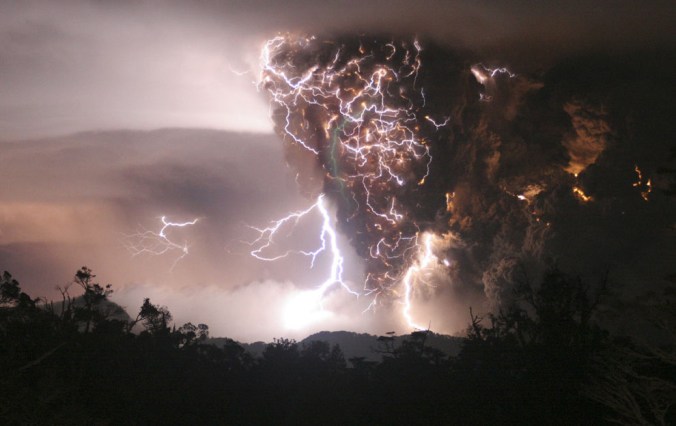
With that grid in place–namely that visual aids can be selectively helpful for understanding the Bible– I introduce a ‘visual aid’ that I ran across today, and which prompted thoughts of Exodus 19-24 and Hebrews 12.

01_chaitenv

Lightning bolts appear above and around the Chaiten volcano as seen from Chana, some 30 kms (19 miles) north of the volcano, as it began its first eruption in thousands of years, in southern Chile May 2, 2008. Picture taken May 2, 2008. (Carlos Gutierrez)

As you ponder the picture, consider Moses words in front of Mount Sinai:

On the morning of the third day there were thunders and lightnings and a thick cloud on the mountain and a very loud trumpet blast, so that all the people in the camp trembled. Then Moses brought the people out of the camp to meet God, and they took their stand at the foot of the mountain. Now Mount Sinai was wrapped in smoke because the Lord had descended on it in fire. The smoke of it went up like the smoke of a kiln, and the whole mountain trembled greatly. And as the sound of the trumpet grew louder and louder, Moses spoke, and God answered him in thunder. The Lord came down on Mount Sinai, to the top of the mountain. And the Lord called Moses to the top of the mountain, and Moses went up (Ex. 19:16-20).

This electrifying image of a thunderstorm on top of a volcano in Chile provokes images of  what it must have been like to encounter the living God at Sinai.  Yet, that historical event, which may have looked something like this, is not spectacular because of its atmospheric power,  as much as its redemptive-historical significance.  Consequently, as terrifying as such an image is, Scripture tells us that the people did not fear the cosmological occurence, nearly as much as the One who stood behind the smoking curtain and SPOKE (cf. Deut. 4:33).  What terrified the people was not just the smoke on the mountain, but the Word of God itself.  Listen to their plea:

Now when all the people saw the thunder and the flashes of lightning and the sound of the trumpet and the mountain smoking, the people were afraid and trembled, and they stood far off and said to Moses, “You speak to us, and we will listen; but do not let God speak to us, lest we die.” Moses said to the people, “Do not fear, for God has come to test you, that the fear of him may be before you, that you may not sin.” The people stood far off, while Moses drew near to the thick darkness where God was (Ex. 20:18-21).

What this picture and these texts remind us is that God’s world is frightening, and he is present in the world; but his word is even more fear-producing and his presence to save and to judge is mediated through his Word.  Accordingly, the people of God begged Moses for a mediator, and God was pleased to speak to them through Moses (Deut. 5:28-33).  The people’s fears were both incited by God’s Holy Word, and allayed by God’s merciful mediator.

The same is and should be true for us.  In the fullness of time, God sent another mediator, a greater Word, His own Son, Jesus Christ to confirm the words spoken at Sinai and to speak to God’s people as a sympathetic mediator.  Hebrews 12, in fact, says this very thing recalling the temptuous events at Sinai to beckon us to believe in Jesus Christ with greater fear and faith.  Consider these fearful words

For you have not come to what may be touched, a blazing fire and darkness and gloom and a tempest and the sound of a trumpet and a voice whose words made the hearers beg that no further messages be spoken to them. For they could not endure the order that was given, “If even a beast touches the mountain, it shall be stoned.” Indeed, so terrifying was the sight that Moses said, “I tremble with fear.” But you have come to Mount Zion and to the city of the living God, the heavenly Jerusalem, and to innumerable angels in festal gathering, and to the assembly of the firstborn who are enrolled in heaven, and to God, the judge of all, and to the spirits of the righteous made perfect, and to Jesus, the mediator of a new covenant, and to the sprinkled blood that speaks a better word than the blood of Abel. See that you do not refuse him who is speaking. For if they did not escape when they refused him who warned them on earth, much less will we escape if we reject him who warns from heaven (Heb. 12:18-25).

While we can picture Sinai, we have no way to preview Zion, but here is where the sufficiency and severity of God’s word is most powerful: The truth of the matter is that Zion is more awesome–terrible and glorious–than anything visible today.  Visual aids cannot helps us discern Zion, only God’s word can do that.   We can only apprehend Zion’s reality by faith in God’s word.  Thus we prepare ourselves for the kingdom’s arrival by meditating on God’s Word and prayerfully anticipating the coming of Jesus Christ, the final Word and the perfect mediator.

Thus as we look on the image of this Chilean mountain we are helped to imagine what it must have been like for the people of Israel to stand before God, but our hearts must not be contented to only look backwards.  By the revelation of God’s word, we are beckoned to look forward to the coming, unshakeable kingdom of God, remembering this fact: Our God is a Consuming Fire!  What happened at Sinai is only a foreshadowing of things to come.  In this respect, the visual aid above both furthers our understanding of Exodus 19-24, but fails to do the same for us and our impending encounter with God.  It is only God’s Word, written and incarnate (cf. John 1:14), that enables us to envision Zion and the reality of entering God’s presence.  Thus with fear and faith, may we respond in faith to the Holy Word of God (cf. Heb. 4:2).

Sola Deo Gloria, dss